robotics
The Robot Learned Touch Through Its Eyes
A general multimodal model interpreted vision-based tactile images and used their contact cues across nineteen simulated manipulation tasks.
Summary
A general multimodal model interpreted vision-based tactile images and used their contact cues across nineteen simulated manipulation tasks.
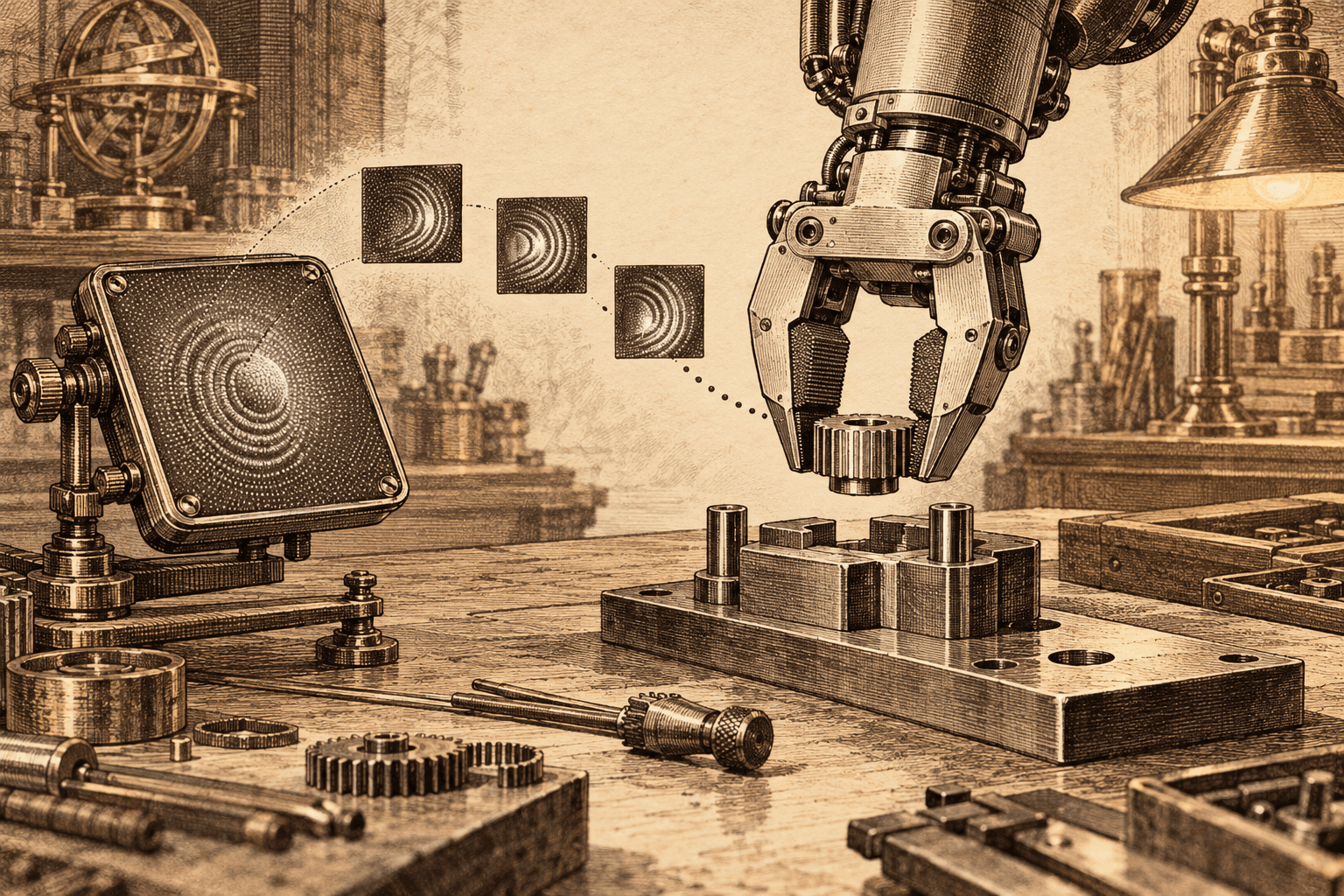
Touch has usually been treated as specialist territory in robot learning. In a new simulation study, researchers passed RGB images from vision-based tactile sensors through GPT-6 Astra's existing visual interface, then asked the model to control nineteen contact-rich tasks with few-shot demonstrations and closed-loop feedback. Across 210 sampled scene seeds per setting, the authors report mean success of 93.8 percent on UniVTAC tasks and 81.8 percent on OpenViTac tasks, exceeding the strongest specialist baselines in their comparison by 22.9 and 13.1 percentage points. Trajectories showed active probing, cautious grasps, contact-guided alignment and recovery; tangential loading and corrective execution remained difficult. This is not a physical-robot validation, and the authors warn of possible benchmark saturation. The narrower result is still useful: a general visual model may already possess primitives for reading touch when tactile sensing is rendered as images.
Why it matters
A general multimodal model interpreted vision-based tactile images and used their contact cues across nineteen simulated manipulation tasks.
Limits and context
- This is not a physical-robot validation, and the authors warn of possible benchmark saturation.
Key claims
A general multimodal model interpreted vision-based tactile images and used their contact cues across nineteen simulated manipulation tasks.
Qualification: This is not a physical-robot validation, and the authors warn of possible benchmark saturation.
Evidence: source-2026-10-20-001
Sources
- arXiv preprint 2610.26846, original v1arXiv · primary research
Corrections
No corrections have been recorded for this story.