Matched safe and harmful agent lifecycles can look identical to an offline verifier, forcing monitors to distinguish a valid calculation from an answer the evidence cannot support.
Editorial illustration
Concept illustration of observationally identical offline audits leading to different deployment outcomes; not the benchmark, a deployed monitor or experimental evidence. Original editorial illustration generated with built-in Codex Image Gen for The Machine Press, October 24, 2026 edition.
An offline verifier can calculate correctly and still be unable to identify what will happen after an agent update reaches deployment. The authors construct matched safe and harmful lifecycles that expose identical evidence at the audit boundary while an isolated scorer records opposite outcomes. Their theorem turns that observational equivalence into an error-versus-abstention trade-off. In executable authorization, scheduling and shared-capacity environments, a monitor that receives fresh group-labelled outcomes can sometimes recover the missing distinction, but remains undecided for rare groups, small effects or missing observations. The result is a benchmark and formal boundary, not proof that every offline audit fails.
Concept illustration of a capability, approval and budget-aware execution harness; not a literal Petri net, autonomous release system or certification result. Original editorial illustration generated with built-in Codex Image Gen for The Machine Press, October 24, 2026 edition.
A Petri-net supervisor represents capabilities, approvals and budgets as spendable marks, refusing unsafe tool actions even when an injected prompt asks persuasively.
Prompt-level rules are fragile when an agent can invoke consequential tools. This work places a formal execution harness between reasoning and action. Capabilities, approvals and budgets become marks in a Petri net; a transition fires only when its prerequisites remain present, so an injected request cannot talk its way past missing or already spent authority. Treating tool outcomes as uncontrollable, the conventional supervisor enforces the specified safety rules under four stated assumptions. The paper also shows that the most permissive safe supervisor can become needlessly intrusive when the agent replans after refusal, and derives a value-threshold refinement for a given proposer. In an autonomous-release example, safe deployment requires a step that can still be refused after rollout begins. This is a formal design under explicit assumptions, not universal certification of agent systems.
A decision-theoretic framework tracks what history preserves, what bounded agents can use and what expensive recovery remains possible.
The paper measures memory in units of avoided task loss rather than raw recall. It follows value from history into persistent state, operational use and later recovery or revision, with frontiers that make risk and cost explicit. Minimal counterexamples separate information timing, retrieval access, component interaction, feedback and demand uncertainty. One striking case shows that a pointer carrying no mutual information about the answer can still reduce the cost of exact recovery. Dataset and longitudinal diagnostics illustrate how preservation, use and evaluation can each fail. This is a framework for reasoning about memory value, not a universal ranking of memory architectures.
Illustrative programming file image; it does not show the reported skill router, repository, agent trace, macro or benchmark result. Nemuel Sereti / Pexels; cropped, resized, metadata stripped, and converted to WebP by The Machine Press.
Runtime routing chooses primitive calls, reusable macro skills or a hybrid path that drops to micro-level recovery after a mismatch.
Reusable coding-agent skills can save work when their assumptions fit, but fixed macro execution becomes brittle when they do not. Adaptive Skill Granularity treats the choice among primitive actions, macro skills and hybrid recovery as a runtime control policy based on task structure, execution state and macro failures. In a deterministic protocol with verifier-defined success, fixed macros were efficient when applicable, while routing plus explicit macro-to-micro recovery handled controlled failures that fixed granularity left unresolved. The evidence comes from the authors’ protocol and metrics, not unrestricted production repositories.
A small policy trained on trajectory-contraction targets improves the accuracy-versus-compute frontier by rejecting locally confident commitments that derail the reference path.
Masked diffusion language models predict many positions in parallel, making the commitment policy central to both speed and accuracy. The authors separate the effects of teacher labels, imitation states, observations and policy size. Labels based only on matching the final output were too permissive at low evaluation counts, while hidden states helped when combined with confidence. An 856,000-parameter policy trained to accept commitments that stay on a reference trajectory delivered the strongest reported accuracy-versus-evaluation frontier on GSM8K and transferred substantially to another tested model. The result is limited to the evaluated models, tasks and throughput setup.
Contestable agents present cited arguments for disputed metadata, while human stewards can accept, reject, edit or add evidence before anything becomes precedent.
Industrial metadata links telemetry and structured records to manuals, service notes and other unstructured evidence. The proposed contestable-governance workflow makes specialist agents produce scored, cited arguments instead of bare classifications. A steward can modify both conclusion and reasoning, and the system retains the evidence, intervention and outcome; a separate gate controls which verified decisions become precedent. The paper illustrates the design with HVAC point classification and a warranty scenario. These are workflow examples and an open reference implementation, not evidence that automated governance is error-free.
Jev-DLC stores action identity and the directed relation between preferred and rejected decisions without retaining raw interaction history.
User preferences often appear only after deployment, when a decision is accepted or replaced. Jev-DLC turns typed corrections into two bounded channels above a frozen scorer: evidence about recurring action identity and a directed preference relation. It keeps no raw history, adds no scorer call and performs no runtime model update. On a chronological benchmark, it reached 44.83 percent user-macro accuracy overall, 2.43 points above a four-item history replay baseline; after at least two earlier feedback events, the margin rose to 7.54 points. The claims concern the benchmark’s typed decisions, not general personal memory.
A deployed pharmaceutical tool reports stronger audience, content and quality targeting after compliance context moved from prompts into structured retrieval.
A production case study compares prompt-level rules with a Golden Data Model covering 1,867 pharmaceutical claims across four products. The structured retrieval layer attaches references, audience labels, material type, usage history, linked text variants and a six-dimension quality score before generation. Across six product-audience segments, the authors report improvements in intended indication, content type, target audience, quality score and claim reuse, alongside a 29.5 percent reduction in weekly API cost. The paper labels this descriptive deployment evidence; it does not establish clinical efficacy or regulatory approval.
Generic solar-panel file image used illustratively; it does not depict either PVDAQ system, a forecast, measured output or model evidence. Los Muertos Crew / Pexels; cropped, resized, metadata stripped, and converted to WebP by The Machine Press.
A nonnegative combiner lets complementary neural predictors reduce residual error while assigning zero weight to models that would make the forecast worse.
The study starts from a strong LightGBM photovoltaic forecaster and asks whether seven neural alternatives add complementary signal across 15- to 240-minute horizons. A constrained combiner keeps nonnegative weights summing to one, so unhelpful candidates can receive zero and the tree remains a fallback. On 56,078 windows from two co-located public PVDAQ systems, shared weights reduced scaled mean absolute error by 3.21 percent relative to the tree alone; a newer bounded correction did not improve further. The evaluation reuses an inspected period and does not establish independent replication or universal gains.
In a twenty-map visual benchmark, one model controls both players through high-level actions; the strongest tested system completes only 26.2 percent of orders on average.
DuoCook uses top-down Unreal Engine scenes to test whether a vision-language model can track changing state, sequence recipe steps and allocate shared equipment between two players. The benchmark spans twenty maps with contention, terrain changes and handoff dependencies; the engine handles navigation after the model selects high-level actions. The strongest evaluated model completed 26.2 percent of orders on average. A shared self-authored notebook helped some model families and hurt others. The result measures this benchmark’s centralized controller, not human collaboration or all embodied planning.
DIAL adds a lightweight text-conditioned adapter whose numerical control changes how strongly a model follows requested concepts and personas.
Prompts do not reliably express how strongly a model should follow a broad instruction such as being concise or adopting a persona. DIAL distills multiple instruction-adherence levels from classifier-free guidance into a lightweight steering adapter. A text-conditioned classifier sets token-level edit magnitude while accounting for hidden-state geometry. Across the evaluated model families, concept scores rose monotonically with target adherence; training on the 98,625-instruction SteerIF collection also improved several verifiable instruction-following tasks when combined with prompting. The method controls the tested instruction concepts and does not guarantee faithful behavior under every request.
PhysTrace compares history-conditioned expectations with observed windows, localizing physical inconsistencies in time without task-specific probes.
Video models used as world models need more than a global plausible-or-impossible score. PhysTrace asks a multimodal model to form history-conditioned physical expectations, aligns them with later video windows and marks where observations conflict. The authors add violation intervals to an existing benchmark and report hit rates up to 70.7 percent across physical principles, plus stronger overall possible-versus-impossible discrimination than the compared methods. Applied to reconstructed model trajectories, it exposes attribute- and noise-dependent violation patterns. This is an interpretability evaluation, not proof that the model understands physics.
RIDAR defines fourteen violation types, detects them in completed trajectories and intervenes during execution to reduce violations remaining at task end.
Autonomous research agents can compromise validity, reproducibility or faithfulness even when they appear productive. RIDAR begins with a fourteen-type taxonomy spanning the research lifecycle, then trains a post-hoc detector on sixty expert-annotated trajectories. The detector reached 85.2 percent F1 on that benchmark and flagged at least one violation in 99.7 percent of a separate 300-trajectory collection. A runtime version reduced violations remaining at completion by 36.8 percent. Those rates depend on the taxonomy, annotations, tasks and intervention method; they do not establish that every flagged act is misconduct or that monitoring ensures sound science.
Illustrative laboratory-glassware file image; it does not show Trion-1, a protein, a structure, a sample or biological validation. Rodolfo Clix / Pexels; cropped, resized, metadata stripped, and converted to WebP by The Machine Press.
Trion-1 uses one discrete token space for sequence, three-dimensional structure and natural language, then applies bidirectional diffusion across all three.
Trion-1 represents amino-acid sequence, protein structure and natural language in a unified discrete vocabulary. Its diffusion-language-model backbone replaces strict left-to-right generation with bidirectional or semi-bidirectional interactions, supporting folding, inverse folding, understanding and design tasks in one system. The authors report broadly competitive benchmark results, including a folding TM-score above 0.8 from one sample under strict homology control. They also compare language understanding with named frontier systems. These are preprint benchmark claims, not experimental validation of designed proteins or a guarantee of biological function.
MUFFIN uses an asynchronous common buffer for intermediate evidence while private reasoning stays local, reporting a stronger quality-cost trade-off than debate.
Synchronous multi-agent debate can spend many tokens repeating full traces. MUFFIN routes demanding queries to multiple agents that write intermediate findings into a shared memory buffer while keeping private reasoning local. Across twenty benchmark settings, the system achieved the best accuracy in seventeen. Against the cited debate comparison, it improved accuracy by 19.2 points while using 77.4 percent fewer tokens. The gains come from the authors’ routing, prompts, models and benchmarks, and do not show that more agents help every task.
A graph compresses prior trajectories into reusable intent-level nodes that can merge, extend and transfer across mobile tasks.
Single actions are too fine-grained to capture meaningful progress, while whole trajectories are often too specific to reuse. The proposed memory graph groups consecutive actions with one intent into subgoal nodes, then merges related experience and retrieves it from the current observation. On SPA-Bench, the method improved task success by 11.11 percent over the reported baseline. The result supports subgoal-level reuse in that mobile-interface benchmark, not universal memory transfer across applications.
Independent builders turning improbable ideas into real things.
Four editorial selections
$7 for seven days
Paid work is clearly labeled
Placement is never endorsement
Original editorial concept art generated with built-in Codex Image Gen for The Machine Press, 2026-09-27; carried over because October 4 remains validation pending and no complete October 11 or October 18 replacement handoff exists; the October 25 Sunday refresh is not yet due.
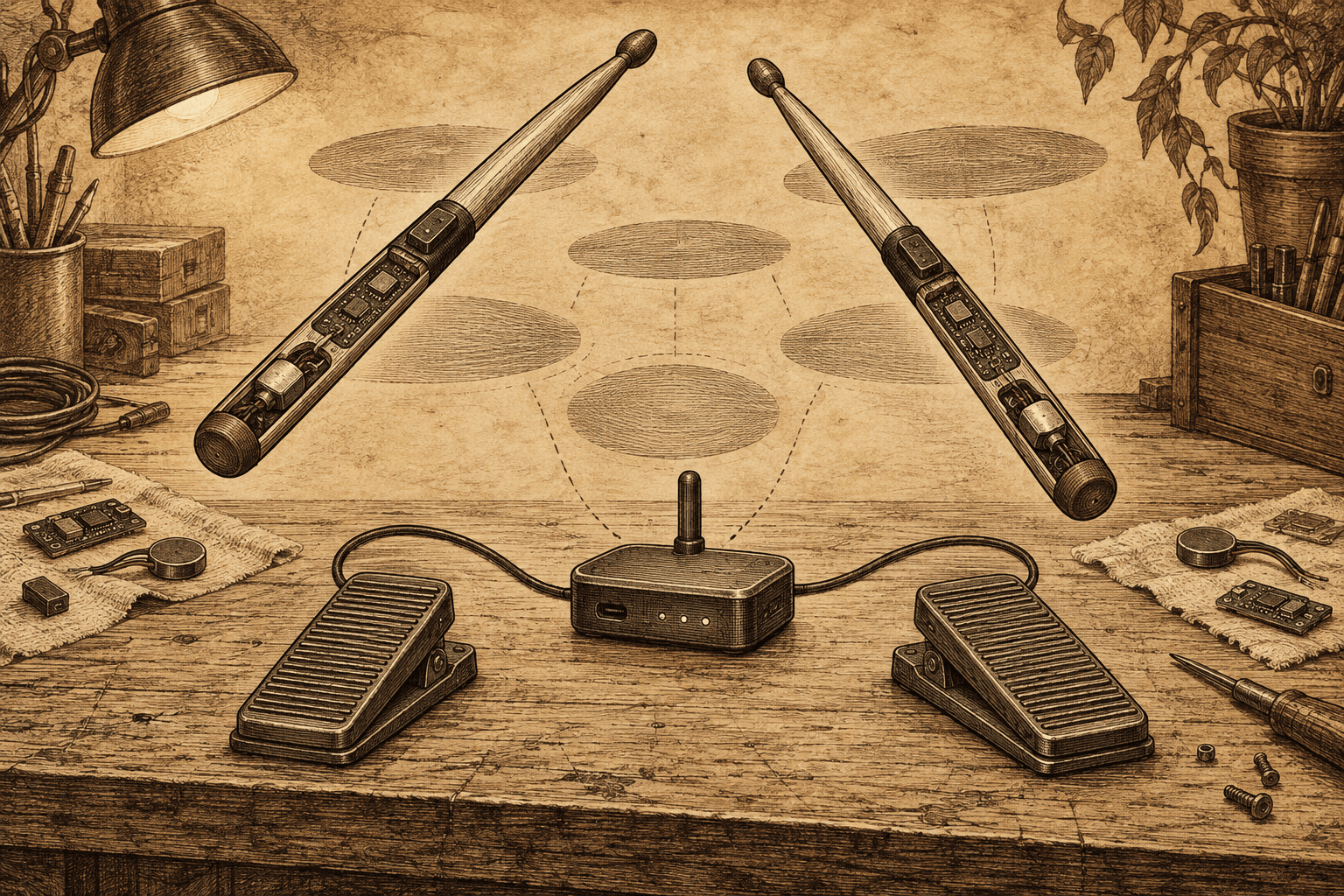
Moves motion tracking onto two ESP32-S3 drumsticks, adds haptic hits and a two-pedal hub, and sends velocity-sensitive drum events to open PC or Android playback software.
Visit Space Drums 2.0Original editorial concept art generated with built-in Codex Image Gen for The Machine Press, 2026-09-27; carried over because October 4 remains validation pending and no complete October 11 or October 18 replacement handoff exists; the October 25 Sunday refresh is not yet due.
Pairs a chip-level 65C02 computer with custom hardware, video, sound, floppy, and microSD support with a cycle-honest emulator and browser assembler built around the same machine.
Visit 3RICOriginal editorial concept art generated with built-in Codex Image Gen for The Machine Press, 2026-09-27; carried over because October 4 remains validation pending and no complete October 11 or October 18 replacement handoff exists; the October 25 Sunday refresh is not yet due.
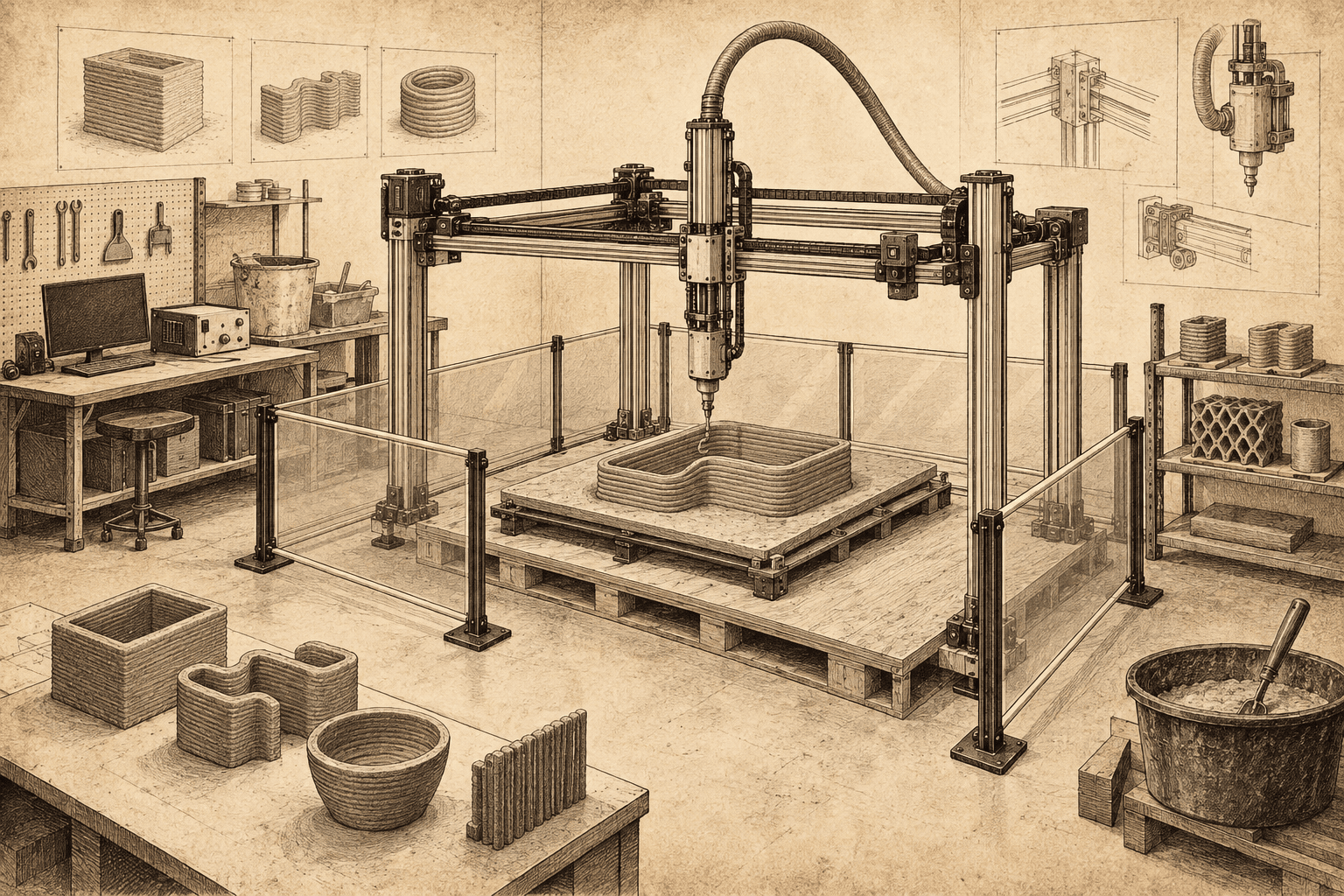
Publishes a pallet-scale cartesian motion reference, CAD, BOM, and low-voltage controls for supervised cementitious-extrusion research while explicitly excluding certified structural use.
Visit M3-CRETEOriginal editorial concept art generated with built-in Codex Image Gen for The Machine Press, 2026-09-27; carried over because October 4 remains validation pending and no complete October 11 or October 18 replacement handoff exists; the October 25 Sunday refresh is not yet due.
Turns a bare ESP32-S3 touchscreen into a USB-connected desk instrument for PC activity and optional room temperature, humidity, and light measurements.
Visit DeskNodeOriginal Codex Image Gen concept art from 2026-07-10; carried forward from the validated 2026-10-03 edition.
Desk Picks are selected by the newsroom. Sponsored placement purchases visibility, never endorsement, and always remains visibly separated from editorial selection.
 Editorial illustration