An automated search loop improves three quantum-compilation problems while a frozen exact checker certifies every submitted program before any result counts.
Editorial illustration
Concept illustration of verifier-gated agent search for quantum-circuit designs; not a literal circuit, agent interface, benchmark trace or quantum computer. Original editorial illustration generated with built-in Codex Image Gen for The Machine Press, October 25, 2026 edition.
Quantum-circuit compilation contains optimization problems that are difficult to solve but sometimes efficient to verify. This work turns that asymmetry into an agent workflow: a researcher and an agent formulate the challenge, the agent builds an exact verifier, and the verifier is tested against solved cases, deliberately broken answers and published results before search begins. Later agents iteratively submit programs and notes, with only verifier-certified candidates retained. Across fermion-to-qubit encoding, Hamiltonian layout and unitary synthesis, the authors report cost reductions of up to 73 percent at the largest tested sizes and better results than a state-of-the-art fermion-to-qubit optimizer. The method applies only when correctness and objective value can be checked exactly and efficiently; it does not establish general quantum advantage or reliable automated discovery without a sound verifier.
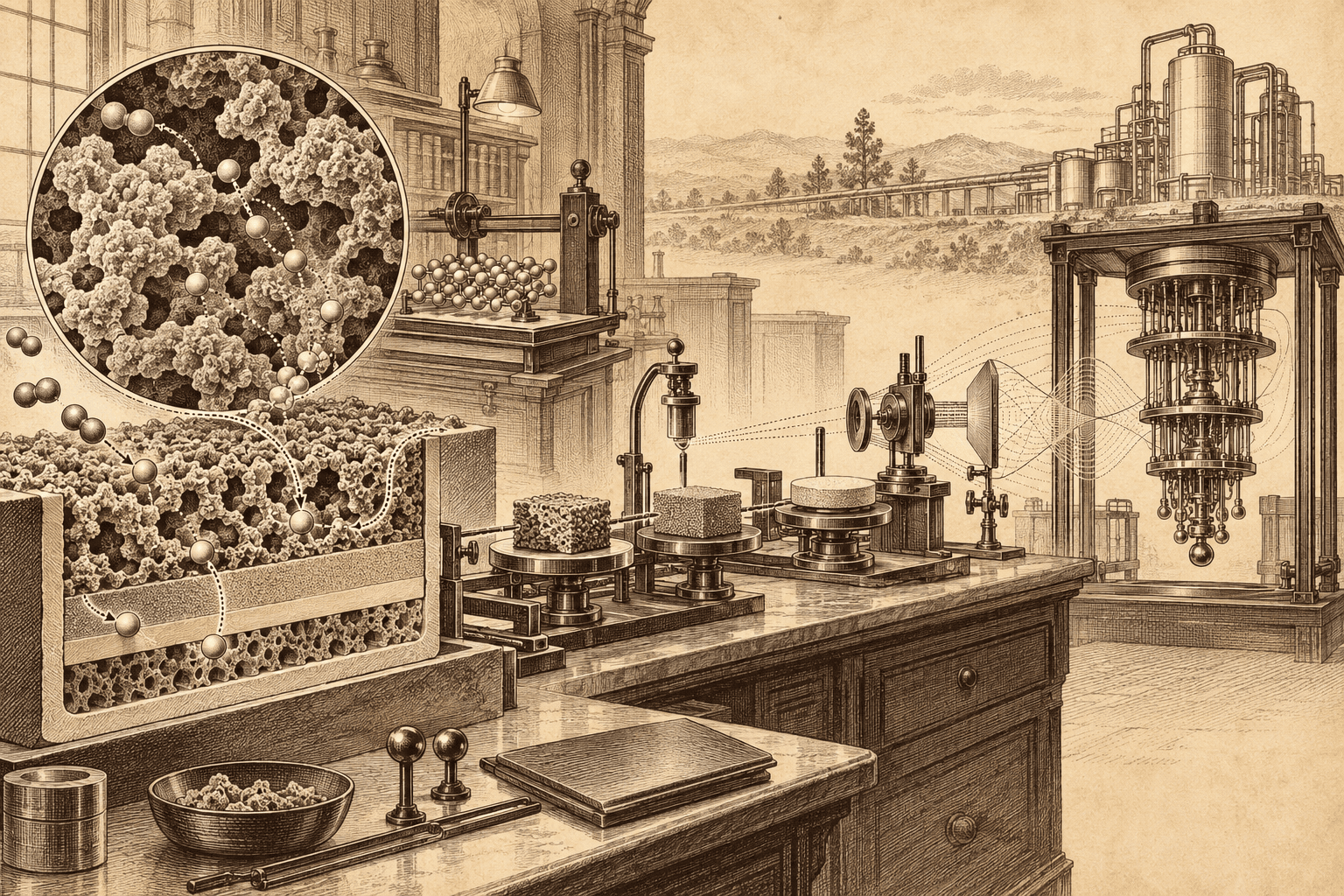
Concept illustration of a proposed quantum materials-screening workflow; not a tested electrode, working cell, demonstrated advantage or commercial plant. Original editorial illustration generated with built-in Codex Image Gen for The Machine Press, October 25, 2026 edition.
A proposed screening stack connects oxygen vacancies and electronic conductivity to solid-oxide-cell performance, then names the benchmarks still needed before the quantum case is real.
Strongly correlated oxygen-electrode materials can make classical electronic-structure calculations difficult as the active space grows. The authors lay out an end-to-end assessment framework for solid-oxide fuel and electrolysis cells: density-functional screening narrows candidates, GW-based embedding constructs correlated impurity problems, and prospective quantum impurity solvers provide finite-temperature Green's functions. A continuum model then connects vacancy formation, migration and conductivity to surface exchange, transport, microstructure and electrode thickness. The paper supplies illustrative logical-qubit counts and lists the state-preparation, simulation, measurement and repeated-solve costs that a full resource assessment must include. It identifies an opportunity and a benchmark program, not a demonstrated quantum advantage, validated material or commercial deployment; its worldwide value estimates depend on public targets and adoption scenarios.
FastHarness schedules model supervision less often as reviewed experience accumulates, then restores scrutiny around failures and recovery.
Reviewing every action chunk can make agentic robot supervision expensive even when the policy repeats a familiar stage. FastHarness stores reviewed outcomes and stage experience to lengthen the fast path, while a separate recovery path concentrates oversight after errors. Once recovery is verified, routine execution resumes and the failure remains in memory. Across four simulated manipulation tasks, the authors report a 57.2 percent average decline in reviewer-token use from the first evaluated episode to the mean of the last five, and mean episode time falling from 85.5 to 52.0 minutes. Success rose from 80 percent for the compared GPT-as-policy setup to 97.19 percent. The result uses four simulations, one frozen policy and one reviewer configuration; it does not establish safe sparse review in open-world robotics.
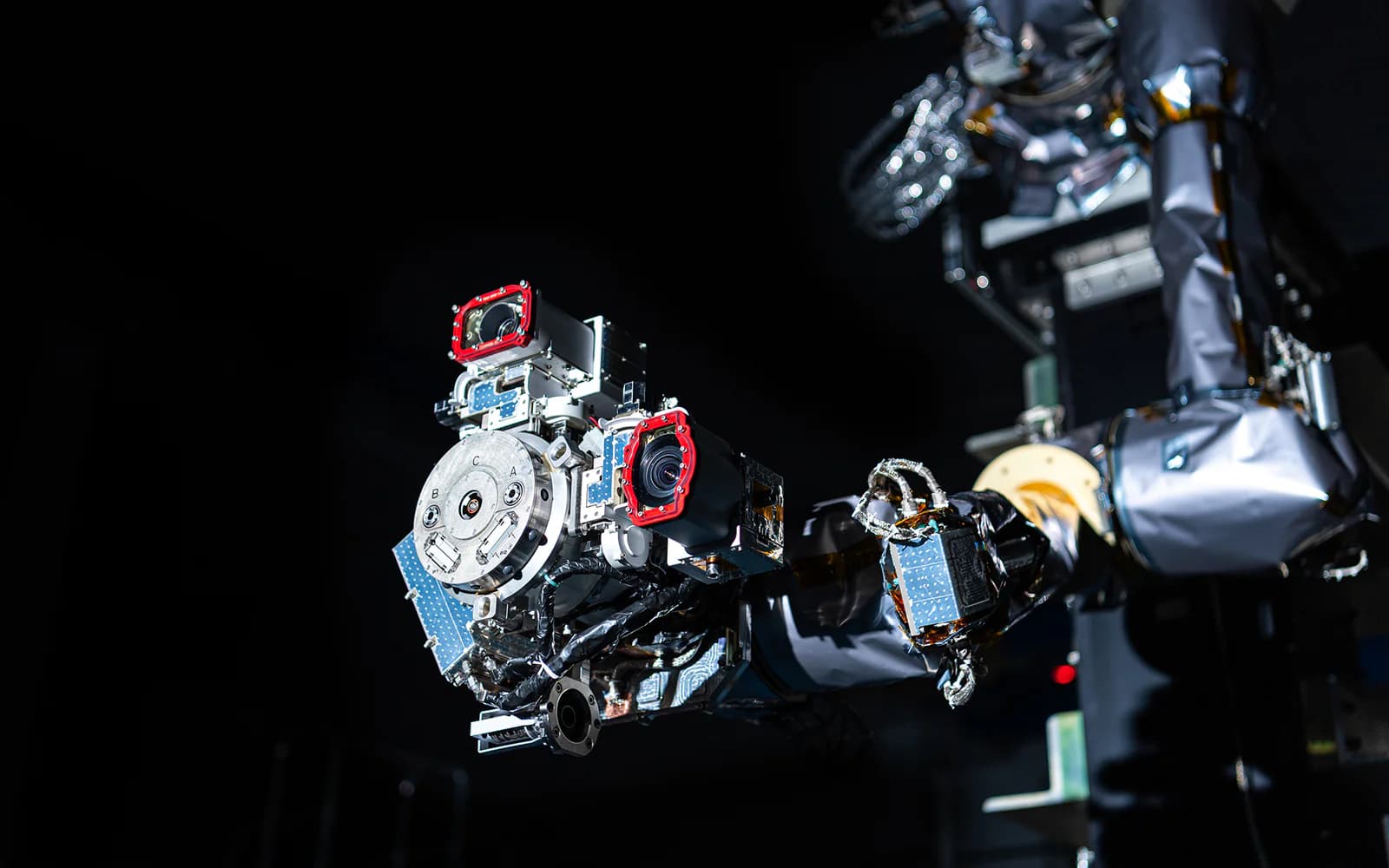
Illustrative NASA robotics file image; it does not show Echo, a vision-language-action policy, task-status signals or the reported experiments. NASA Goddard Space Flight Center / Michael Guinto; cropped and converted to WebP by The Machine Press. Use does not imply NASA endorsement.
Echo folds stop and failure signals into each action chunk, learning completion and recovery cues without frame-by-frame progress labels.
A robot policy needs to know not only what to do next but whether the task has succeeded or failed. Echo adds stop and failure values as two dimensions of every vision-language-action chunk and denoises them alongside the motor commands. Successful, failed and recovery trajectories provide complementary supervision without frame-level progress labels. The status dimensions are denoised faster, allowing later action steps to condition on cleaner estimates while controlled interactions keep status and action learning coupled. The authors report accurate status prediction and consistent policy improvements in real-world manipulation experiments. The evidence belongs to the tested tasks, data construction and model design; it does not show that every failure will be detected.
A conservative architecture search uses paired shadow replay, simulated canaries and rollback instead of treating every proposed team change as progress.
Agent architectures deployed under shifting conditions face delayed feedback, correlated failures and costly changes. Conservative Meta-Agent Search retrieves prior architectures, proposes typed graph edits and compares each candidate with the incumbent through paired shadow replay using common random numbers. Promotion requires a variance-penalized margin, followed by a simulated canary and predefined rollback. On the author-designed MetaInvest-Bench, CMAS lowered normalized dynamic-oracle regret from 0.116 to 0.104 and raised held-out utility from 0.44 to 0.48 over the strongest adaptive baseline, while shrinking teams when extra workers added no value. Search-inclusive token cost was highest. The calibration concerns one replay statistic and benchmark; it guarantees neither harm-free canaries nor production improvement.
ValuSpec filters low-value speculative candidates before expensive verification while preserving the target model's greedy output exactly.
Retrieval-based speculative decoding can reuse historical drafts, but larger candidate trees accumulate branches unlikely to survive target-model verification. ValuSpec scores and filters a supplied tree before that expensive step. Its threshold comes from the target model's greedy trajectories on a calibration split, and transfer-based supervision aligns valuation with the target without parameter training. The remaining tree is still verified under an output-identical greedy rule, so accepted tokens match ordinary autoregressive decoding. The authors report up to 2.38-times end-to-end speedup in retrieval-based settings and 2.78-times when attached to EAGLE-3. Those maxima depend on the tested models, tasks, calibration and serving setup; the method does not accelerate every workload by that amount.
WarpWeaver grows local command trees and prices contested regions so decentralized planners can approach a certified agreement before the clock runs out.
Joint optimal control for multiple nonlinear robots is usually centralized and offline, while real-time decentralized planners emphasize collision avoidance rather than the joint optimum. WarpWeaver replaces coupling with local constraints, grows dispersive command trees onboard and uses decentralized column generation to negotiate rents on shared space. At quiescence, the resulting agreement carries a near-optimality certificate; under deadlines, the asynchronous loop returns the best agreement reached so far. In simulation, the authors report travel-time reductions up to 22 percent against centralized offline planners and up to 37 percent against a decentralized real-time baseline, plus hardware experiments on six robots. The gains are benchmark- and scenario-specific and do not certify optimality when negotiation stops early.
SCOPE turns planner execution errors into feedback for correcting hallucinated scene graphs before they enter long-horizon robot datasets.
Automatically generated task-and-motion-planning data can be repetitive or physically unsolvable when a language model invents inconsistent scene graphs. SCOPE measures scenario diversity while running a planner against each generated scene. Execution failures feed a retroactive correction loop that repairs logical and physical inconsistencies before the example is accepted. In the reported comparison, an LLM fine-tuned on SCOPE data achieved a 12.33-point absolute success-rate gain over a counterpart trained on data from the DELTA PDDL-based generator. This evaluates the authors' generation pipeline, planners and downstream tasks; it does not establish that every corrected scene is physically complete or that synthetic planning data transfers to every robot.
Conceptual Visualising AI artwork inspired by neural networks; it does not depict the reported semantic map, point confidences, datasets or robot results. Novoto Studio / Google DeepMind / Pexels; cropped, resized, metadata stripped, and converted to WebP by The Machine Press.
Point-level confidence updates remove stale geometry instead of letting an open-vocabulary spatial memory grow forever by accumulation.
Object-centric semantic maps often append new points without revisiting old ones, allowing segmentation errors and geometry from moved objects to persist. This framework gives every object point a confidence score updated from multi-view temporal evidence. Consistent observations reinforce a point; conflicting masks, depth and visibility cues suppress it. Object tracking and re-identification preserve identity across relocation while the point cloud itself remains editable. The authors report accuracy gains of 3.46 percent on Replica and 2.55 percent on ScanNet, plus navigation and embodied-question-answering success rates of 82.4 and 76.7 percent. Those results depend on the tested datasets and perception stack and do not imply a complete or error-free map of arbitrary dynamic spaces.
Skeleton supervision grounds one latent-action channel in robot kinematics while a residual channel retains the rest of the visual change.
Video-trained robot world models can blur together commanded motion, object response and incidental scene change. SkeLAM splits latent action into a kinematic component supervised by robot skeletons and a residual component for complementary visual dynamics. Cross-modal reconstruction encourages RGB- and skeleton-derived kinematics to align, while branch dropout limits reliance on future-derived residual information. A lightweight adapter maps real robot actions into the kinematic space at inference. On DROID, the authors report a 19.5 percent reduction in end-effector displacement error and an 11.1 percent LPIPS improvement against DreamDojo, with qualitative human-to-robot motion transfer. The findings concern the evaluated data, metrics and rollouts; generated agreement is not a safety guarantee for physical execution.
Future interaction intent routes attention between global and wrist views instead of letting one camera dominate every manipulation stage.
Multi-view robot policies receive complementary global and local observations, yet the authors found persistent over-reliance on the wrist camera. FocusVLA predicts future interaction intent from action history and uses that estimate to route visual information differently across task stages. The modules can be attached to existing vision-language-action frameworks without changing their cores. On RoboTwin 2.0, the paper reports a 10.10-point average success-rate improvement over the strongest pi-0.5 baseline; in real-world tests, success rose from 71.7 to 85.0 percent. These figures describe the selected benchmark, baseline and physical tasks and do not demonstrate that predicted intent will choose the right view under every occlusion or distribution shift.
An event-camera tracker estimates one homography across a quadrotor while keeping separate rotation states for each spinning propeller.
A moving event camera sees blade rotation mixed with camera motion, background events and half- or double-rate ambiguities. CoHelix assigns events to four coplanar propellers, updates each rotation state separately and lets accepted measurements from any propeller refine one shared projective geometry. The paper emphasizes lock—the fraction of time an estimate remains within two percent of synchronized ground truth—rather than mean error alone. On moving-camera recordings, CoHelix reached 62.9 percent lock versus 39.8 and 22.2 percent for two comparisons; on a private target-follower set it reached 95.9 percent. The private set and fixed initialization limit generalization, and the tracker does not prove safe flight control.
DiffDreamer leaves external dynamics to a learned world model while a differentiable simulator carries the quadrotor's explicit physical state.
Agile flight through moving gates requires predicting the environment without losing high-frequency control of the vehicle. DiffDreamer separates those jobs within one reinforcement-learning update. A learned latent world model propagates external motion and history-dependent features; a differentiable simulator propagates the quadrotor's physical state. The actor objective also separates critic-driven task rewards from differentiable motion rewards. On aggressive tracking and dynamic-gate racing, the authors report faster convergence and stronger final performance than model-free, model-based, differentiable-RL and classical planning-and-control comparisons, plus proof-of-concept real flights. The abstract provides no universal margin, and simulation structure, reward design and selected tasks constrain the claim.
Generic policy illustration used for person-level privacy; it does not depict a law, regulator, dataset, privacy proof or implementation outcome. Perhelion / Wikimedia Commons (CC0 1.0); gold background added and converted to WebP by The Machine Press.
A degree-six sum-of-squares estimator reaches near-optimal user counts when every participant contributes a batch from one discrete distribution.
Sample-level privacy can understate exposure when one person contributes many correlated records. This work studies person-level differential privacy for learning a discrete distribution from n users, each supplying m independent samples. It gives polynomial-time algorithms for both pure and approximate privacy, with the pure-DP user requirement matching the information-theoretic optimum up to logarithmic factors. The construction uses a degree-six sum-of-squares estimator for untrusted batches and a covariance certificate that preserves mean-dependent multinomial variance. A statistical-query lower bound rules out uniformly smaller error under fixed polynomial resources. These are theoretical rate and complexity results under the stated distributional assumptions, not a turnkey privacy guarantee for arbitrary behavioral datasets.
CRANE retrieves real training examples whose text, image or other components jointly resemble the query while belonging to the alternate class.
Most counterfactual explanations are built for one data type, while multimodal attribution methods often explain each input independently. CRANE is a post-hoc, model-agnostic retrieval framework that searches real training examples from the target class. Its strongest strategy intersects nearest-neighbor sets from each modality, grounding the explanation in a jointly observed example rather than synthesizing an unconstrained alternative. Across four heterogeneous datasets and three fusion strategies, multimodal consensus retrieval produced the best or joint-best result on three datasets, while single-modality methods remained competitive when one channel dominated the decision. The approach inherits the coverage and biases of the training set and does not show that a nearby example is a causal explanation.
A self-supervised attention module predicts future body-environment contacts, giving a whole-body controller a movable interface between perception and action.
Reference-free locomotion policies can adapt broadly but struggle to discover coordinated whole-body motion; imitation produces natural movement but can bind behavior to recorded trajectories. This framework uses motion data only as a training prior. A self-supervised attention planner predicts future contacts, and a contact-conditioned tracker converts those plans into coordinated motion. Fine-tuning then explores terrain variations beyond the original demonstrations. At deployment, the policy uses onboard observations and no reference trajectory. The paper presents versatile humanoid mobility in challenging environments, but the abstract reports no common benchmark margin and the work remains under review. Learned contact structure is a control abstraction, not evidence that the robot can safely traverse every terrain.
Independent builders turning improbable ideas into real things.
Four editorial selections
$7 for seven days
Paid work is clearly labeled
Placement is never endorsement
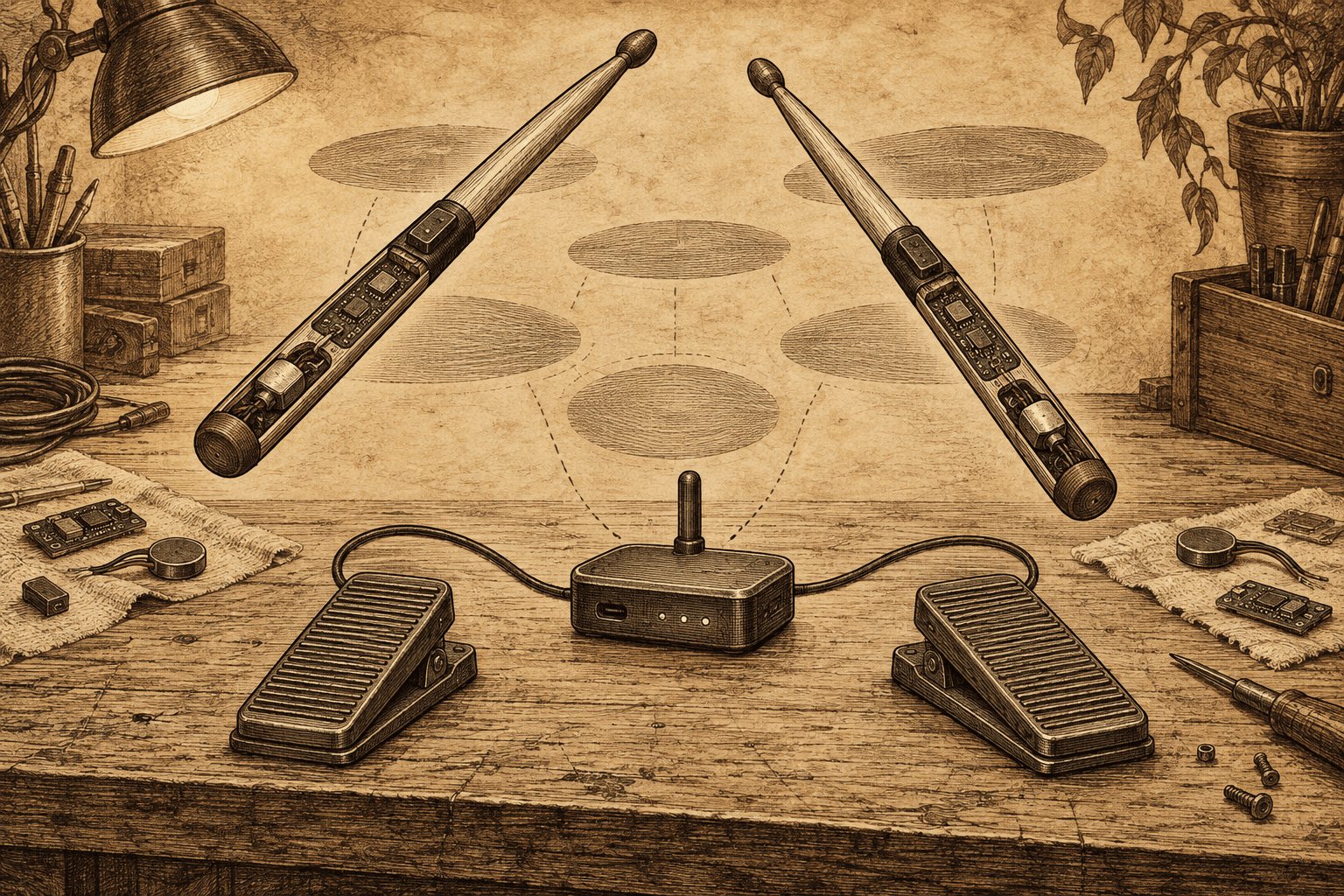
Original editorial concept art generated with built-in Codex Image Gen for The Machine Press, 2026-09-27; carried over because the October 25 weekly refresh handoff is absent and October 4 remains validation pending.
Moves motion tracking onto two ESP32-S3 drumsticks, adds haptic hits and a two-pedal hub, and sends velocity-sensitive drum events to open PC or Android playback software.
Visit Space Drums 2.0Original editorial concept art generated with built-in Codex Image Gen for The Machine Press, 2026-09-27; carried over because the October 25 weekly refresh handoff is absent and October 4 remains validation pending.
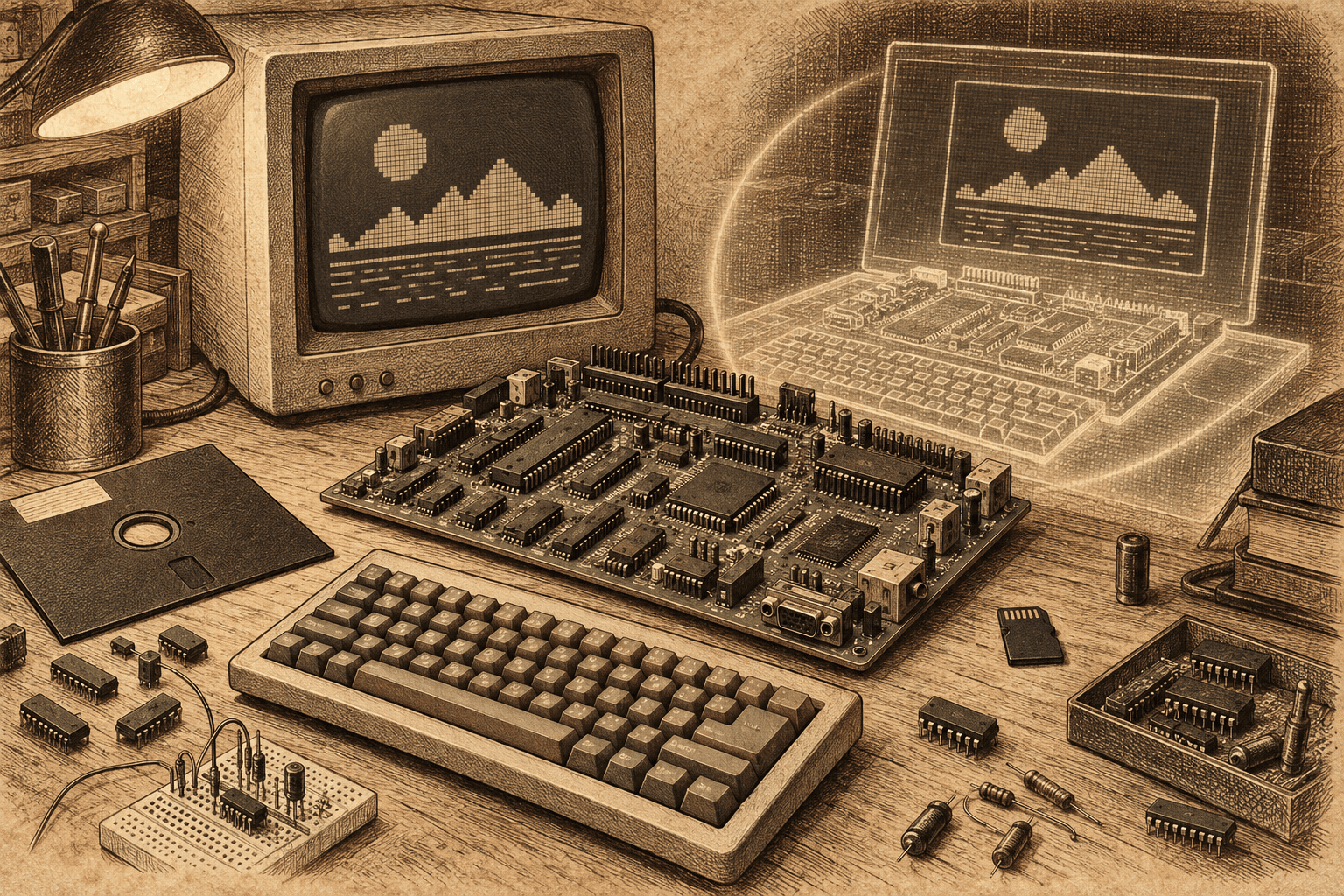
Pairs a chip-level 65C02 computer with custom hardware, video, sound, floppy, and microSD support with a cycle-honest emulator and browser assembler built around the same machine.
Visit 3RICOriginal editorial concept art generated with built-in Codex Image Gen for The Machine Press, 2026-09-27; carried over because the October 25 weekly refresh handoff is absent and October 4 remains validation pending.
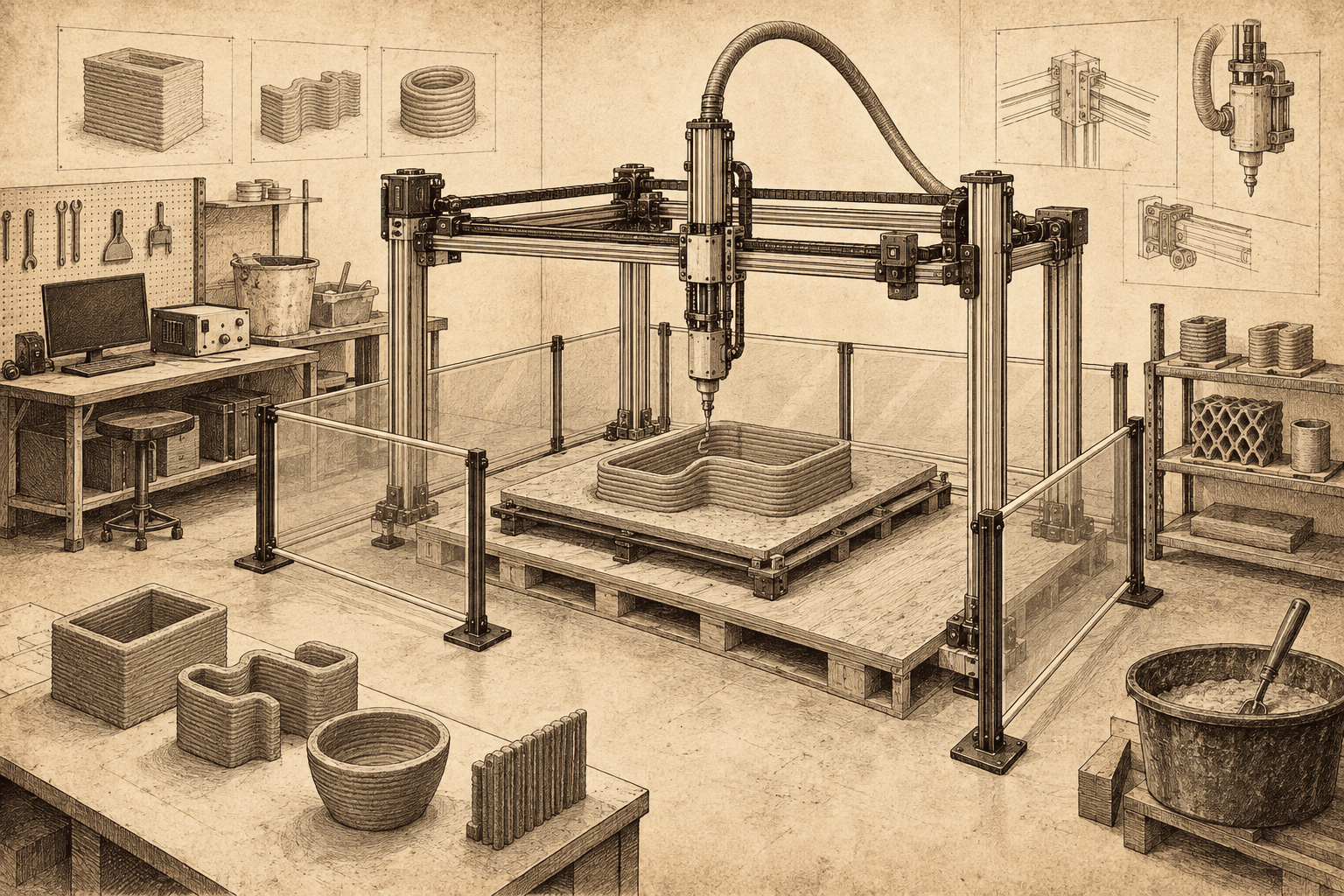
Publishes a pallet-scale cartesian motion reference, CAD, BOM, and low-voltage controls for supervised cementitious-extrusion research while explicitly excluding certified structural use.
Visit M3-CRETEOriginal editorial concept art generated with built-in Codex Image Gen for The Machine Press, 2026-09-27; carried over because the October 25 weekly refresh handoff is absent and October 4 remains validation pending.
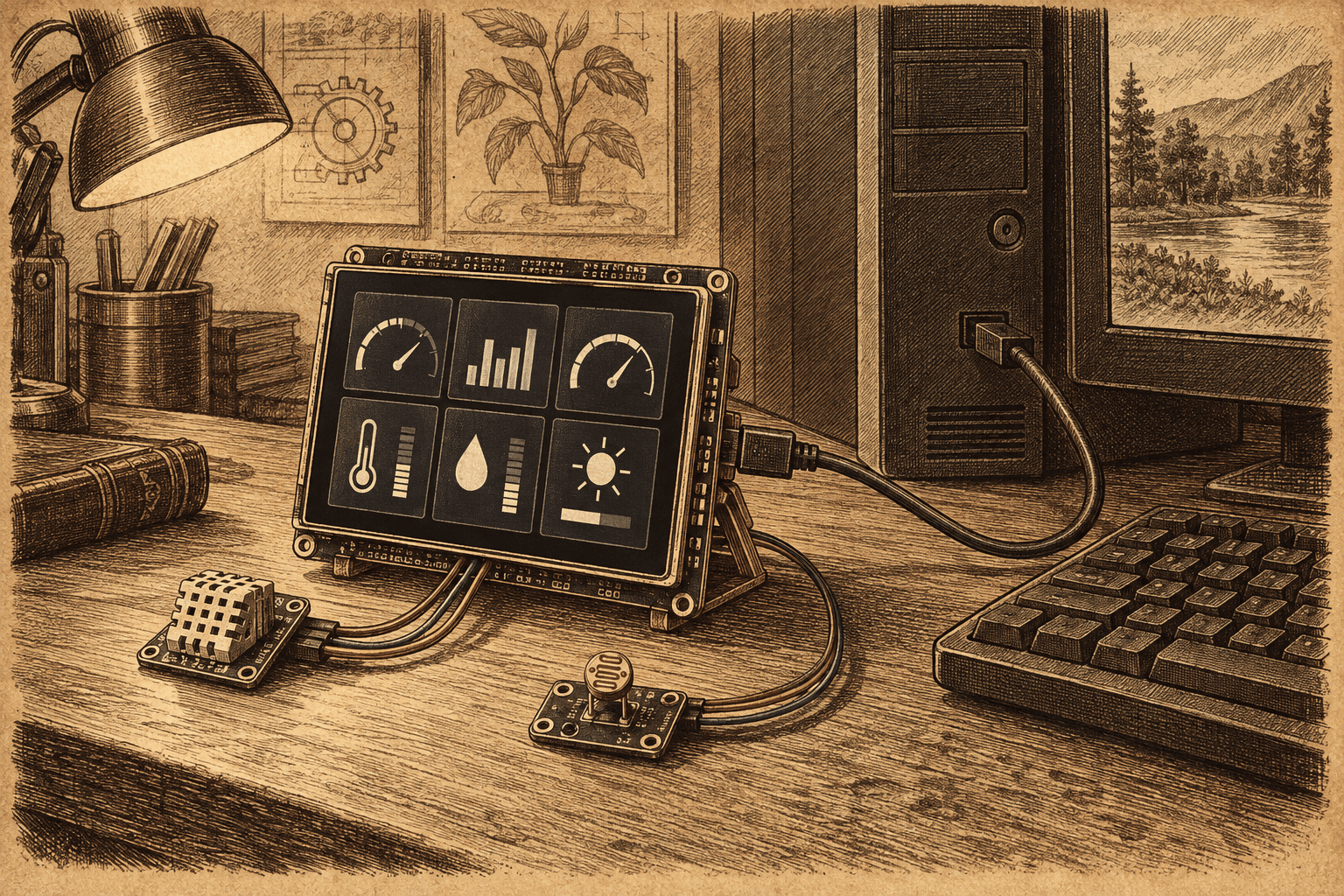
Turns a bare ESP32-S3 touchscreen into a USB-connected desk instrument for PC activity and optional room temperature, humidity, and light measurements.
Visit DeskNodeOriginal Codex Image Gen concept art from 2026-07-10; carried forward from the validated 2026-10-24 edition.
Desk Picks are selected by the newsroom. Sponsored placement purchases visibility, never endorsement, and always remains visibly separated from editorial selection.
 Editorial illustration