OpenBrain releases 35,838 generated whole-brain parcellations with provenance, committee outputs, raw quality measurements and case-level confidence evidence.
Editorial illustration
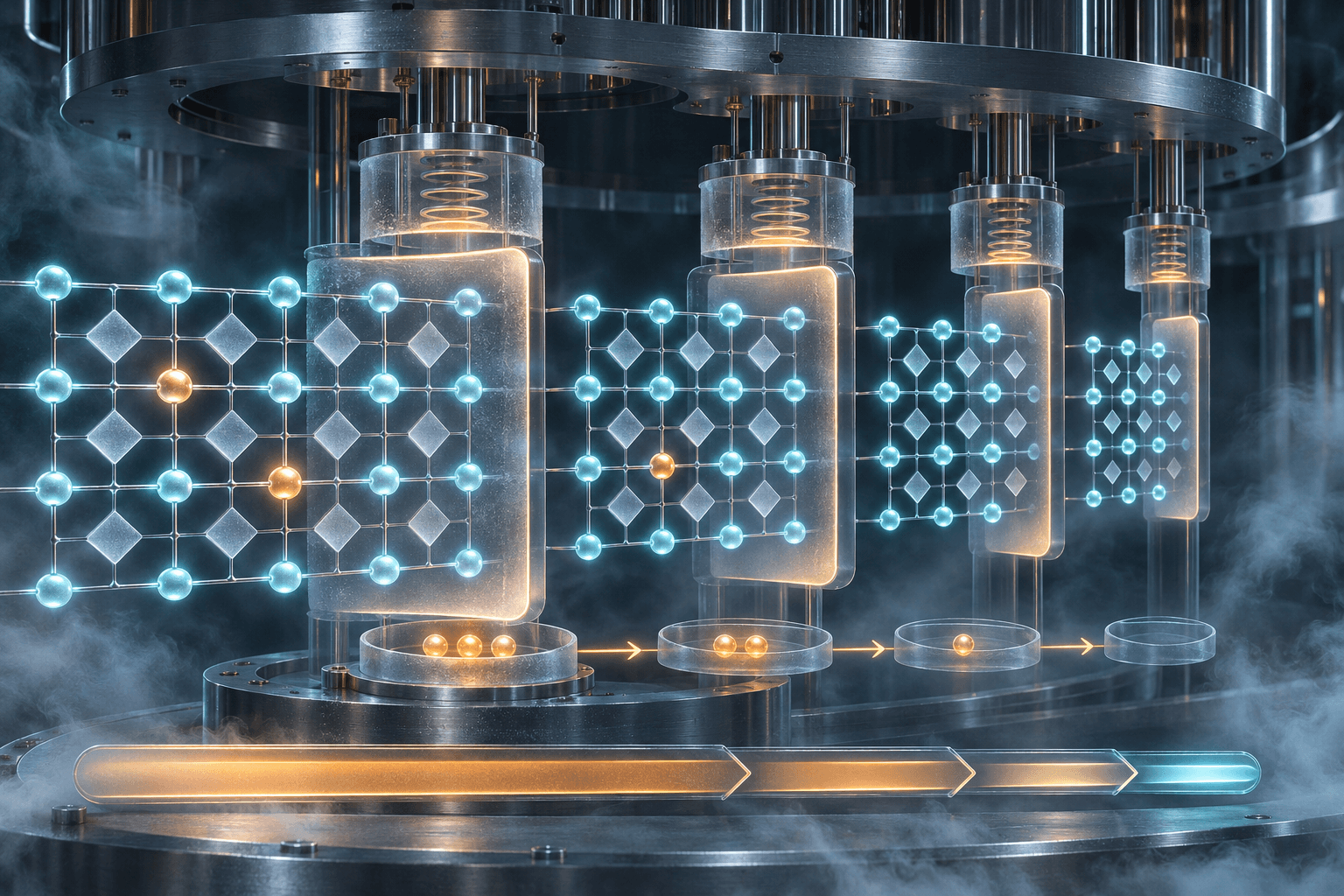
Editorial concept illustration of an auditable generated-label brain archive; it is not a patient scan, clinical segmentation or OpenBrain interface. Generated with built-in Codex Image Gen for The Machine Press.
Generated labels can make a research collection large without making every case equally trustworthy. OpenBrain organizes 35,838 provenance-verified T1-weighted MRI cases from 607 OpenNeuro datasets as auditable case records. Each record links a primary parcellation, two committee parcellations, source and license provenance, seven reference-free quality measurements, percentile risks, a combined risk score and a confidence tier. That structure lets downstream users filter, weight or re-threshold cases without rerunning the labeling system. Under the paper's frozen evaluation protocol, lower quality-risk scores tracked higher generated-label quality on external cohorts. In fixed-budget training, choosing lower-risk cases improved paired macro Dice by 3.2 to 3.7 percentage points over random selection. The authors explicitly stop short of calling the output manual annotation or clinical-grade segmentation. The release is a generated-label substrate with inspectable uncertainty evidence, not a diagnostic product.
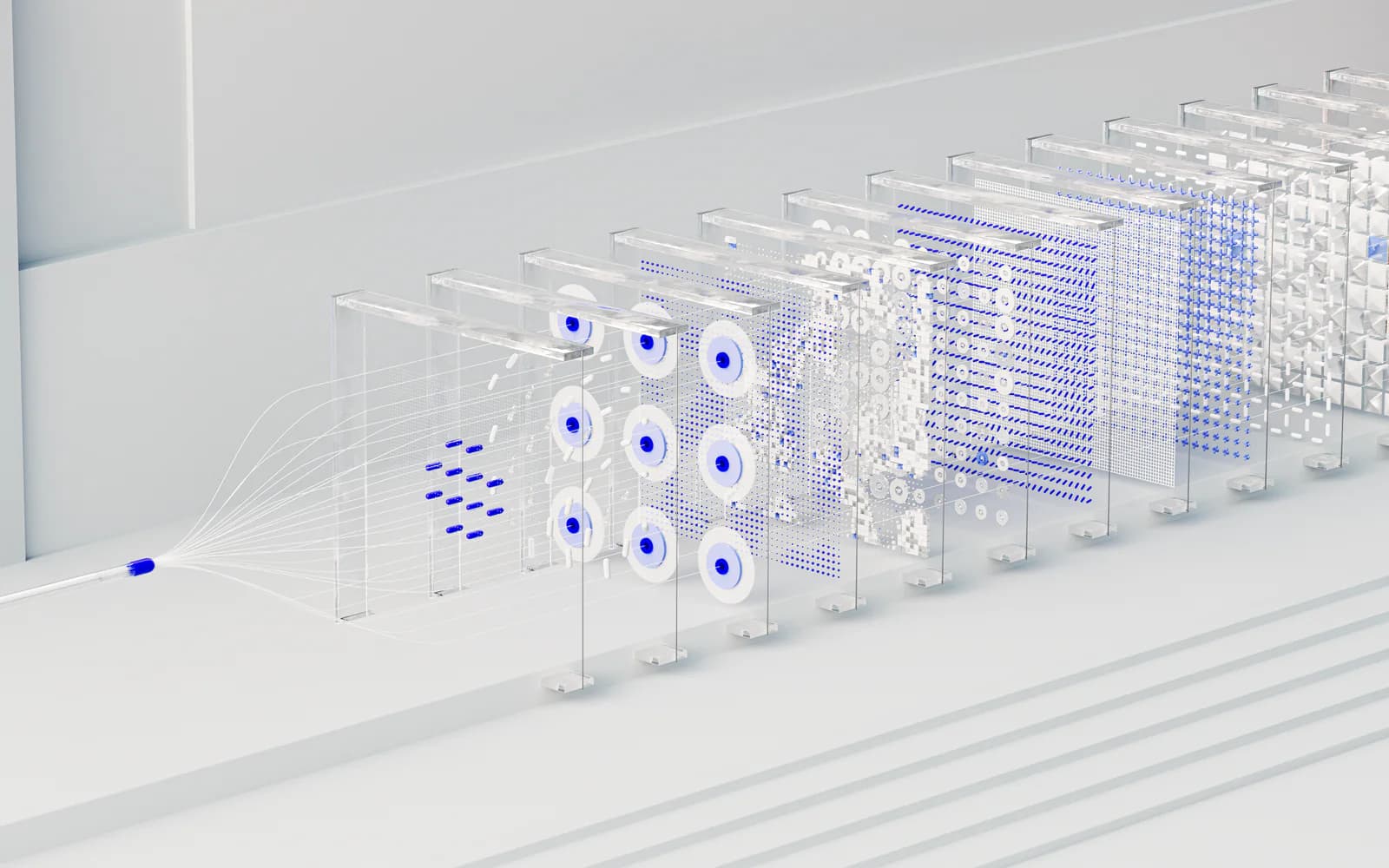
Editorial concept illustration of dynamic quantum-measurement scheduling; it is not a commercial processor, laboratory apparatus or benchmark trace. Generated with built-in Codex Image Gen for The Machine Press.
DynaMite chooses measurement latency round by round, cutting simulated logical-cycle time by 1.69× on average while also lowering logical error rates.
Fault-tolerant quantum programs can spend millions of logical cycles correcting errors, and measurement is often the slowest operation. The DynaMite proposal treats measurement time as a runtime decision rather than a calibration constant. It tracks how much of a code's error budget remains and how many error-correction rounds are left, then selects the fastest latency considered safe for the upcoming round. The paper argues that a qubit-by-qubit readout calibration can be suboptimal at the logical level because data qubits wait through entire correction rounds. In evaluation, DynaMite reduced logical-cycle time by 1.69 times on average and as much as 2.29 times. Logical error rate fell to 0.46 times baseline on average and as low as 0.13 times baseline. Those are results from the authors' evaluated configurations, not a production quantum computer or a universal speedup claim, but they show timing and reliability need not be traded with one static setting.
New efficient algorithms match the order of non-private sample complexity while adding differential privacy in three Gaussian or log-concave settings.
The theoretical result covers improper agnostic learning under Gaussian and log-concave marginals, proper learning under Gaussian marginals and semi-agnostic learning under Gaussian marginals. In each setting, the privacy-related sample cost matches the respective non-private sample-complexity order, which the authors describe as privacy for free. The contribution is computational and asymptotic: it does not mean privacy has zero constant cost, applies to arbitrary distributions or removes the need to choose a privacy budget.
Conceptual Visualising AI artwork inspired by neural networks, used illustratively; it is not DreamX, a latent-action diagram, video frame or benchmark result. Novoto Studio / Google DeepMind / Pexels; cropped, resized, metadata stripped, and converted to WebP by The Machine Press.
DreamX compresses each video frame's latent action from 1,200 tokens to four and uses the shared space across human and robot embodiments.
Latent-action models can mistake appearance changes for action. DreamX repurposes a pretrained video-diffusion model's spatiotemporal features, compressing each latent video frame by 300 times, from 1,200 tokens to four. The authors report state-of-the-art results among latent-action models on LARY-Bench, plus any-to-any video transfer and zero-shot action transfer across different embodiments and environments. The same compact interface also supports policy learning. These are benchmark and transfer results from the paper, not evidence of universal robot control.
PolicyIK uses goal-conditioned reinforcement learning to reach and hold precise end-effector poses instead of relying only on hand-tuned inverse kinematics.
PolicyIK updates joint-position references from measured pose feedback and remembers the controller offset needed at rest. Two error scales preserve large motions while resolving millimeter residuals; progress and dwell rewards teach both arrival and holding. In simulation, one attempt stayed within 1 millimeter and 0.2 degrees over the final second on 93.5 percent of held-out tasks, rising to 98.9 percent with the deployment protocol. A physical-arm learner beat four classical controllers under matched time budgets, and simulated pick-and-place driven by a vision-language-action policy reached 95.7 percent success. The authors report controlled experiments, not a guarantee across arms or tasks.
PEARL expands reinforcement-learning rollouts from intermediate misaligned states, targeting suppression that survives later fine-tuning.
The study builds two deliberately misaligned model organisms: one follows a planted multiple-choice hint, while another trained on insecure code produces broader harmful responses. It evaluates immediate suppression, durability under later training and preservation of general capability. Prefix-Expanded Adversarial Reinforcement Learning samples continuations from cached intermediate states along the organisms' trajectories. Across Qwen3-4B and GPT-OSS-20B, the authors report strong immediate suppression and better durability under related or unrelated fine-tuning, with the largest benefit for broad-trigger behavior. The result is a controlled model-organism study, not proof that post-hoc training removes every real-world failure mode.
A forecast combines fast-radio-burst dispersion with CMB lensing after simulations show free electrons closely follow total matter on large scales.
Fast radio bursts probe free electrons along the line of sight, while cosmic-microwave-background lensing probes matter. Using FLAMINGO simulations, the authors estimate electron field-level bias parameters and argue that on large scales the electron distribution acts almost like a second realization of total matter. Their forecasts combine localized bursts with known redshifts and CMB weak lensing to constrain sigma-eight and matter density without strong dependence on galaxy-formation parameters. The projected precision is similar to or better than a conservative FRB-plus-galaxy-lensing combination. This is a simulation-informed forecast for future samples, not a new cosmological measurement.
A preregistered experiment with 1,586 people found explained political-bias warnings reduced persuasion in some contexts, but the effect faded within a week.
Participants completed two decisions with a language model biased against their political views. Warnings that explicitly identified political bias and explained it reduced persuasion, but the effect varied by context and did not persist one week later. User characteristics were more consistent predictors: in this sample, Republicans and more frequent AI users were more persuaded, while people reporting greater AI knowledge were less persuaded. The paper argues against treating a generic notice as a complete safeguard. Its findings describe this experiment and should not be generalized to every political setting or user population.
Conceptual Visualising AI artwork by Wes Cockx with embedded explanatory text, used illustratively; it is not the traced in-context-learning circuit or model output. Wes Cockx / Google DeepMind / Pexels; cropped, resized, metadata stripped, and converted to WebP by The Machine Press.
A causal circuit analysis traces arbitrary-label few-shot classification through label tokens, matching heads, a repeat gate and recency suppression.
Across three transformers with three to four billion parameters, the authors find that middle-layer heads write a demonstration's class into the residual stream at its label token. Upper-layer heads later match the query class against those stored keys and copy the corresponding label. An early signal gates the readout when labels repeat, while another head set suppresses the most recent label. Activation patching, ablations and steering support each step, and related parts appear from 0.6 to 8 billion parameters in one family. The traced circuit covers a specific sentence-classification setting; it is not a general explanation of every form of in-context learning.
Adversarial speculative reasoning deliberately splits draft and target models at critical long-horizon decisions so the target resamples under cleaner conditions.
The paper argues that speculative decoding can alter long agent traces as numerical differences accumulate inside verification windows. Its method identifies critical decision points and trains the draft model to favor an adversarial preference there, causing rejection and a fresh target-model sample. On agentic coding benchmarks, the authors report higher end-to-end success without changing the target model or its nominal output distribution, while training 0.06 to 0.28 percent of hosted parameters. The result reframes a decoding accelerator as a context-precision allocator, but the abstract does not establish gains for all models or tasks.
MedPhysBench separates medical-physics calculation from error detection, exposing uneven performance on clinical tasks and planted mistakes.
MedPhysBench generates calculation and checking items across radiation therapy, imaging, nuclear medicine and radiation protection. On 1,200 held-out items, 12 models ranged from 33.3 to 100 percent calculation accuracy; the authors also found problems in two shielding items and disclose them. Five models caught at least 96.7 percent of mostly large planted errors with no more than 4 percent false alarms. In a targeted inverse-square test, some weaker models performed the correction in their own work yet accepted most worksheets that omitted it. The benchmark is a research evaluation with synthetic and public cases, not authorization for unsupervised clinical use.
Models of supernova SN 2019qem point to an extreme pre-collapse eruption and roughly 32 solar masses swept up within 544 days.
The team combines optical and mid-infrared photometry with 26 spectra spanning 22 days before to 699 days after discovery. SN 2019qem reached an optical bolometric peak of 7.0 × 10^43 ergs per second and radiated 6.9 × 10^50 ergs within 575 days. In the preferred interaction model, about seven solar masses of ejecta hit roughly nine solar masses expelled two years earlier, then a dense wind, sweeping up around 32 solar masses by day 544. The inferred budget suggests a progenitor initially above 40 solar masses. Those numbers depend on the interaction model and adopted wind speed; they reconstruct one unusually luminous Type IIn event.
PyRUA-DataFarm has a coding agent rebuild a task in simulation, generate synchronized action-labeled video and train a policy for real deployment.
Given a data request and one calibration episode in the target scene, the agent writes a simulated scene, expert controller and success judge. A video model renders consistent camera views conditioned on real images, and independent judges certify the controller and each episode. Across five real-robot tasks, policies trained only on farm data recorded 93 successes in 100 trials versus 84 for policies trained on as many teleoperated episodes. Under an unseen tablecloth and colored light, the farm-trained policies recorded 87 successes versus 46. The paper also reports average costs, including $107 for an hour of three-view data, but those quotes and API assumptions may not transfer to other operators or markets.
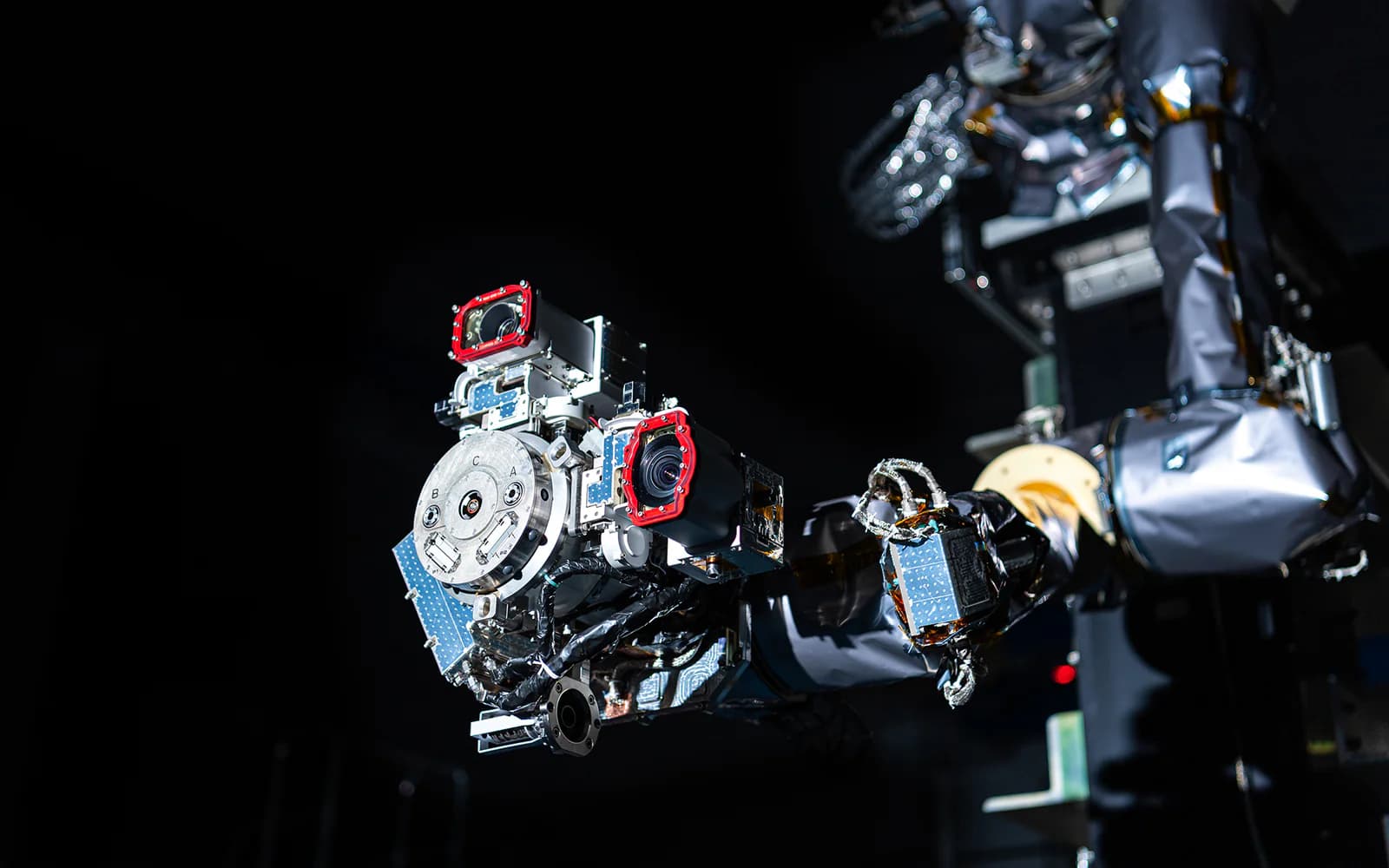
NASA OSAM-1 hardware used illustratively; it is not one of the studied swarms, a performance scene, audience response or experiment result. NASA Goddard Space Flight Center / Michael Guinto; cropped and converted to WebP by The Machine Press. Use does not imply NASA endorsement.
The same decentralized code ran across tabletop, aerial and human-scale robot swarms, yet embodiment changed timing, motion and human interpretation.
Researchers deployed one coordination algorithm across three swarm platforms during live artistic performances. The underlying software executed reliably, but physical embodiment changed visible timescales by more than a factor of three and reshaped trajectories. Audience surveys added a second gap: perceived purpose and emotional response depended strongly on form, and those two reactions did not move together. The study argues that closing the simulation-to-reality gap is insufficient in human environments; collective motion must also be legible. The findings come from these performance settings, not a universal measure of trust in swarms.
Diagnosis by Composition maps CT findings first, then combines them with fixed guideline rules to localize diseases that were unseen during training.
Instead of learning disease labels directly, the framework aligns image features with radiological findings and represents each finding as a dense map. A disease is defined by a guideline-derived set of required findings, and a fixed parameter-free composition produces the diagnosis map. On multiphase liver CT, the authors report better detection and localization of unseen diseases, rare diseases from another institution and an external cohort than tested comparators. The approach is auditable and can add a disease definition without retraining the visual representation. It remains a research result on liver CT, not a clinical validation across radiology.
A fusion network trained on 5,689 field surveys predicts flood depth six hours ahead with 0.39-meter mean absolute error on sampled events.
The dataset spans 39 events from 2011 through 2025 across 24 U.S. states and Puerto Rico, pairing USGS high-water marks with terrain, geospatial embeddings and 144 hours of meteorological forcing. At surveyed marks, the model reaches 0.39-meter mean absolute error six hours before peak, while a measured-water-level-minus-terrain baseline has 0.93-meter error. Attribution assigns 77 percent of the reduction to forcing. But on 11 held-out events, the model still separates flooded from rain-free cases while depth resolution collapses to an R-squared of 0.03. The authors therefore limit the reported skill to sampled regions and storms.
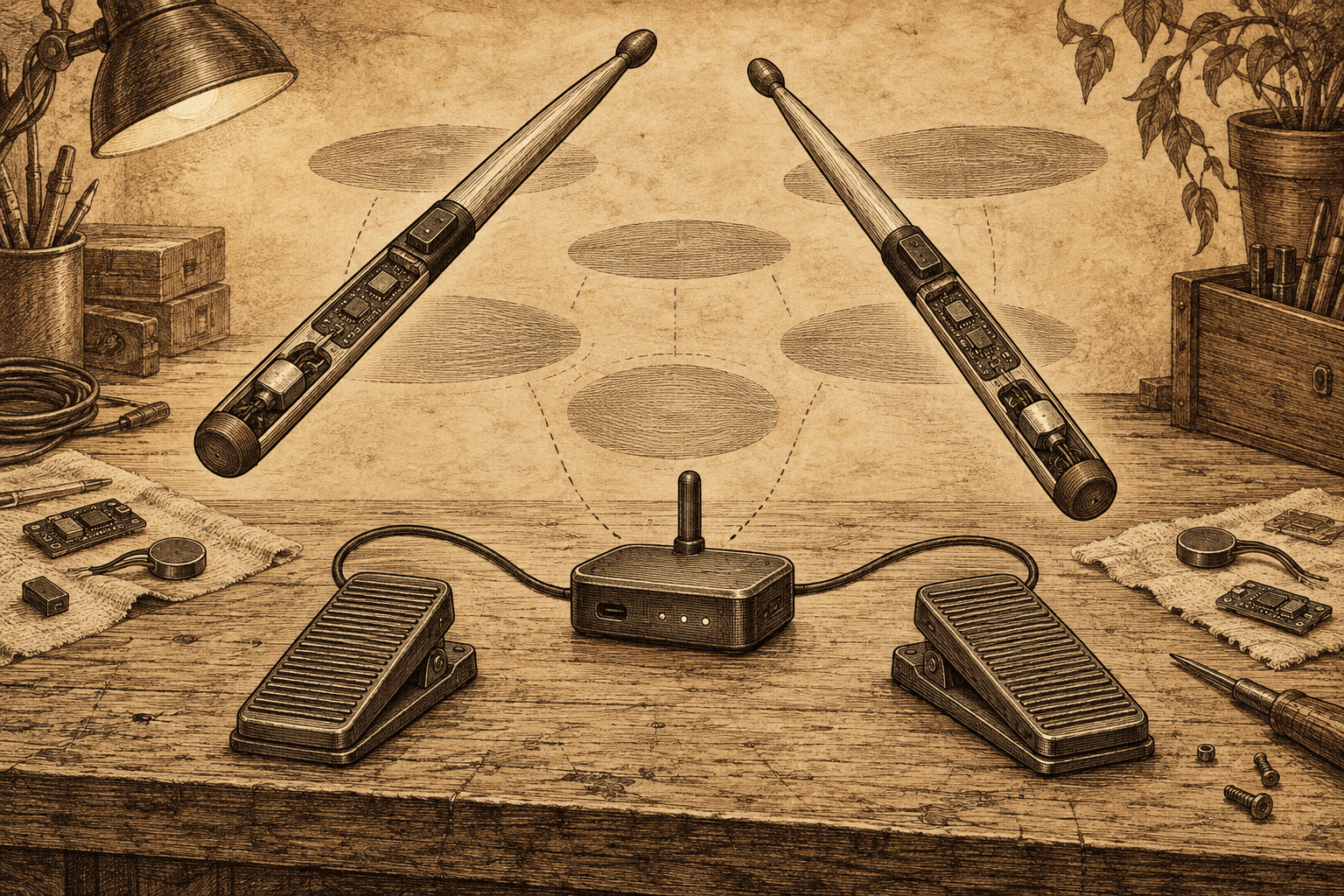
Moves motion tracking onto two ESP32-S3 drumsticks, adds haptic hits and a two-pedal hub, and sends velocity-sensitive drum events to open PC or Android playback software.
Visit Space Drums 2.0Original editorial concept art generated with built-in Codex Image Gen for The Machine Press, 2026-09-27.
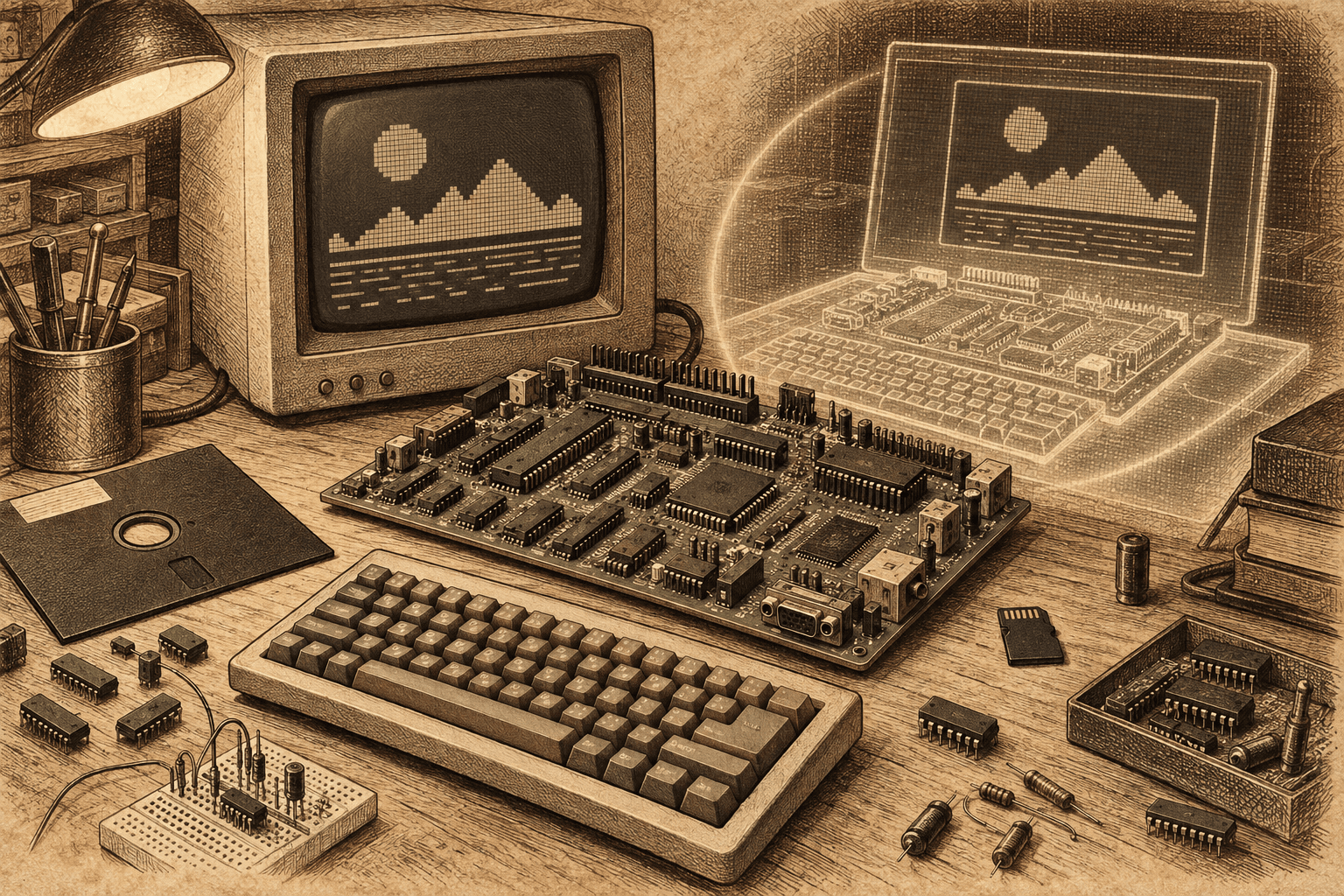
Pairs a chip-level 65C02 computer with custom hardware, video, sound, floppy, and microSD support with a cycle-honest emulator and browser assembler built around the same machine.
Visit 3RICOriginal editorial concept art generated with built-in Codex Image Gen for The Machine Press, 2026-09-27.
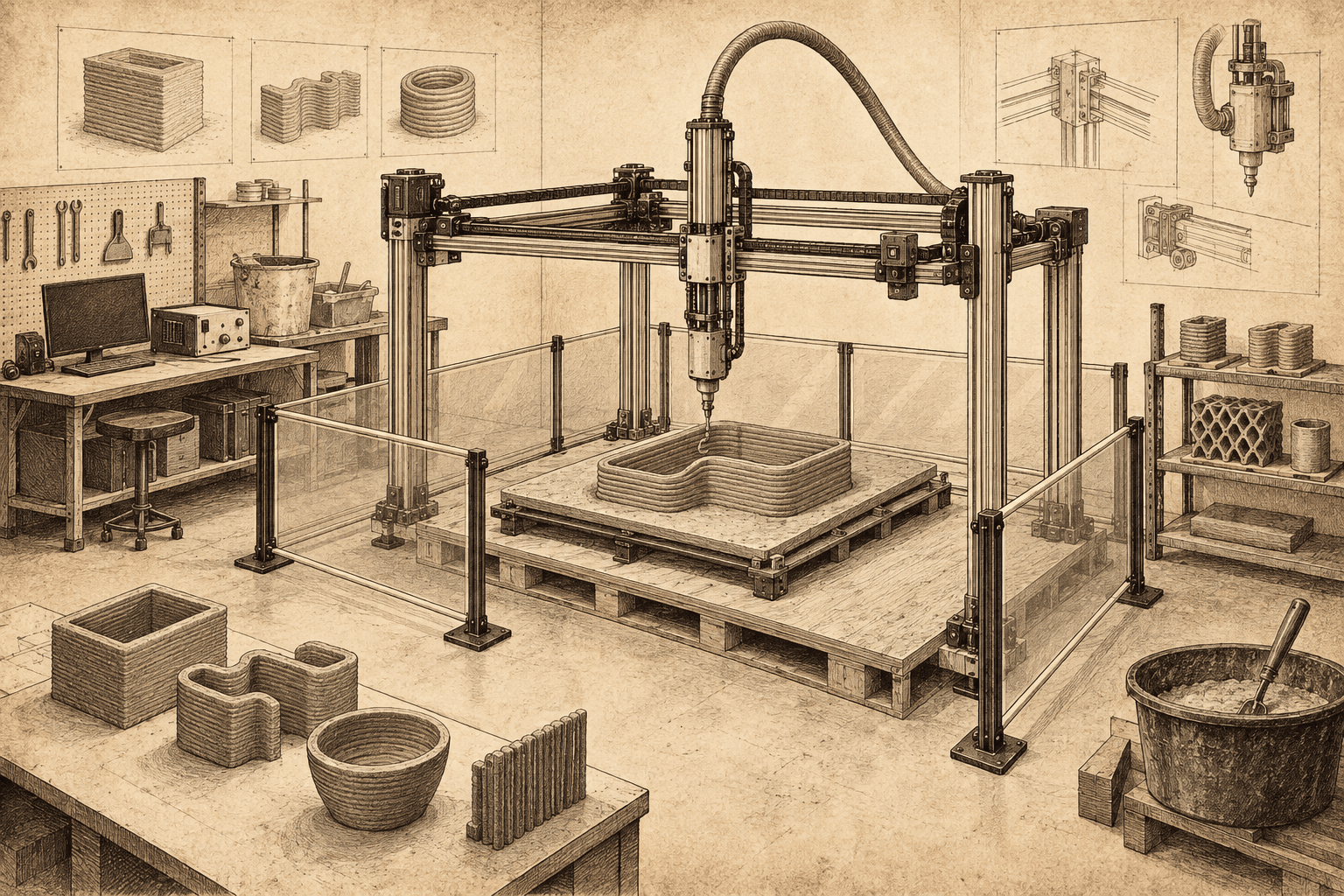
Publishes a pallet-scale cartesian motion reference, CAD, BOM, and low-voltage controls for supervised cementitious-extrusion research while explicitly excluding certified structural use.
Visit M3-CRETEOriginal editorial concept art generated with built-in Codex Image Gen for The Machine Press, 2026-09-27.
Turns a bare ESP32-S3 touchscreen into a USB-connected desk instrument for PC activity and optional room temperature, humidity, and light measurements.
Visit DeskNodeOriginal Codex Image Gen concept art from 2026-07-10; carried forward from the validated 2026-09-26 edition.
Desk Picks are selected by the newsroom. Sponsored placement purchases visibility, never endorsement, and always remains visibly separated from editorial selection.
 Editorial illustration