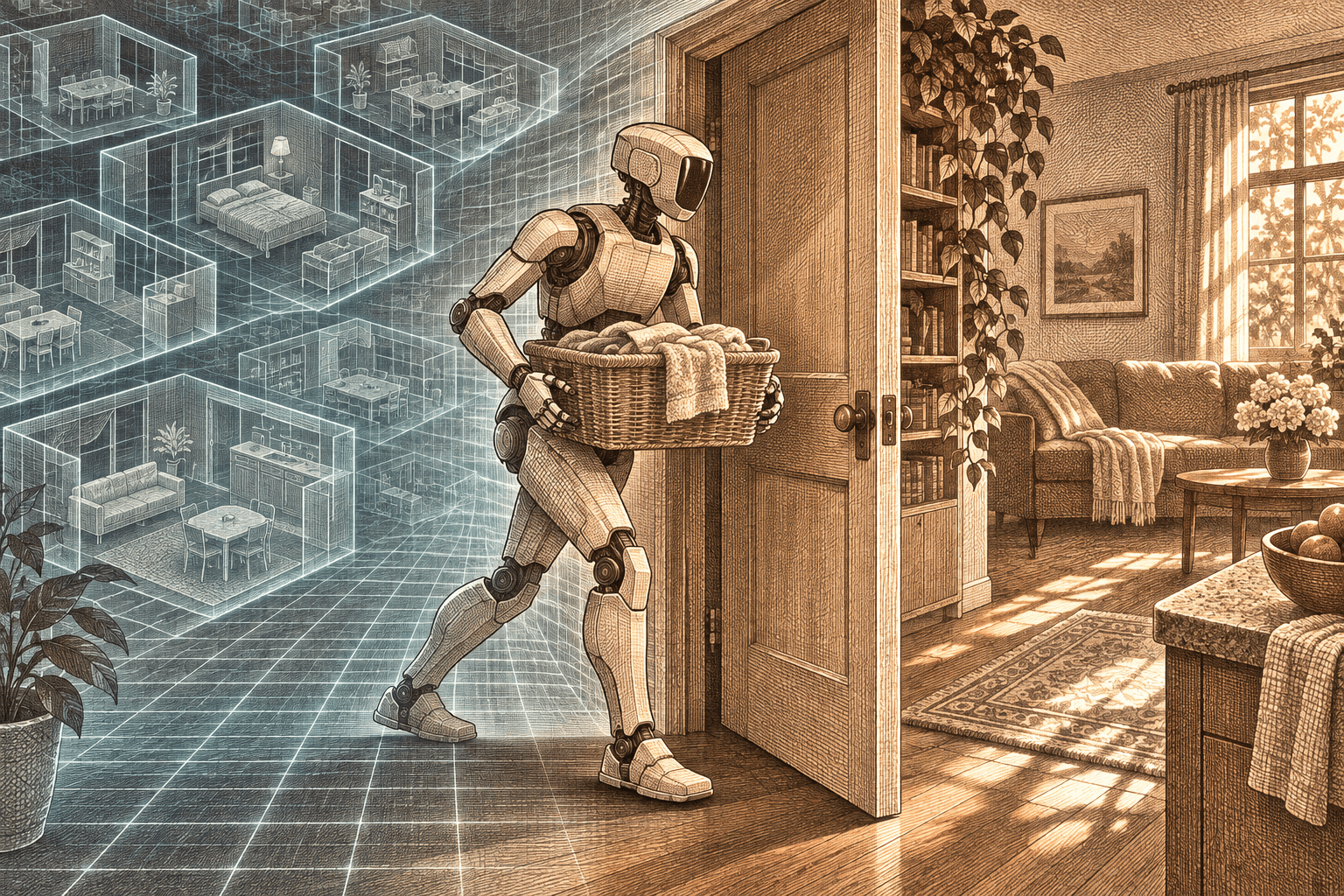
HALO trains vision-language-motion control across a thousand generated homes, then transfers to six unmapped physical environments without real-home training.
Editorial illustration
Editorial concept illustration of HALO's simulation-to-reality training path; it is not a documentary robot, trial image or product claim. Generated with built-in Codex Image Gen for The Machine Press.
Generalist humanoid control needs paired images, language and low-level motion, but collecting that supervision through teleoperation consumes human time one hour at a time. HALO replaces that bottleneck with a procedurally generated corpus spanning a thousand simulated homes. The system learns individual skills including sitting, moving to named objects, squeezing through half-open doors, crouching beneath tables and pushing boxes, then composes them into longer tasks. In 360 physical trials across six unmapped real environments, the authors report 91 percent success without training in a real home. That is a result from the paper's robots, scenes and task definitions—not evidence that a household humanoid can handle arbitrary homes—but it makes the simulation-to-reality claim unusually concrete.
Editorial concept illustration of the classified dimension-six measurement landscape; it is not an experimental apparatus or literal mathematical figure. Generated with built-in Codex Image Gen for The Machine Press.
A topological classification maps every mutually unbiased triple in dimension six and independently proves that none can be extended to four bases.
Mutually unbiased bases describe complementary quantum measurements: certainty in one basis reveals nothing about outcomes in another. Dimension six has resisted a complete classification for more than three decades. The new proof treats transition matrices between bases as a topological space. Except for Tao's matrix, the authors show that the order-six complex Hadamard matrices form one connected space. That connectedness reduces the search to finitely many overlapping phase regions that can be certified with interval arithmetic. Every triple then falls either into a two-parameter family or one isolated Fourier-based case, and none admits a fourth basis. The paper says this independently reaches a recently reported impossibility result while adding a full classification. Dimension six becomes the first non-prime-power dimension whose complete sets of mutually unbiased bases are known.
TASC finds models often calculate elapsed time correctly without applying the safety rule that depends on it.
The benchmark contains 3,418 conversational inputs derived from 128 templates plus 33 scenarios that separate time calculation from action. Across 13 models, assistants account for time-dependent constraints in 30.5 percent of cases where the requested action violates a rule, while seldom warning unnecessarily. In 62.1 percent of failures, the model had calculated the elapsed time correctly. Supplying timing explicitly fixes only about half. TASC is a benchmark of templated everyday constraints, but it exposes a practical gap between temporal reasoning and advice.
Conceptual Visualising AI artwork by Tim West, used illustratively; it is not NEO-VLA, a model diagram, robot scene or evaluation result. Tim West / Google DeepMind / Pexels; cropped, resized, metadata stripped, and converted to WebP by The Machine Press.
NEO-VLA lets robot control read evolving visual computation at multiple depths instead of inheriting one fixed encoder output.
The encoder-free design tokenizes images with lightweight patch convolutions and evolves vision jointly with language through the backbone. A flow-matching action expert can draw from instruction-conditioned visual representations at different depths. Controlled comparisons favor the native architecture over encoder-based counterparts, and full fine-tuning or extra scale narrows but does not erase the gap. Layer probes place some action-critical signals before the final visual representation. These are results across the paper's manipulation settings and distribution shifts, not a universal verdict against visual encoders.
A public DR4-like catalog injects more than 15 million null, one-companion and two-companion systems to stress-test astrometric orbit fitting.
The epochalypse catalog starts from 5,040,328 main-sequence stars within 500 parsecs and creates three matched scenarios for each. Injected companions span Mars to 80 Jupiter masses and 0.03 to 100 astronomical units without imposing an occurrence model or detectability cut. A demonstration with an astrometric periodogram finds that beyond the mission baseline, significant curvature can reveal a companion while leaving its period—and therefore mass—poorly constrained. This is a synthetic benchmark for future Gaia DR4 pipelines, not a count of detected planets.
cuRoboV2-Fast combines B-spline optimization, differentiable inverse dynamics and traversal-time optimization for payload-aware motion.
With a three-kilogram payload on an RTX 5090, the authors report 4.4 milliseconds mean planning time, 14.7 times faster than cuRoboV2. Their Jetson AGX Orin implementation also plans faster than a cuRoboV1-plus-TOPPRA baseline running on an RTX 5090. In stereo-camera deployment on YAM, mean completed pick-and-drop cycles take 5.93 seconds, 34.6 percent shorter than cuRoboV2. The results concern the tested planner, hardware, payload and tasks; they do not establish collision-free performance for every robot or scene.
FlowReconBench puts ten learned and five classical reconstruction methods on common splits, sensors, calibration measures and cost accounting.
The leading method changes with the flow regime. Classical linear estimators lead on a cylinder wake and recover unobserved pressure; inverse-distance weighting matches the best learned methods on observed channels in large three-dimensional turbulence. Learned systems pull ahead as sensors become sparse or poorly informative. The benchmark also finds that point error and probabilistic calibration can rank models differently, while full-grid methods hit memory limits that queryable methods avoid. The paper evaluates three controlled regimes, so it supplies a comparative map rather than one universal reconstruction champion.
BEAKER tests 28 multimodal models on 1,000 expert-authored image and video questions for self-driving chemical laboratories.
Eleven task types cover affordance grounding, trajectories, apparatus, state and safety recognition, setup, operation and temporal procedure reasoning. Chemistry and embodied-AI experts created and reviewed every item without AI-assisted annotation. Current models handle coarse procedures in video better than operable regions, feasible paths, fine-grained apparatus and safety norms, and mid-length step ordering. BEAKER is an offline, single-turn benchmark; it diagnoses gaps in laboratory actionability rather than demonstrating a robot running experiments.
Generic laboratory-glassware file image used illustratively; it is not a FrontierPhysics task, experiment, agent output or benchmark result. Rodolfo Clix / Pexels; cropped, resized, metadata stripped, and converted to WebP by The Machine Press.
FrontierPhysics asks agents to complete 56 end-to-end research tasks authored by 42 physicists, then scores correctness and publishability.
Each task spans literature review, planning, analysis or experiment, structured output and a scientific manuscript. The benchmark covers nine theoretical, computational and experimental domains and combines deterministic checks with expert-written rubrics. Across 22 models in 26 configurations, no configuration passes more than 46 of 168 rollouts. Manual trajectory review attributes the largest deficits to rigor and expert intuition rather than missing physics knowledge or tool execution. The benchmark measures the supplied research tasks, not autonomous discovery in every scientific field.
A structured study finds online reinforcement learning can raise performance across many deployment tasks and sometimes transfer gains to held-out tasks.
The authors vary value estimation, policy extraction, resource allocation and the training-task distribution around a generalist robot foundation policy. Their results show simultaneous improvement across diverse tasks, with gains on tasks excluded from online training under the right recipe. Value-based reinforcement learning and a sufficiently broad training distribution are central to that transfer. The work provides evidence for multi-task online improvement in the evaluated system; it does not show open-ended self-improvement or guaranteed transfer to arbitrary robots.
A fixed 60.8-gigahertz communication link classifies pace and direction from motion-shaped power fades without dedicated radar hardware.
Three participants made 144 perpendicular and diagonal crossings through a wall-reflected millimeter-wave link. Fade duration supplies walking-pace features, while asymmetry before and after the fade carries direction. Under leave-one-participant-out validation, logistic regression reaches 86.1 percent for binary pace, 79.2 percent for three pace classes and 77.1 percent for travel direction. The experiment uses continuous-tone signals and a small participant set, so it demonstrates feasibility rather than production-grade occupancy sensing.
A training-free score detects occlusion when apparent human height and monocular depth disagree.
A person's detected box can retain full apparent height while a depth map is pulled toward the nearer occluder. The method needs only the ordering of those cues, not focal length, true stature or calibrated depth scale. It reports 0.909 AUC for heavy occlusion on KITTI and remains strong inside fixed distance bands, while distance alone sits near chance. Synthetic CARLA scenes produce 0.819 AUC. The authors also document cross-region detector degradation, but these results do not eliminate missed detections or establish performance on every camera and city.
MCP-Eco links server projects, consumer configurations, declared interfaces and repository activity across 19 Parquet tables.
The frozen release contains 16,880,899 records covering 78,302 candidate server projects, 16,165 candidate consumer repositories and 9,200 configuration declarations. Matching resolves 5,975 declarations into 5,138 distinct repository-server pairs. Provenance separates directory claims from live probing and records how declarations were matched. The public dataset enables ecosystem research and schema inspection, but its use of candidate projects and inferred links means the numbers are not a census of verified, active or safe MCP deployments.
NASA OSAM-1 hardware used illustratively; it is not a VABAR task, simulated robot, reference skill or benchmark result. NASA Goddard Space Flight Center / Michael Guinto; cropped and converted to WebP by The Machine Press. Use does not imply NASA endorsement.
VABAR turns object-shape and pose variation into an open benchmark for code-writing robot agents.
The suite covers tool sorting, tool hanging, gear meshing, syringe packing, cable insertion and cable routing across industrial, medical and infrastructure settings. Built on open-source simulation, it includes standardized variations, difficulty tiers, success measures and 33 reusable skills with human-authored programmatic references. Initial results use a Graph-as-Policy harness and Isaac Lab Arena. VABAR is a reproducible simulation benchmark, not evidence that an agent can safely automate these tasks on a factory or clinical floor.
SpecCompact drafts structured context slots in parallel, then has the target model verify and repair each proposed line.
A small tuned drafter generates independent summary slots while the target model accepts or repairs lines and feeds the updated prefix into later work. Across AppWorld and tau-cubed with two target models, the system reports 2.04 to 5.63 times faster compaction than Hermes-style summarization. A Hermes user study records an 8.68 times median speedup. Downstream quality varies by model and task, so the result is a latency technique with measured tradeoffs, not lossless memory compression.
A controlled robot-code study separates retry gains from resampling, static guidance and feedback matched to the actual failure.
On the same 252 initial failures, Qwen2.5-Coder-7B recovers 85.3 percent within five template-guided retries, versus 68.3 percent for capped resampling. Yet feedback borrowed from other episodes and fixed task guidance produce similar point estimates, with no detected advantage from matching the coarse failure label. A rim-grasp task even worsens when the template prescribes an incompatible center grasp. The simulation study argues that self-repair evaluations need resampling, mismatched feedback and concise static guidance as baselines.
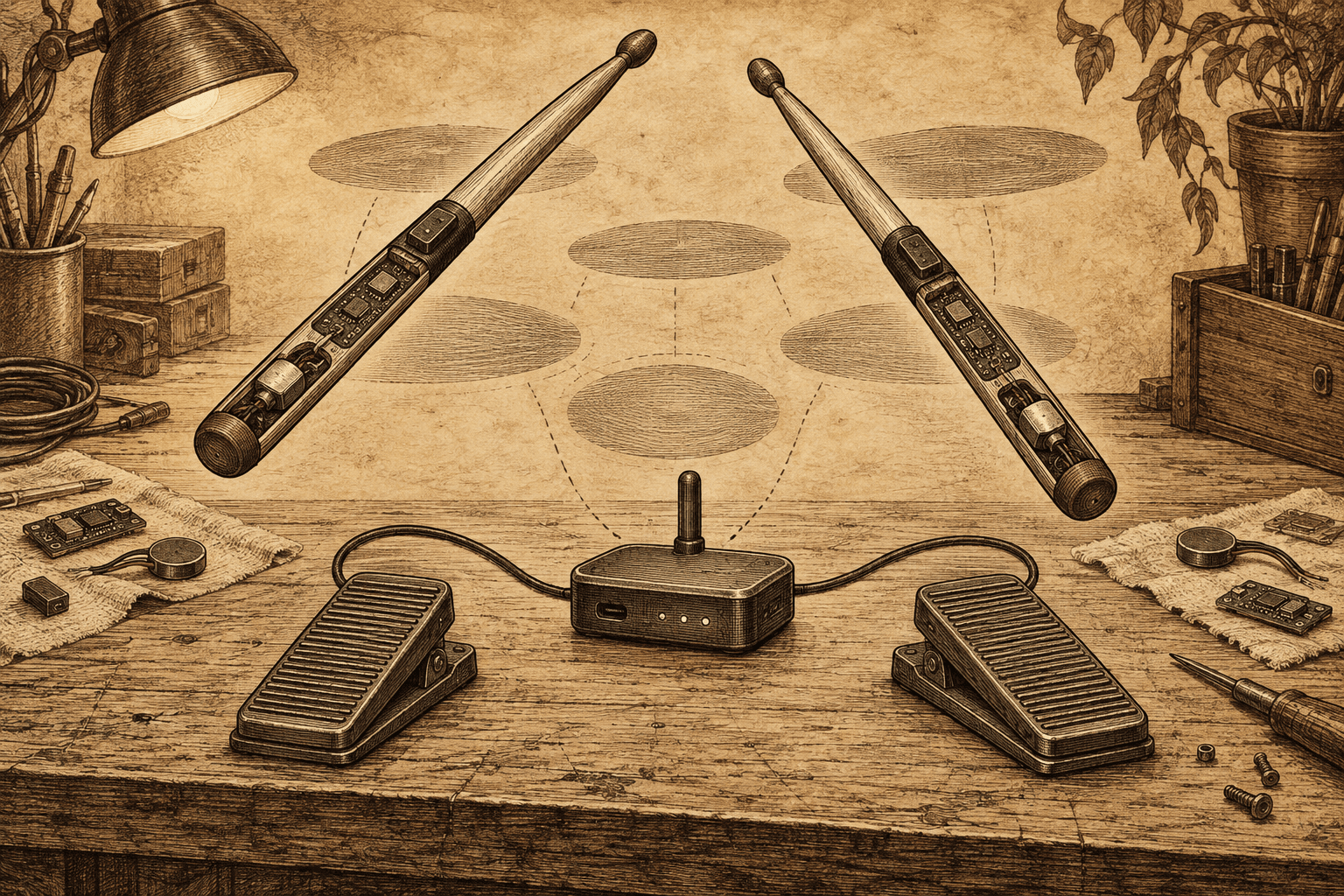
Moves motion tracking onto two ESP32-S3 drumsticks, adds haptic hits and a two-pedal hub, and sends velocity-sensitive drum events to open PC or Android playback software.
Visit Space Drums 2.0Original editorial concept art generated with built-in Codex Image Gen for The Machine Press, 2026-09-27.
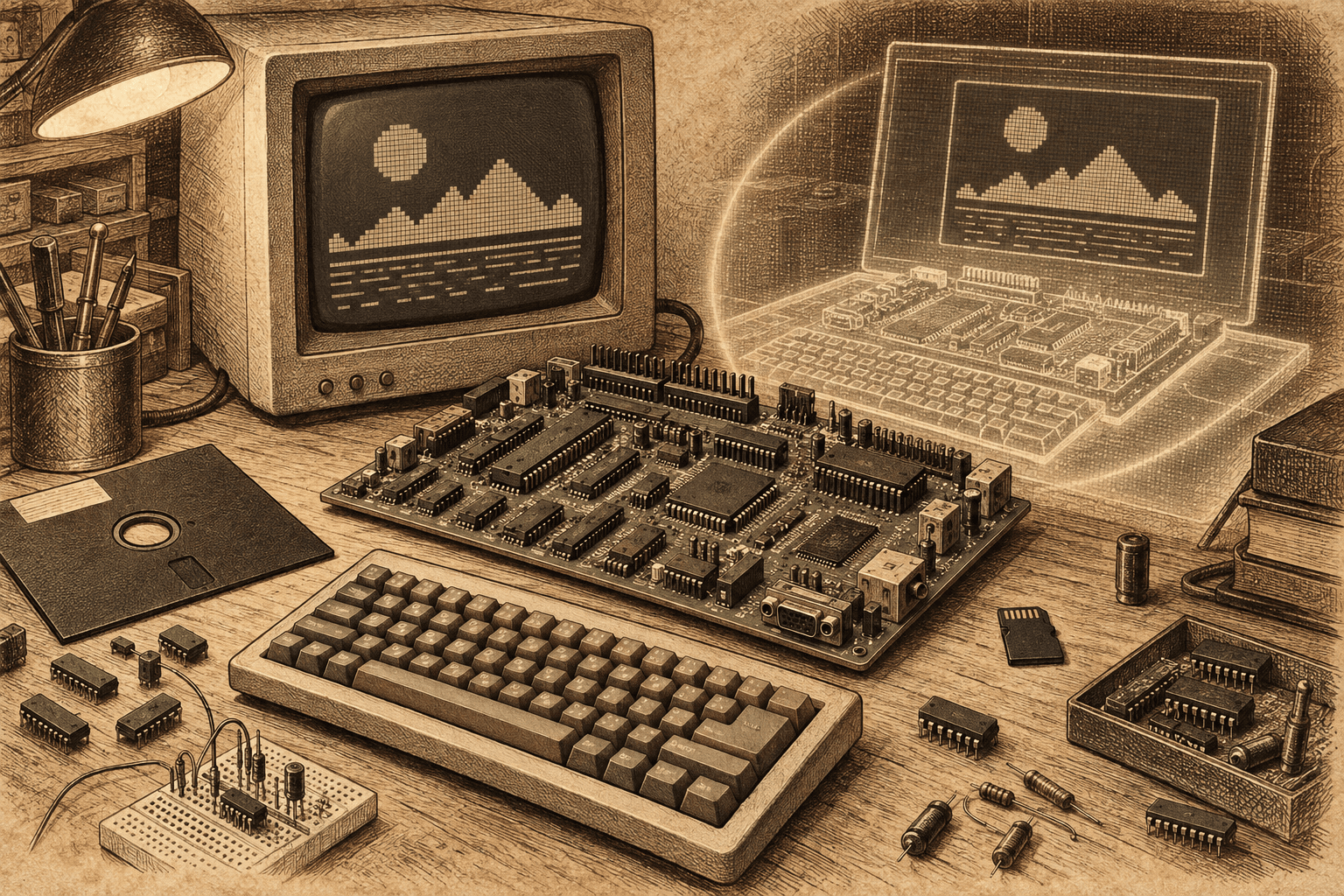
Pairs a chip-level 65C02 computer with custom hardware, video, sound, floppy, and microSD support with a cycle-honest emulator and browser assembler built around the same machine.
Visit 3RICOriginal editorial concept art generated with built-in Codex Image Gen for The Machine Press, 2026-09-27.
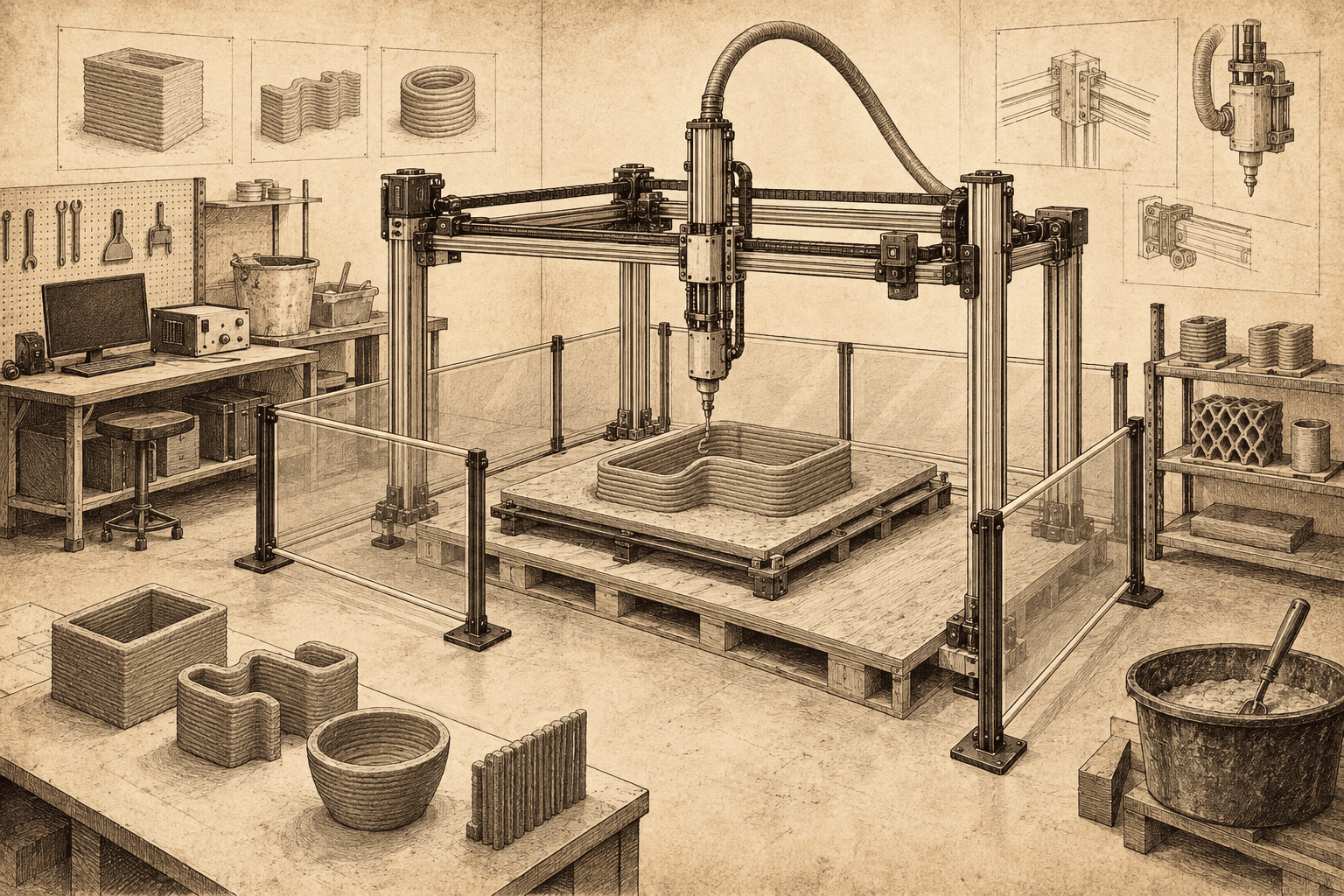
Publishes a pallet-scale cartesian motion reference, CAD, BOM, and low-voltage controls for supervised cementitious-extrusion research while explicitly excluding certified structural use.
Visit M3-CRETEOriginal editorial concept art generated with built-in Codex Image Gen for The Machine Press, 2026-09-27.
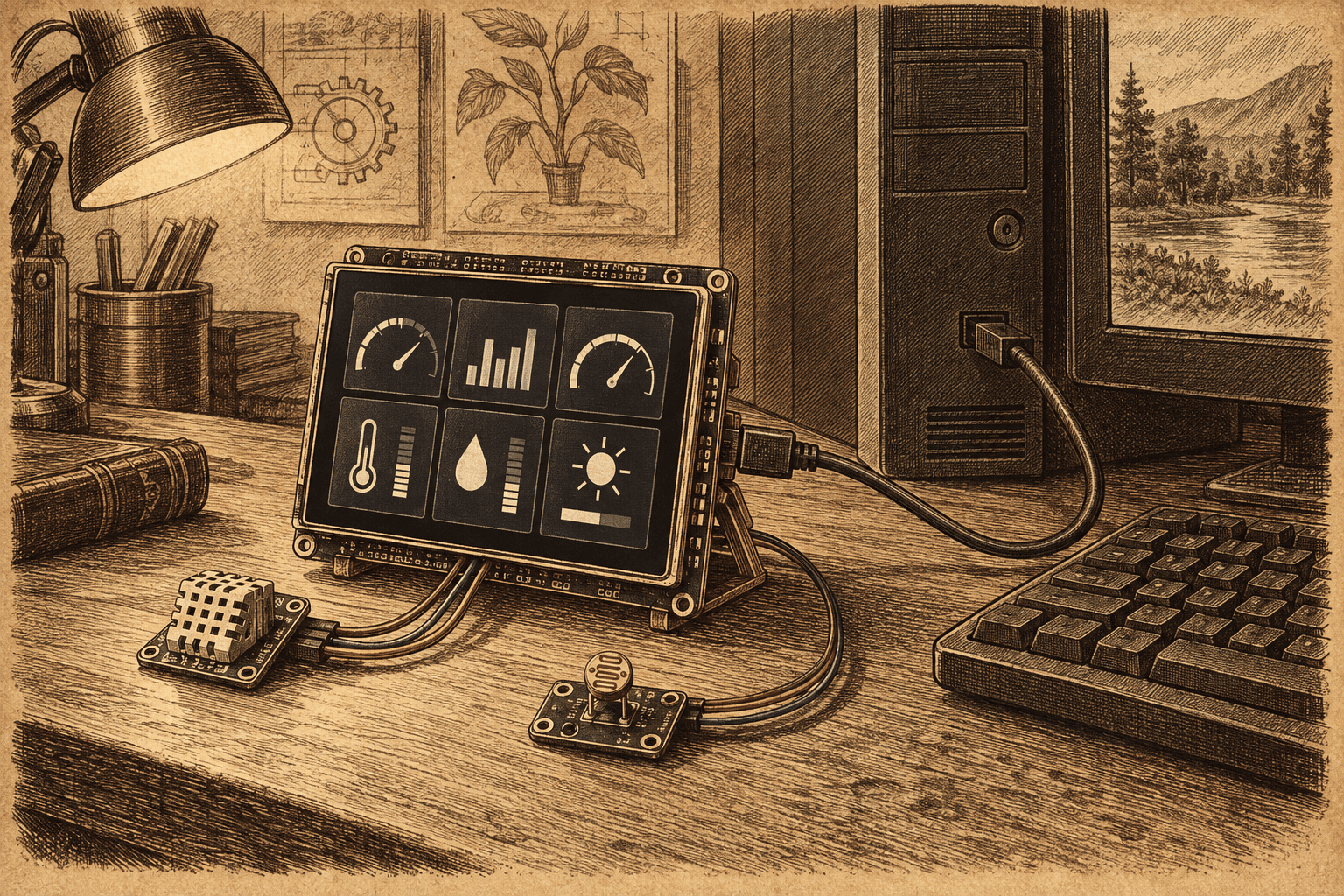
Turns a bare ESP32-S3 touchscreen into a USB-connected desk instrument for PC activity and optional room temperature, humidity, and light measurements.
Visit DeskNodeOriginal Codex Image Gen concept art from 2026-07-10; carried forward from the validated 2026-09-26 edition.
Desk Picks are selected by the newsroom. Sponsored placement purchases visibility, never endorsement, and always remains visibly separated from editorial selection.
 Editorial illustration