research
The Lab Loop Gets New Assistants
Nature pairs two independent multi-agent systems that generate hypotheses, propose experiments, interpret results, and return revised ideas to scientists.
Summary
Nature pairs two independent multi-agent systems that generate hypotheses, propose experiments, interpret results, and return revised ideas to scientists.
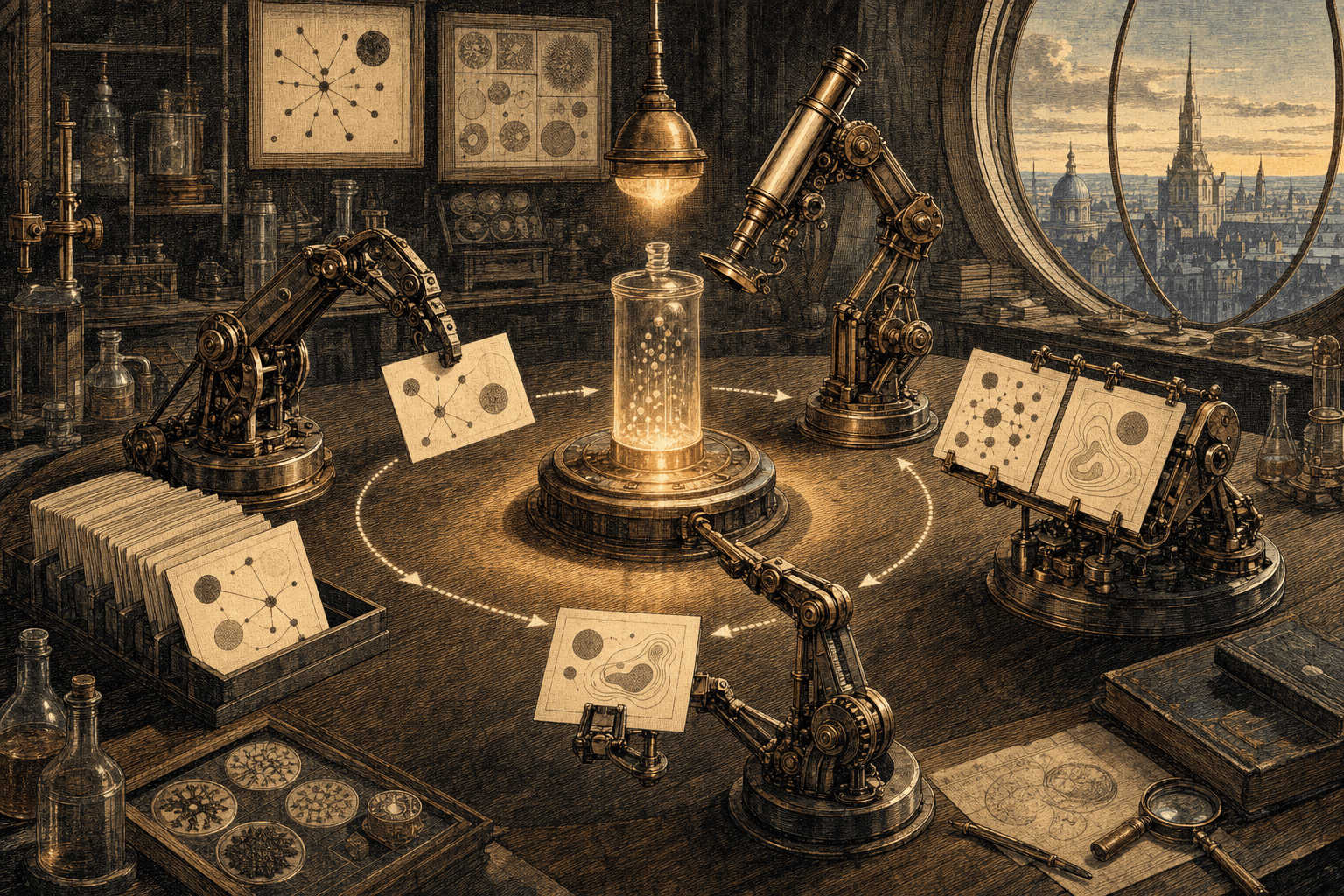
Nature's July 9 issue places two agentic science systems side by side. Google DeepMind's Co-Scientist uses specialized Gemini-based agents to generate, critique, rank, and refine hypotheses; the paper reports expert-guided wet-lab validation across biomedical problems. FutureHouse's Robin connects literature search and data-analysis agents in a lab-in-the-loop process that identified and tested candidates for dry age-related macular degeneration. The striking result is not a machine replacing a laboratory. Both teams describe systems built around experimental validation and scientists who choose goals, constraints, and what to test next.
Why it matters
Nature pairs two independent multi-agent systems that generate hypotheses, propose experiments, interpret results, and return revised ideas to scientists.
Limits and context
- The striking result is not a machine replacing a laboratory.
Key claims
Nature pairs two independent multi-agent systems that generate hypotheses, propose experiments, interpret results, and return revised ideas to scientists.
Qualification: The striking result is not a machine replacing a laboratory.
Evidence: source-2026-07-10-002
Sources
- Nature, Volume 655 Issue 8122: Discovery channelsnature.com · primary research
Corrections
No corrections have been recorded for this story.