research
The Pigment Cells Were Sleeping, Not Gone
Researchers found dormant melanocytes inside vitiligo patches, reframing how lost pigment might one day be restored.
Summary
Researchers found dormant melanocytes inside vitiligo patches, reframing how lost pigment might one day be restored.
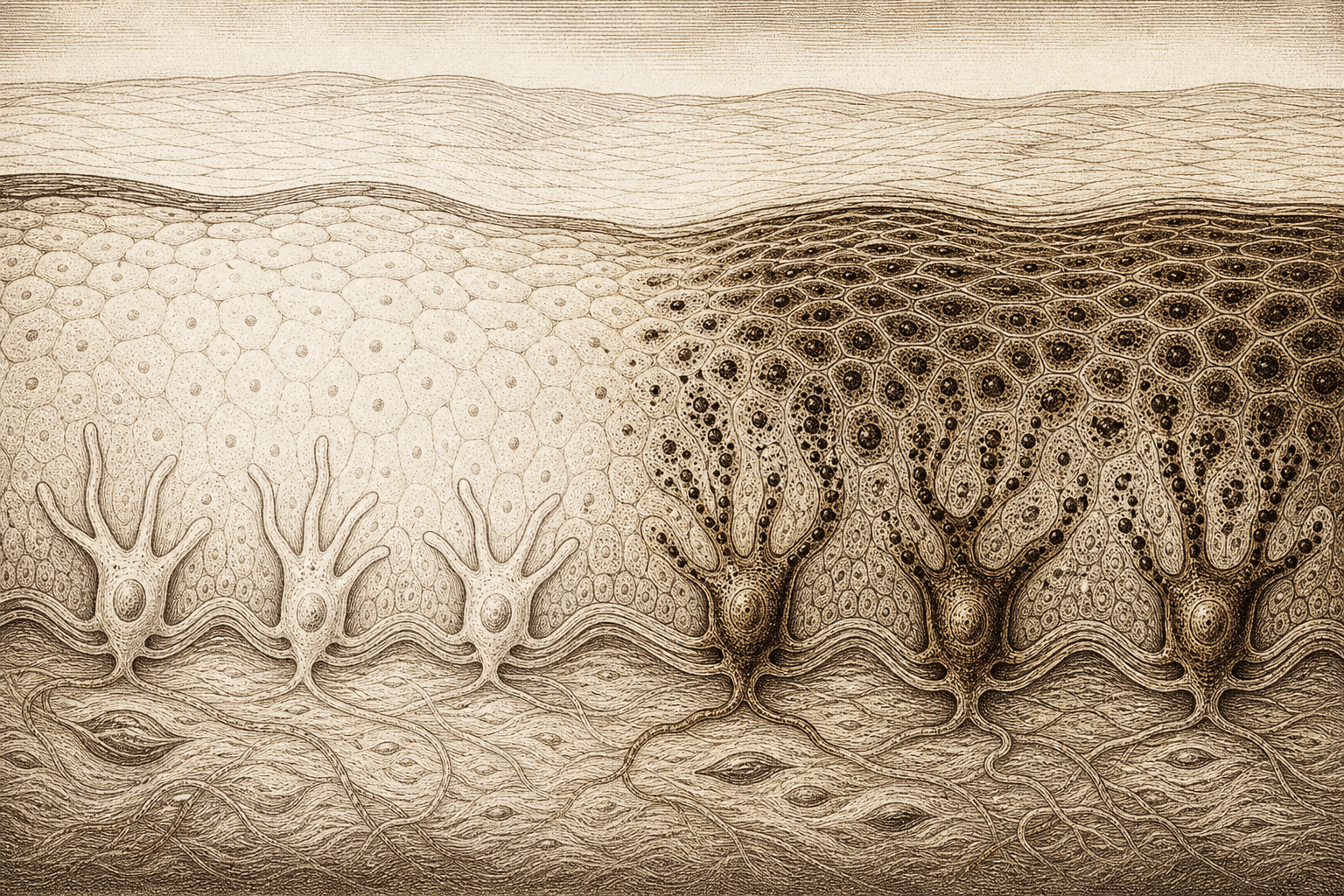
Osaka Metropolitan University researchers report that melanocytes can persist inside vitiligo lesions after losing their mature, pigment-producing state. Their tissue and cell experiments link the change to remodeling of the basement membrane: laminin-332 and integrin signaling activate c-Jun and push cells toward dedifferentiation. Blocking that pathway restored pigment-related features in laboratory work. The finding suggests a route for future therapies, but it is not a clinical treatment and does not show that every lesion retains recoverable cells.
Why it matters
Researchers found dormant melanocytes inside vitiligo patches, reframing how lost pigment might one day be restored.
Limits and context
- Blocking that pathway restored pigment-related features in laboratory work.
- The finding suggests a route for future therapies, but it is not a clinical treatment and does not show that every lesion retains recoverable cells.
Key claims
Researchers found dormant melanocytes inside vitiligo patches, reframing how lost pigment might one day be restored.
Qualification: Blocking that pathway restored pigment-related features in laboratory work.
Evidence: source-2026-07-23-001
Sources
- Osaka Metropolitan University via EurekAlert: Dormant melanocytes in vitiligoOsaka Metropolitan University via EurekAlert · official announcement
Corrections
No corrections have been recorded for this story.