research
The Brain Crosses a Cellular Line Before Dementia
Human-tissue maps place a sharp microglial state change at the transition from amyloid accumulation to tau spread, while very old resilient brains appear to take different routes around damage.
Summary
Human-tissue maps place a sharp microglial state change at the transition from amyloid accumulation to tau spread, while very old resilient brains appear to take different routes around damage.
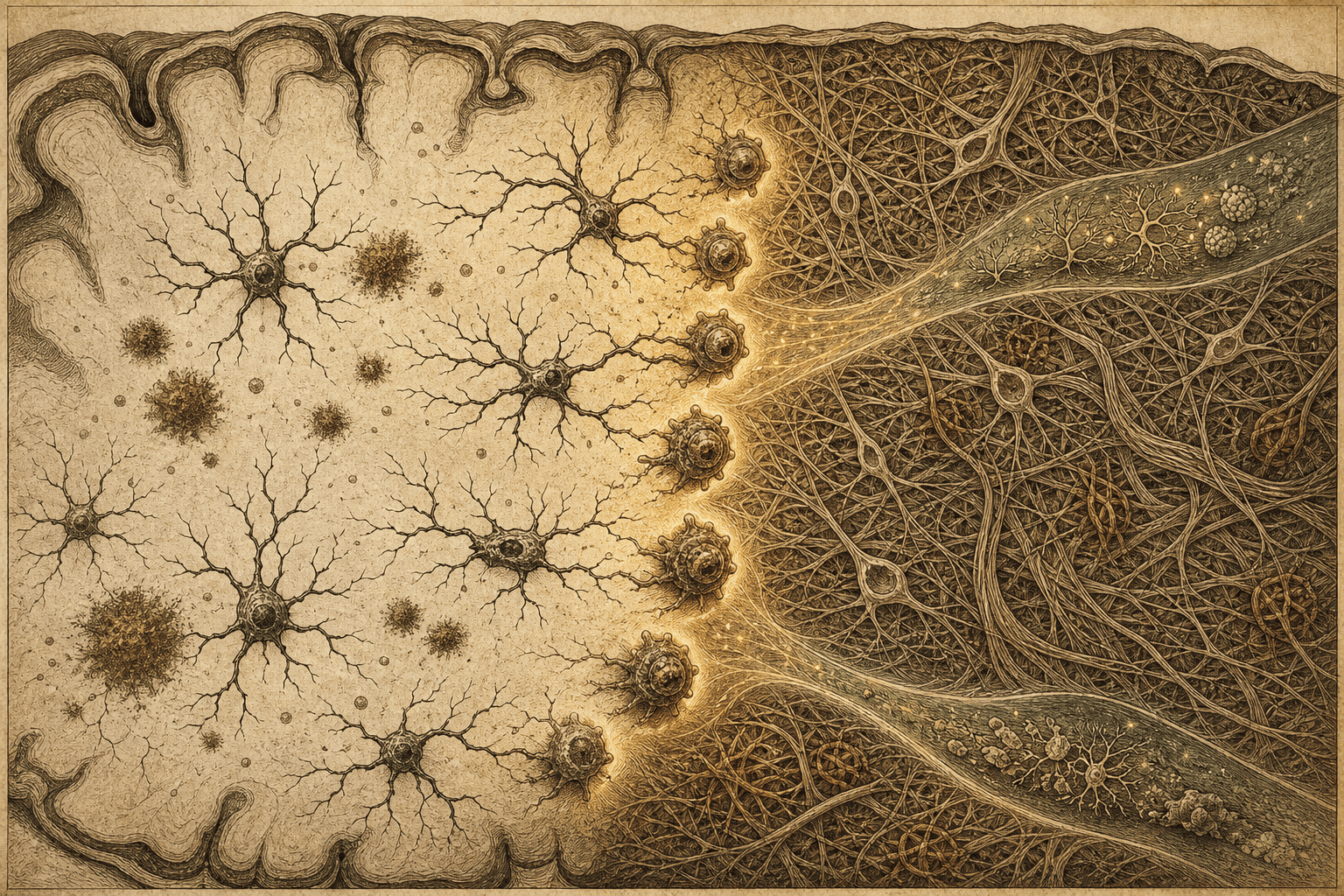
Researchers from VIB and KU Leuven combined spatial transcriptomics with single-cell analysis across donated human brains and identified six cellular neighborhoods along the Alzheimer disease continuum. They report that microglia shift from an inflammatory state toward an antigen-presenting state near the point where amyloid pathology gives way to tau pathology. Brains from resilient octogenarians and centenarians showed different cellular patterns despite pathology, suggesting more than one route to cognitive preservation. The work maps associations in postmortem tissue; it does not prove that the microglial transition causes dementia or identify a treatment.
Why it matters
Human-tissue maps place a sharp microglial state change at the transition from amyloid accumulation to tau spread, while very old resilient brains appear to take different routes around damage.
Limits and context
- The work maps associations in postmortem tissue; it does not prove that the microglial transition causes dementia or identify a treatment.
Key claims
Human-tissue maps place a sharp microglial state change at the transition from amyloid accumulation to tau spread, while very old resilient brains appear to take different routes around damage.
Qualification: The work maps associations in postmortem tissue; it does not prove that the microglial transition causes dementia or identify a treatment.
Evidence: source-2026-07-26-002
Sources
- VIB-KU Leuven via ScienceDaily: Cellular turning point in Alzheimer diseaseVIB and KU Leuven via ScienceDaily · secondary reporting
Corrections
No corrections have been recorded for this story.