robotics
The Same View Needed the Opposite Motion
EndoLIFT uses an explicit language instruction to distinguish advance from withdrawal when an endoscope camera image alone is ambiguous.
Summary
EndoLIFT uses an explicit language instruction to distinguish advance from withdrawal when an endoscope camera image alone is ambiguous.
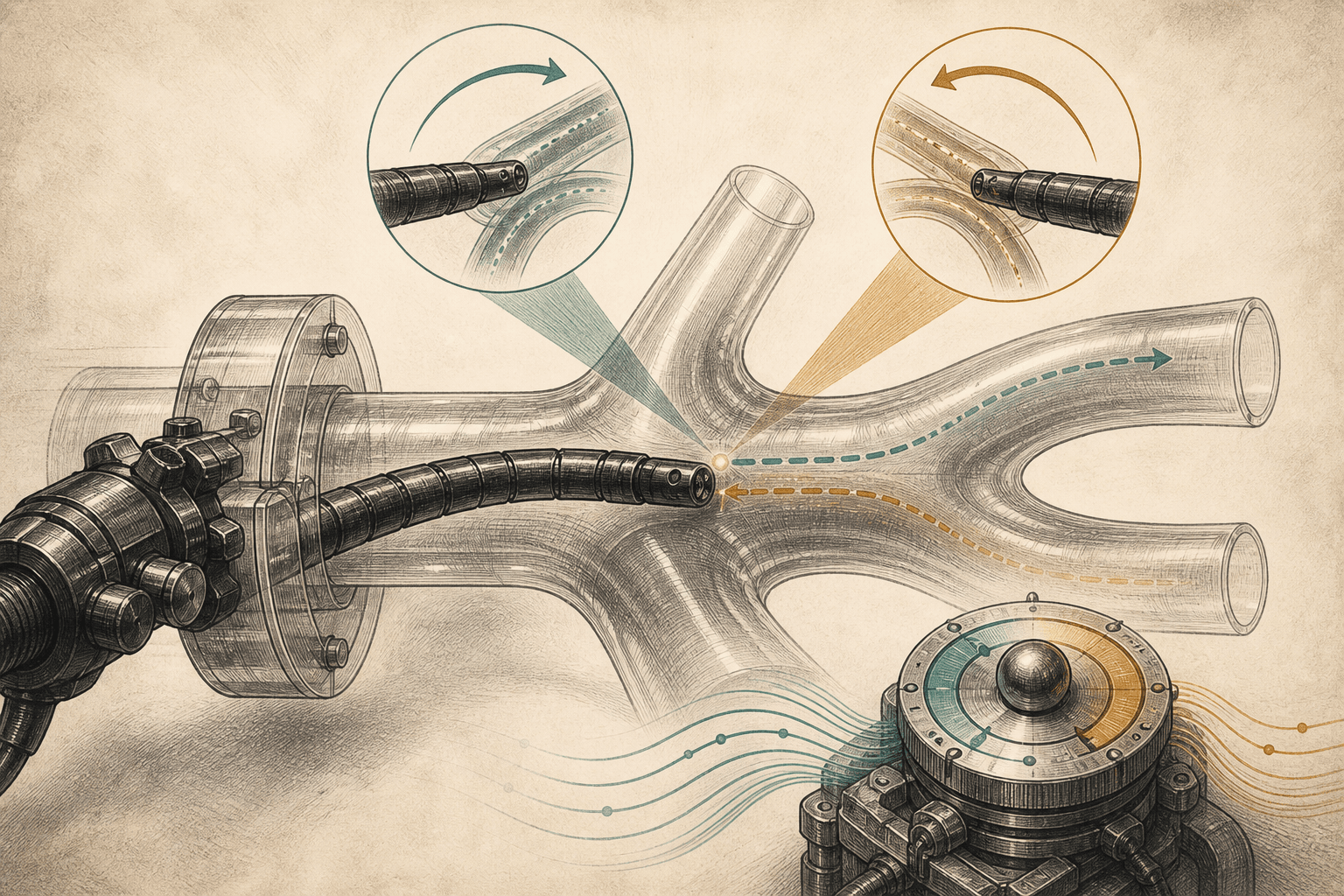
Routine endoscopy changes direction: an instrument advances toward anatomy, withdraws for inspection and may reverse early when an operator requests it. The EndoLIFT preprint calls the resulting same-view, opposite-action problem intent aliasing. Its policy conditions continuous action chunks on RGB video, prior action state, language and a learned trajectory latent. Controlled instruction swaps showed that language selected the axial direction, while the latent improved directional correctness and retraction; the system retained 82.8 percent intent-following accuracy across 44 held-out phrasings and completed ten of ten ex-vivo porcine-trachea trials. Those phantom and ex-vivo results are not human clinical validation, but they isolate why an action policy sometimes needs the operator's stated intent, not another look at the same frame.
Why it matters
EndoLIFT uses an explicit language instruction to distinguish advance from withdrawal when an endoscope camera image alone is ambiguous.
Limits and context
- Those phantom and ex-vivo results are not human clinical validation, but they isolate why an action policy sometimes needs the operator's stated intent, not another look at the same frame.
Key claims
EndoLIFT uses an explicit language instruction to distinguish advance from withdrawal when an endoscope camera image alone is ambiguous.
Qualification: Those phantom and ex-vivo results are not human clinical validation, but they isolate why an action policy sometimes needs the operator's stated intent, not another look at the same frame.
Evidence: source-2026-08-24-002
Sources
- arXiv preprint 2608.20478arXiv · primary research
Corrections
No corrections have been recorded for this story.