research
The Design Loop Ended at an External Gate
A closed-loop agent connected language models to deterministic engineering solvers, then sent its floating-wind design to a classification society.
Summary
A closed-loop agent connected language models to deterministic engineering solvers, then sent its floating-wind design to a classification society.
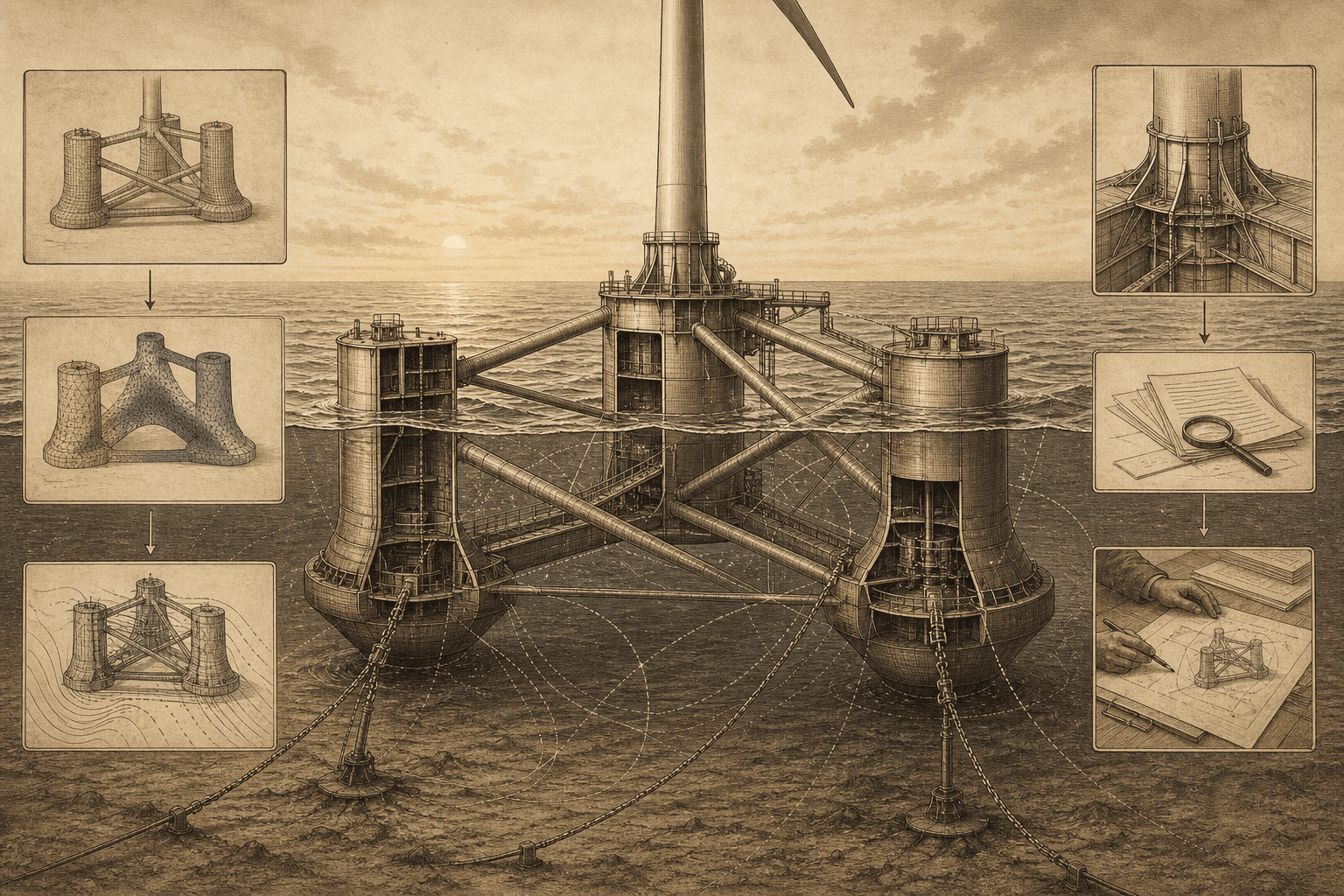
The AI Engineer turns natural-language requirements into geometry and a mesh, then couples topology and member-size searches to structural, aero-hydro-servo-elastic and cost checks. Its automated reviewer stops only when capacity, steel intensity, unit cost, constructability and fatigue scores clear stated floors. The top floating-wind support design passed China Classification Society Approval in Principle and used 8.1 percent less steel and 8.1 percent lower unit capital cost than the human-optimized TuQiang baseline. Approval in Principle is an external design-stage check, not final construction certification, and the authors list detailed design and fabrication constraints as remaining work.
Why it matters
A closed-loop agent connected language models to deterministic engineering solvers, then sent its floating-wind design to a classification society.
Limits and context
- Its automated reviewer stops only when capacity, steel intensity, unit cost, constructability and fatigue scores clear stated floors.
- Approval in Principle is an external design-stage check, not final construction certification, and the authors list detailed design and fabrication constraints as remaining work.
Key claims
A closed-loop agent connected language models to deterministic engineering solvers, then sent its floating-wind design to a classification society.
Qualification: Its automated reviewer stops only when capacity, steel intensity, unit cost, constructability and fatigue scores clear stated floors.
Evidence: source-2026-08-25-002
Sources
- arXiv preprint 2608.21976arXiv · primary research
Corrections
No corrections have been recorded for this story.