robotics
The Planner Learned to Keep the Journey Open
NavMCP couples high-level reasoning to a navigation foundation model and carries evidence, negative findings and unfinished goals across repeated trips.
Summary
NavMCP couples high-level reasoning to a navigation foundation model and carries evidence, negative findings and unfinished goals across repeated trips.
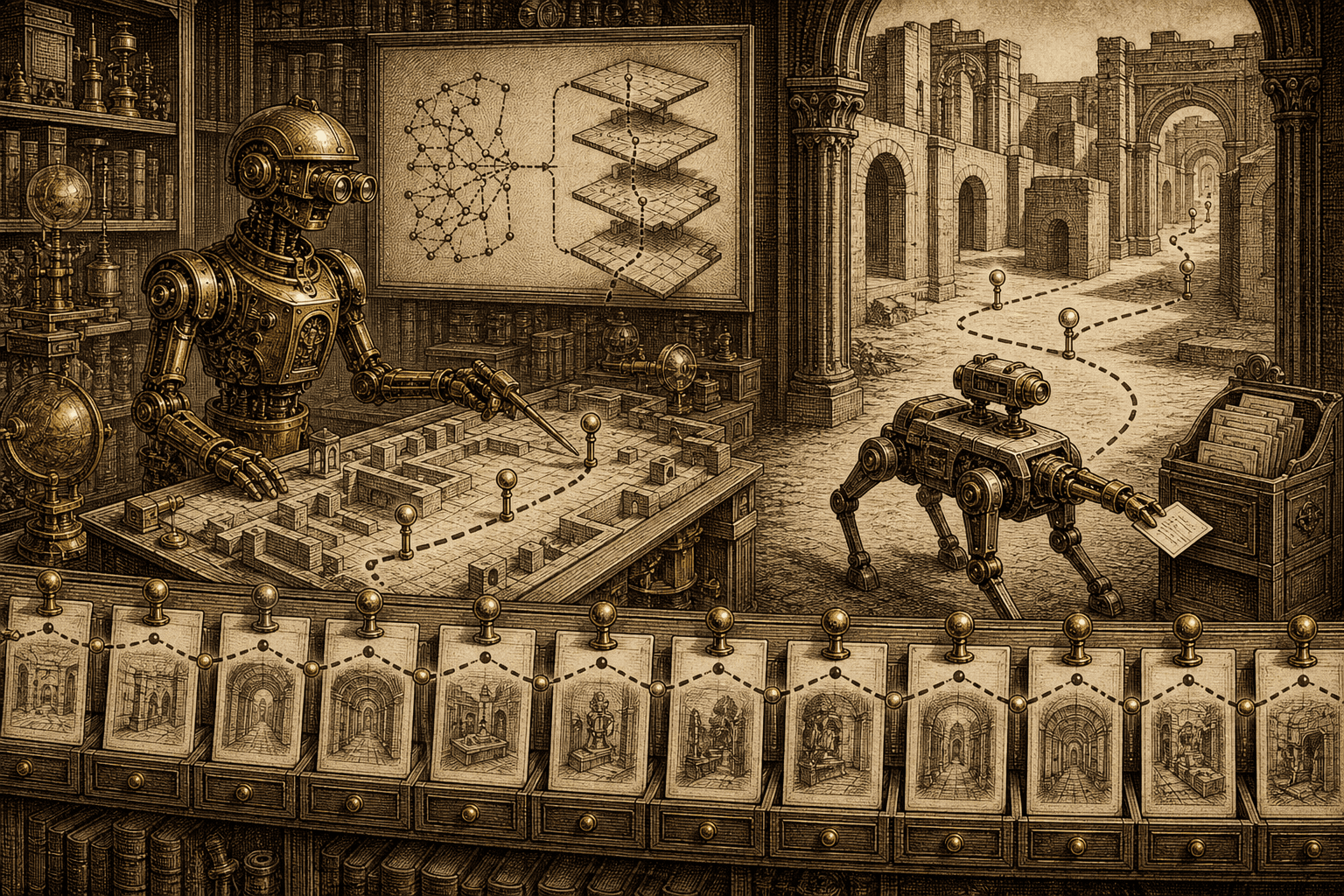
The framework assigns a vision-language model the long-horizon work of choosing evidence, search locations and stopping conditions, while a navigation foundation model executes each semantic sub-goal in a closed loop. Intent, observation and memory channels turn isolated trips into a persistent investigation without retraining either model. The authors report state-of-the-art results on three embodied-question-answering benchmarks, a 14.9-point advantage over an episodic interface on HM-EQA with matched backbones, and 78.3 percent success on a Unitree Go2. Those figures describe the paper's controlled tasks and robot setup, not general autonomous navigation.
Why it matters
NavMCP couples high-level reasoning to a navigation foundation model and carries evidence, negative findings and unfinished goals across repeated trips.
Limits and context
- Those figures describe the paper's controlled tasks and robot setup, not general autonomous navigation.
Key claims
NavMCP couples high-level reasoning to a navigation foundation model and carries evidence, negative findings and unfinished goals across repeated trips.
Qualification: Those figures describe the paper's controlled tasks and robot setup, not general autonomous navigation.
Evidence: source-2026-09-01-002
Sources
- arXiv preprint 2608.30396arXiv · primary research
Corrections
No corrections have been recorded for this story.