research
The Early Universe May Have Forged Stars Ten Thousand Suns Heavy
JWST spectra found magnesium-poor, aluminum-rich gas in Little Red Dots—the chemical fingerprint expected from extremely hot hydrogen burning.
Summary
JWST spectra found magnesium-poor, aluminum-rich gas in Little Red Dots—the chemical fingerprint expected from extremely hot hydrogen burning.
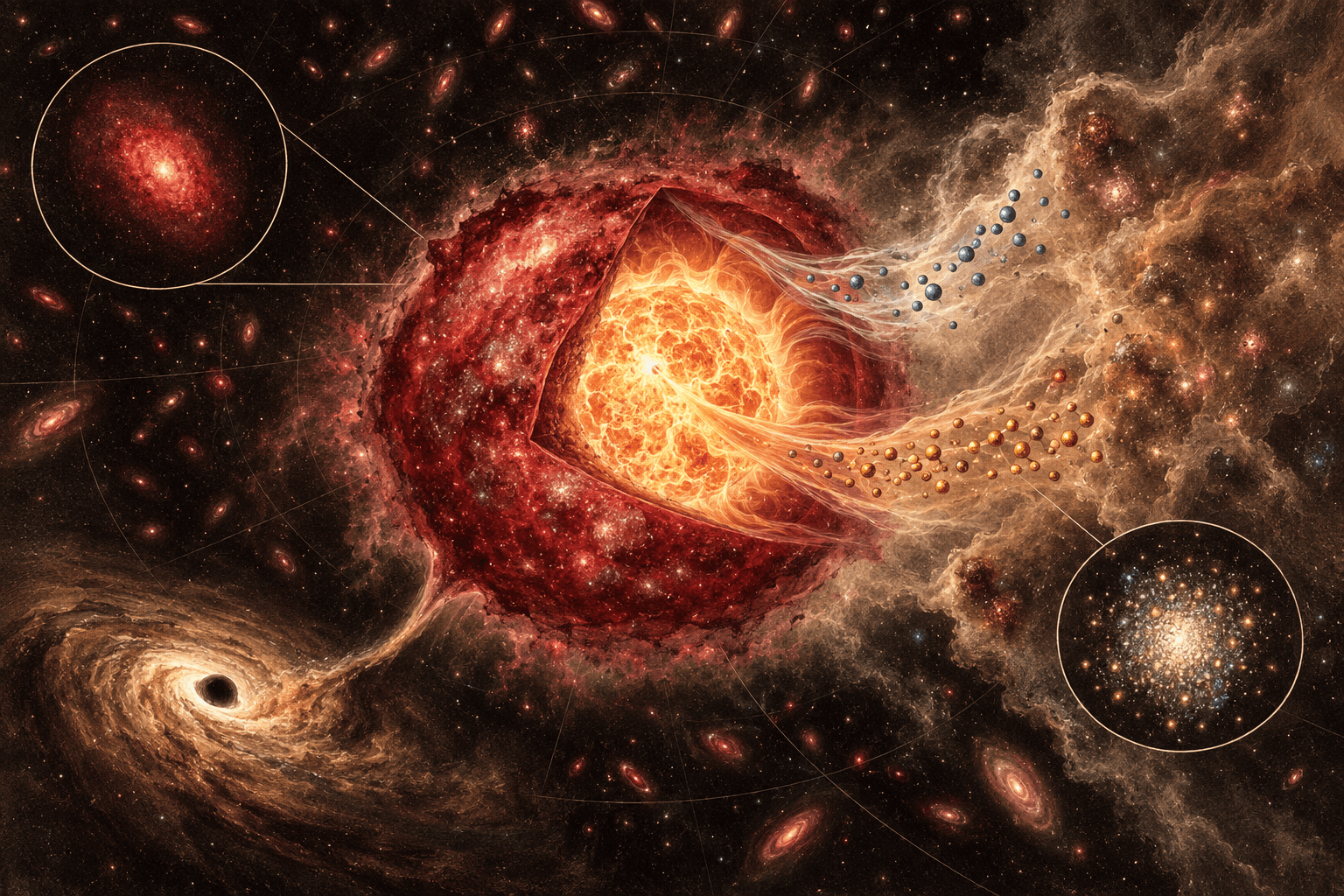
Deep SPURS spectroscopy of compact early-universe Little Red Dots found central gas depleted in magnesium and enhanced in aluminum at about one percent of the Sun’s metallicity. The authors argue that ordinary massive stars at those redshifts, along with changes in ionization, geometry or dust, cannot reproduce the reported pattern. Fully convective supermassive-star models can, and the inferred burning conditions imply objects of at least 10,000 solar masses—roughly one hundred times heavier than any star observed today. The result offers one possible bridge between globular-cluster abundance anomalies and seeds of massive black holes, but it remains an interpretation of spectra and stellar models rather than a direct image of such a star.
Why it matters
JWST spectra found magnesium-poor, aluminum-rich gas in Little Red Dots—the chemical fingerprint expected from extremely hot hydrogen burning.
Limits and context
- The authors argue that ordinary massive stars at those redshifts, along with changes in ionization, geometry or dust, cannot reproduce the reported pattern.
Key claims
JWST spectra found magnesium-poor, aluminum-rich gas in Little Red Dots—the chemical fingerprint expected from extremely hot hydrogen burning.
Qualification: The authors argue that ordinary massive stars at those redshifts, along with changes in ionization, geometry or dust, cannot reproduce the reported pattern.
Evidence: source-2026-09-10-002
Sources
- arXiv preprint 2609.09271arXiv · primary research
Corrections
No corrections have been recorded for this story.