research
One Hundred Qubits Settled a Dissipative Chain
A superconducting processor simulated 50 sites at depths up to 1,700 entangling gates and mapped 117 hardware points.
Summary
A superconducting processor simulated 50 sites at depths up to 1,700 entangling gates and mapped 117 hardware points.
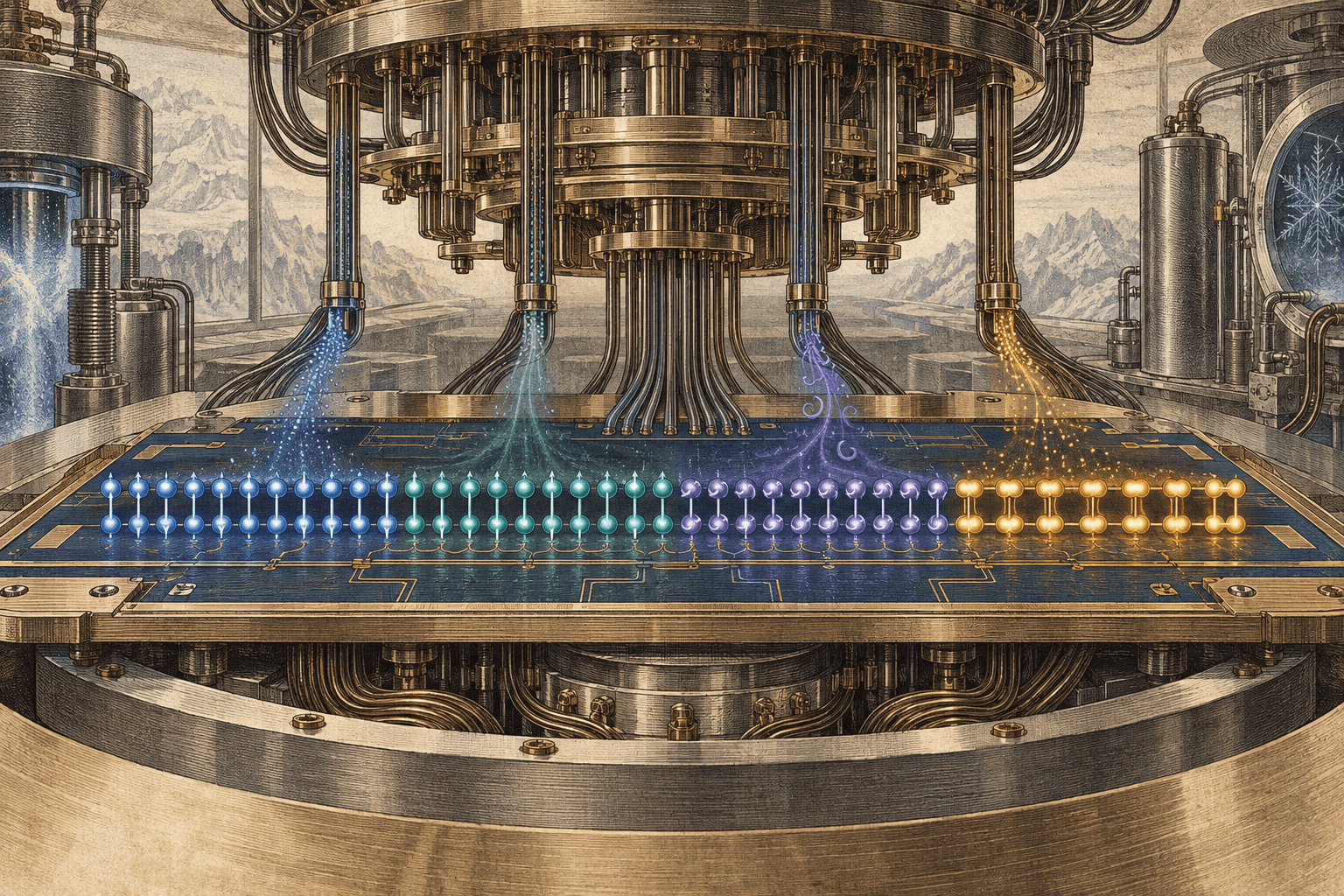
Open quantum systems can settle into steady states with no equilibrium counterpart, but their density matrices grow too quickly for controlled large-scale calculations. The team mapped a dissipative spin-1/2 Heisenberg chain onto 100 simultaneously active qubits on IBM's Kingston processor, using Stinespring dilation to represent 50 sites at entangling-gate depths up to 1,700. From 117 hardware measurements, they resolved ferromagnetic, antiferromagnetic, spin-density-wave and paramagnetic regions. Because the modeled dissipation continually erases some errors, hardware noise acts as a weaker competing bath. The result is a hardware study of one benchmark model, not a general claim of quantum advantage.
Why it matters
A superconducting processor simulated 50 sites at depths up to 1,700 entangling gates and mapped 117 hardware points.
Limits and context
- The result is a hardware study of one benchmark model, not a general claim of quantum advantage.
Key claims
A superconducting processor simulated 50 sites at depths up to 1,700 entangling gates and mapped 117 hardware points.
Qualification: The result is a hardware study of one benchmark model, not a general claim of quantum advantage.
Evidence: source-2026-09-16-002
Sources
- arXiv preprint 2609.16108arXiv · primary research
Corrections
No corrections have been recorded for this story.