robotics
The Robot Threw Faster Than 30 Meters per Second
AthenaZero moved at human timescales by cutting effective endpoint mass to roughly that of a human arm.
Summary
AthenaZero moved at human timescales by cutting effective endpoint mass to roughly that of a human arm.
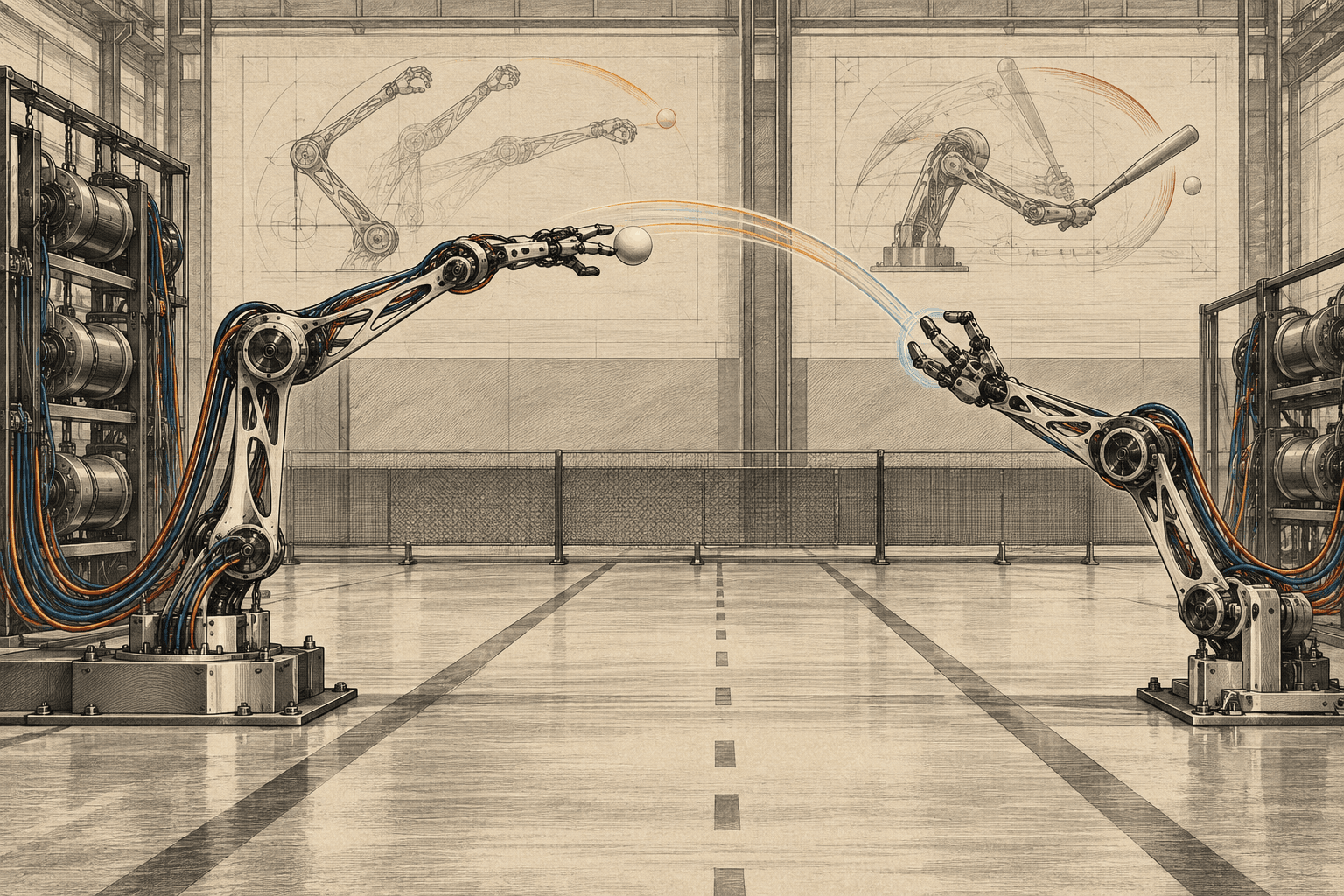
Dynamic manipulation is constrained by the mass a robot must accelerate at its endpoint. AthenaZero combines quasi-direct-drive actuation with remotely mounted transmissions to keep effective endpoint mass about an order of magnitude below conventional manipulators while retaining torque transparency. The bimanual system threw a ball above 30 meters per second and caught or batted balls moving above 14 meters per second across a 7.3-meter lane. Robot-to-robot and human-to-robot games of catch demonstrate the design's speed; the evidence is a platform paper, not a general guarantee for unstructured environments.
Why it matters
AthenaZero moved at human timescales by cutting effective endpoint mass to roughly that of a human arm.
Limits and context
- Robot-to-robot and human-to-robot games of catch demonstrate the design's speed; the evidence is a platform paper, not a general guarantee for unstructured environments.
Key claims
AthenaZero moved at human timescales by cutting effective endpoint mass to roughly that of a human arm.
Qualification: Robot-to-robot and human-to-robot games of catch demonstrate the design's speed; the evidence is a platform paper, not a general guarantee for unstructured environments.
Evidence: source-2026-09-18-001
Sources
- arXiv preprint 2609.19194arXiv · primary research
Corrections
No corrections have been recorded for this story.