research
LIGO Quieted Quantum Back-Action by 47%
Correlated measurement noise partly canceled radiation-pressure motion in the observatory’s 40-kilogram mirrors.
Summary
Correlated measurement noise partly canceled radiation-pressure motion in the observatory’s 40-kilogram mirrors.
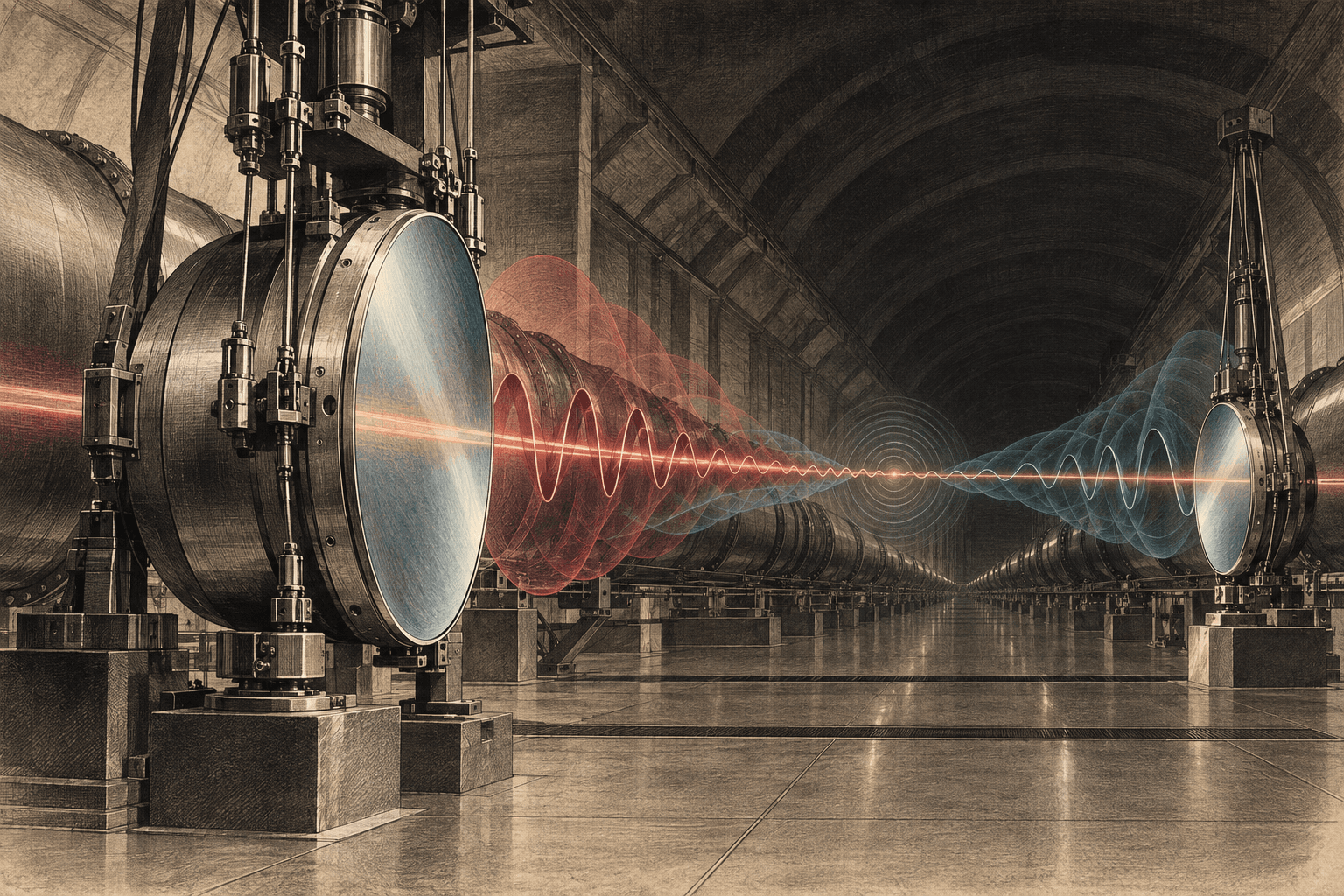
A LIGO experiment trapped the differential motion of its 40-kilogram mirrors in a sub-hertz-linewidth optomechanical mode where radiation-pressure back-action dominated. By engineering the quantum state entering the dark port, the team created correlations between readout imprecision and back-action that partly canceled their contributions, reducing observed motion near resonance by about 47%. The analysis separates the two noise terms and their correlation. This is a macroscopic demonstration of quantum back-action evasion inside a gravitational-wave detector, not a 47% improvement across LIGO’s full observing band.
Why it matters
Correlated measurement noise partly canceled radiation-pressure motion in the observatory’s 40-kilogram mirrors.
Limits and context
- This is a macroscopic demonstration of quantum back-action evasion inside a gravitational-wave detector, not a 47% improvement across LIGO’s full observing band.
Key claims
Correlated measurement noise partly canceled radiation-pressure motion in the observatory’s 40-kilogram mirrors.
Qualification: This is a macroscopic demonstration of quantum back-action evasion inside a gravitational-wave detector, not a 47% improvement across LIGO’s full observing band.
Evidence: source-2026-09-20-001
Sources
- arXiv preprint 2609.19317arXiv · primary research
Corrections
No corrections have been recorded for this story.