research
The Interstellar Comet Carried Dirty Water Ice
JWST spectra favor tiny water-ice aggregates mixed with refractory material around 3I/ATLAS.
Summary
JWST spectra favor tiny water-ice aggregates mixed with refractory material around 3I/ATLAS.
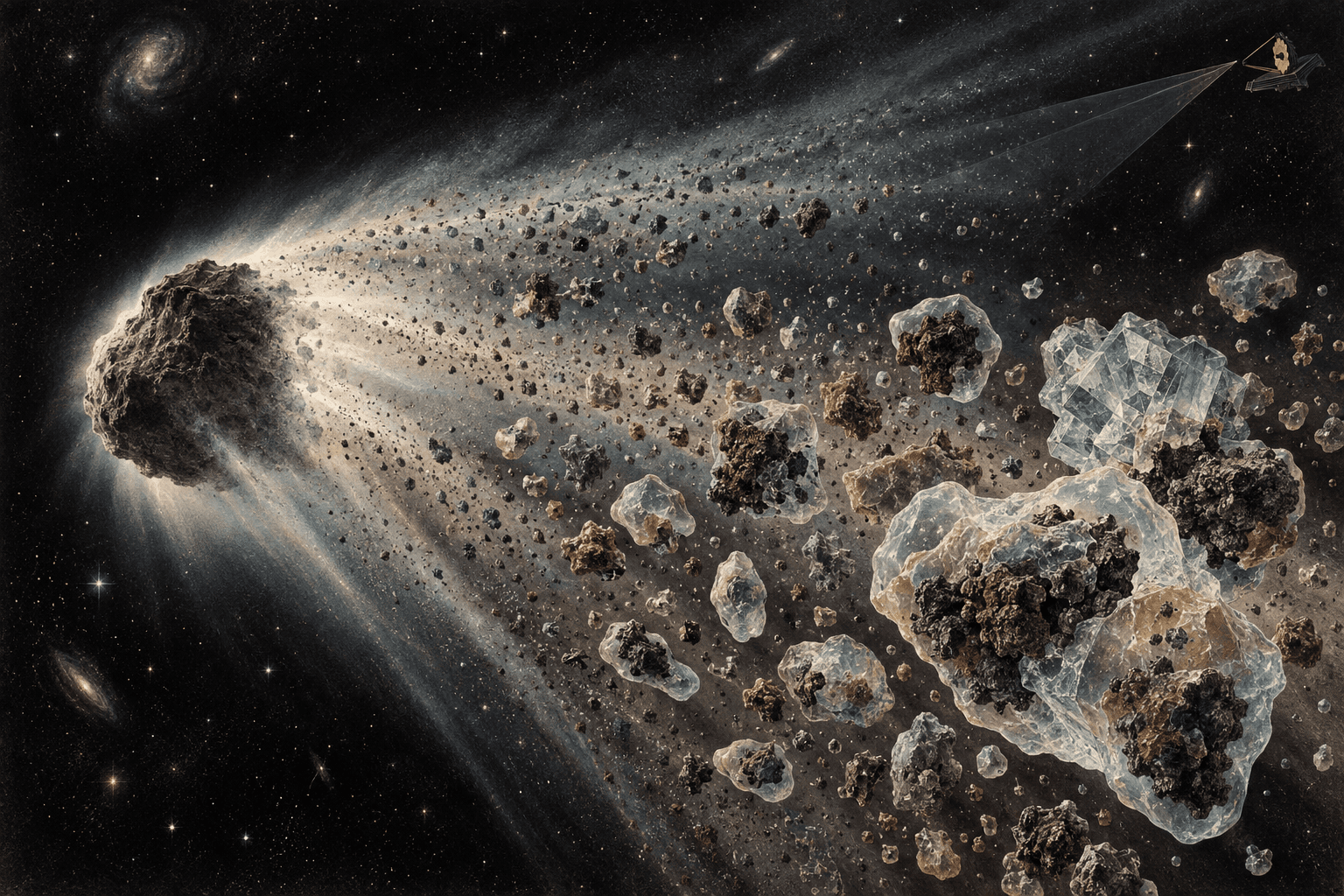
JWST/NIRSpec observed interstellar comet 3I/ATLAS at three epochs spanning eight months around perihelion. Its spectra show a broad three-micrometer absorption band together with water, carbon-dioxide and carbon-monoxide gas emission, but the shorter water-ice bands common in Solar System comae were weak or absent. Modeling favors submicron-to-micron water-ice-bearing aggregates mixed with refractory material. The final epoch also favors a second population of larger ice-rich grains and a subtle structure consistent with crystalline ice, though the authors say changing grain size and mixing can explain the evolution without requiring crystallization during the visit.
Why it matters
JWST spectra favor tiny water-ice aggregates mixed with refractory material around 3I/ATLAS.
Limits and context
No additional limitation was separately recorded.
Key claims
JWST spectra favor tiny water-ice aggregates mixed with refractory material around 3I/ATLAS.
Evidence: source-2026-09-20-002
Sources
- arXiv preprint 2609.19286arXiv · primary research
Corrections
No corrections have been recorded for this story.