research
This Planet Orbits Against Its Star’s Spin
Six transit observations put GJ3090 b on a backward path around an M dwarf.
Summary
Six transit observations put GJ3090 b on a backward path around an M dwarf.
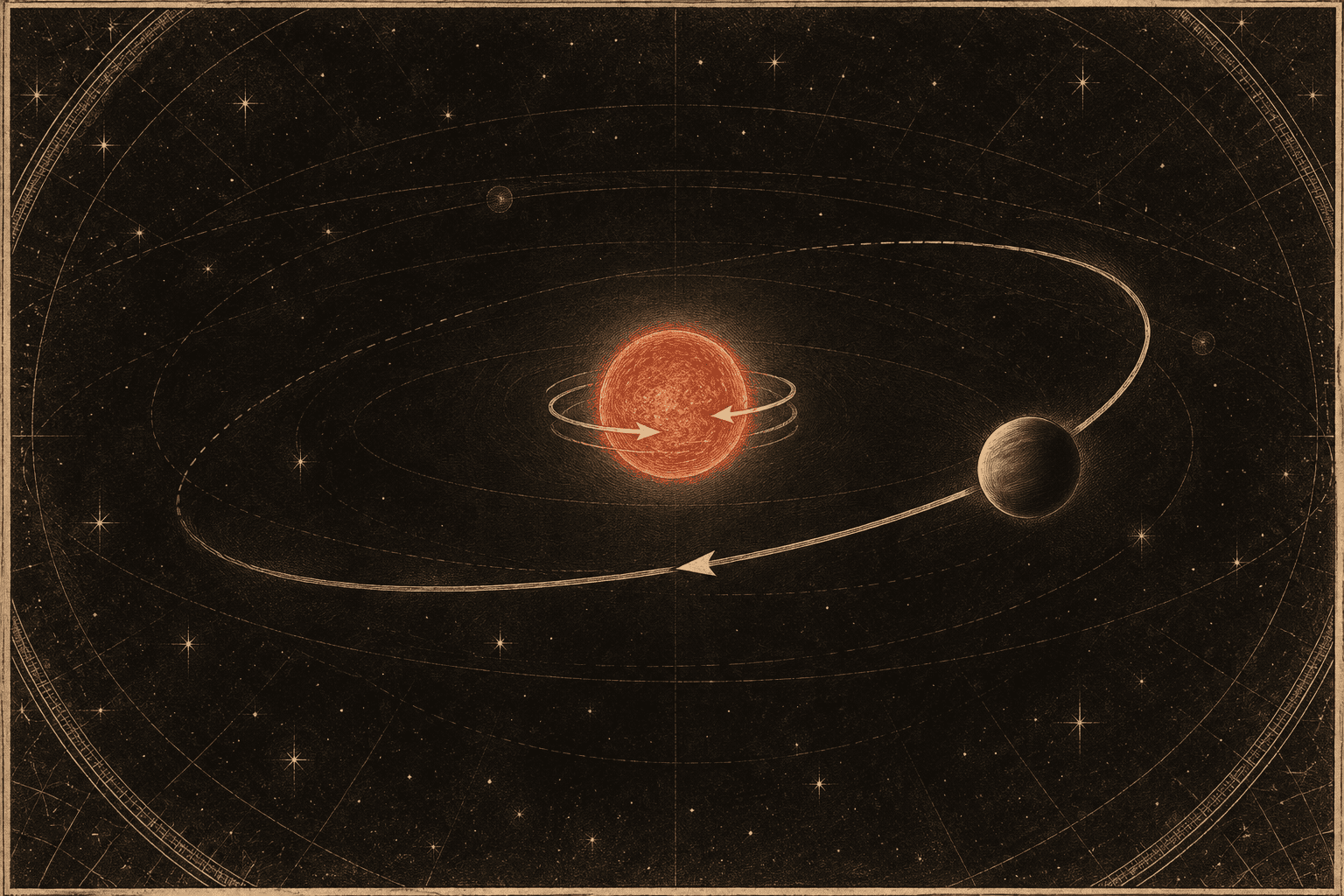
Astronomers used six transits observed with NIRPS and HARPS to measure how the sub-Neptune GJ3090 b crosses its host star's rotating face. Their Rossiter–McLaughlin analysis yields a three-dimensional orbital obliquity of 136 degrees, with an uncertainty of minus 18 and plus 24 degrees: the planet travels retrograde relative to the star's spin. The team reports no evidence of a massive outer planet or wide stellar companion and favors an initially tilted protoplanetary disk over a later gravitational shove. This is an interpretation of a measured orientation, not a direct image of the planet's path.
Why it matters
Six transit observations put GJ3090 b on a backward path around an M dwarf.
Limits and context
- This is an interpretation of a measured orientation, not a direct image of the planet's path.
Key claims
Six transit observations put GJ3090 b on a backward path around an M dwarf.
Qualification: This is an interpretation of a measured orientation, not a direct image of the planet's path.
Evidence: source-2026-09-22-001
Sources
- arXiv preprint 2609.24870arXiv · primary research
Corrections
No corrections have been recorded for this story.