robotics
The Robot Looked Before Its Hands Moved
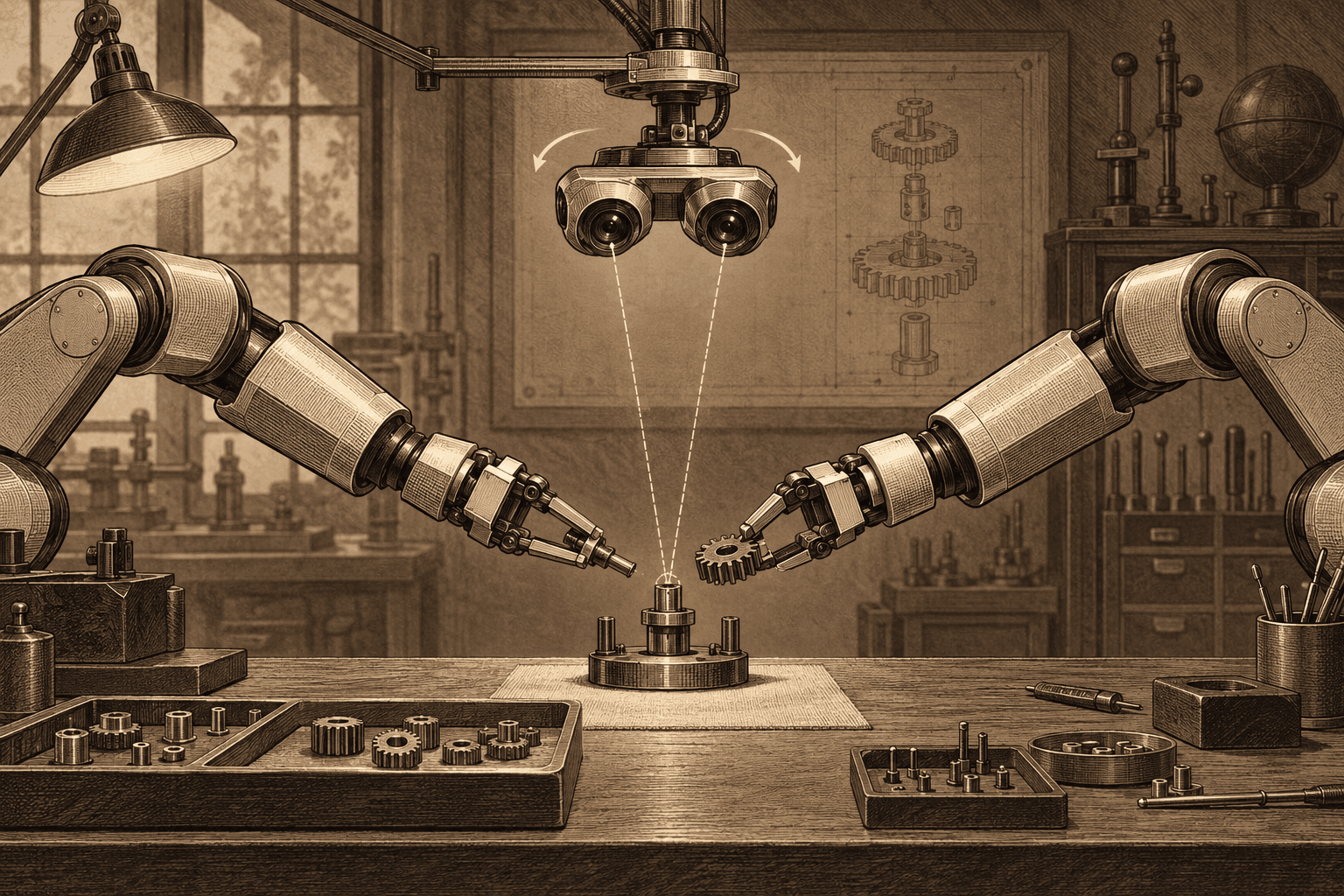
EyeRobot 2.0 steers one stereo gaze system through a bimanual task instead of mounting cameras on both wrists.
Summary
EyeRobot 2.0 steers one stereo gaze system through a bimanual task instead of mounting cameras on both wrists.
EyeRobot 2.0 uses two swiveling viewpoints in one stereo camera to center a chosen 3D fixation point, then allocates more visual tokens near the image centers. A low-level gaze servo and a task-progress target selector were trained with reinforcement learning while the gripper policy learned from demonstrations. Across more than 1,000 physical and 1,800 simulated trials covering seven real and six simulated tasks, passive stereo reached 27 percent real-world success after wrist cameras were removed. The active-gaze system improved on passive stereo by 40 percentage points in real trials and 20 in simulation. It matched the ego-plus-wrist baseline when wrist views were clear, 69 percent versus 64 percent, and reached 48 percent versus 22 percent when grasped objects blocked those wrist views. These are source-reported results for the tested tasks and hardware.
Why it matters
EyeRobot 2.0 steers one stereo gaze system through a bimanual task instead of mounting cameras on both wrists.
Limits and context
No additional limitation was separately recorded.
Key claims
EyeRobot 2.0 steers one stereo gaze system through a bimanual task instead of mounting cameras on both wrists.
Evidence: source-2026-10-05-002
Sources
- arXiv preprint 2610.03710arXiv · primary research
Corrections
No corrections have been recorded for this story.