frontier models
The Missing Skill Was Knowing What Changed
Training on visual transitions transferred across spatial, physical and temporal tasks even when the scenes and actions differed.
Summary
Training on visual transitions transferred across spatial, physical and temporal tasks even when the scenes and actions differed.
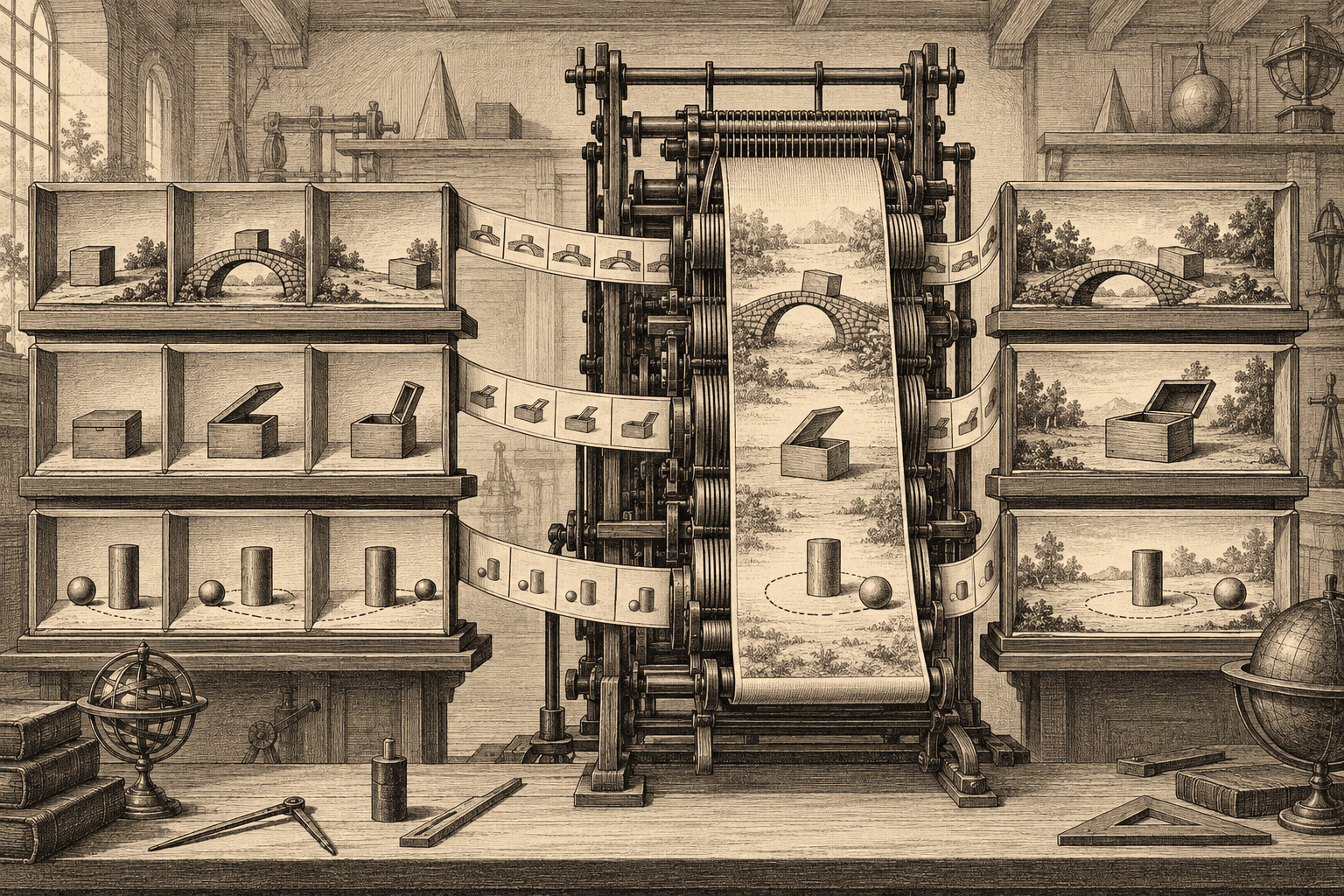
WOVEN treats visual transition reasoning—the ability to track how a scene changes under an action—as a shared training primitive for multimodal models. Its source and benchmark contain 36,076 examples spanning 20 scene types, five action types and eight reasoning operations. Across 38 evaluated models, the authors report a persistent gap from human performance. Training experiments then showed that small, operation-focused subsets collectively improved 22 of 26 external benchmarks by as much as 27.3 percentage points; in some settings WOVEN data replaced 30% to 50% of task-specific data at comparable accuracy. The reported recipe favors the reasoning operation being taught and larger state changes, rather than matching a target domain's surface details. These are benchmark transfer results, not proof of general physical understanding.
Why it matters
Training on visual transitions transferred across spatial, physical and temporal tasks even when the scenes and actions differed.
Limits and context
- These are benchmark transfer results, not proof of general physical understanding.
Key claims
Training on visual transitions transferred across spatial, physical and temporal tasks even when the scenes and actions differed.
Qualification: These are benchmark transfer results, not proof of general physical understanding.
Evidence: source-2026-10-11-002
Sources
- arXiv preprint 2610.12417, original v1arXiv / submitting research authors · primary research
Corrections
No corrections have been recorded for this story.