research
Photon Loss Opens a Classical Path Through BosonSampling
A new algorithm efficiently approximates the lossy sampling distribution whenever any constant fraction of input photons survives, under the paper's random-interferometer conditions.
Summary
A new algorithm efficiently approximates the lossy sampling distribution whenever any constant fraction of input photons survives, under the paper's random-interferometer conditions.
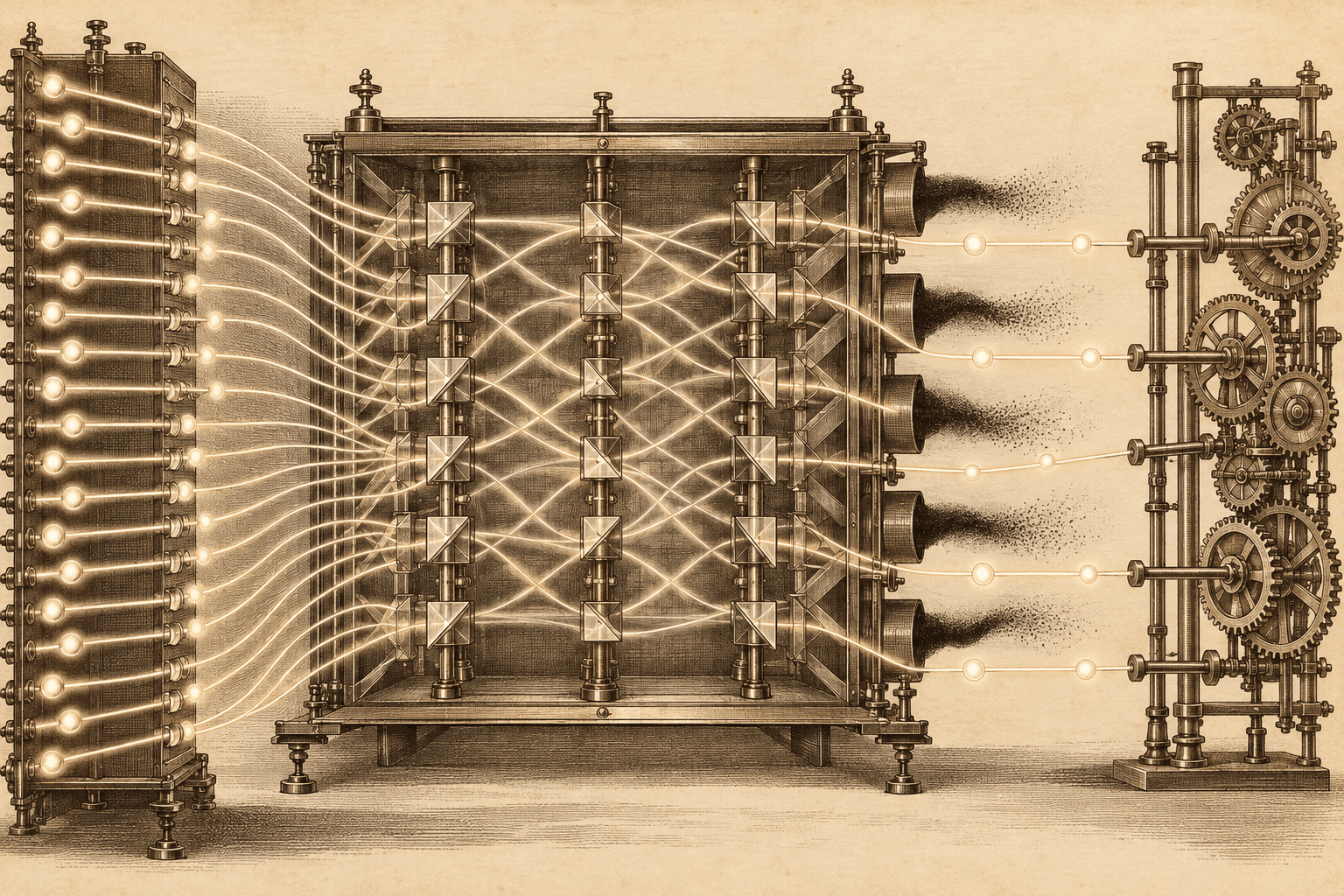
Photon loss has long been treated as an engineering tax on photonic quantum experiments. A new theoretical result makes it part of the complexity boundary. The authors give a polynomial-time classical algorithm that approximately samples fixed-loss BosonSampling when the number of surviving photons is any constant fraction of the input, with guarantees over Haar-random interferometers. They extend the result to uniform transmission loss at any fixed transmission rate. That substantially enlarges the provably simulable regime beyond earlier bounds tied to roughly square-root survival. The proof does not say every lossy photonic experiment is easy, nor does it reproduce a particular laboratory device. It says an experimentally relevant linear-survival regime can admit efficient classical simulation under the stated model—raising the bar for claims that photon survival alone preserves quantum advantage.
Why it matters
A new algorithm efficiently approximates the lossy sampling distribution whenever any constant fraction of input photons survives, under the paper's random-interferometer conditions.
Limits and context
- The proof does not say every lossy photonic experiment is easy, nor does it reproduce a particular laboratory device.
Key claims
A new algorithm efficiently approximates the lossy sampling distribution whenever any constant fraction of input photons survives, under the paper's random-interferometer conditions.
Qualification: The proof does not say every lossy photonic experiment is easy, nor does it reproduce a particular laboratory device.
Evidence: source-2026-10-21-001
Sources
- arXiv preprint 2610.27065, original v1arXiv · primary research
Corrections
No corrections have been recorded for this story.