developer tools
The Coding Agent Gets a Building Inspector
BrickWright gave pretrained agents a brick-assembly API and a physical validator; guided builds reached 100 percent validity across 512 prompts.
Summary
BrickWright gave pretrained agents a brick-assembly API and a physical validator; guided builds reached 100 percent validity across 512 prompts.
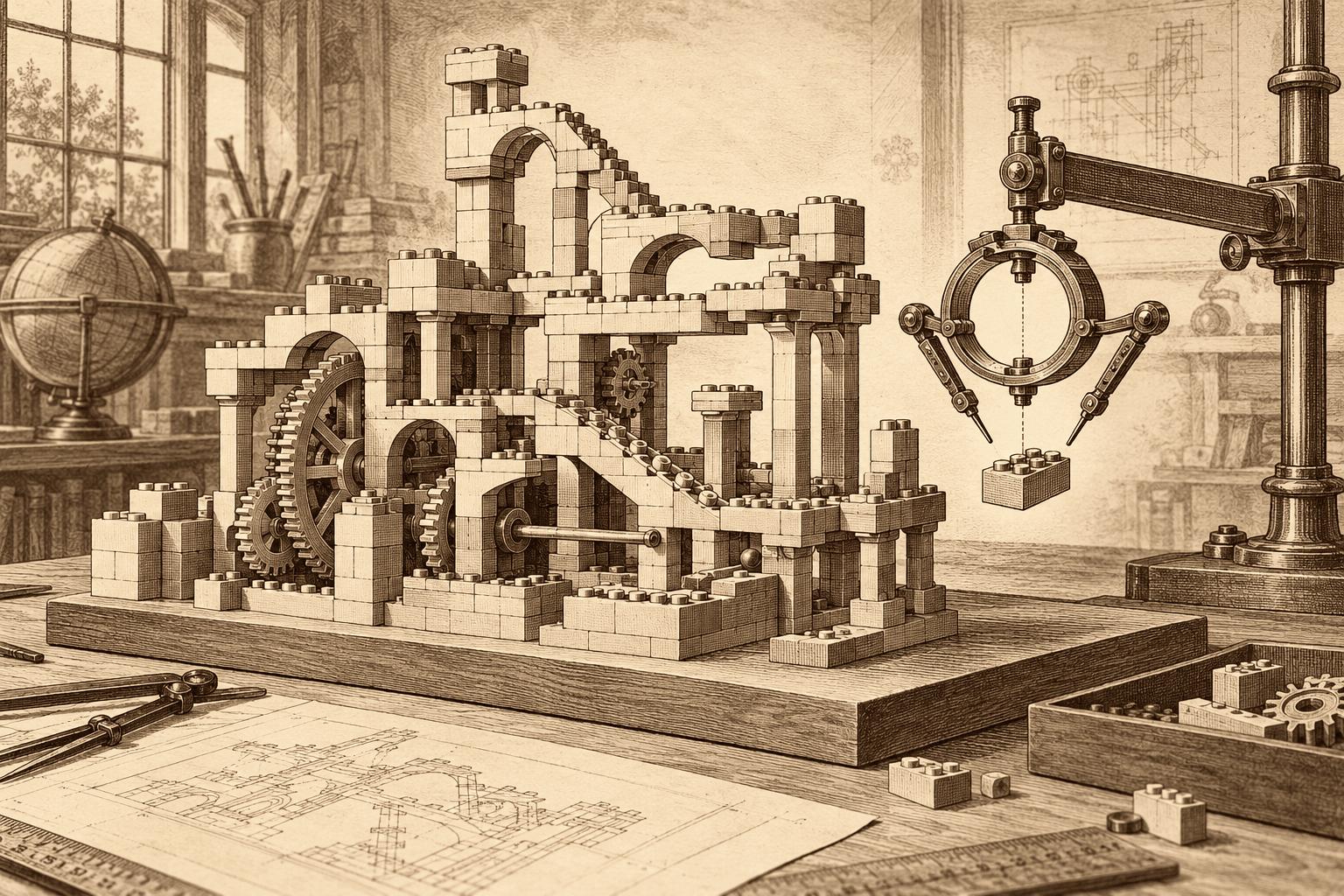
Coding agents can write 3D models that look convincing while hiding floating, colliding or disconnected pieces. BrickWright narrows that gap for interlocking-brick designs. Its BrickLayer toolkit exposes an ergonomic assembly API and checks whether a build uses real parts, avoids collisions and unsupported pieces, and remains connected where possible. The authors report that unguided baseline agents produced physically valid builds on 9 to 69 percent of prompts, depending on the model. With BrickWright, the tested agents reached 100 percent validity on a 512-prompt sample while maintaining or improving prompt adherence, and the higher-level API halved inference cost relative to raw LDraw. The result concerns the reported brick domain and validation rules, not arbitrary manufacturing or structural engineering.
Why it matters
BrickWright gave pretrained agents a brick-assembly API and a physical validator; guided builds reached 100 percent validity across 512 prompts.
Limits and context
- The result concerns the reported brick domain and validation rules, not arbitrary manufacturing or structural engineering.
Key claims
BrickWright gave pretrained agents a brick-assembly API and a physical validator; guided builds reached 100 percent validity across 512 prompts.
Qualification: The result concerns the reported brick domain and validation rules, not arbitrary manufacturing or structural engineering.
Evidence: source-2026-10-23-001
Sources
- arXiv preprint 2610.31651, original v1arXiv · primary research
Corrections
No corrections have been recorded for this story.