research
The Quantum Processor Watches a String Break Free
Sixty-three superconducting qubits follow electric flux as charge, matter and sideways deformation compete beyond the reach of short classical simulations.
Summary
Sixty-three superconducting qubits follow electric flux as charge, matter and sideways deformation compete beyond the reach of short classical simulations.
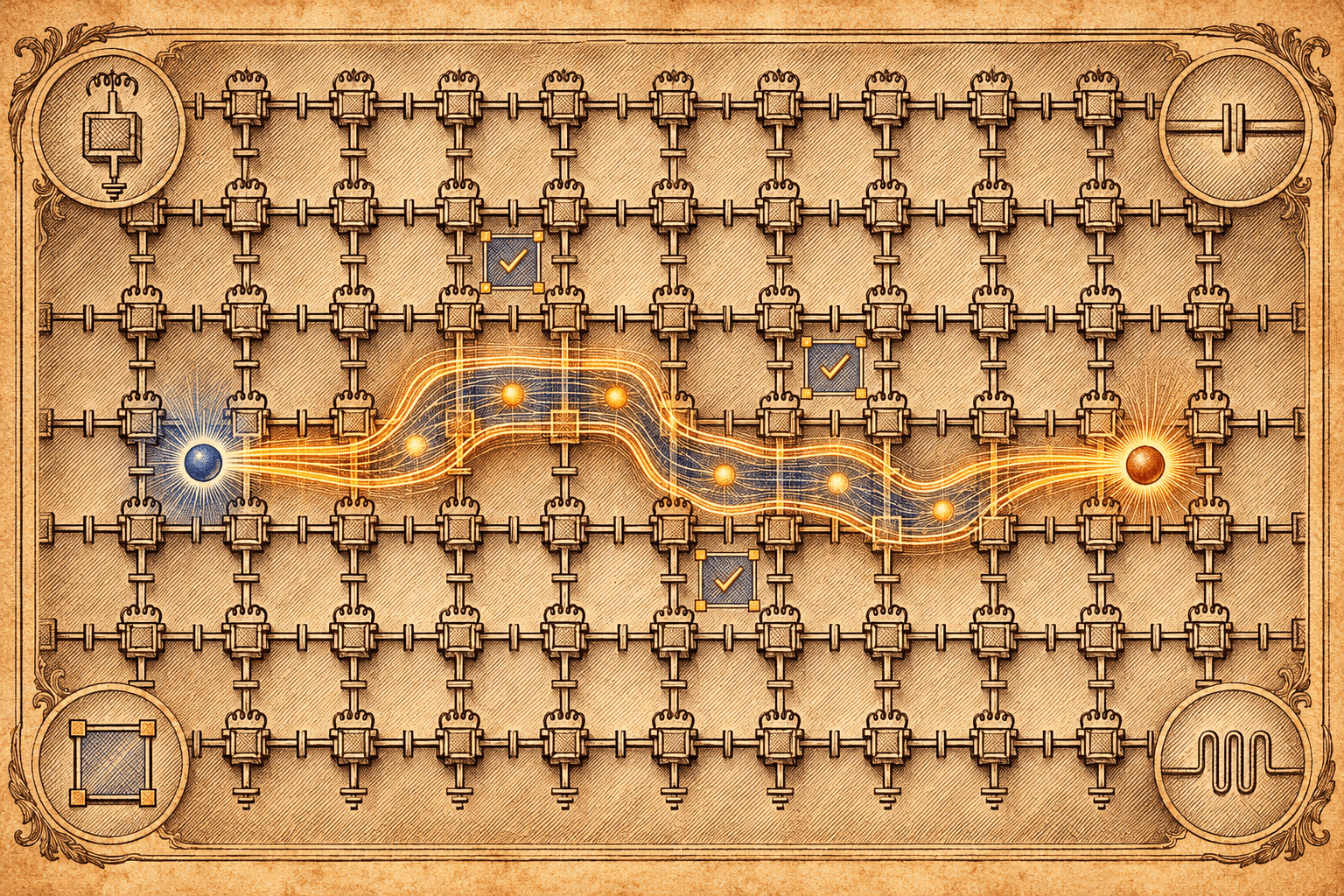
A new quantum simulation follows electric flux strings in a two-dimensional Z2 lattice gauge theory with dynamical matter and an explicit magnetic plaquette interaction. The researchers used 63 superconducting qubits, including 12 ancillas, to evolve localized strings with static or moving endpoint charges across strongly confined and nonperturbative deconfined regimes. Spatial measurements showed rapid charge and flux spreading when confinement weakened, enhanced matter occupation near a pair-creation resonance and suppressed spreading under strong electric fields. The team used local Gauss-law constraints, ancilla checks and noise rescaling to detect errors in circuits reaching 15 second-order Trotter steps; the result is a laboratory demonstration reported by the authors, not a general solution to gauge dynamics.
Why it matters
Sixty-three superconducting qubits follow electric flux as charge, matter and sideways deformation compete beyond the reach of short classical simulations.
Limits and context
- The team used local Gauss-law constraints, ancilla checks and noise rescaling to detect errors in circuits reaching 15 second-order Trotter steps; the result is a laboratory demonstration reported by the authors, not a general solution to gauge dynamics.
Key claims
Sixty-three superconducting qubits follow electric flux as charge, matter and sideways deformation compete beyond the reach of short classical simulations.
Qualification: The team used local Gauss-law constraints, ancilla checks and noise rescaling to detect errors in circuits reaching 15 second-order Trotter steps; the result is a laboratory demonstration reported by the authors, not a general solution to gauge dynamics.
Evidence: source-2026-11-11-001
Sources
- arXiv:2611.14484v1arXiv / Cornell University · primary research
Corrections
No corrections have been recorded for this story.