Cambridge and UC Santa Barbara researchers mapped where data-driven prediction is reliable, where it is impossible, and how to attach rigorous error bounds.
Editorial illustration
Original conceptual illustration of a boundary between bounded prediction and unstable long-range dynamics; it is not a research figure or documentary image. Original editorial illustration generated with built-in Codex Image Gen for The Machine Press.
Researchers at the University of Cambridge and UC Santa Barbara constructed adversarial dynamical systems to test the limits of machine learning. Their Nature Communications paper separates problems that can be learned reliably from those in which sensitivity to initial conditions makes long-range prediction fundamentally unstable, even with unlimited data. The team also presents an efficient algorithm with built-in error bounds and tested it against more than four decades of Arctic sea-ice data. The result is not a universal explanation for model hallucinations, but a practical framework for distinguishing a confident forecast from a problem whose structure defeats reliable learning.
Original conceptual illustration of customized additive lens fabrication and non-contact smoothing; it does not show the Waterloo apparatus or clinical evidence. Original editorial illustration generated with built-in Codex Image Gen for The Machine Press.
Waterloo researchers combined a printable hydrophilic silicone with a non-contact smoothing process to make patient-specific hard lenses in one fabrication cycle.
University of Waterloo researchers report a platform for fabricating hard contact lenses matched to an individual cornea in about 20 minutes. Their hydrophilic silicone formulation works with vat photopolymerization, while software defines the inner corneal fit and the outer optical correction. Because layer-by-layer printing leaves microscopic steps, the team added an ultra-thin non-contact coating that smooths the surface without changing the custom geometry. Laboratory testing found the lenses biocompatible, but in-vivo studies still lie ahead; the work demonstrates a manufacturing route, not a product ready for routine wear.
Astronomers detected erythrulose beyond the Solar System, the most complex sugar yet identified in interstellar space.
Astronomers have identified erythrulose, a four-carbon sugar, in interstellar material, Nature reports. The detection extends the inventory of relatively complex organic molecules known to form outside the Solar System and gives origin-of-life chemistry another plausible ingredient to track. A molecule's presence in space does not show that life formed there or that it reached early Earth. The new result is a spectroscopic identification and a chemical-pathway clue, not biological evidence.
Illustrative unidentified data-center file image; it does not show a facility, cooling system, location, or measurement from the Hawaiʻi study. Brett Sayles / Pexels; cropped, resized, metadata stripped, and converted to WebP by The Machine Press.
A global analysis found rising heat and humidity are reducing the hours when data centers can rely on outside air alone.
University of Hawaiʻi at Mānoa researchers combined hourly weather observations, climate simulations, and a database of data-center locations to examine direct-air free cooling. They found that hot, humid periods exceeding recommended operating limits have become more frequent and longer, particularly in the tropics and southeastern United States. Projections extend the constraint through mid-century, while the harshest days can worsen faster than average conditions. The study does not calculate the energy bill of any named facility; it identifies a planning risk for a cooling method that depends on ambient weather.
Researchers, economists, and technology executives called for deeper measurement and policy preparation for a rapid AI-driven economic transition.
More than 200 signatories, including economists, researchers, technology executives, and 15 Nobel laureates, issued a joint statement calling for faster work on AI's economic effects. Reuters reports that the group wants governments and industry to build research programs and institutions before displacement and distributional pressures arrive at scale. The statement is a coalition's warning and agenda, not a forecast with a settled timetable. Its significance lies in the breadth of the signatories and the insistence that adaptation capacity must be built before evidence becomes conclusive.
An NSF-backed Ohio State project aims to build patient-specific wireless devices inside the body through a keyhole opening.
Ohio State researchers are developing a robotic probe that could print and assemble wireless medical implants through a small incision. A new $492,146 National Science Foundation award supports work on conductive and dielectric materials, sub-millimeter features, multilayer devices, and the integration of components that cannot be printed. The proposed approach could allow larger antennas or battery-free structures without a large surgical opening. It remains a research program with ambitious performance targets, not a demonstrated clinical procedure.
A plant-derived, two-sided dressing releases antibiotics into a wound while preserving a protected healing barrier.
University of Bath engineers created a wound dressing from furan-based polymers sourced from plant material. The asymmetric design gives each face a separate job: one releases an antibiotic rapidly during the early infection window, while the other maintains a barrier around the wound. The Bioactive Materials study extends a sustainable-polymer family previously explored for packaging into a biomedical format. It demonstrates material behavior in research conditions; clinical effectiveness, dosing, and manufacturing approval still require further work.
A European energy model found that smart charging is broadly useful, while vehicle-to-grid investment depends on each country's power system.
Delft University of Technology researchers modeled unidirectional smart charging and bidirectional vehicle-to-grid infrastructure as competing investments inside a 2050 European energy system. The Nature Energy study finds V1G a broadly low-regret option, while the cost-optimal scale of V2G varies with national generation, flexibility, and grid constraints. More infrastructure can lower system costs while raising charging costs for consumers. The result argues against setting charging mandates in isolation; it is a modeled planning comparison, not a deployment forecast.
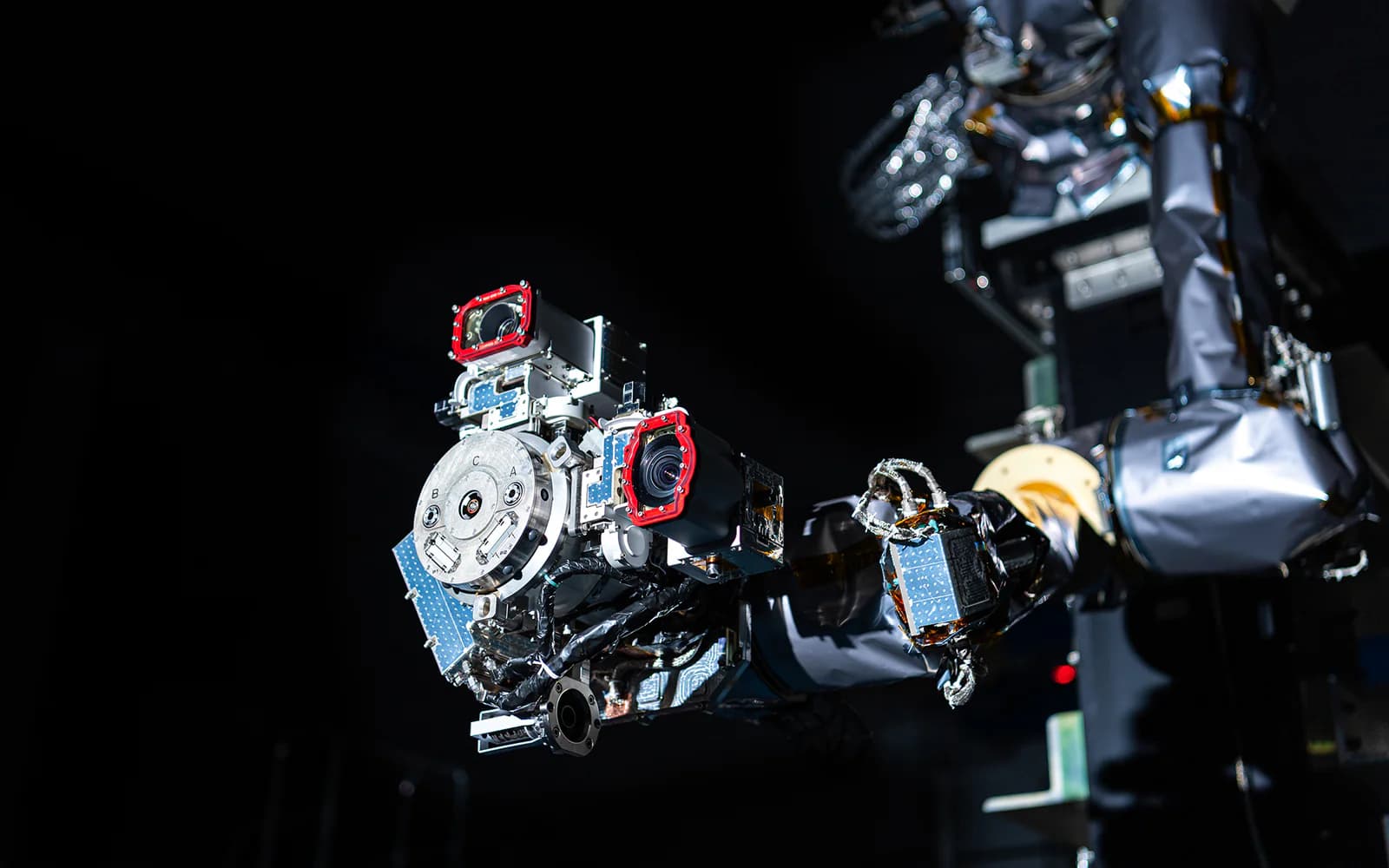
Illustrative NASA OSAM-1 servicing-arm file image; it does not depict a CMU drone, the DARPA Triage Challenge, or emergency-response evidence. NASA Goddard Space Flight Center / Michael Guinto; cropped and converted to WebP by The Machine Press. Use does not imply NASA endorsement.
CMU teams are combining fast autonomous search with camera-based vital-sign assessment for high-risk response scenes.
Carnegie Mellon University is developing coordinated drone groups that can search flooded or hazardous areas and assess human vital signs from a distance. The work includes systems for autonomous exploration and camera-based triage under the DARPA Triage Challenge. Researchers describe swarms as a way to cover large scenes while reducing the number of responders placed in danger. The program is active research: remote observations can support triage, but they do not replace clinicians or establish that autonomous swarms are ready for unrestricted emergency deployment.
NASA found that willingness to fly can fall when simulated vertical-flight motion crosses comfort thresholds.
NASA researchers used a motion simulator to study how passengers respond to the vibration and movement expected in electric vertical-takeoff-and-landing aircraft. The agency says the work connects physical ride characteristics with willingness to use an air taxi, giving designers evidence for comfort targets alongside performance and safety requirements. The study informs an emerging vehicle class; it does not certify a particular aircraft, predict adoption, or show that comfort is the only barrier to commercial service.
A wireless platform continuously tracks pH, glucose, and lactate in both perfusate and bile during warm-machine preservation.
The Terasaki Institute and Mayo Clinic collaborators report a dual-compartment biosensing platform for donor livers undergoing normothermic machine perfusion. The system continuously monitors pH, glucose, and lactate in the circulating preservation fluid and in bile, providing a time-resolved view that occasional samples can miss. The Nature Communications study used human tissue samples and describes clinical deployment of the monitoring platform. Whether those signals improve transplant selection or outcomes requires prospective validation beyond measuring them reliably.
PixVerse raised $439 million at a valuation above $2 billion as capital continues to chase consumer video models.
Video-generation company PixVerse raised $439 million in new financing, TechCrunch reports, pushing its valuation above $2 billion. The round is a market signal about investor appetite for generative video, not evidence that model economics or user retention are settled. PixVerse is competing in a field where training, inference, copyright, and distribution costs can shift quickly. The consequential number is the capital committed; product quality and durable revenue still have to be judged separately.
A phase-one mesothelioma study reported disease control in 67 percent of participants by inhibiting mitochondrial peroxiredoxin 3.
University of Vermont researchers and RS Oncology report early clinical testing of a drug that targets PRDX3, a mitochondrial antioxidant protein used by cancer cells to manage oxidative stress. In a phase-one trial involving people with relapsed mesothelioma, the release says 67 percent had disease controlled and some tumors shrank, with tolerability sufficient to continue development. Phase-one studies are small and designed primarily for safety; the findings justify further trials but do not establish superiority over standard treatment.
Conceptual Visualising AI illustration about neuroscience-inspired machine learning; it is not a participant, scan, cannabis product, or result from the LiBBY trial. Novoto Studio / Google DeepMind / Pexels; cropped, resized, metadata stripped, and converted to WebP by The Machine Press.
A 120-person trial found a fixed THC-CBD formulation reduced agitation in hospice-eligible people with dementia compared with placebo.
Researchers presented results from the 120-participant LiBBY trial at the Alzheimer's Association International Conference. Hospice-eligible people with Alzheimer's disease or other dementias and significant agitation received a defined THC-CBD formulation or placebo; the research team reports significantly less agitation in the treatment group. Conference findings require full peer-reviewed detail to assess effect size, adverse events, and generalizability. The result concerns a controlled medical formulation in a narrowly defined population, not unsupervised cannabis use.
General Fusion's shares rose in their debut, making it the first publicly traded company centered on fusion power.
General Fusion began public trading and saw its shares rise in their debut, TechCrunch reports, becoming the first publicly traded company focused on fusion power. The listing gives public investors direct exposure to a field previously funded largely through governments, strategic partners, and private capital. A strong first session measures demand for the stock, not the readiness or cost of commercial fusion. General Fusion still must prove its machine, financing plan, and path from experimental plasma to sellable electricity.
Mathematical texts at a Guatemalan site identify Sak Tahn Waax and reveal calculations comparable in sophistication to surviving ancient traditions.
Researchers studying painted wall texts at a Maya site in Guatemala have identified mathematical and astronomical work attributed to a named figure, Sak Tahn Waax. Nature reports that the notation preserves a formula whose structure rivals insights known from other ancient mathematical traditions. The finding expands the record beyond finished calendar tables by exposing something closer to an astronomer's working method. Interpretation depends on fragmentary inscriptions and specialist reconstruction, but the wall establishes that advanced calculation was embedded in an identifiable scholarly practice.
Reach readers curious about what people are building. One manually reviewed placement stays active for seven days and remains separate from Desk Picks.
Manual launch intake; automated checkout is not live yet. Payment buys placement, never endorsement, and every submission is reviewed before publication.
Desk Picks are selected by the newsroom. Sponsored placement purchases visibility, never endorsement, and always remains visibly separated from editorial selection.
 Editorial illustration