research
The Model Needs to Know When the Future Breaks
Cambridge and UC Santa Barbara researchers mapped where data-driven prediction is reliable, where it is impossible, and how to attach rigorous error bounds.
Summary
Cambridge and UC Santa Barbara researchers mapped where data-driven prediction is reliable, where it is impossible, and how to attach rigorous error bounds.
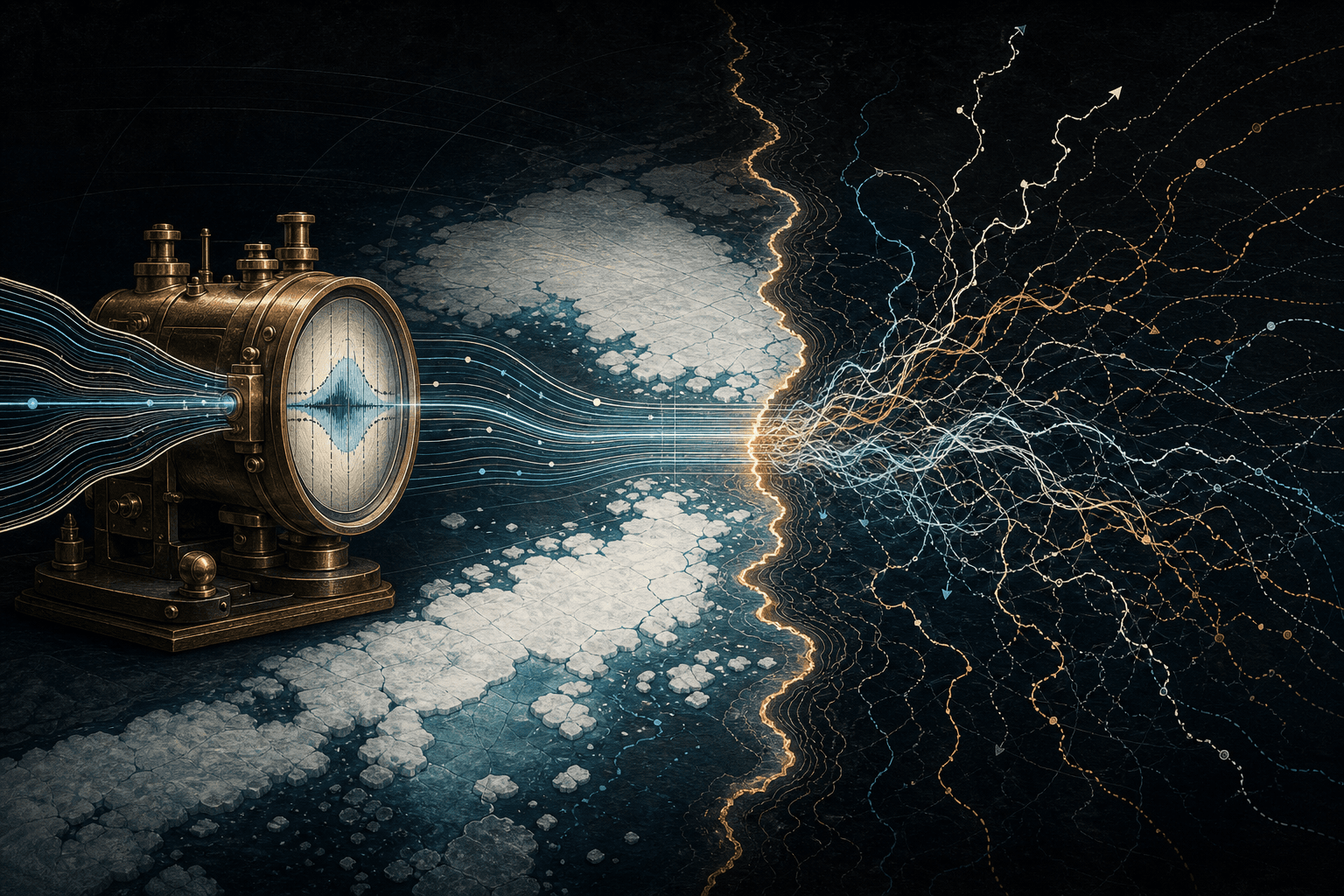
Researchers at the University of Cambridge and UC Santa Barbara constructed adversarial dynamical systems to test the limits of machine learning. Their Nature Communications paper separates problems that can be learned reliably from those in which sensitivity to initial conditions makes long-range prediction fundamentally unstable, even with unlimited data. The team also presents an efficient algorithm with built-in error bounds and tested it against more than four decades of Arctic sea-ice data. The result is not a universal explanation for model hallucinations, but a practical framework for distinguishing a confident forecast from a problem whose structure defeats reliable learning.
Why it matters
Cambridge and UC Santa Barbara researchers mapped where data-driven prediction is reliable, where it is impossible, and how to attach rigorous error bounds.
Limits and context
- The result is not a universal explanation for model hallucinations, but a practical framework for distinguishing a confident forecast from a problem whose structure defeats reliable learning.
Key claims
Cambridge and UC Santa Barbara researchers mapped where data-driven prediction is reliable, where it is impossible, and how to attach rigorous error bounds.
Qualification: The result is not a universal explanation for model hallucinations, but a practical framework for distinguishing a confident forecast from a problem whose structure defeats reliable learning.
Evidence: source-2026-07-14-001
Sources
- University of Cambridge via EurekAlert: Testing the limits of what is possible with AIUniversity of Cambridge via EurekAlert · official announcement
Corrections
No corrections have been recorded for this story.