research
A Contact Lens Comes Off the Printer in Twenty Minutes
Waterloo researchers combined a printable hydrophilic silicone with a non-contact smoothing process to make patient-specific hard lenses in one fabrication cycle.
Summary
Waterloo researchers combined a printable hydrophilic silicone with a non-contact smoothing process to make patient-specific hard lenses in one fabrication cycle.
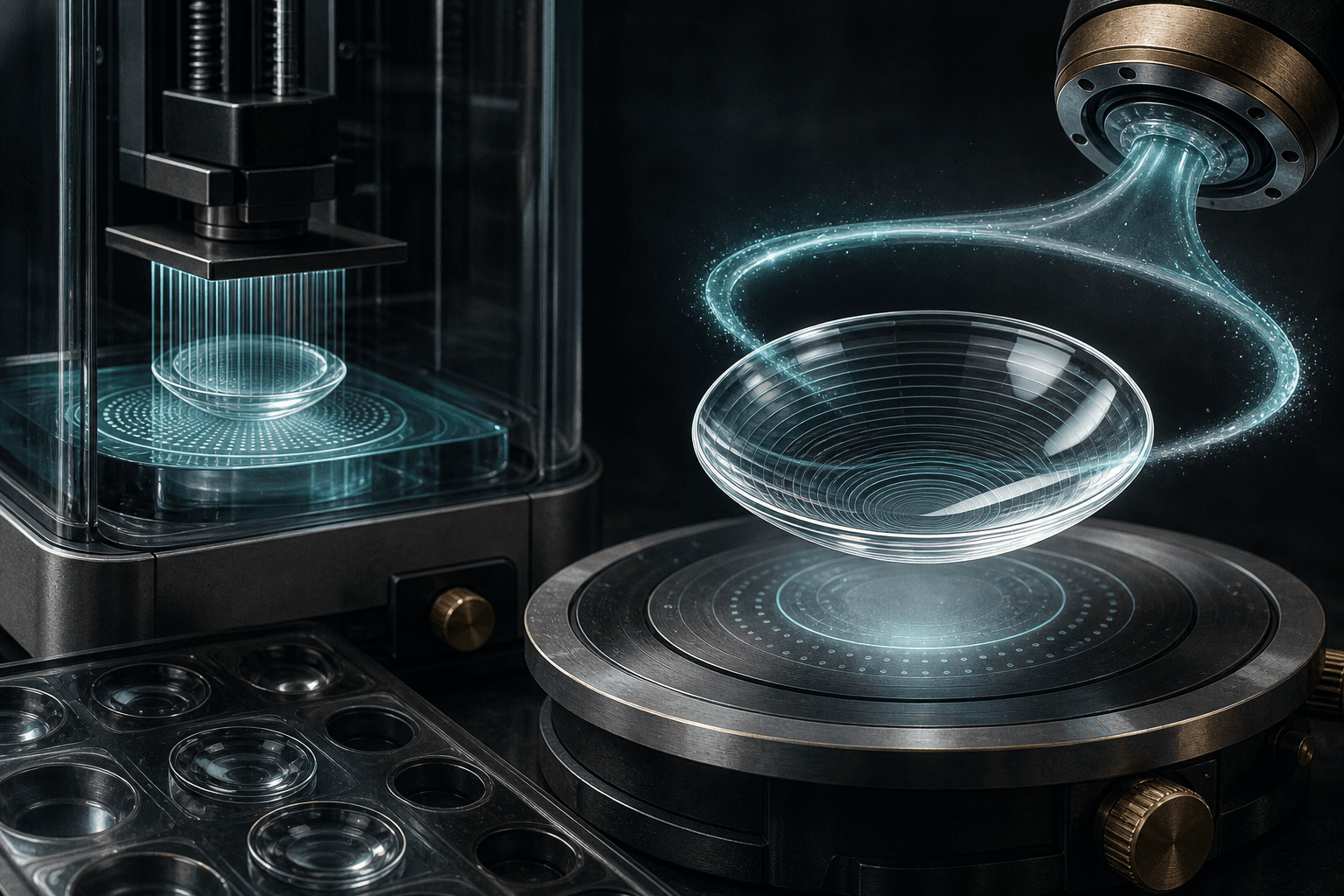
University of Waterloo researchers report a platform for fabricating hard contact lenses matched to an individual cornea in about 20 minutes. Their hydrophilic silicone formulation works with vat photopolymerization, while software defines the inner corneal fit and the outer optical correction. Because layer-by-layer printing leaves microscopic steps, the team added an ultra-thin non-contact coating that smooths the surface without changing the custom geometry. Laboratory testing found the lenses biocompatible, but in-vivo studies still lie ahead; the work demonstrates a manufacturing route, not a product ready for routine wear.
Why it matters
Waterloo researchers combined a printable hydrophilic silicone with a non-contact smoothing process to make patient-specific hard lenses in one fabrication cycle.
Limits and context
- Laboratory testing found the lenses biocompatible, but in-vivo studies still lie ahead; the work demonstrates a manufacturing route, not a product ready for routine wear.
Key claims
Waterloo researchers combined a printable hydrophilic silicone with a non-contact smoothing process to make patient-specific hard lenses in one fabrication cycle.
Qualification: Laboratory testing found the lenses biocompatible, but in-vivo studies still lie ahead; the work demonstrates a manufacturing route, not a product ready for routine wear.
Evidence: source-2026-07-14-002
Sources
- University of Waterloo via EurekAlert: 3D-printed contact lenses in 20 minutesUniversity of Waterloo via EurekAlert · official announcement
Corrections
No corrections have been recorded for this story.