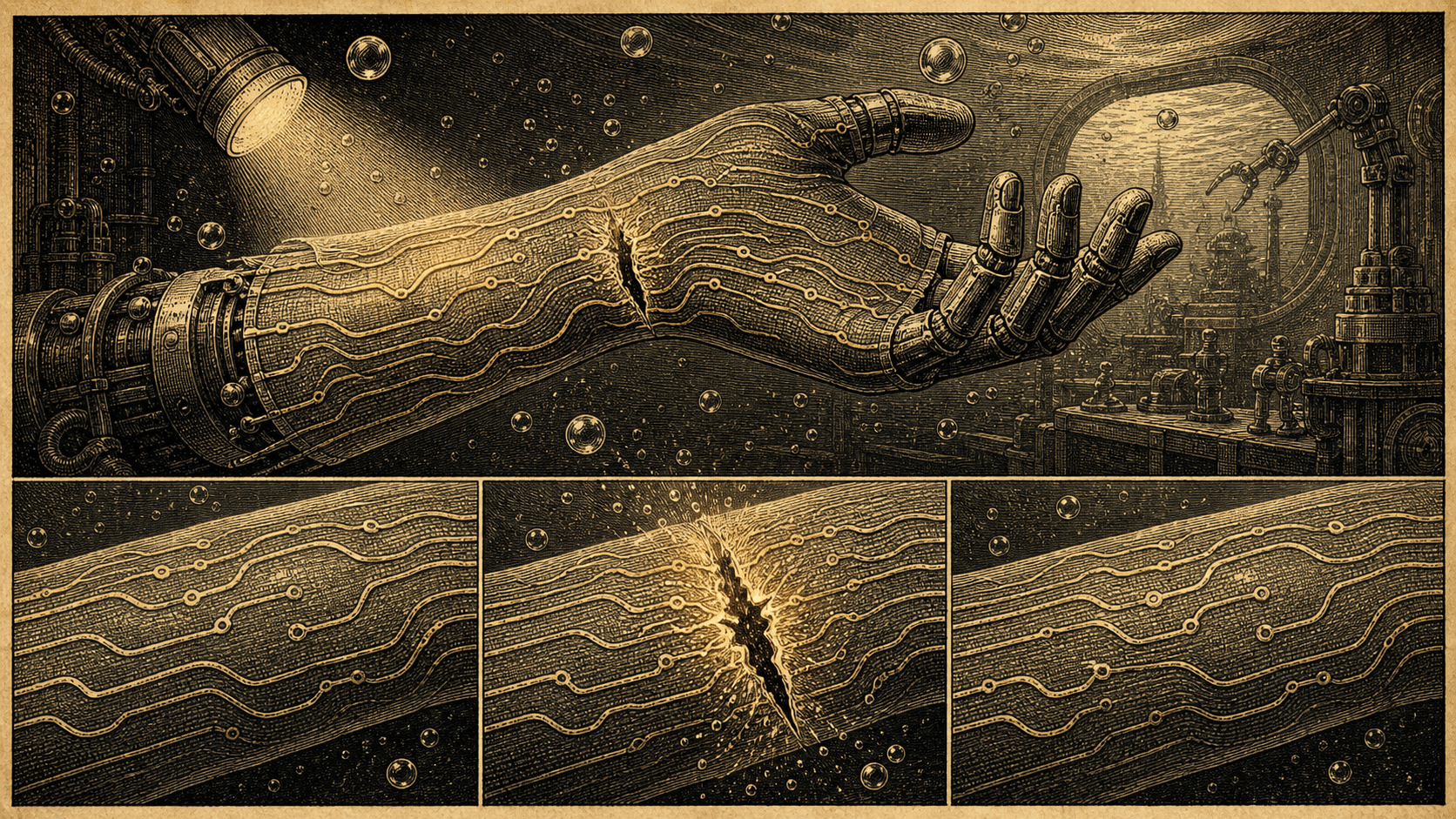
A self-powered magnetoelectric sensor detects touch and damage, then restores its function even while submerged.
Editorial illustration
Conceptual self-healing underwater sensor; not a deployed diving device or documentary photograph. Original editorial illustration generated with built-in Codex Image Gen for The Machine Press, 2026-07-19.
National University of Singapore engineers combined a stretchable self-healing elastomer, liquid-metal conductors, a magnet, and a coil into a sensor that produces its own touch and proximity signals through electromagnetic induction. Punctures cause a resistance spike that acts as a damage alarm; reversible molecular bonds then reconnect, with small needle damage recovering electrical performance within seconds. Demonstrations included a gesture-sensing diving glove and an underwater robotic hand. The prototypes are laboratory devices, not deployed safety equipment, and severe cuts still require contact and time to regain full function.
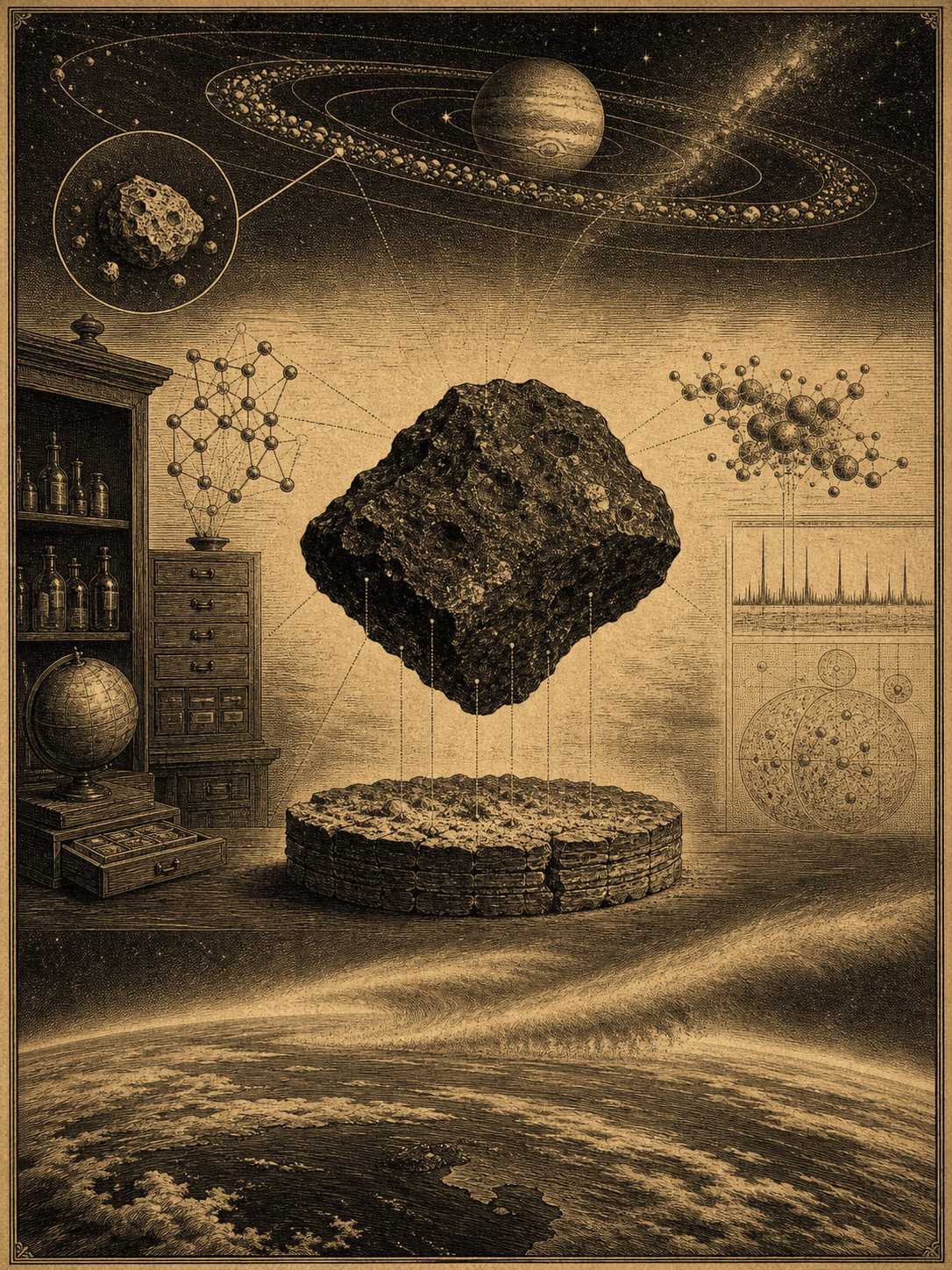
Conceptual nickel-isotope identification of the Chicxulub impactor class; not the recovered projectile or a documentary sample. Original editorial illustration generated with built-in Codex Image Gen for The Machine Press, 2026-07-19.
Nickel isotopes in the global impact layer point to an exceptionally rare CO carbonaceous chondrite, not a typical meteorite.
Researchers from British Columbia, Paris, Brussels, and Vienna analyzed nickel isotope traces preserved in the thin clay layer left by the Chicxulub impact. The signature points to a carbonaceous chondrite of the Ornans class, a very small subset of the roughly five percent of sampled meteorites classed as carbonaceous. Because CO chondrites contain relatively little sulfur, the team argues that fine debris lofted by the impact was probably more important to the extinction aftermath than sulfur carried inside the projectile. The isotope result narrows the impactor class; it does not identify its exact original orbit.
A simulated programmable resonator circuit independently controls pulse delay and spectral shape on one photonic platform.
Seoul National University and University of Seoul researchers proposed a coupled-resonator-induced-transparency circuit whose tunable couplings adjust both the delay and frequency content of optical signals. The design addresses buffering and synchronization problems in optical computing and communications. Its reported performance comes from computational simulation and modeling; the release does not describe a fabricated production chip, endurance test, or deployed optical memory.
Generic empty laboratory glassware; not fluvoxamine, a participant, clinical site, or trial result. Rodolfo Clix / Pexels; cropped, resized, metadata stripped, and converted to WebP by The Machine Press.
In a 399-person randomized trial, fluvoxamine reduced persistent fatigue and improved reported quality of life.
The REVIVE-TOGETHER trial enrolled 399 adults in Brazil with fatigue lasting at least 90 days after confirmed SARS-CoV-2 infection. Participants received fluvoxamine, metformin, or placebo for 60 days. Fluvoxamine outperformed placebo on fatigue and quality-of-life measures, while metformin did not improve established fatigue. The adaptive trial offers evidence for one symptom in one study population; the authors say further work must identify who benefits and how the drug fits into broader long-COVID care.
Three fossil species may belong to Keeunamorphia, an ancient lineage that persisted for roughly 35 million years.
A University of New South Wales analysis of teeth and jaw fragments from Queensland's Riversleigh fossil deposits proposes a sixth Australian marsupial order. The three species lived about 18 million years ago, but their teeth resemble the much older Djarthia murgonensis, supporting a lineage that may have split early and survived for tens of millions of years. The classification rests on fragmentary fossils and a reconstructed evolutionary tree, so it is a proposal about deep relationships rather than a complete ancestry.
Laboratory models link caffeic acid and other coffee compounds to the stress-responsive receptor NR4A1.
Texas A&M researchers found that several coffee compounds bind to and alter the activity of NR4A1, a nuclear receptor involved in inflammation, metabolism, and tissue repair. Polyphenolic compounds such as caffeic acid were more active in the models than caffeine, and protective cell effects disappeared when NR4A1 was removed. The work proposes a mechanism for prior population associations; it does not prove that coffee prevents disease in people or change drinking recommendations.
Nearly 13,000 adults with higher intake showed faster cognitive decline, especially below age 60 and with diabetes.
An eight-year Brazilian cohort study tracked 12,772 adults and seven low- or no-calorie sweeteners. The highest-intake group experienced a faster decline on memory and thinking tests than the lowest-intake group, a difference the researchers compared with about 1.6 additional years of cognitive aging. Food questionnaires and observational data cannot establish that sweeteners caused the decline; health conditions, diet, and other unmeasured factors may contribute.
Models connect the Eulalia parent body's destruction to an inner-solar-system impact shower about 800 million years ago.
A Southwest Research Institute-led study links the breakup of the Eulalia asteroid family's parent body near a Jupiter-controlled orbital gateway to a surge of impacts recorded on the Moon. Because Earth's active geology erases very old craters, the lunar record and asteroid dynamics provide indirect evidence for debris reaching Earth and Mars. Possible climate or biological consequences remain hypotheses; the paper chiefly supplies a plausible source and delivery route for the bombardment.
Illustrative code-screen file image; not a clinical teaching system, survey instrument, or measured response. Nemuel Sereti / Pexels; cropped, resized, metadata stripped, and converted to WebP by The Machine Press.
At one teaching hospital, clinical teachers reported high willingness but much lower routine use of AI for teaching.
A survey of 335 clinical teachers found mean AI-adoption intention of 3.93 on a five-point scale but usage behavior of 2.30. Although 78.81 percent reported AI use in daily life and 68.96 percent in research, only 24.48 percent reported using it for teaching. Cognitive trust had the strongest modeled association with intention. The single-hospital, cross-sectional convenience sample cannot establish cause or represent clinical education broadly.
Seismic waves reveal horizontal layers cut by vertical dike swarms beneath the Ontong Java Plateau.
Researchers used Po and So seismic waves recorded by ocean-bottom and island instruments to model the structure under the world's largest oceanic plateau. Efficient Po transmission and weakened So waves fit a composite plate crossed by broad vertical magma intrusions, while unusually slow velocities suggest chemical alteration as magma rose. The analysis reconstructs a 110- to 120-million-year-old event from present-day wave behavior; it does not directly observe the ancient flow.
Participants retained modest weight-loss differences a year after a 12-week time-restricted eating program.
A University of Granada-led study followed 99 adults with overweight or obesity after all groups received Mediterranean-diet guidance. Those assigned to eight-hour eating windows maintained more weight loss at one year than participants eating across 12 hours or more, and the early-window group preserved more fat loss. The small intervention supports durability of a modest effect; it does not show that one schedule suits every patient or replaces individualized care.
Researchers mixed bituminous coal with one to 10 percent industrial organic cleaning wastewater and heated samples under controlled thermogravimetric conditions. One to five percent blends lowered ignition temperature at low heating rates, and five percent reduced modeled average activation energy from 131.68 to 115.92 kilojoules per mole. At 10 percent, moisture, ash, and diffusion resistance delayed burnout. The laboratory combustion study supplies engineering data, not a field-scale disposal approval or emissions assessment.
Conceptual file image; not the PEEPSS photonic lantern, a telescope image, exoplanet, or instrument diagram. Tim West / Google DeepMind / Pexels; cropped, resized, metadata stripped, and converted to WebP by The Machine Press.
UCF's PEEPSS project aims to recover phase information that conventional exoplanet imaging usually discards.
A NASA-funded University of Central Florida team is developing photonic lanterns that split incoming starlight into separate optical channels, preserving brightness and phase information for wavefront correction. The three-year PEEPSS effort targets the extreme contrast needed to image Earth-like planets for a future Habitable Worlds Observatory; some related components have reached telescope tests in Hawaii. It is a prototype program, not a completed space instrument or a detection of life.
Moderate dietary biochar improved gut measures and cut nitrogen pollutants without changing bass growth.
In a 42-day trial, 480 largemouth bass received feed containing zero, 10, 20, or 40 grams of mulberry-branch biochar per kilogram. Moderate levels increased digestive enzymes and microbial richness and reduced ammonia nitrogen by 60.7 percent in the 10-gram group and 49.3 percent in the 20-gram group by day 42. Growth did not change significantly, and the highest dose may disturb microbial balance; commercial aquaculture effects remain to be tested.
A combined fossil and genetic tree finds that large, warm-bodied pelagic fishes re-emerged gradually after the K-Pg extinction.
Yale-led researchers built a time-calibrated evolutionary tree for tunas, mackerels, and relatives using genetic data and fossils. The reconstruction rejects a simple burst in which tunas immediately filled ocean-predator niches after the dinosaur-killing impact; large body size and endothermy arose repeatedly over a longer interval. The work revises an evolutionary timing hypothesis and may inform conservation, but it does not link the traits directly to human metabolic disease.
An X-type quasi-2D perovskite reached 21.9 percent external quantum efficiency in a vacuum-deposited LED.
Seoul National University and Cambridge researchers designed spacer molecules and a lithium-fluoride hetero-scaffold that steer perovskite crystallization during vacuum deposition. The resulting films exceeded 85 percent photoluminescence quantum yield, while devices reached 21.9 percent external quantum efficiency with a 16.8-nanometer emission linewidth. The team also fabricated large-area, flexible, and patterned samples. These are laboratory device metrics, not manufacturing yield, lifetime, or a commercial display.
Desk Picks are selected by the newsroom. Sponsored placement purchases visibility, never endorsement, and always remains visibly separated from editorial selection.
 Editorial illustration