robotics
The Skin Knows It Has Been Cut
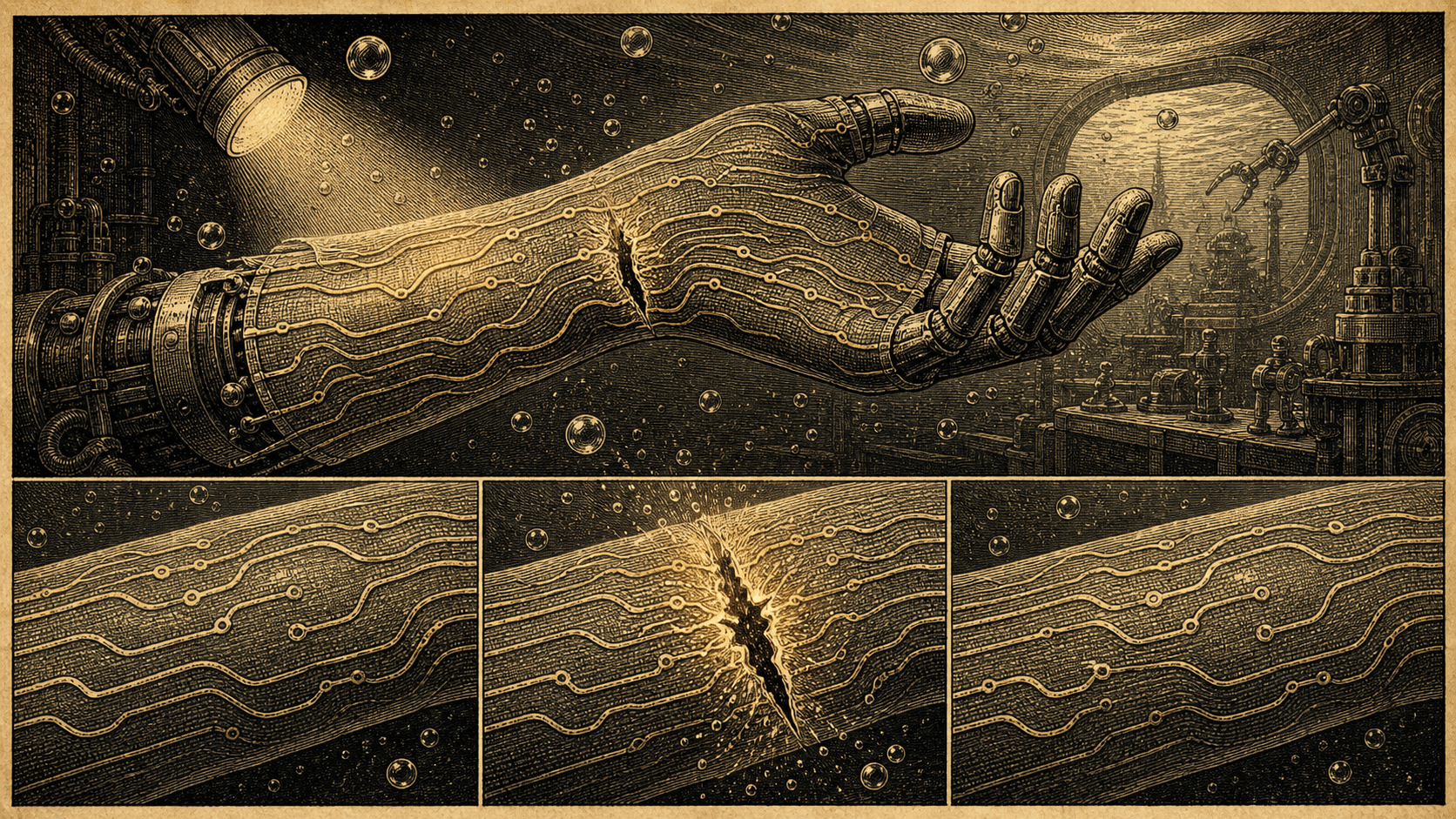
A self-powered magnetoelectric sensor detects touch and damage, then restores its function even while submerged.
Summary
A self-powered magnetoelectric sensor detects touch and damage, then restores its function even while submerged.
National University of Singapore engineers combined a stretchable self-healing elastomer, liquid-metal conductors, a magnet, and a coil into a sensor that produces its own touch and proximity signals through electromagnetic induction. Punctures cause a resistance spike that acts as a damage alarm; reversible molecular bonds then reconnect, with small needle damage recovering electrical performance within seconds. Demonstrations included a gesture-sensing diving glove and an underwater robotic hand. The prototypes are laboratory devices, not deployed safety equipment, and severe cuts still require contact and time to regain full function.
Why it matters
A self-powered magnetoelectric sensor detects touch and damage, then restores its function even while submerged.
Limits and context
- The prototypes are laboratory devices, not deployed safety equipment, and severe cuts still require contact and time to regain full function.
Key claims
A self-powered magnetoelectric sensor detects touch and damage, then restores its function even while submerged.
Qualification: The prototypes are laboratory devices, not deployed safety equipment, and severe cuts still require contact and time to regain full function.
Evidence: source-2026-07-19-001
Sources
- NUS via EurekAlert: Self-healing underwater electronic skinNUS via EurekAlert · secondary reporting
Corrections
No corrections have been recorded for this story.