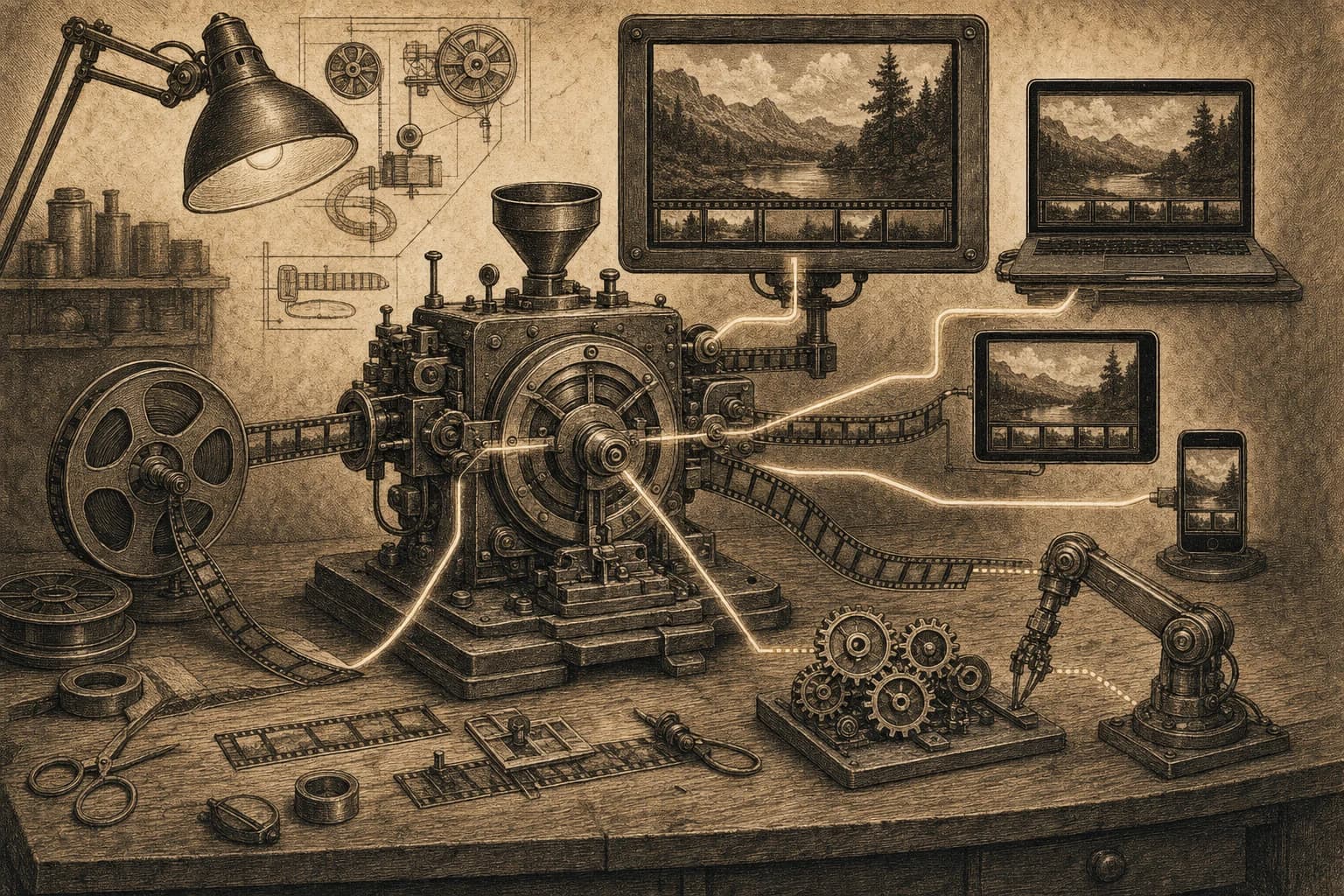
A single laser pass programs both the geometry and light response of a nickel-titanium surface, letting near-infrared light lift tactile forms on command.
Editorial illustration
Conceptual illustration of light-programmed kirigami; not a documentary image, commercial display, or deployed accessibility device. Original editorial illustration generated with built-in Codex Image Gen for The Machine Press, 2026-07-20.
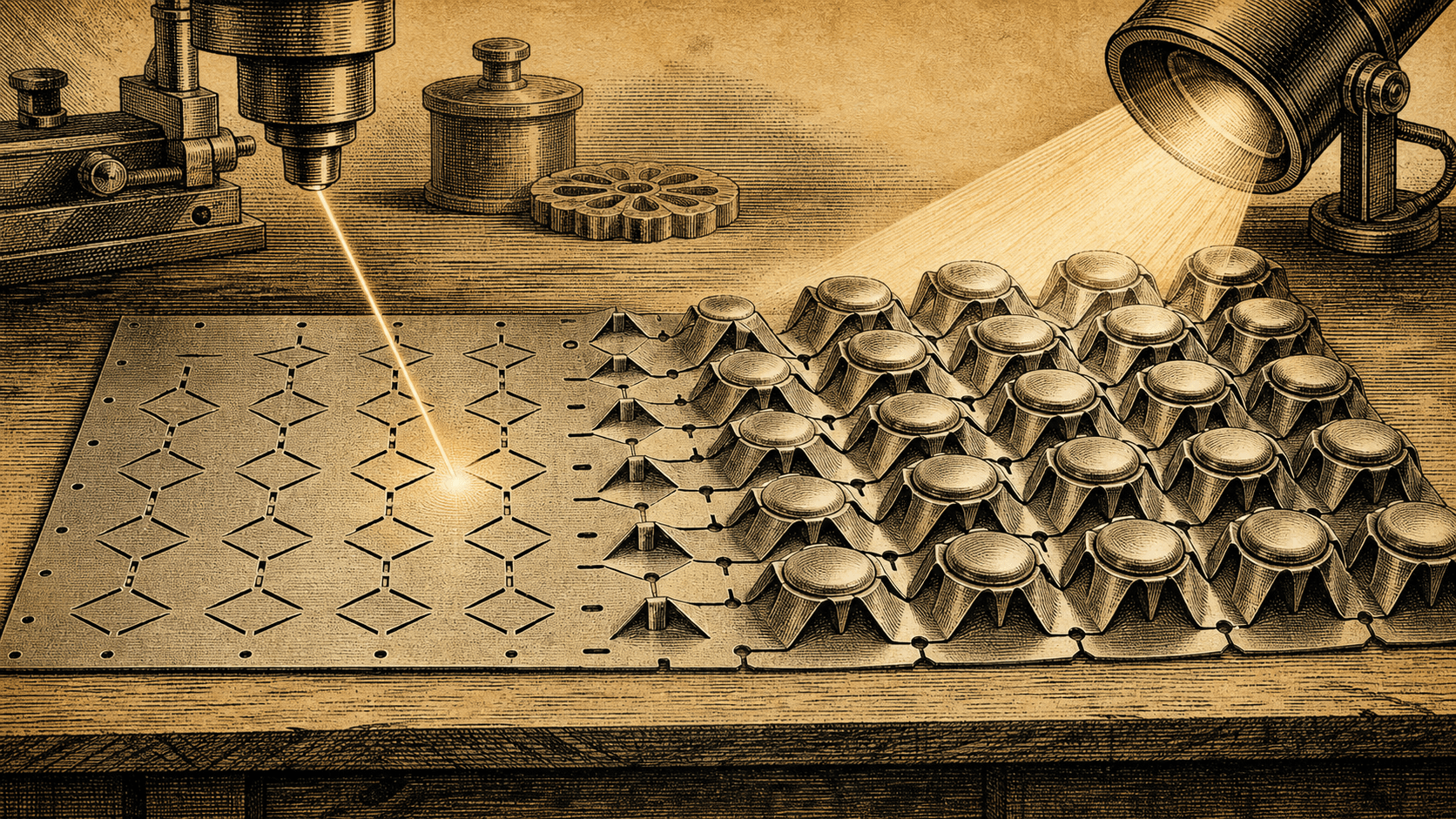
KAIST researchers report a monolithic nickel-titanium kirigami structure whose fold pattern and photothermal behavior are written in one ultraviolet-laser step. The laser cuts the geometry and creates a porous titanium-oxide surface that absorbs near-infrared light without a separate coating; varying the oxidation lets different regions respond in sequence. The team demonstrated reconfigurable buttons and tactile signals. The work is an institutional research report about laboratory prototypes, not a commercial display or deployed accessibility device.
Conceptual tensor-network compression; not a quantum computer, literal study diagram, or commercial benchmark. Original editorial illustration generated with built-in Codex Image Gen for The Machine Press, 2026-07-20.
Tensor networks let researchers classically simulate hundreds of interacting qubits on several lattices, with some runs completed on ordinary hardware.
Researchers at the Flatiron Institute and Boston University used tensor-network methods to compress quantum many-body states that would be impossibly large if represented directly. Their classical calculations covered hundreds of interacting qubits on square, cubic, and diamond lattices; some simulations ran on a laptop and agreed with theory and quantum-computer results. The Science paper challenges a prior claim that this problem class was already beyond classical reach. It does not show that classical machines can efficiently reproduce every quantum computation.
In a national survey, fewer than one in five older cannabis users reported discussing it with a clinician.
A University of Michigan-led analysis of more than 14,000 older adults found that only about one third were screened for cannabis or other drug use, and fewer than one in five people who used cannabis had discussed it with a clinician. Federal survey data cited by the researchers put past-year cannabis use among adults 65 and older at 10.5 percent in 2024. The findings describe self-reported communication and screening gaps; they do not show that cannabis caused a particular health outcome.
Generic empty laboratory glassware; not seawater, microplastics, fish samples, a field site, or study result. Rodolfo Clix / Pexels; cropped, resized, metadata stripped, and converted to WebP by The Machine Press.
A global analysis argues that reproductive timing exposes hazards hidden by annual averages.
Researchers combined 6,327 seawater observations, 3,959 fish-burden samples, pollutant records, and reproductive data for 992 species across 65 large marine ecosystems. They estimate that 7.8 percent of critical spawning grounds exceeded ecological safety thresholds, while mean concentrations in the Baltic Sea and Gulf of Thailand were more than 7.8 times the global average. The study maps modeled ecological risk and co-exposure; it does not establish a uniform causal effect for every fish population.
A temporary microglia depletion reversed sleep loss in an Alzheimer's model without changing amyloid plaques.
University of Kentucky researchers temporarily depleted about 87 percent of microglia for 14 days in a mouse model of Alzheimer's disease. The animals recovered more than two hours of sleep per day, chiefly non-REM sleep, even though amyloid plaque burden did not change. The result points toward immune signaling as a contributor to disrupted sleep in this model. It is a short preclinical experiment and does not establish a safe or effective treatment for people.
Mayo Clinic's decentralized program was associated with more participation from distant, rural, and underserved communities.
A Mayo Clinic evaluation covered 765 trials and 7,469 participants over 15 months as remote consent, video visits, home blood draws, and medication delivery expanded. Participation by people living more than 120 miles away rose from 18.9 to 29.6 percent; rural participation rose from 16.6 to 24.9 percent, and participation from underserved racial and ethnic groups rose from 12.5 to 17.4 percent. The before-and-after program study shows association, not randomized proof that decentralization caused every change.
Across four health systems, 16 percent of adults never repeated annual FIT screening after an initial negative result.
Researchers followed 492,812 adults after a negative fecal immunochemical test across four health systems. Fifty-four percent repeated screening in more than three quarters of eligible years, 30 percent returned at least once, and 16 percent never retested. Advanced cancer accounted for 19 percent of diagnoses among never-retesters versus 12 percent in the other groups. Outreach practices differed sharply between systems, but this observational analysis cannot assign every outcome to reminder design alone.
A field study says carcass surveys delayed by days can miss wildlife deaths after prescribed fire.
Adelaide University researchers report that animal remains after prescribed burns can vanish in less than two weeks as scavengers and decomposition erase evidence. The finding means delayed monitoring can substantially undercount deaths and distort comparisons between burn practices. The team recommends surveys begin within hours and continue repeatedly after a fire. The work improves detection, but it does not by itself estimate the total wildlife toll of every prescribed burn or argue against fire management as a whole.
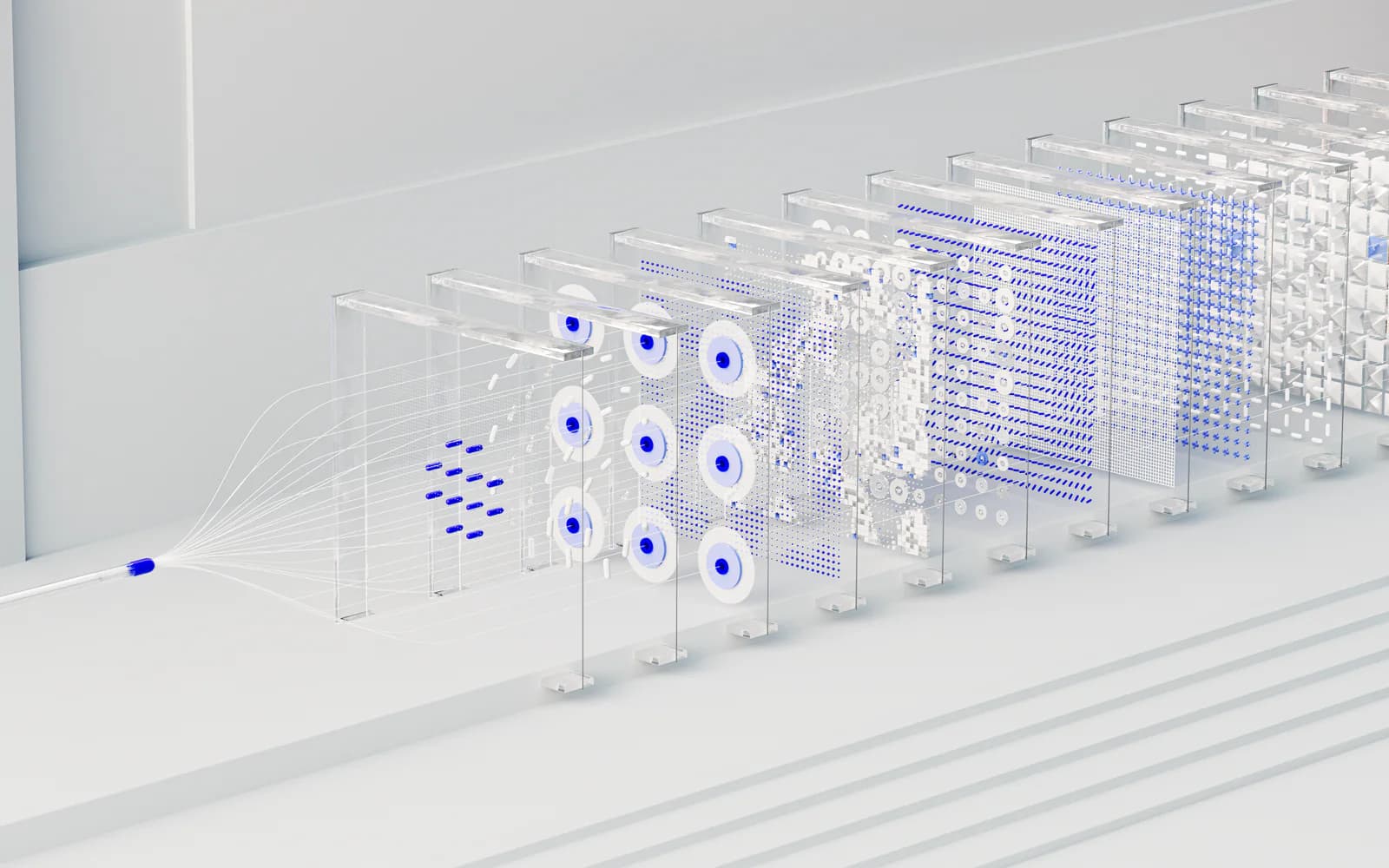
Conceptual Visualising AI artwork inspired by neural networks; not CardiOmicScore, biological data, a model architecture, or study result. Novoto Studio / Google DeepMind / Pexels; cropped, resized, metadata stripped, and converted to WebP by The Machine Press.
CardiOmicScore combines thousands of proteins and metabolites to identify elevated cardiovascular risk years ahead.
A University of Hong Kong team trained a deep-learning model on UK Biobank measurements spanning 2,920 proteins and 168 metabolites. The resulting CardiOmicScore predicted risk across six cardiovascular diseases and, for people it classified as elevated risk, could signal danger as far as 15 years ahead. In the reported analysis it outperformed a polygenic risk score. The score remains a research model derived from one large cohort, not an approved clinical blood test or a substitute for established assessment.
Tetrapod zinc oxide formed porous networks that spread ultraviolet protection more evenly in laboratory formulations.
UCLA researchers replaced conventional zinc-oxide particles with tetrapod-shaped structures that interlock into porous networks rather than clumping. At the same zinc-oxide concentration, the experimental formula reached roughly SPF 30 while appearing less white in laboratory measurements and controlled skin applications, without pigments or surface coatings. Particle geometry may improve both coverage and appearance, but the formulation is a research prototype and has not been established as a commercial or regulator-approved sunscreen.
Cavitation and cold plasma degraded PFAS in water, but incomplete mineralization and energy costs remain central problems.
Helmholtz-Zentrum Dresden-Rossendorf researchers compared hydrodynamic cavitation with cold plasma for destroying PFAS in contaminated water. Cavitation degraded about 37 percent of PFOS with evidence of mineralization, short of the team's greater-than-80-percent goal. Cold plasma nearly degraded both long- and short-chain compounds but released only about 35 percent of the fluorine and required more energy, leaving transformation products and possible gaseous emissions to resolve. Both results are laboratory demonstrations, not treatment-plant performance claims.
A glow discharge turned simple gases into carbon-, hydrogen-, oxygen-, and nitrogen-rich grains with familiar infrared signatures.
University of Sydney researchers mixed nitrogen, carbon dioxide, and acetylene in a glass vessel, then applied an electrical glow discharge of roughly 10,000 volts for an hour. The experiment produced complex CHON-rich organic molecules and dust whose infrared signals resembled material observed in space. The benchtop analog gives researchers a repeatable way to study possible formation pathways. It does not reproduce every condition in a molecular cloud or demonstrate how life began.
Illustrative fiber-optic macro photograph; not an acoustic measurement, participant sensation, tinnitus mechanism, or external source of the Hum. Atlantic Ambience / Pexels; cropped, resized, metadata stripped, and converted to WebP by The Machine Press.
Tests of 28 people who hear a persistent low tone found little evidence for exceptional hearing or measurable sound emitted by the ear.
Norwegian University of Science and Technology researchers examined 28 German participants who report hearing the low-frequency phenomenon called the Hum. Most did not have unusually sensitive low-frequency hearing, and measurements did not support the idea that their ears were physically emitting the sound. The authors say low-frequency tinnitus is the strongest remaining explanation. The study is small and does not rule out external noise sources in every case or identify a single mechanism for all listeners.
Procedures among men ages 18 to 44 increased more than 60 percent from 2016 to 2024.
Adelaide University researchers analyzed Medicare and national demographic data from 2015 through 2024. Vasectomies among Australian men ages 18 to 44 rose from 18,544 in 2016 to 29,848 in 2024, an increase above 60 percent. The researchers place the trend alongside cost-of-living pressure and changing fertility patterns. Those population-level associations do not reveal why any individual chose the procedure, and the statistical analysis should not be read as a causal measure of household finances.
A 62-country analysis classifies Gaza-war slogans through victim, villain, and hero frames.
Sungkyunkwan University sociologist Tay Jeong analyzed country-level X trending data from the early Gaza war through a victim-villain-hero framework. Across 62 countries, pro-Palestinian trends emphasized victimhood broadly, with hero language more prominent in Arab countries; pro-Israel trends centered more heavily on villain framing and rarely used the hero role. The study examines the composition of trending slogans, not the views of every user or population, and its categories remain an interpretive model of public rhetoric.
Focused ultrasound with microbubbles triggered oligodendrocyte-lineage growth in adult mice.
Researchers used focused ultrasound plus microbubbles to modulate the blood-brain barrier in adult mice. Oligodendrocyte precursor-cell proliferation in the hippocampus rose 6.8-fold after one day and 2.3-fold after four days; myelinating oligodendrocytes were 5.3-fold higher after a month. A second striatal experiment showed a similar trajectory, while ultrasound without microbubbles produced no effect. The work is preclinical and does not establish repair, functional benefit, or safety in human neurological disease.
Desk Picks are selected by the newsroom. Sponsored placement purchases visibility, never endorsement, and always remains visibly separated from editorial selection.
 Editorial illustration