research
The Quantum Problem Fits on a Laptop
Tensor networks let researchers classically simulate hundreds of interacting qubits on several lattices, with some runs completed on ordinary hardware.
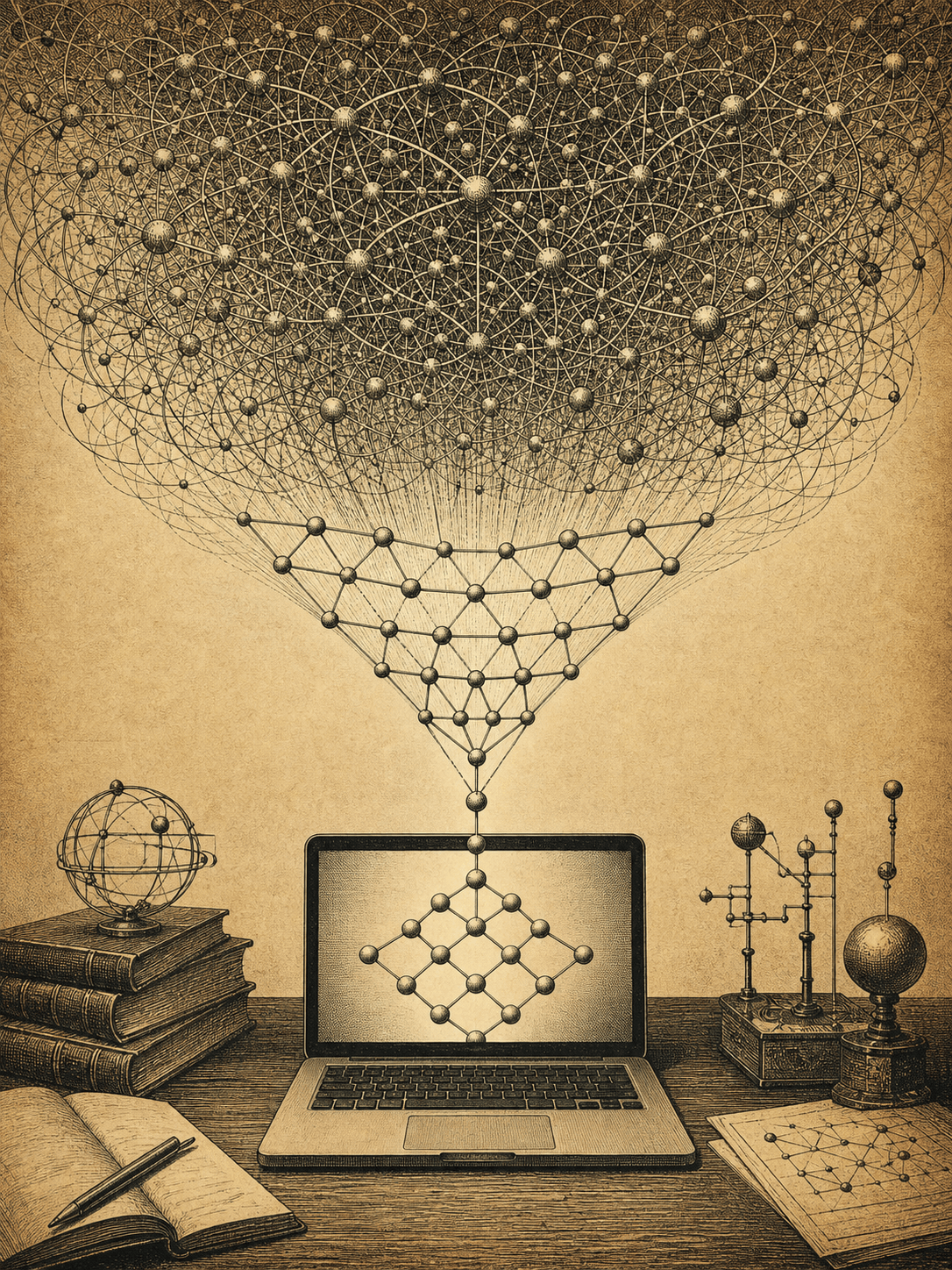
Summary
Tensor networks let researchers classically simulate hundreds of interacting qubits on several lattices, with some runs completed on ordinary hardware.
Researchers at the Flatiron Institute and Boston University used tensor-network methods to compress quantum many-body states that would be impossibly large if represented directly. Their classical calculations covered hundreds of interacting qubits on square, cubic, and diamond lattices; some simulations ran on a laptop and agreed with theory and quantum-computer results. The Science paper challenges a prior claim that this problem class was already beyond classical reach. It does not show that classical machines can efficiently reproduce every quantum computation.
Why it matters
Tensor networks let researchers classically simulate hundreds of interacting qubits on several lattices, with some runs completed on ordinary hardware.
Limits and context
- It does not show that classical machines can efficiently reproduce every quantum computation.
Key claims
Tensor networks let researchers classically simulate hundreds of interacting qubits on several lattices, with some runs completed on ordinary hardware.
Qualification: It does not show that classical machines can efficiently reproduce every quantum computation.
Evidence: source-2026-07-20-002
Sources
- Simons Foundation via ScienceDaily: Classical quantum simulationSimons Foundation via ScienceDaily · secondary reporting
Corrections
No corrections have been recorded for this story.