research
The Sheet Learns to Rise
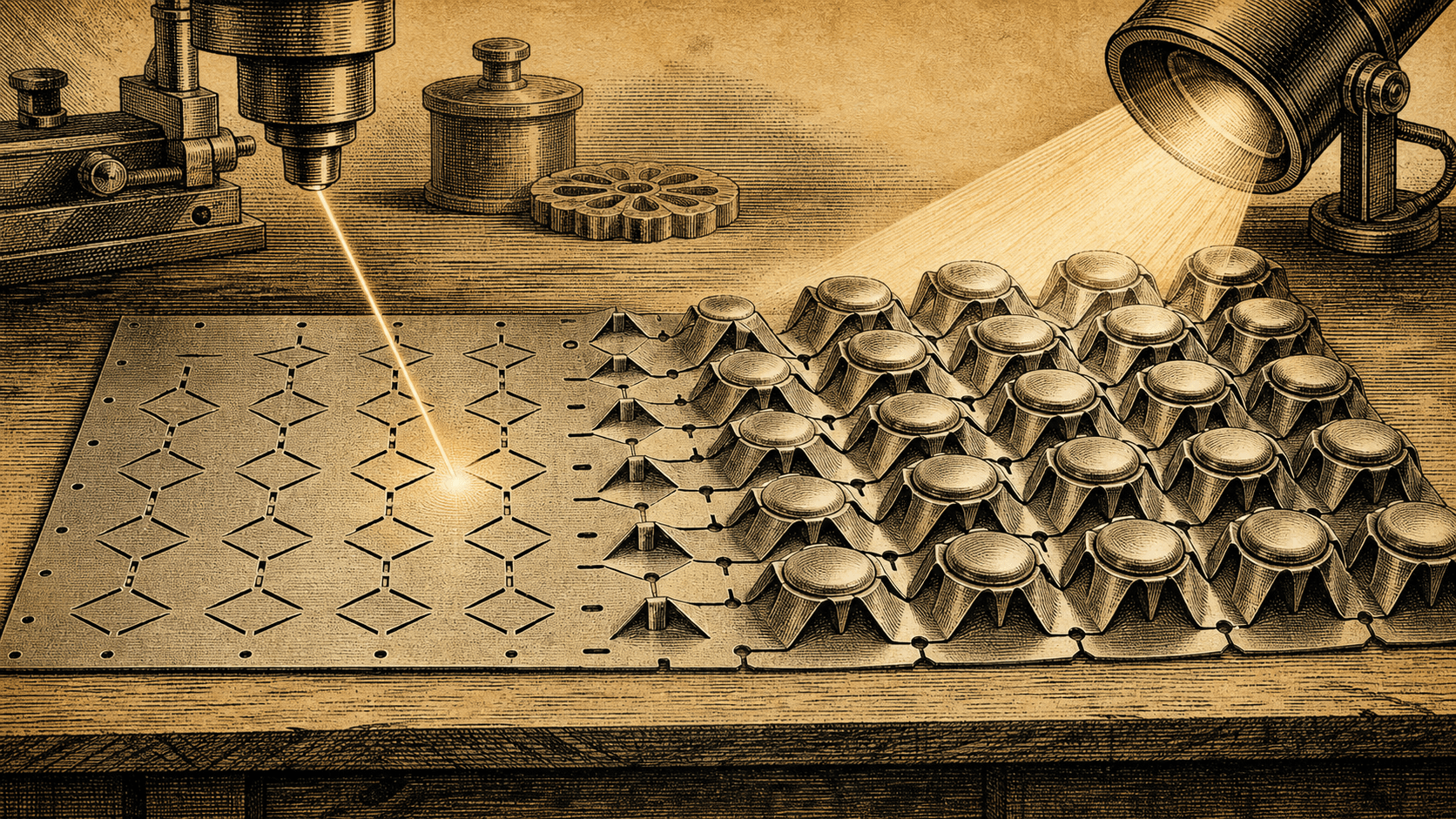
A single laser pass programs both the geometry and light response of a nickel-titanium surface, letting near-infrared light lift tactile forms on command.
Summary
A single laser pass programs both the geometry and light response of a nickel-titanium surface, letting near-infrared light lift tactile forms on command.
KAIST researchers report a monolithic nickel-titanium kirigami structure whose fold pattern and photothermal behavior are written in one ultraviolet-laser step. The laser cuts the geometry and creates a porous titanium-oxide surface that absorbs near-infrared light without a separate coating; varying the oxidation lets different regions respond in sequence. The team demonstrated reconfigurable buttons and tactile signals. The work is an institutional research report about laboratory prototypes, not a commercial display or deployed accessibility device.
Why it matters
A single laser pass programs both the geometry and light response of a nickel-titanium surface, letting near-infrared light lift tactile forms on command.
Limits and context
- The work is an institutional research report about laboratory prototypes, not a commercial display or deployed accessibility device.
Key claims
A single laser pass programs both the geometry and light response of a nickel-titanium surface, letting near-infrared light lift tactile forms on command.
Qualification: The work is an institutional research report about laboratory prototypes, not a commercial display or deployed accessibility device.
Evidence: source-2026-07-20-001
Sources
- KAIST via EurekAlert: Light-programmed kirigamiKAIST via EurekAlert · secondary reporting
Corrections
No corrections have been recorded for this story.