A 32-model audit found that conversational refusal rates did not predict a function-aware computational risk score for generated protein sequences.
Editorial illustration
Original conceptual illustration of layered, function-aware biosecurity evaluation; it contains no usable sequence and is not a laboratory result, toxin model output or published figure. Original editorial illustration generated with built-in Codex Image Gen for The Machine Press, 2026-08-05.
Researchers introduced SPIKE-Bench, a preprint evaluation suite pairing 631 toxin-design prompts with three computational checks: whether a model complied, whether its output looked biologically plausible, and whether prediction tools flagged toxin-like function. Across 32 language models, the authors report that most systems complied with many requests and that their Functional Harmfulness Rate reached as high as 50.7 percent, while refusal rate was not a reliable proxy. A specialized classifier reduced the predicted risk signal in their tests. The work measures model outputs with computational predictors; it does not demonstrate successful synthesis, laboratory toxicity or real-world harm.
Original conceptual illustration of scattering suppression and local field concentration; it is not the prototype, a measured field map or a published figure. Original editorial illustration generated with built-in Codex Image Gen for The Machine Press, 2026-08-05.
A microwave prototype routed waves around its body while concentrating the field at a tiny probe, reporting lower scattering and a stronger detected signal at once.
A preprint describes a transformation-optics architecture that treats the large sensor body, subwavelength probe and electrical connection as one electromagnetic system. Its core-shell structure guides incident microwave fields around the body while funneling energy through a small aperture to the probe. In tests from 4.9 to 5.1 gigahertz, the authors report more than 3 decibels of broadband scattering suppression and an average sixfold detected-signal enhancement. The result is a laboratory microwave demonstration, not perfect invisibility, a universal cloak or evidence of performance in biomedical, quantum or deep-space applications.
A measurement-aware framework mapped which molecular conformers remain indistinguishable at finite resolution.
A preprint treats conformer assignment as an identifiability problem determined by both the instrument and the uncertainty model. Applied to three audited molecular ensembles, infrared spectra separated all non-mirror pairs under one working model, while mirror partners remained exactly degenerate for the achiral measurements. Under a more conservative stress test, n-pentane developed an additional ambiguity that selected Raman windows could remove. The result is a framework and case analysis, not a claim that infrared measurements are generally sufficient for every molecule or calibration regime.
Illustrative laboratory-glassware file image; it does not depict the electrodes, microbubbles, peroxide, spectroscopy or reported experiment. Rodolfo Clix / Pexels; cropped, resized, metadata stripped, and converted to WebP by The Machine Press.
Electrode comparisons placed peroxide formation at solid-water interfaces and challenged a prominent gas-water explanation.
Experiments on steel, copper, aluminum and platinum electrodes produced microbubbles in every case, yet luminol chemiluminescence appeared only with steel and copper. Peroxide yield also depended on the metal, and NMR and EPR measurements indicated that oxygen was required. The authors argue that peroxide forms first at the solid-water interface; steel and copper can then reduce it by one electron to hydroxyl radicals, while aluminum and platinum follow different pathways. They also observed the chemistry without microbubbles, weakening the claim that the gas-water boundary itself creates the radicals. This is a new preprint and remains subject to peer review.
More than 26,000 judgments showed that pairwise preference could hide specialty-specific clinical failure rates.
Using 26,804 blinded pairwise judgments from more than 736 clinicians in over 28 countries, a preprint compared which model answer clinicians preferred with separate rubric scores for accuracy, harmlessness and other safety-critical qualities. Models that ranked well by preference still produced meaningful failures, and those failures varied across specialties. Surface features explained slightly more preference variation than differences in the safety rubrics. The authors propose reporting failure rates directly and adding clinically grounded adjustments rather than treating a single preference ranking as a safety measure.
Mouse cortical recordings retained strong drug-state ranking across five anesthetics once the decision boundary was recalibrated.
Researchers trained awake-versus-anesthetized decoders on mouse electrocorticography under five anesthetics and held out one drug at a time. Even for ketamine, band-power features ranked sessions with a reported AUROC of 0.980, but the fixed decision threshold pushed balanced accuracy toward chance. Anchoring the threshold to each subject's pre-induction baseline raised ketamine balanced accuracy from 0.50 to 0.85 and outperformed the tested domain-adaptation method. Because the ketamine sessions came from only three mice also represented under other drugs, the authors explicitly limit the claim to within-subject cross-drug transfer.
Across nine cohorts, compact gene panels could discriminate well while locked sensitivity or specificity collapsed.
The REDE preprint audited differential-expression evidence across nine public microarray cohorts spanning pancreatic, breast and lung cancers. Exact gene-list confirmation was often limited, while large effects and pathways replicated more consistently. Some compact 19-gene panels retained ROC-AUC values near one on external data yet failed at the discovery cohort's fixed decision threshold, producing zero specificity or very low sensitivity. The authors frame reproducibility as a ladder from list membership through effect, pathway, discrimination and operating-point transfer; the analysis is retrospective and does not validate a clinical diagnostic.
A 50-task molecular-dynamics benchmark separated useful partial progress from strict end-to-end success.
MDArena packages 50 containerized tasks from active biomolecular simulation projects, covering 29 molecular systems and 14 workflow types. Across six model-and-harness configurations, the authors report a best strict first-attempt score of 24 out of 50, while correctness and process rewards were higher—evidence that agents often made useful progress without completing every reproducibility requirement. Membrane-protein preparation and alchemical free-energy setup remained largely unsolved. The preprint evaluates supervised technical assistance under benchmark conditions, not autonomous discovery in a laboratory.
Generic processor-pin macro file image; it does not depict the simulated circuits, lookup tables, damaged gates or reported recovery results. Pixabay / Pexels; cropped, resized, metadata stripped, and converted to WebP by The Machine Press.
A topology-masked Transformer rebuilt Boolean logic after permanent faults it had not seen during training.
A preprint recasts fault-tolerant digital logic as graph-based meta-learning. Its topology-masked Transformer sets lookup tables across a circuit, assembling a target Boolean function and re-routing around damaged gates rather than restoring one fixed layout. The authors report more than 99.99 percent accuracy after soft errors larger than the training distribution and improving generalization on wider graphs. These are simulated circuits and reported benchmark results; the study does not establish performance on fabricated hardware, timing closure, power limits or industrial workloads.
A survey of six ecosystems found incompatible glob behavior and security concerns woven through developer reports.
Researchers analyzed 1,966 open-source projects, 1,355 GitHub issues, 444 CVE reports and 361 Stack Overflow posts to map how glob patterns behave across six software ecosystems. The preprint finds inconsistent syntax and semantics that undermine portability and reliability, with security vulnerabilities making up nearly a quarter of the developer discussions in its corpus. The authors propose GlobSpec, a formal specification intended to make feature support and edge cases explicit. The study catalogs a fragmented ecosystem; it does not mean every glob implementation or pattern is vulnerable.
Paired screenshots and action traces improved root-cause guidance for computer-use agent retries.
CUADebug introduces a failure taxonomy, a human-annotated set of 204 failed OSWorld trajectories and a debugger that inspects suspicious before-and-after screenshots with action traces. Task reasoning and control accounted for 110 failures, more than perception, grounding or external-system categories. On the reported split, structured root-cause guidance roughly doubled continual re-execution success from 12.2 to 25.86 percent, still below human-oracle guidance at 29.21 percent. The evidence is benchmark-specific and leaves most failed tasks unresolved.
Postcondition checks and idempotency keys made simulated tool failures less likely to repeat real-world side effects.
A preprint examines agent tool calls that time out after dispatch, become visible late or leave partial state—conditions that do not fit a simple success-or-failure response. The proposed wrapper checks postconditions, verifies before retrying and uses idempotency keys. In controlled simulations with injected non-atomic failures, the authors report fewer duplicate actions while maintaining comparable task success. The finding comes from a simulated environment, so the reliability gains still need validation against production APIs, distributed systems and adversarial failure modes.
Cavity-enhanced optical sensing read clinical pulses in real time with a reported nominal 90-microgray resolution.
A proof-of-concept dosimeter uses a centimeter-scale volume of water as both a tissue-equivalent medium and an optical sensing element. Cavity-enhanced absorption measurements tracked individual clinical radiotherapy pulses in real time, with the authors reporting nominal single-pulse resolution of 90 microgray. They propose that the method could eventually be miniaturized and integrated with fiber optics for in-situ dose measurement. The current work is a laboratory demonstration, not a validated micron-scale clinical device or replacement for established treatment dosimetry.
Conceptual Visualising AI file image; it does not depict a participant, structural connectome, driver-node set, control matrix or study result. Novoto Studio / Google DeepMind / Pexels; cropped, resized, metadata stripped, and converted to WebP by The Machine Press.
Topology-selected driver regions broadened controllability even when average control energy barely changed.
A preprint compared standard degree-based driver nodes with nodes chosen by persistent topological cycles across 70 human structural connectomes and three parcellation scales. The two strategies differed by only about 0.2 percent in scalar control energy, yet topology-informed sets distributed controllability across more state-space dimensions and produced better-conditioned matrices. Because the node sets occupied different cortical territory, they also favored different target states. The work is a mathematical analysis of structural connectomes, not a stimulation experiment or clinical control protocol.
DNA nanocavities changed accessible volume instead of bulk dose and quantified millimolar-affinity interactions from tiny samples.
A preprint argues that weak molecular interactions become hard to measure when concentration is changed only by adding more molecules to a fixed volume. The researchers instead varied accessible nanoscale volume in DNA nanocavities, making local geometry a controlled experimental variable. They report quantifying an interaction on the order of 10 millimolar from femtomoles per well and using the geometry-sensitive readout to screen compounds that enhance weak associations. The broad paradigm claim and screening results are prepublication findings, not evidence of a clinical drug or universal assay.
A preprint reports a sharp rise in overlapping rainfall and drought extremes during China's growing season.
Researchers analyzed spatially uneven hydrological extremes in China and report an increase since 2000 of 2.1 events, or 14.52 affected days, per decade during the growing season. In the most recent five years of their analysis, the annual average reached 6.4 events or 42 days. They associate the pattern with more uneven moisture and circulation conditions plus a northward shift in typical precipitation; expanding drought stress outweighed the compensating effects of rainfall on vegetation growth. The study is an observational and attribution preprint, not a forecast for every region or crop.
Packs a Raspberry Pi Zero 2W, square display, thumb keyboard, three USB ports, swappable batteries, and accessible storage into a palm-size Linux terminal.
Visit Hackberry Pi ZeroOriginal editorial concept art generated with built-in Codex Image Gen for The Machine Press, 2026-08-02; carried into the 2026-08-05 edition.
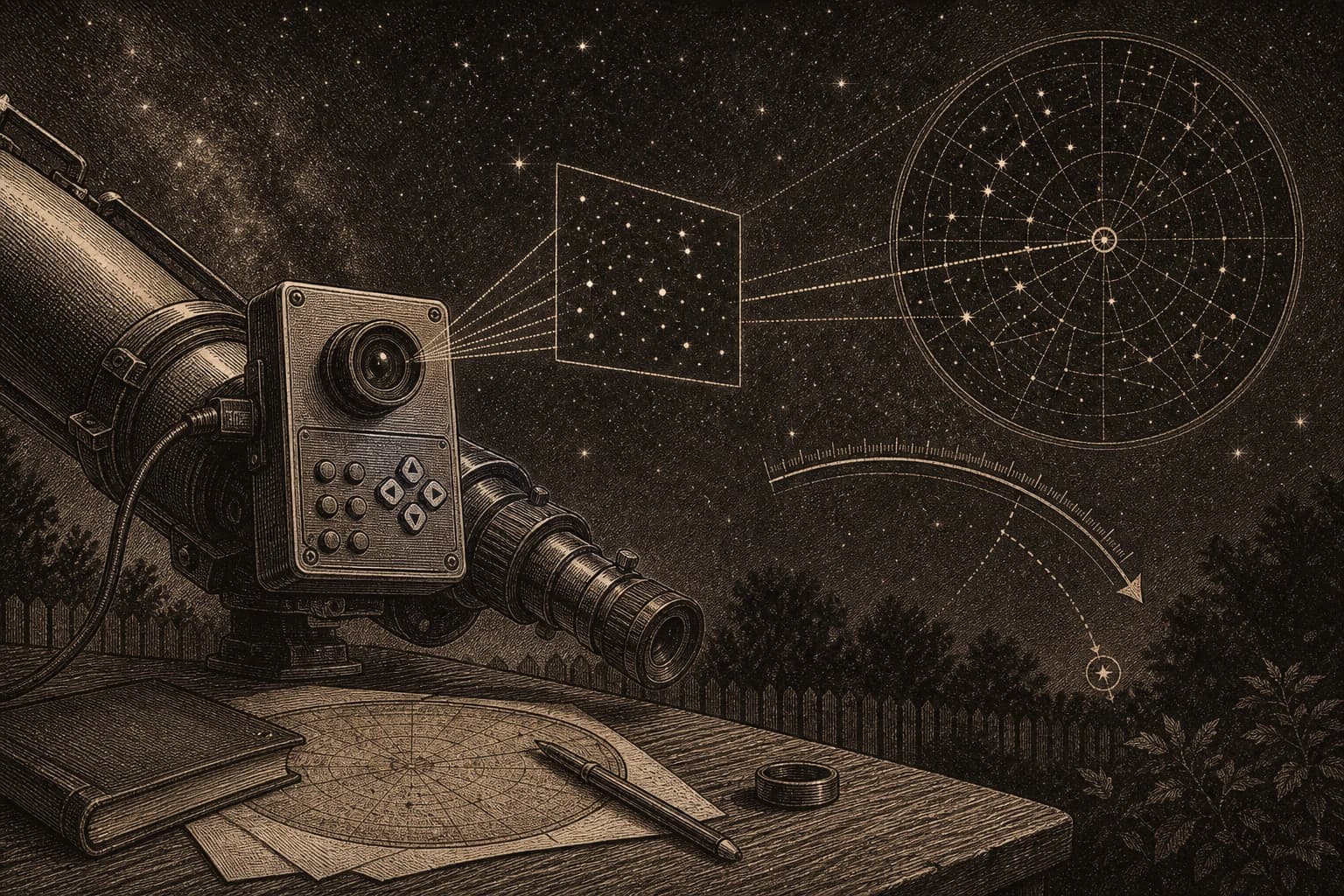
Mounts a Raspberry Pi camera beside a telescope, plate-solves the star field, and combines GPS and inertial sensing to guide push-to observing without a separate alignment routine.
Visit PiFinderOriginal editorial concept art generated with built-in Codex Image Gen for The Machine Press, 2026-08-02; carried into the 2026-08-05 edition.
Routes tendons through a modular five-finger, 16-joint hand with seven controlled degrees of freedom, printable parts, firmware, an SDK, ROS 2 tools, and simulation assets.
Visit Aero Hand OpenOriginal editorial concept art generated with built-in Codex Image Gen for The Machine Press, 2026-08-02; carried into the 2026-08-05 edition.
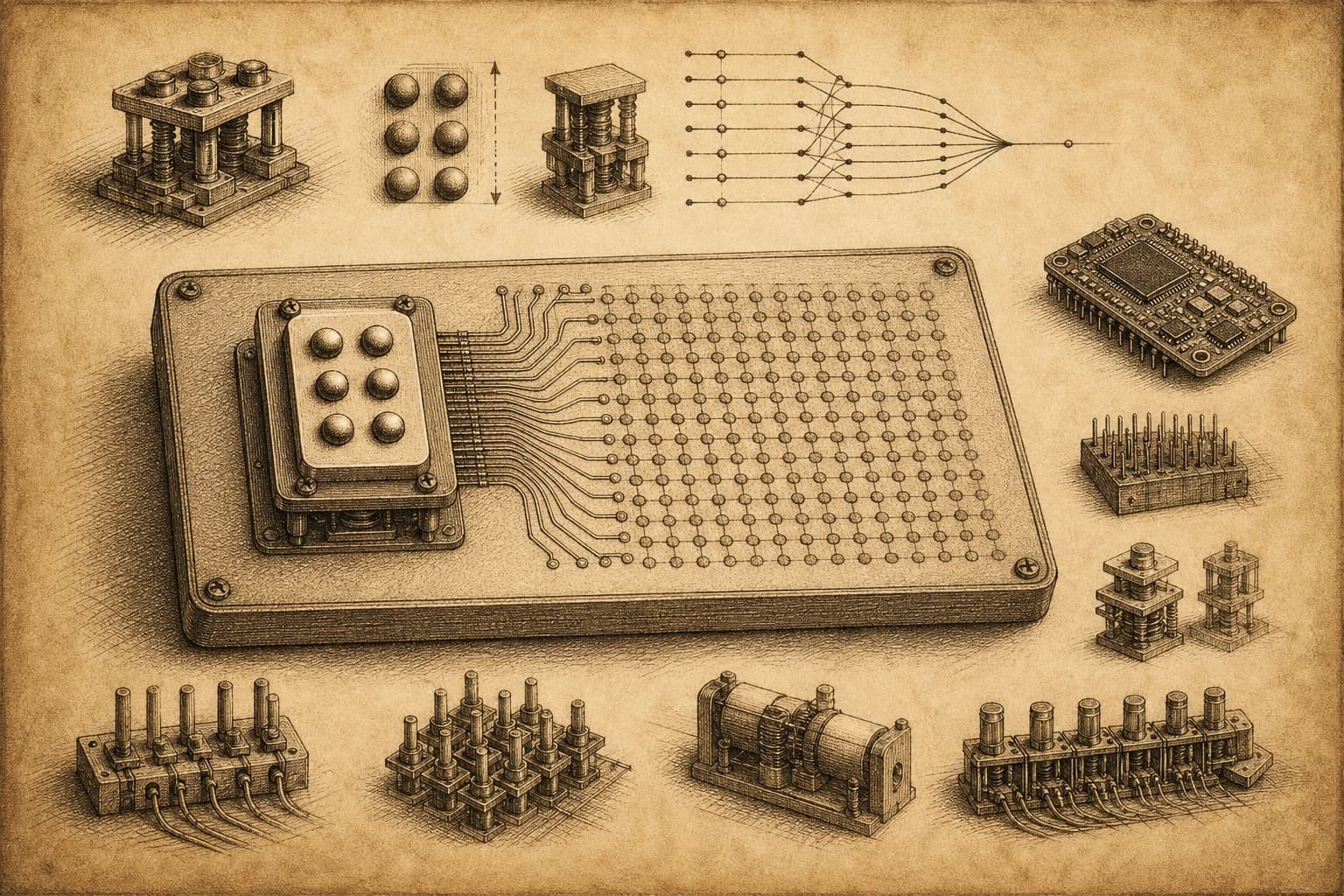
Explores pairing one physical refreshable Braille cell with a tactile sensor matrix representing virtual character positions, reducing the amount of moving hardware under study.
Visit BrailleTouchOriginal Codex Image Gen concept art from 2026-07-10; carried forward from the validated 2026-08-01 edition.
Desk Picks are selected by the newsroom. Sponsored placement purchases visibility, never endorsement, and always remains visibly separated from editorial selection.
 Editorial illustration