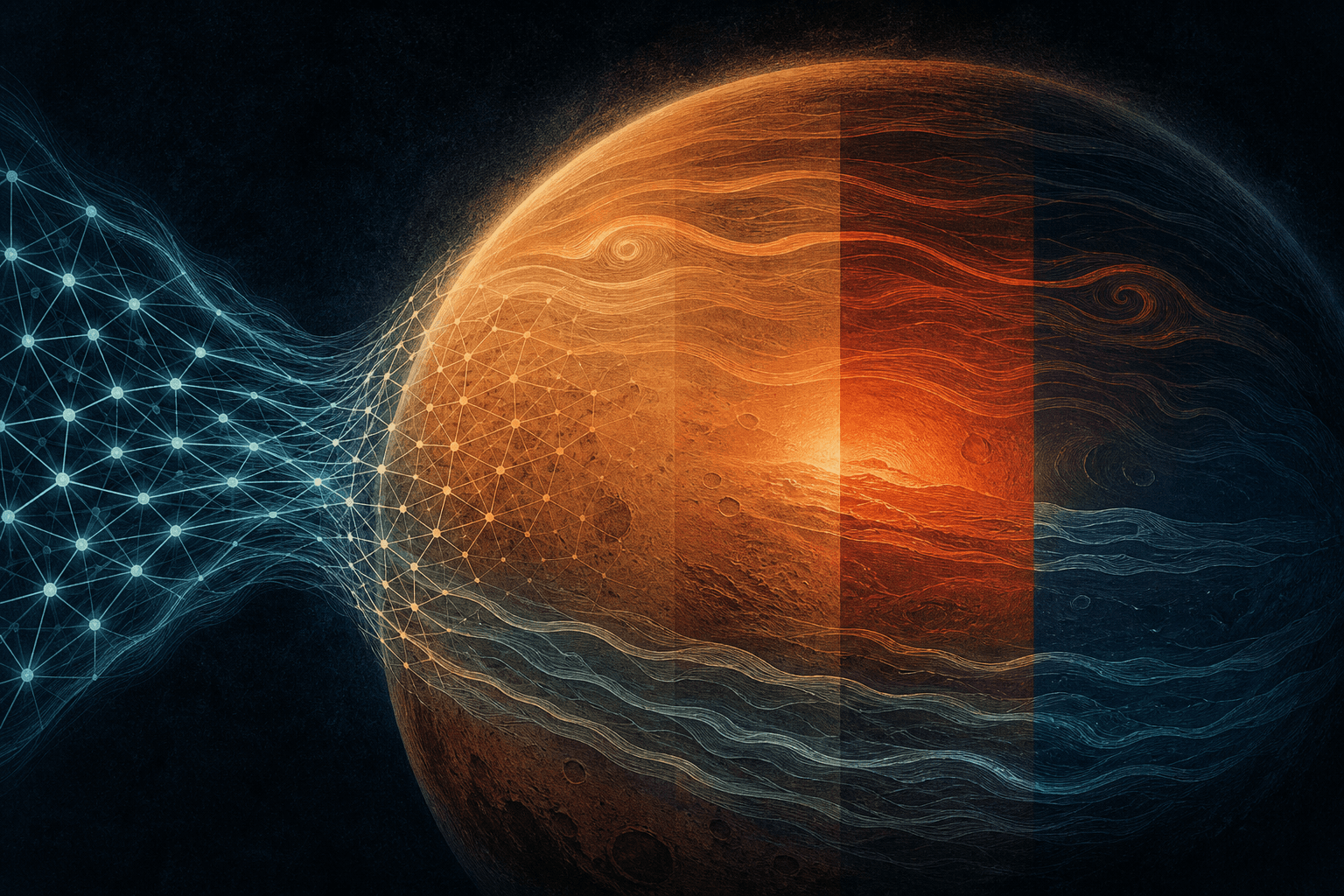
An Earth-trained graph forecaster lost Mars's daily rhythm until researchers taught it the planet's variables and the Sun's changing input.
Editorial illustration
Original conceptual illustration of an Earth weather representation being adapted to modeled Martian temperature and wind; it is not an observation, operational forecast, interface or published figure. Original editorial illustration generated with built-in Codex Image Gen for The Machine Press, 2026-08-06.
MarsCast adapts GraphCast, a model developed for terrestrial weather, to temperature and wind fields from the Mars Climate Database. In zero-shot tests, the transferred model captured the initial atmospheric state but its forecasts decayed toward climatology and lost much of the day-night variation. Fine-tuning with Mars-specific variables and top-of-atmosphere solar forcing recovered a diurnal cycle within ten training epochs; the authors report forecasts out to ten days that reproduce seasonal and vertical temperature structure. These are preprint experiments against a climate database, not operational forecasts or validation against a new observing campaign.
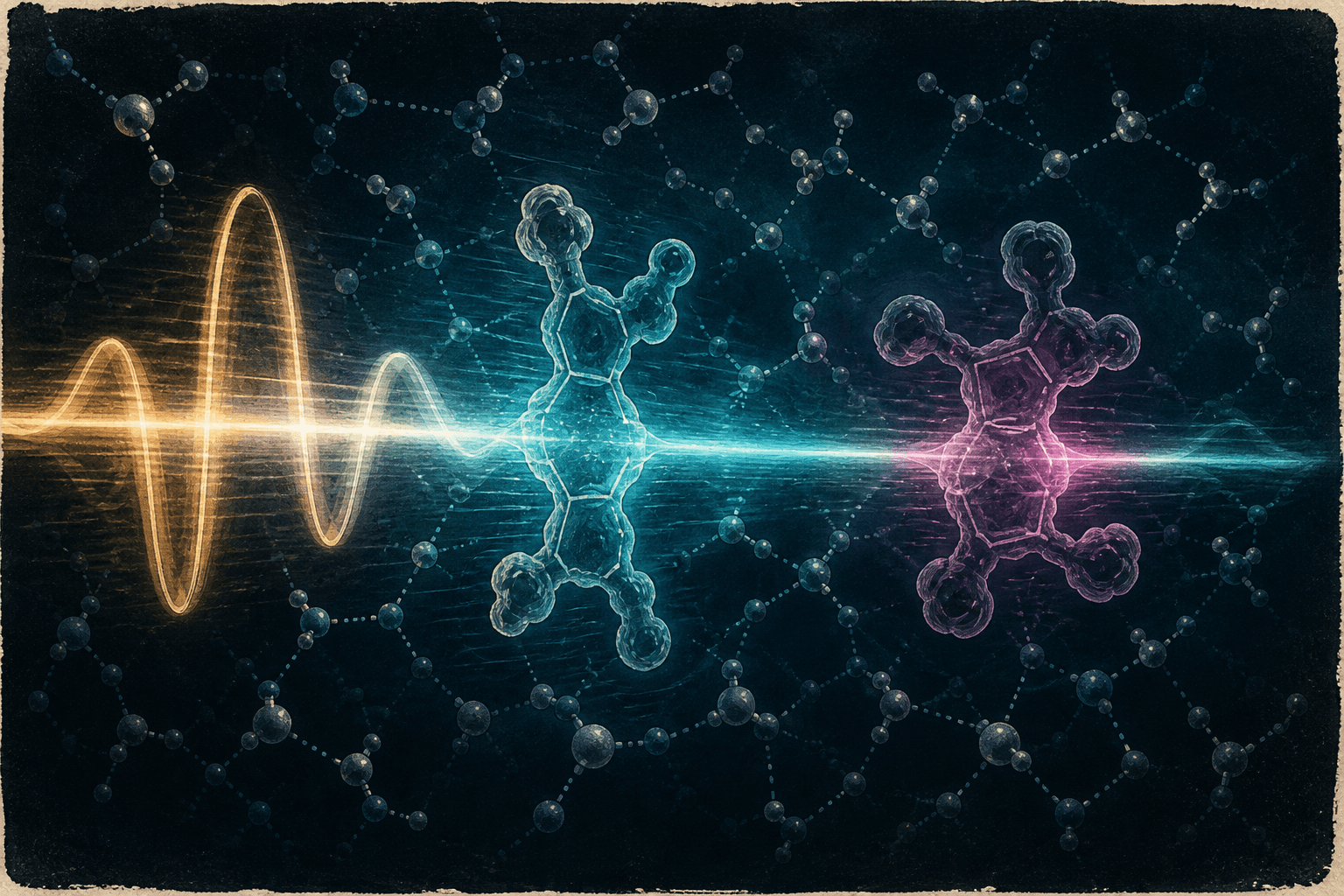
Original conceptual illustration of ultrafast electric-field spectroscopy in liquid water; it is not a molecular structure, apparatus, measured spectrum or published figure. Original editorial illustration generated with built-in Codex Image Gen for The Machine Press, 2026-08-06.
A single-cycle terahertz field let researchers read electric responses from dissolved dyes at room temperature before rotational motion took over.
Researchers report room-temperature Stark spectroscopy in water using intense, single-cycle terahertz pulses. Because the field changes on a sub-picosecond timescale, the experiment probes solvated molecules before they can substantially rotate in the liquid. Measurements on Malachite Green and Methyl Orange showed distinct linear and quadratic spectral responses, which the authors connect respectively to permanent-dipole and polarizability effects using time-dependent density-functional calculations. The preprint establishes a technique in two dye systems; it does not demonstrate universal molecular identification, biological effects or a commercial sensor.
Assigning real molecules to an abstract reaction network while preserving mass balance and allowed mechanisms is computationally hard, but pruning helps in practice.
A theoretical chemistry preprint formalizes molecular realizability: whether the nodes of an abstract reaction network can be assigned known molecules while satisfying mass balance and specified reaction mechanisms. The authors prove the general decision problem NP-complete and present a backtracking-and-pruning algorithm for practical instances. The result concerns computational assignment under a defined database and rule set; it does not show that an assigned network will be kinetically viable in a laboratory.
Conceptual Visualising AI file image inspired by neural networks; it does not depict CT data, a scanner, a patient, acquisition geometry, artifacts or the reported reconstruction. Novoto Studio / Google DeepMind / Pexels; cropped, resized, metadata stripped, and converted to WebP by The Machine Press.
A reconstruction study traced streaks and strips chiefly to small pose errors in the scanner geometry, then refined that geometry alongside the image.
A study of splat-based sparse-view computed tomography argues that acquisition-pose errors, more than sparse sampling alone, drive prominent streak and strip artifacts. The authors jointly optimized the reconstruction and geometric parameters with gradients, reporting improved results after pose refinement across their tests. The work appears in the CVPR 2026 record and is a reconstruction-method study, not a clinical trial or claim about a particular scanner or patient.
Android-style tests found multimodal agents treated the same request differently when a calendar app became an unfamiliar music requester.
Researchers tested four frontier multimodal models on Android-style permission pop-ups embedded in tasks. In one comparison, changing the requesting app from a calendar to PiMusic moved grants from 26 of 32 cases to zero, even when the requested permission stayed the same. Task context also strongly affected decisions, while explanations were inconsistent. The authors propose separating task execution from authorization; their benchmark measures simulated interface choices, not production-device security.
A retrieval attack avoided direct contradiction by presenting false material as newer information, increasing success across many tested settings.
PURSUE tests a black-box retrieval-augmented-generation poisoning strategy that frames injected misinformation as a non-contradictory update rather than an explicit conflict. Across three question-answering benchmarks, five generators and three conflict-resolution methods, the authors report the highest attack success in 35 of 45 settings and a mean gain of 9.7 percentage points over their strongest prior baseline. This is defensive preprint research on benchmark systems; it does not establish compromise of a named deployed service, and this report omits operational injection instructions.
A synthetic-image detector used language-aligned provenance concepts and calibrated prototypes to generalize beyond its training generators.
A preprint introduces PE-SPC, an AI-generated-image detector that aligns visual evidence with language-described provenance concepts and calibrates semantic prototypes. The authors report better cross-generator and cross-dataset performance than a DINOv3 baseline on their selected benchmarks. The work is an evaluation of benchmark images, not a universal authenticity test, and its abstract does not establish performance against every editing pipeline or future generator.
MultiPathFormer represents individual propagation paths as tokens and retrieves environmental context rather than flattening a channel into one vector.
MultiPathFormer is a proposed wireless foundation model built around path-level channel tokens, an environment-retrieval component and a codebook anchored to the first arriving path. The authors report gains of as much as 59 percent in path-statistics tasks across 27 environments, along with improvements on downstream evaluations. The numbers are author-reported preprint results; they do not establish deployed-network throughput, coverage or commercial performance.
NASA OSAM-1 hardware file image; it does not depict Mimir, an embodied-agent benchmark, a memory system, a task environment or the reported results. Use does not imply NASA endorsement. NASA Goddard Space Flight Center / Michael Guinto; cropped and converted to WebP by The Machine Press. Use does not imply NASA endorsement.
Mimir stores environmental knowledge separately from task history, then grounds both memories when an embodied agent must act over long horizons.
Mimir separates an embodied agent's memory into world and task stores and dynamically grounds retrieved records against the current scene. The authors report a maximum success rate of 42.5 percent, a 23 percent average and an 8.5-point overall improvement over their best same-backbone comparison; they also report 86 percent on long-horizon EB-Habitat tasks. These are preprint benchmark results, and the authors say code is forthcoming rather than presently documenting a deployed robot system.
A spiking sensing-and-policy stack improved reported ObjectNav success under clean and corrupted inputs while using fewer parameters and less stepwise computation.
SpikingNav combines spiking perception with a spiking navigation policy for PointNav and ObjectNav. On the authors' ObjectNav tests, success rose from 31.05 to 34.12 percent in clean conditions and from 8.45 to 13.71 percent under corruption, alongside fewer parameters and lower per-step computation than their comparisons. The team also reports deploying its sensing component on a Thruster-V2 platform. The preprint does not establish general robot reliability outside those benchmarks and hardware tests.
A prefix-value estimate let a diffusion policy end its iterative action search early while retaining nearly all reported task performance.
POGP treats early stopping in dynamic diffusion policies as a prefix-decision problem and learns a Bellman-style value for partial denoising trajectories. The authors report about 2.7 times fewer denoising iterations with near-full performance, plus a 3.5 percent improvement over their dynamic-diffusion baselines. These are preprint results on the evaluated robot-policy settings, not a guarantee of lower latency or safety on arbitrary hardware.
Experiments traced stray electric fields in a glass Rydberg-atom cell to charge trapped in anti-reflection layers and suppressed the residue with electrodes.
Researchers investigating Rydberg atoms inside a glass vacuum cell attribute persistent stray electric fields to trapped charge in anti-reflection coatings. They photo-ionized cold atoms to characterize the effect and used external electrodes to reduce the residual field. The preprint concerns one experimental cell and mitigation approach; it does not show that every coated vacuum window behaves identically or that the field is eliminated in all operating conditions.
The MOTION chamber was built to study breakdown, emission and feedthrough behavior at voltages relevant to a much larger future observatory.
MOTION is a 70-kilogram liquid-xenon test chamber designed to operate at cathode voltages as low as minus 200 kilovolts. Its program targets dielectric breakdown, field and photoemission, and high-voltage feedthrough performance for the proposed 60-to-80-tonne XLZD detector. The paper describes test infrastructure and commissioning goals; it is not a dark-matter detection result and does not demonstrate the final observatory's performance.
Illustrative fiber-optic macro file image used as a light motif; it does not depict an accelerator, electron bunch, storage ring, beamline, coherent pulse or simulation result. Atlantic Ambience / Pexels; cropped, resized, metadata stripped, and converted to WebP by The Machine Press.
A design study proposes compressing laser-plasma electron bunches before injecting them into a PETRA-IV-like ring for femtosecond coherent radiation.
A simulation study proposes feeding electrons from a laser-plasma accelerator into a PETRA-IV-like storage ring after active longitudinal compression. The authors describe kiloampere-scale short pulses at repetition rates of tens of hertz and project femtosecond coherent-radiation capability. This is a source and injection concept, not an operating beamline, measured light source or approved PETRA IV configuration.
Simulations found stellar tides and high impact speeds can strip or prevent the disks needed to assemble large moons close to a star.
Simulations of giant impacts around close-in planets identify a bottleneck for forming large exomoons. At ultra-short orbital periods, impacts produced almost no bound debris disk; around ten-day periods, stellar tides truncated and depleted disks, while higher encounter speeds made outcomes more destructive. Retrograde impacts partly offset the loss in some cases. The preprint models formation conditions and does not report an observed exomoon.
An analytical treatment separates disruptive and compressive tidal regimes in galaxy encounters and predicts where diffuse gas feels the switch most strongly.
An analytical framework for galaxy mergers identifies a critical orientation near 54.7 degrees separating disruptive from compressive tidal behavior. The authors argue the effect is strongest for diffuse gas and near pericenter, while dense gas remains closer to the classical response. This is a theoretical preprint intended to clarify merger dynamics; it is not a new observation of a named galaxy pair or a direct measurement of star formation.
Packs a Raspberry Pi Zero 2W, square display, thumb keyboard, three USB ports, swappable batteries, and accessible storage into a palm-size Linux terminal.
Visit Hackberry Pi ZeroOriginal editorial concept art generated with built-in Codex Image Gen for The Machine Press, 2026-08-02; carried into the 2026-08-06 edition.
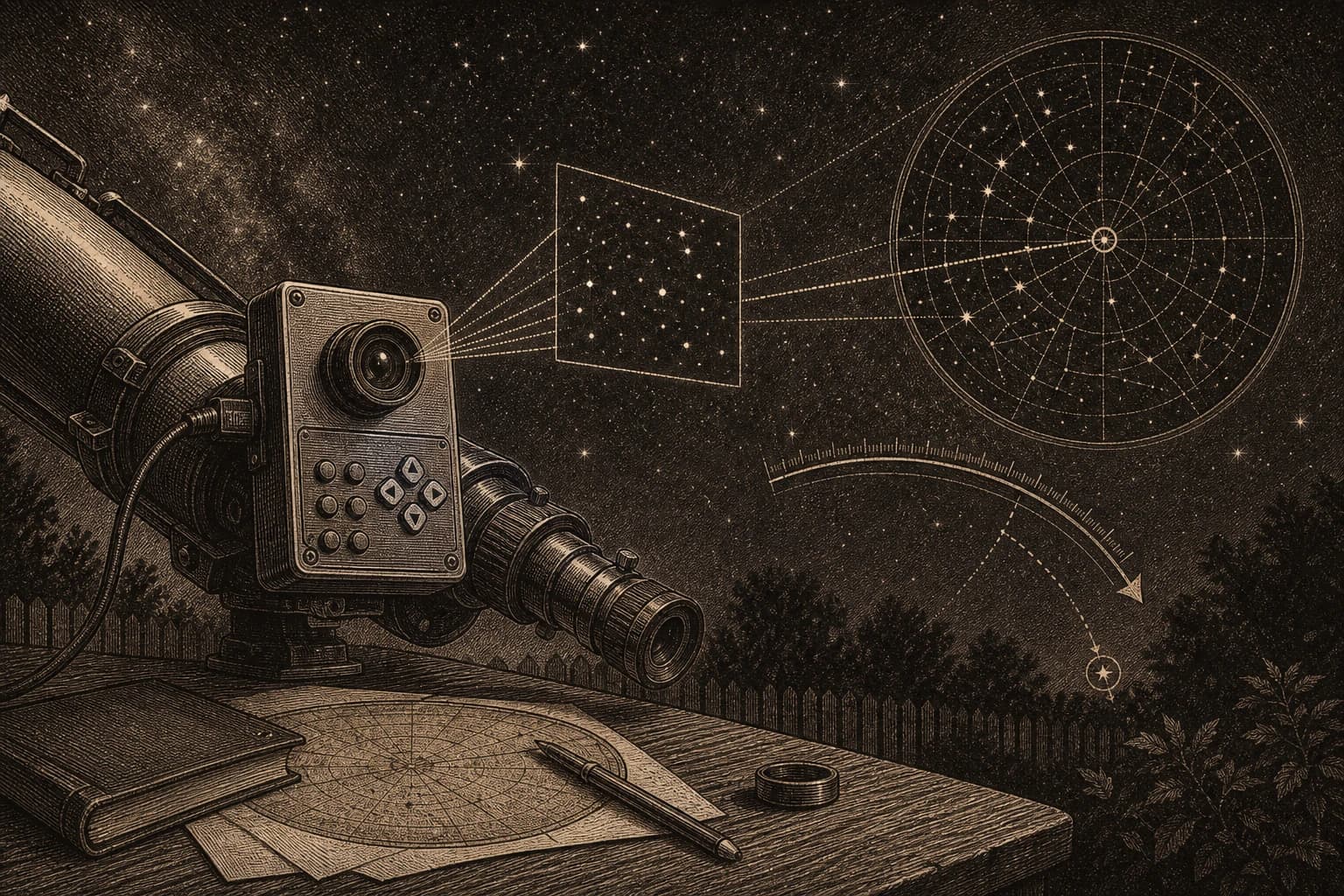
Mounts a Raspberry Pi camera beside a telescope, plate-solves the star field, and combines GPS and inertial sensing to guide push-to observing without a separate alignment routine.
Visit PiFinderOriginal editorial concept art generated with built-in Codex Image Gen for The Machine Press, 2026-08-02; carried into the 2026-08-06 edition.
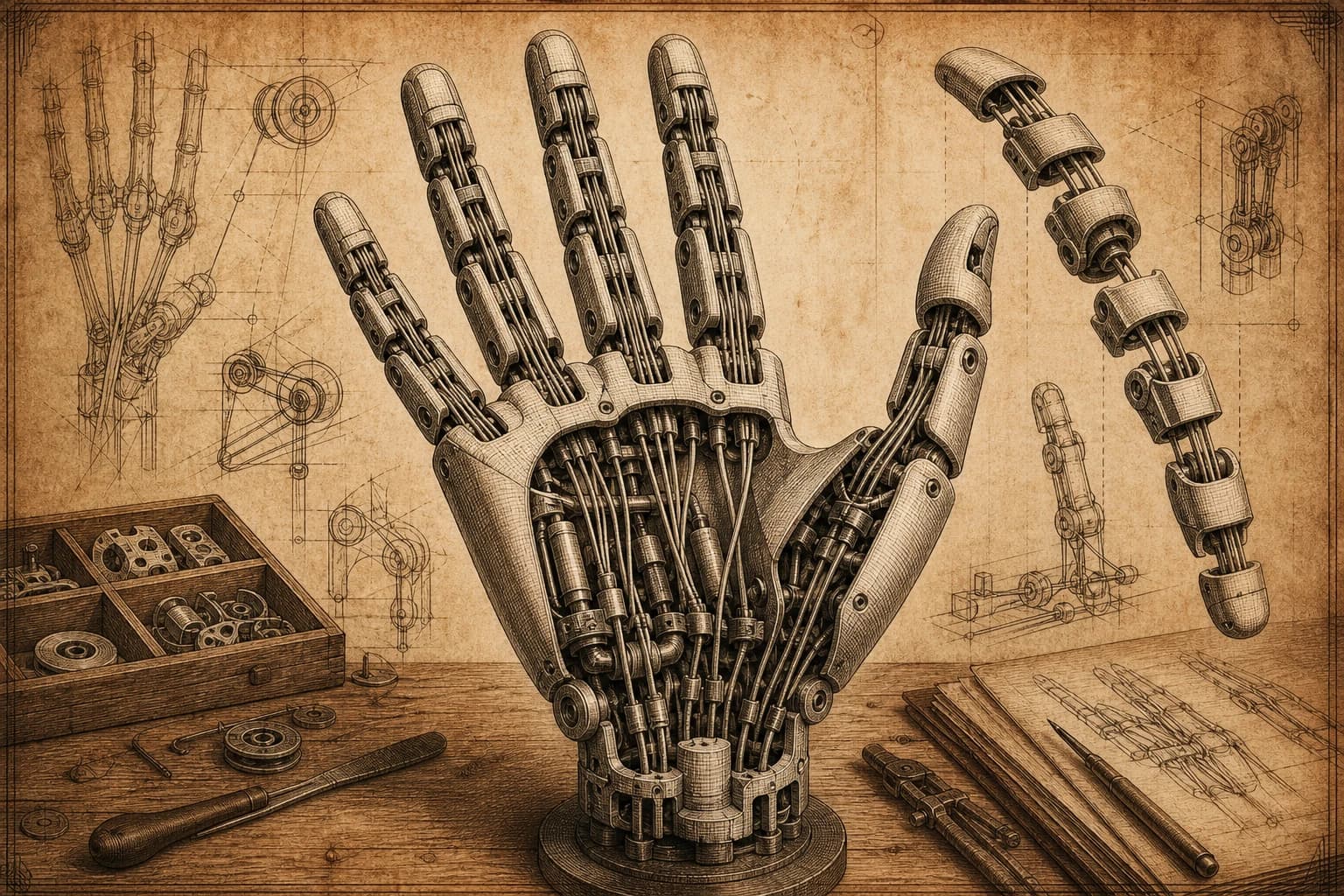
Routes tendons through a modular five-finger, 16-joint hand with seven controlled degrees of freedom, printable parts, firmware, an SDK, ROS 2 tools, and simulation assets.
Visit Aero Hand OpenOriginal editorial concept art generated with built-in Codex Image Gen for The Machine Press, 2026-08-02; carried into the 2026-08-06 edition.
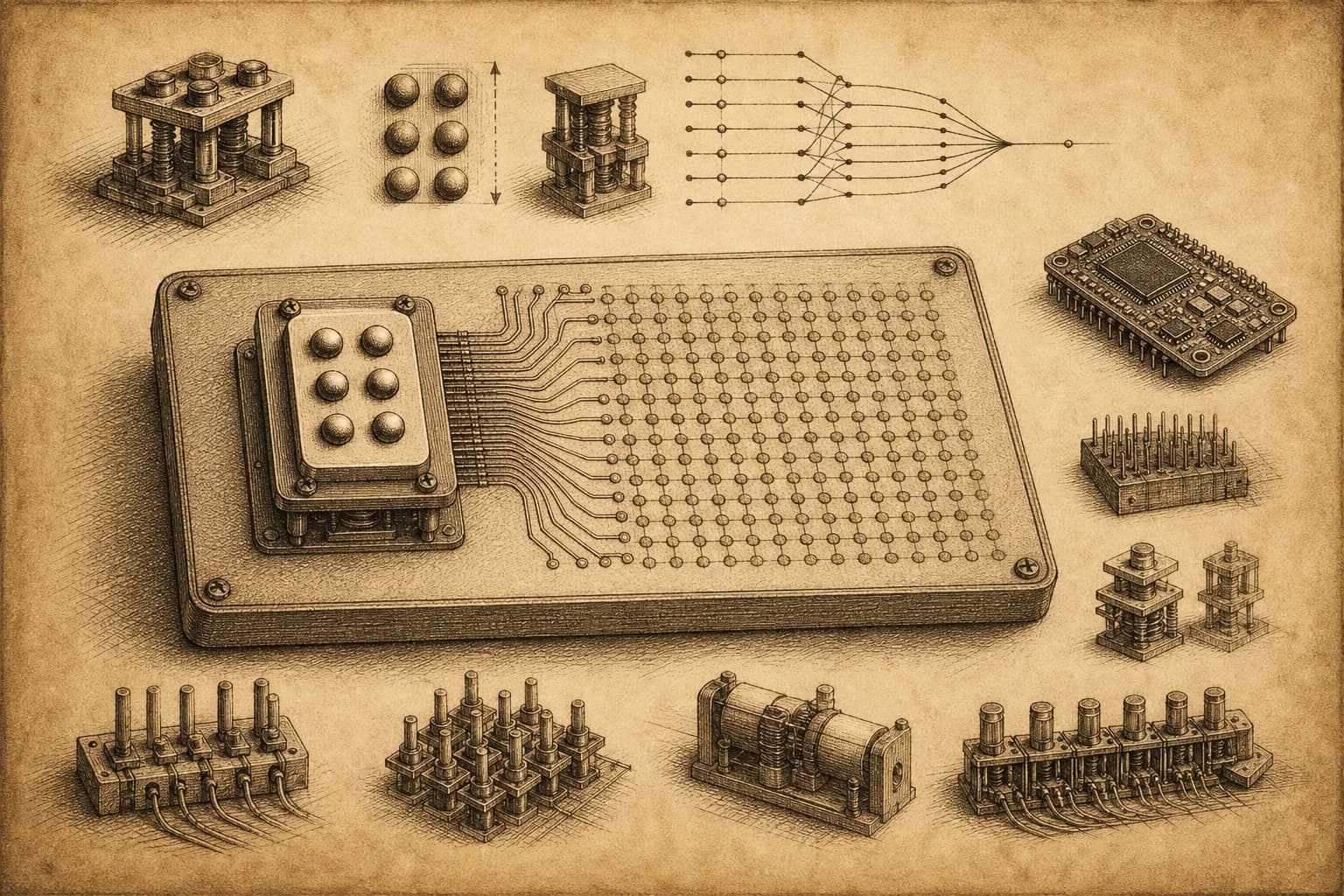
Explores pairing one physical refreshable Braille cell with a tactile sensor matrix representing virtual character positions, reducing the amount of moving hardware under study.
Visit BrailleTouchOriginal Codex Image Gen concept art from 2026-07-10; carried forward from the validated 2026-08-01 edition.
Desk Picks are selected by the newsroom. Sponsored placement purchases visibility, never endorsement, and always remains visibly separated from editorial selection.
 Editorial illustration