research
The Weather Model Learned Another Sky
An Earth-trained graph forecaster lost Mars's daily rhythm until researchers taught it the planet's variables and the Sun's changing input.
Summary
An Earth-trained graph forecaster lost Mars's daily rhythm until researchers taught it the planet's variables and the Sun's changing input.
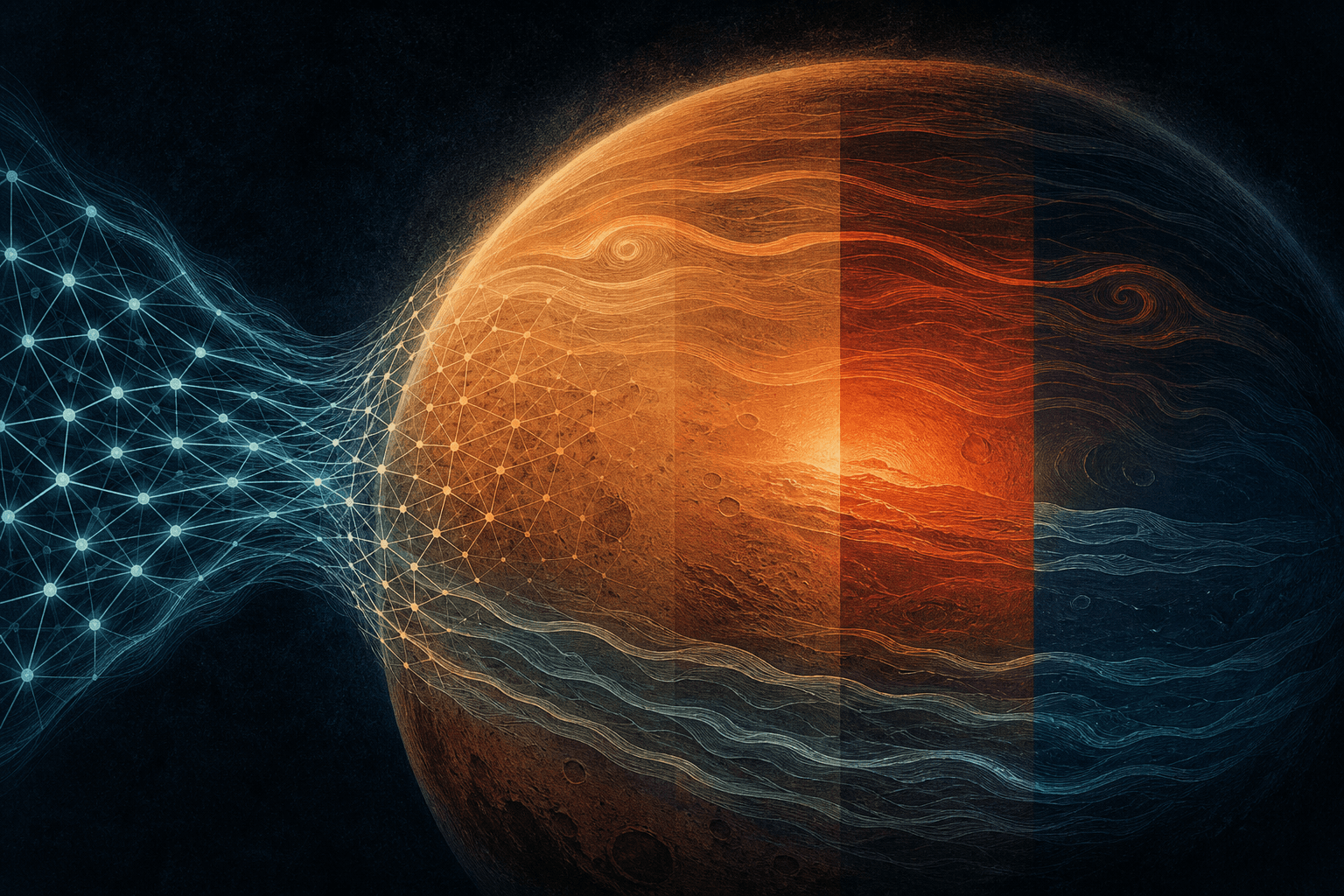
MarsCast adapts GraphCast, a model developed for terrestrial weather, to temperature and wind fields from the Mars Climate Database. In zero-shot tests, the transferred model captured the initial atmospheric state but its forecasts decayed toward climatology and lost much of the day-night variation. Fine-tuning with Mars-specific variables and top-of-atmosphere solar forcing recovered a diurnal cycle within ten training epochs; the authors report forecasts out to ten days that reproduce seasonal and vertical temperature structure. These are preprint experiments against a climate database, not operational forecasts or validation against a new observing campaign.
Why it matters
An Earth-trained graph forecaster lost Mars's daily rhythm until researchers taught it the planet's variables and the Sun's changing input.
Limits and context
- These are preprint experiments against a climate database, not operational forecasts or validation against a new observing campaign.
Key claims
An Earth-trained graph forecaster lost Mars's daily rhythm until researchers taught it the planet's variables and the Sun's changing input.
Qualification: These are preprint experiments against a climate database, not operational forecasts or validation against a new observing campaign.
Evidence: source-2026-08-06-001
Sources
- arXiv preprint 2608.05054arXiv · primary research
Corrections
No corrections have been recorded for this story.