Action-free endoscopic video raised a simulated surgical controller's average task success from 63.5 to 77.8 percent under a fixed demonstration budget.
Editorial illustration
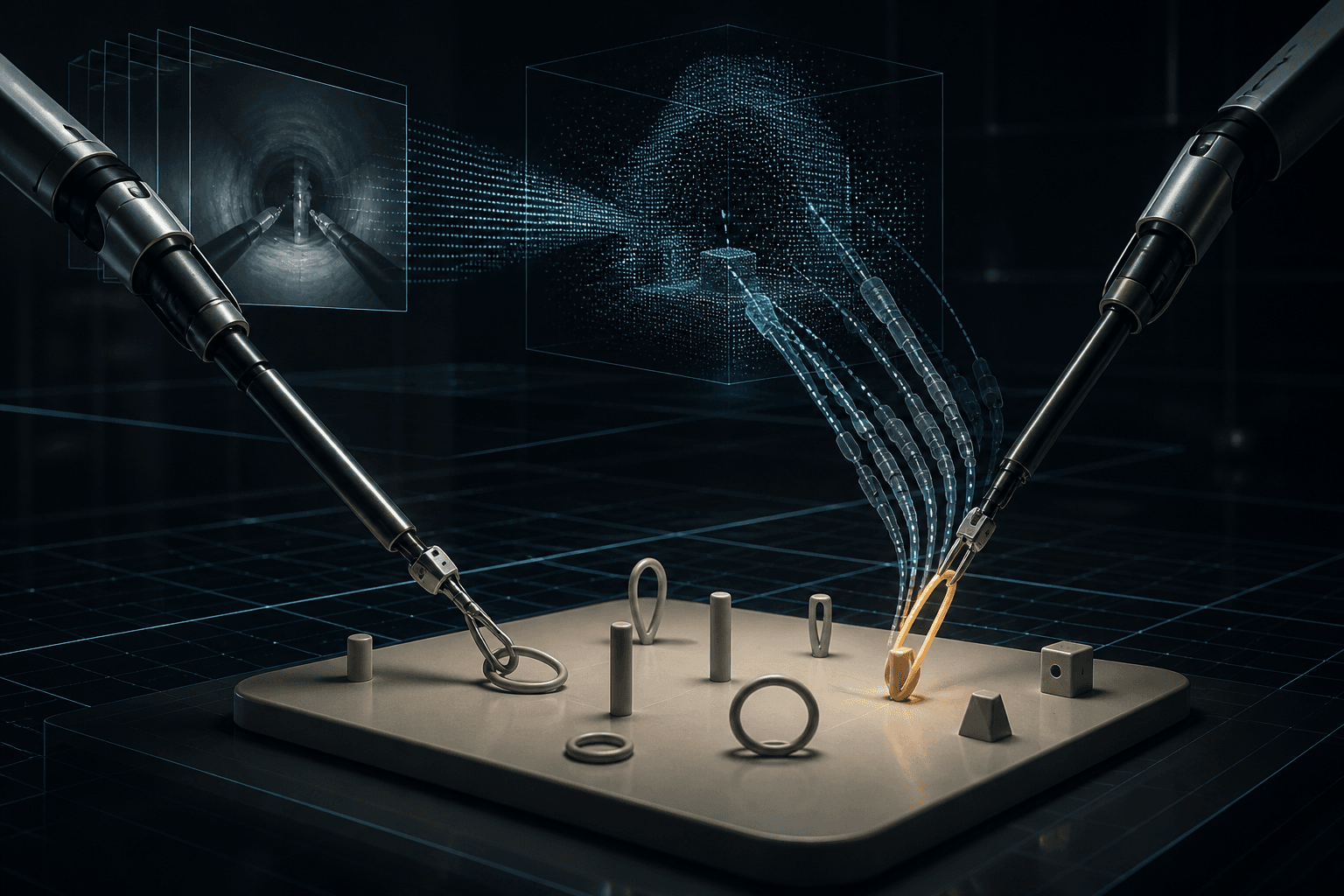
Conceptual illustration: Surgical WAM learned visual dynamics from action-free video and was evaluated on simulated manipulation tasks; this is not a real operation or deployed system. Original editorial concept art generated with built-in Codex Image Gen for The Machine Press, 2026-08-12.
Surgical WAM first learns visual dynamics from video that contains no robot-action labels, then fine-tunes a single generative model to predict both future endoscopic observations and executable action chunks. During control it executes only a short prefix before observing and planning again. Across four simulated manipulation tasks, the authors report an average success increase from 63.5 to 77.8 percent, including a 20-point gain on PegTransfer. The work is a simulation study, not evidence of clinical safety or deployment, but it tests whether abundant video can reduce dependence on scarce synchronized demonstrations.
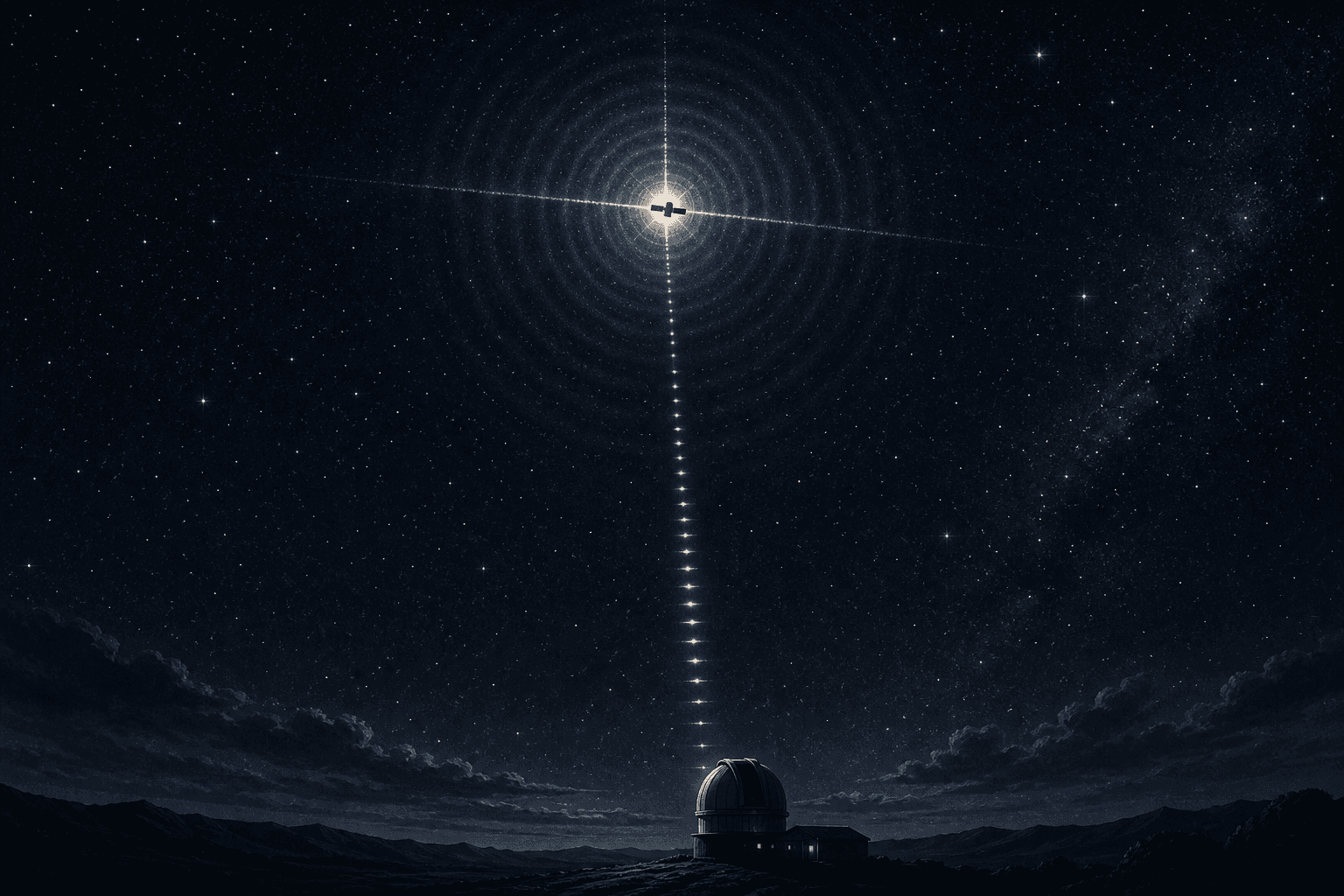
Conceptual illustration: a proposed method would use microsecond satellite occultations and photon counting to infer stellar diameters; no reported observation is depicted. Original editorial concept art generated with built-in Codex Image Gen for The Machine Press, 2026-08-12.
A proposal turns microsecond occultations by artificial satellites into diffraction patterns that could measure stellar diameters beyond a telescope's normal limit.
The authors model the brief diffraction signal created when the Moon or an artificial satellite crosses a star and apply a Bayesian analysis to simulated high-speed photon counts. They estimate that satellite and lunar events could deliver better than two-milliarcsecond resolution for roughly ten thousand stars per year, with tens to hundreds constrained more tightly than half a milliarcsecond. The satellite method would require continuous photon-resolving readout with inter-frame delay controlled below about one microsecond. These are feasibility estimates for a proposed observing method, not completed stellar measurements.
A conductance spectrum recovered a hidden hyperuniformity parameter from correlated disorder in a quantum-transport model.
The authors modeled spinless fermions in a one-dimensional chain whose disorder suppresses long-wavelength fluctuations. The sharp boundary between high- and low-transmission regions moved primarily with the stealthiness parameter, while disorder strength mostly changed transmission magnitude. Comparing measured and target spectra therefore produced a clear minimum near the hidden parameter, suggesting transport can fingerprint correlations when the microscopic arrangement is inaccessible.
Illustrative NASA file image of the unrelated OSAM-1 servicing arm; it does not show the reported rover planner, planetary terrain, experiments or mission hardware. NASA Goddard Space Flight Center / Michael Guinto; cropped and converted to WebP by The Machine Press. Use does not imply NASA endorsement.
A two-stage planner used conditional value-at-risk to cut simulated and hardware navigation risk by more than 97 percent.
The method first uses an asymptotically optimal sampling planner to find a dynamically feasible route, then refines that route with sequential convex programming. It explicitly carries uncertainty from terrain interaction and perception into a conditional-value-at-risk objective. Across the authors' simulation and hardware experiments, trajectory risk fell by more than 97 percent. The result is a research demonstration of a planning method, not an operational planetary-mission validation.
VidForensics-M1 trains on verifiable manipulated intervals instead of trusting only labels or model-written rationales.
The authors generate paired real and synthetic videos by replacing controlled temporal segments, giving the detector a precise record of where manipulation occurred. Their reinforcement-learning scheme redistributes reward among label-correct answers according to the quality of that temporal grounding. The paper reports improved robustness to unseen scenes and generators, but the evidence remains benchmark-based and does not establish universal detection of synthetic video.
Removing nearby reservoirs and shaping microwave pulses produced a reported 99.99920 percent single-qubit gate fidelity.
The team found that proximal reservoirs shortened driven-spin coherence and that off-resonant excitation of neighboring qubits could distort fidelity benchmarking. After changing device conditions and tailoring pulse spectra, it reports a pi-over-two gate fidelity of 99.99920(2) percent in silicon spin qubits. Remaining error was attributed mainly to incoherent noise. The figure is an experimental result for the reported devices and benchmarking protocol, not a system-level fault-tolerance claim.
FEEDS selected diverse PET/CT cases for annotation and matched fully labeled training in the authors' multi-dataset evaluation.
FEEDS uses foundation-model embeddings to choose informative and diverse unlabeled whole-body scans for expert annotation in one step. Tested across AutoPET-III, DeepPSMA and an internal Dartmouth-Hitchcock dataset, the authors report performance matching training on the full labeled set while reducing annotation burden by 70 percent. The work evaluates segmentation across tracers and cancers; it does not establish clinical deployment or replace expert review.
A tie-aware reanalysis found that several reported group-recommendation gains shrink or reverse under fairer scoring.
An extra sigmoid before a common ranking objective can compress top scores until many items tie. Deterministic evaluation then lets an implementation detail decide hit-rate and NDCG results. Re-evaluating representative methods on two benchmarks with the exact expectation under random tie-breaking, the authors found that many gains narrowed and some model rankings changed. Temperature scaling retained some optimization benefit without the same tie inflation.
Illustrative fiber-optic macro photograph; it does not show the reported supermode device, waveguides, channels or transmission test. Atlantic Ambience / Pexels; cropped, resized, metadata stripped, and converted to WebP by The Machine Press.
A hierarchical transformation addressed arbitrary supermodes and carried an aggregate 1.2 terabits per second in a silicon demonstration.
The reported design uses a second-order discrete supersymmetric transformation to excite and extract selected supermodes while preserving large, even index spacing. Six-mode multiplexers built on silicon and silicon nitride showed insertion losses below 2.6 decibels and crosstalk below minus 11.1 decibels over 100 nanometers. A silicon device transmitted an aggregate 1.2 terabits per second below the stated error-correction threshold.
Uncertainty-aware screening identified hundreds of unusually low- and high-work-function surfaces for deeper calculation.
A calibrated random-forest model, machine-learned interatomic potentials and targeted first-principles calculations screened 5.5 million compounds from two databases. The workflow identified 209 surfaces below 2.0 electron volts and 227 above 6.0 electron volts, representing 136 and 172 unique materials. These are computational candidates for electronics, catalysis and energy research, not newly synthesized or experimentally verified materials.
A learned codec dispersed information across packets and shortened decoding dependencies to contain loss.
The scheme redistributes channel energy before packetization, interleaves channel groups and uses a two-layer dual-branch autoregressive decoder to reduce cascading failure. At 20 percent packet loss, the authors report a 1.84-decibel average PSNR gain over LossResilientLIC and a tenfold reduction in PSNR variance. Training used random loss, while tests also included bursty loss intended to resemble satellite and emergency links.
A mission study says hotter photovoltaic operation could make a ton-class 200-AU precursor feasible within 25 years under stated assumptions.
The trajectory study concentrates electric thrust near a 0.3-AU perihelion, where the same velocity change yields roughly three times the orbital-energy gain of a one-AU spiral. With a Jupiter assist, an expendable Falcon Heavy could carry a ton-class payload to 200 AU in 25 years if high-temperature solar arrays slightly exceed today's conventional specific power; a direct route would require roughly double it. This is an optimized feasibility analysis, not a funded mission or flight demonstration.
Across 41 languages, four frontier models retained only about 71 to 73 percent of their action policy after correcting five measurement confounds.
The study compares 2.38 million rollouts from eight models on six parallel tool-use benchmarks and measures actions rather than final text. After correcting for trace length, empty outputs, chance overlap, reproducibility and same-language variation, four frontier models converged on 71 to 73 percent cross-language policy retention under greedy decoding. The authors also found that non-English tasks route through an English pivot and that extraction code can manufacture apparent failures.
Illustrative developer-workstation file image; it does not show a studied repository, agent instruction file, prompt comments or reported measurements. Dhirendra Singh Dhami / Pexels; cropped, resized, metadata stripped, and converted to WebP by The Machine Press.
A study of 1,867 repositories found agent instructions more than tripled over their observed lifetimes.
Across 247,694 instruction lifetimes, the authors report that agentic coding prompts grew 226 percent and became less likely to lose a rule as that rule aged. They call the pattern catastrophic remembering: adding a caution is cheap, while deleting it safely becomes expensive after its rationale disappears. In controlled tasks, comments that preserved rationale removed 99.3 percent of excess instructions and improved instruction following in a harder evaluation.
WildFireGS runs combustion and heat transfer directly on semantic Gaussian-splat reconstructions of aerial forest imagery.
The system augments Gaussian scene primitives with vegetation semantics and fuel properties, then simulates ignition, heat transfer, combustion and flame spread without first converting the scene to a mesh or voxel grid. Tests on synthetic and aerially reconstructed forests reproduced expected dependencies on density, wind and slope, and included rain cooling, firebreak and biomass-loss experiments. It is a simulation framework, not a validated operational fire forecast.
Rare choices between nearly equal plastic instabilities, not sustained exponential divergence, split otherwise nearby trajectories.
In simulations of cyclically sheared amorphous solids, small perturbations decayed locally even after the material entered an irreversible regime. Nearby trajectories remained close until a rare branching event changed which nearly degenerate instability fired first; separation then grew diffusively. A mean-field soft-spot model reproduced the branching statistics. The result offers a mechanism for deterministic irreversibility distinct from ordinary chaos.
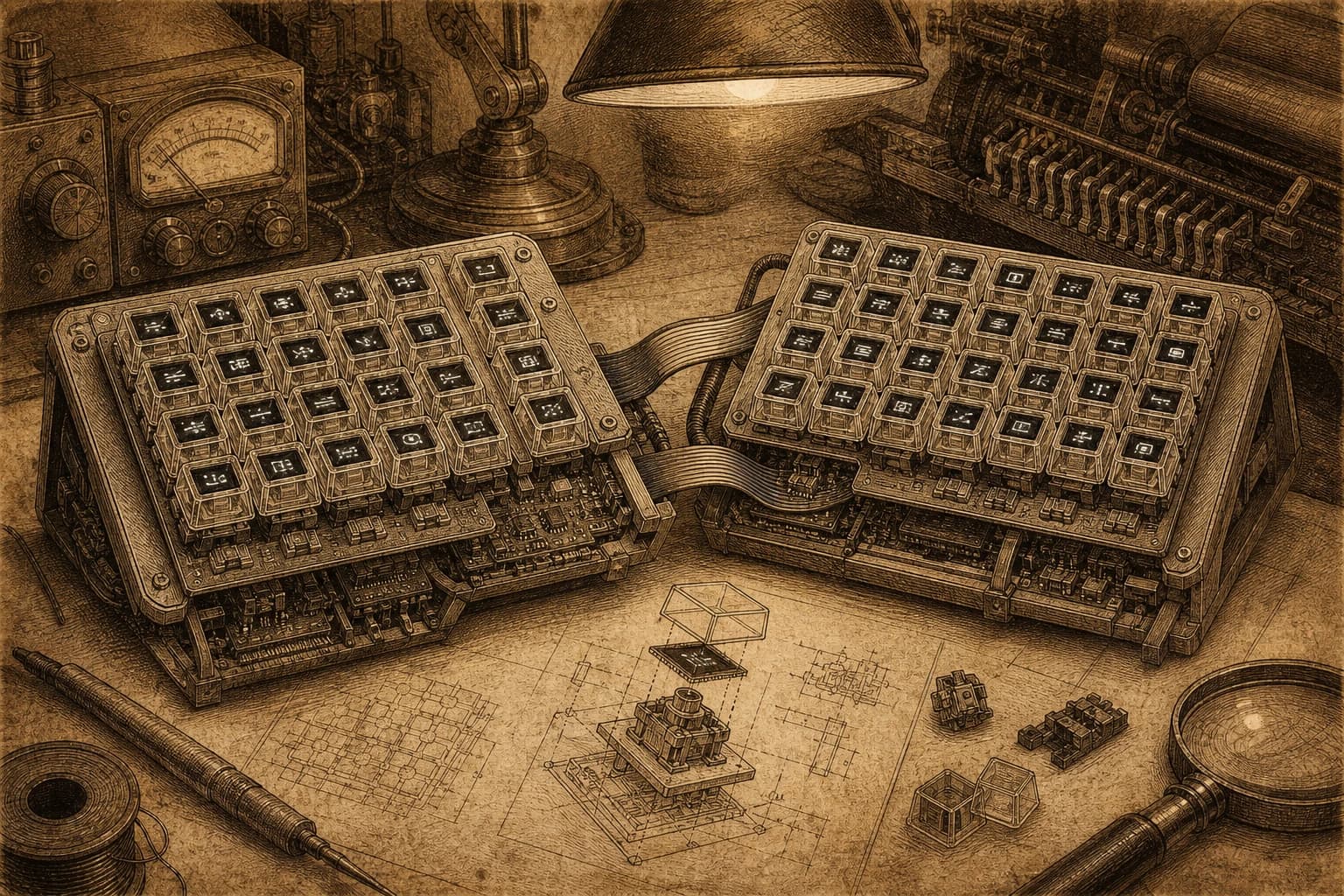
Splits 72 mechanical keys between two halves and puts a tiny OLED beneath each transparent keycap so displayed legends can change with layouts and languages.
Visit PolyKybdOriginal editorial concept art generated with built-in Codex Image Gen for The Machine Press, 2026-08-09.
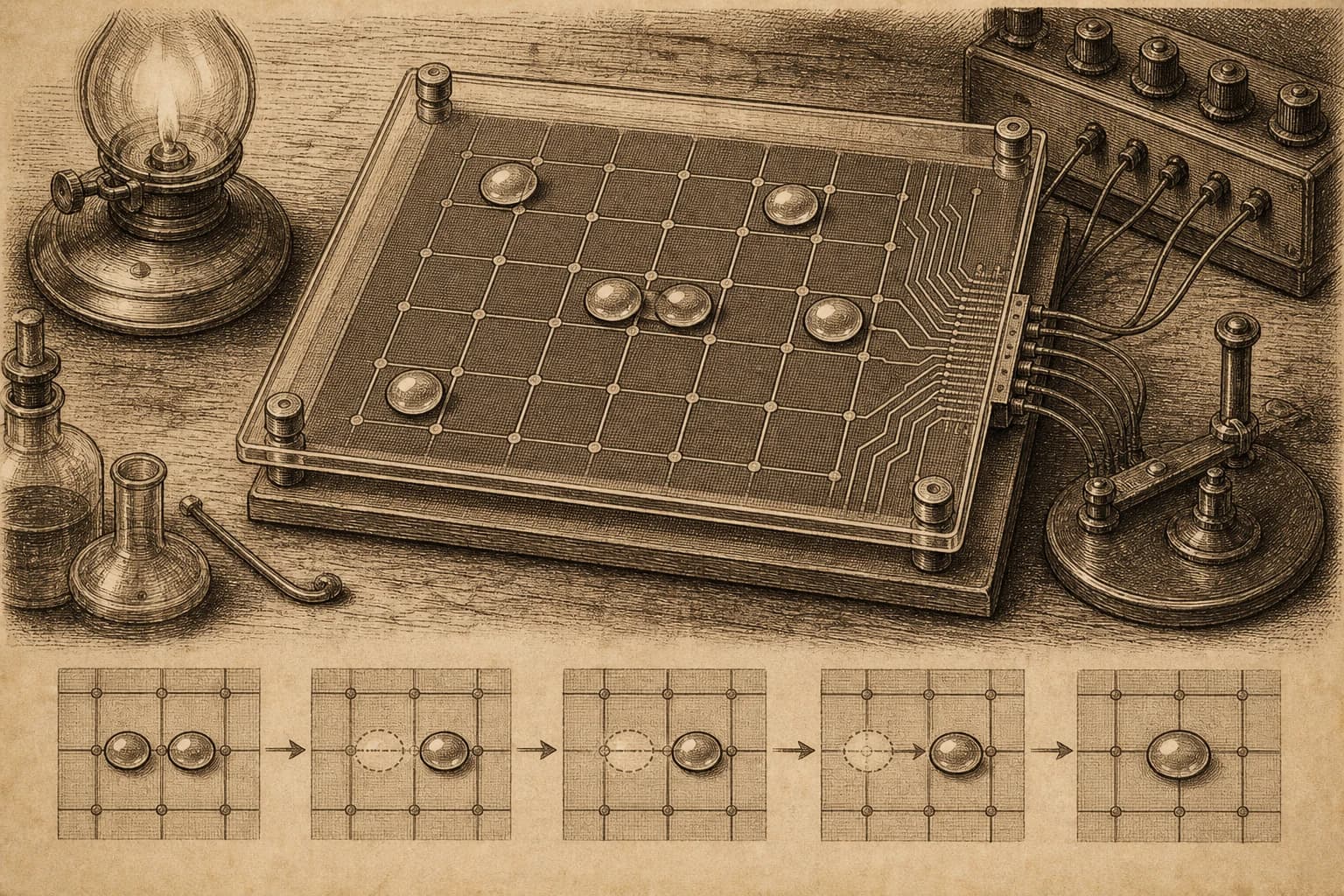
Moves and combines small liquid droplets across an addressable electrode grid, providing an open tabletop platform for digital microfluidics experiments.
Visit OpenDropOriginal editorial concept art generated with built-in Codex Image Gen for The Machine Press, 2026-08-09.
Runs video samples and shaders on a Raspberry Pi Zero, exposes four knob or control-voltage inputs, and can pass compatible external capture through visual effects.
Visit recurBOYOriginal editorial concept art generated with built-in Codex Image Gen for The Machine Press, 2026-08-09.
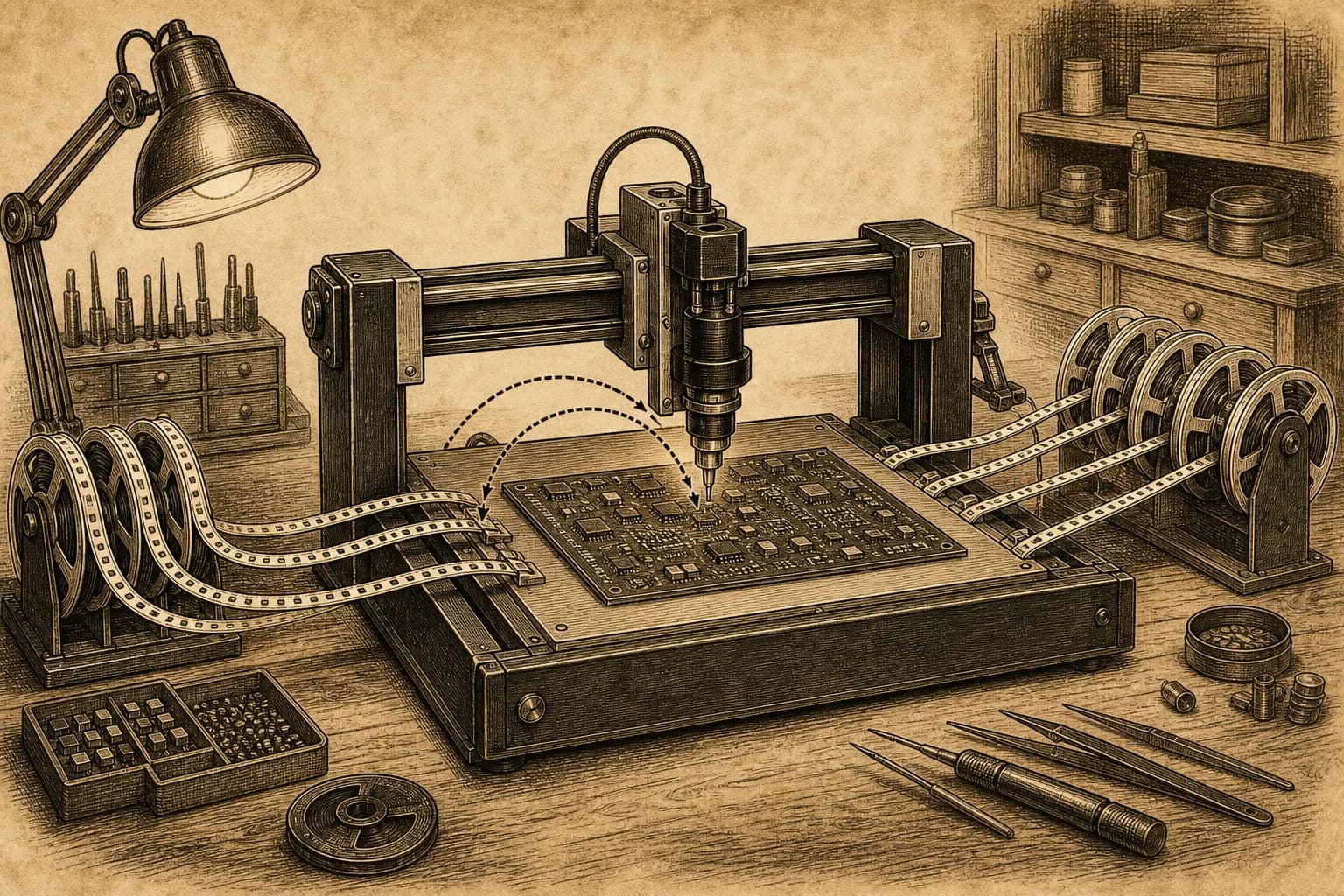
Uses a desktop gantry, placement head, and component feeders to assemble electronic parts onto circuit boards; its primary repository says machines run in active production.
Visit LumenPnPOriginal Codex Image Gen concept art from 2026-07-10; carried forward from the validated 2026-08-08 edition.
Desk Picks are selected by the newsroom. Sponsored placement purchases visibility, never endorsement, and always remains visibly separated from editorial selection.
 Editorial illustration