research
The Satellite Blink Became a Stellar Ruler
A proposal turns microsecond occultations by artificial satellites into diffraction patterns that could measure stellar diameters beyond a telescope's normal limit.
Summary
A proposal turns microsecond occultations by artificial satellites into diffraction patterns that could measure stellar diameters beyond a telescope's normal limit.
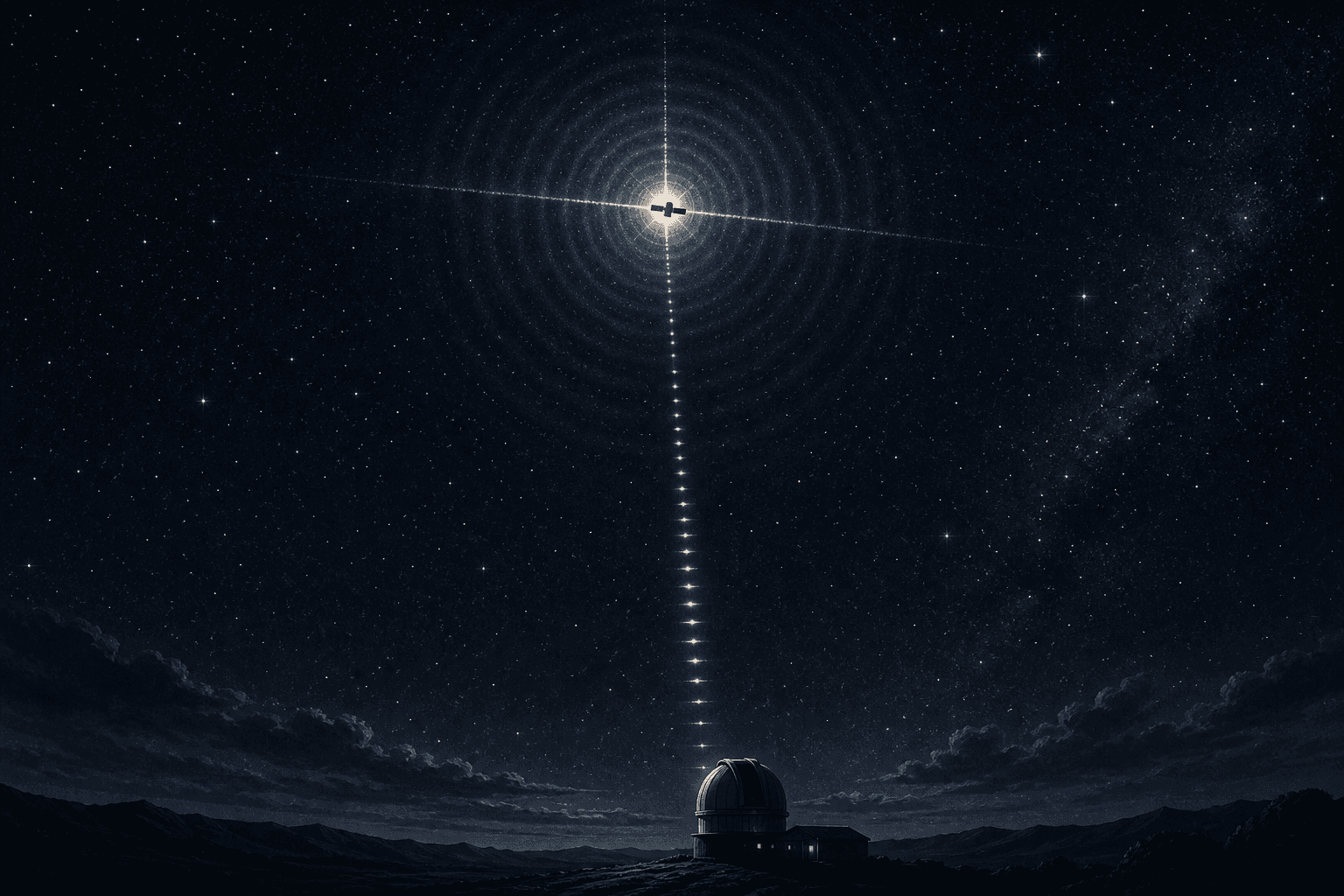
The authors model the brief diffraction signal created when the Moon or an artificial satellite crosses a star and apply a Bayesian analysis to simulated high-speed photon counts. They estimate that satellite and lunar events could deliver better than two-milliarcsecond resolution for roughly ten thousand stars per year, with tens to hundreds constrained more tightly than half a milliarcsecond. The satellite method would require continuous photon-resolving readout with inter-frame delay controlled below about one microsecond. These are feasibility estimates for a proposed observing method, not completed stellar measurements.
Why it matters
A proposal turns microsecond occultations by artificial satellites into diffraction patterns that could measure stellar diameters beyond a telescope's normal limit.
Limits and context
- These are feasibility estimates for a proposed observing method, not completed stellar measurements.
Key claims
A proposal turns microsecond occultations by artificial satellites into diffraction patterns that could measure stellar diameters beyond a telescope's normal limit.
Qualification: These are feasibility estimates for a proposed observing method, not completed stellar measurements.
Evidence: source-2026-08-12-002
Sources
- arXiv preprint 2608.11161arXiv · primary research
Corrections
No corrections have been recorded for this story.