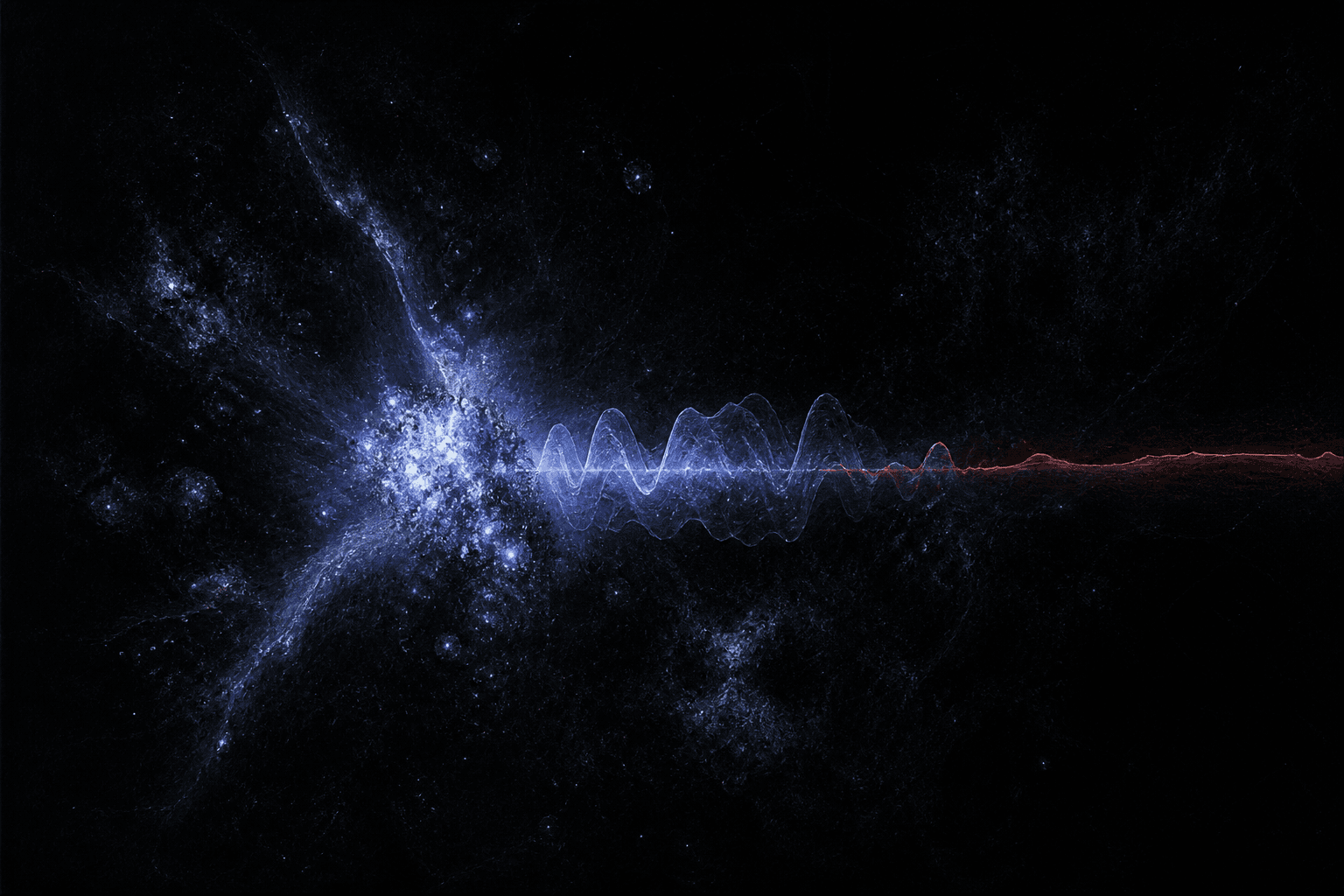
Ultra-deep JWST spectroscopy of GN-z11 resolved faint Lyman-alpha light, a fast ionized outflow and signatures consistent with very massive young stars.
Editorial illustration
Conceptual illustration: ultra-deep spectroscopy of GN-z11 revealed stellar-wind signatures, ionized outflow and a faint red wing in Lyman-alpha; this is not a JWST observation image. Original editorial concept art generated with built-in Codex Image Gen for The Machine Press, 2026-08-15.
The SPURS Cycle 4 program obtained what its authors describe as the deepest rest-ultraviolet spectrum yet for a galaxy beyond redshift 10. In GN-z11, the team reports stellar-wind features and broad helium emission jointly reproduced by low-metallicity population models containing stars above 100 solar masses and younger than roughly three million years. A broad nitrogen component could instead include an active-galactic-nucleus-driven wind, an alternative the paper does not rule out.
The spectrum also shows a roughly 500-kilometer-per-second ionized outflow and little neutral-gas covering along the measured sightline. Lyman-alpha remains weak, but 44 percent of its flux lies in a broad red wing above 500 kilometers per second, where intergalactic absorption should be reduced. The authors interpret the combined evidence as consistent with an intense, compact burst building dense nuclear gas and surrounding star clusters; the measurements do not directly image individual stars.
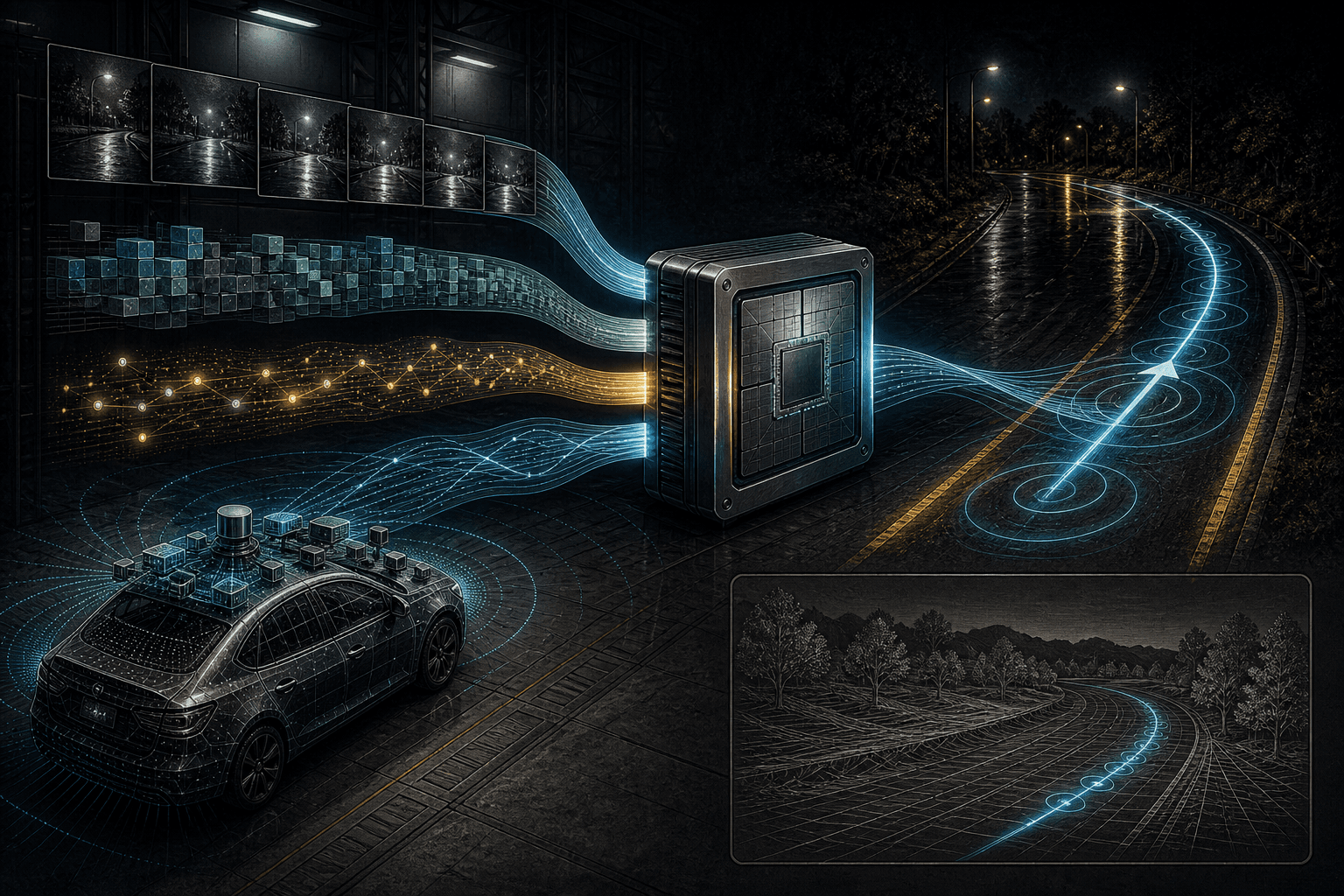
Conceptual illustration: FlashDrive coordinates four inference shortcuts for a driving VLA model; the reported collision and off-road results came from simulation. Original editorial concept art generated with built-in Codex Image Gen for The Machine Press, 2026-08-15.
FlashDrive combined reuse, speculative drafting, adaptive denoising and systems work to cut reported VLA latency from 717 milliseconds to 151.
Vision-language-action driving models have to turn video and language into motion quickly enough for control, but the FlashDrive authors argue that no single optimization fixes the whole delay. Their design reuses visual and key-value context across overlapping frames, drafts low-entropy reasoning tokens non-autoregressively, caches the flatter middle of a flow-matching trajectory, and adds CUDA Graph compilation and kernel fusion.
Applied to a quantized 10-billion-parameter driving model on one GPU, the paper reports a 4.7-fold latency reduction, from 717 milliseconds to 151, raising the loop from 1.4 to 6.6 hertz. The reported trajectory error changed by 0.08 meter on one metric, while single-path error and simulated collision and off-road rates improved. Those safety figures come from closed-loop simulation, not a public-road deployment, and the result is specific to the tested model, hardware and optimization stack.
InFactPlanner compares energy, carbon, water, latency and utilization before an LLM-serving deployment is built.
The trace-driven planning tool combines workload traces, hardware profiles, site capacity, power and water effectiveness, renewable generation and time-varying grid carbon. Its accounting reproduced reference inference-energy estimates within 10 percent, then explored hardware, location, renewable placement and routing scenarios. The case studies show sustainability-optimal choices can diverge from latency-optimal ones and depend on the local grid mix; the framework estimates alternatives rather than measuring a finished facility.
Conceptual Visualising AI file image about model complexity; it does not depict the reported evolution strategies, reinforcement-learning runs or solution distributions. Tim West / Google DeepMind / Pexels; cropped, resized, metadata stripped, and converted to WebP by The Machine Press.
Evolution-strategy post-training preserved broader pass-at-k solution coverage than reinforcement learning in the authors' discovery tests.
The study asks whether optimizing a model around its highest-reward answers can narrow the range of solutions it will explore. Across the reported math and science settings, population-based evolution strategies produced a broader output distribution and consistently higher pass-at-k than reinforcement learning. The result supports diversity-oriented post-training where many valid candidates matter; it does not establish that evolution strategies dominate reinforcement learning for every objective.
SEAG replaces sensitive entities before queries and documents reach an external generator, then restores the answer for the user.
The proposed privacy layer detects confidential entities, generates aliases and applies the replacement table to both the user's query and retrieved documents before sending them to a third-party language model. The authors report more than 80 percent on their user-oriented correctness-and-concealment metric, while complete entity-hiding accuracy ranged from 74.91 to 77.83 percent across three tested models. Those residual misses mean the method is not a guarantee against disclosure.
A vision-language pipeline separated DENV2-infected and uninfected mosquito video in the authors' controlled dataset.
The system first isolates mosquito regions with an object detector, then aligns visual features with biologically meaningful text prompts. The paper reports 98.54 percent frame accuracy and 99.91 percent sensitivity, with complete video-level performance after temporal aggregation. An ablation found that fine-tuning and visual representations drove accuracy while language supplied semantic alignment; the study is a dataset result, not a clinical or field diagnostic validation.
FUSE chooses new viewpoints when function-defining clues are hidden, rather than grounding an affordance from one fixed view.
The authors define active functional affordance grounding: an embodied agent must explore until it can locate an object that satisfies a functional request. FUSE combines uncertainty-guided evidence gathering with a learned planner and is evaluated in a new Habitat-based benchmark. It reached the best reported non-oracle grounding result while using 1.33 times less computation than fully explicit exploration; this is benchmark evidence, not a general household-robot demonstration.
A molecular absorption index recovered an approximately 2,873-day activity period from HARPS spectra of Proxima Centauri.
The analysis compares the strength of a titanium-oxide band near 567 nanometers with adjacent continuum in long-running HARPS spectroscopy. It finds a periodicity of 2,873 days, with an uncertainty of roughly plus 47 and minus 54 days, similar to activity periods inferred from other indicators. The paper presents the molecular index as a proxy for long-term stellar variation, not a new planet signal.
Conceptual Visualising AI file image inspired by neuroscience and machine learning; it is not an MRI scan, tumor image, Mr3D-VL output or clinical result. Novoto Studio / Google DeepMind / Pexels; cropped, resized, metadata stripped, and converted to WebP by The Machine Press.
Mr3D-VL combines multiple 3D MRI modalities in one language-interactive model for brain-tumor tasks.
The four-billion-parameter system uses a shared 3D encoder, rotational position encoding across modality and space, and multiresolution feature projection. The authors report a BERTScore of 0.856 for report generation, 0.713 question-answering accuracy and 0.912 multiple-choice accuracy, outperforming tested domain and general models. These are retrospective benchmark results and do not establish prospective clinical safety or diagnostic approval.
An extended-jet model links TXS 0506+056's high-energy episode with its much later radio brightening.
Instead of treating the blazar as one compact emission zone, the model follows electrons along a parsec-scale evolving jet and fits multi-frequency light curves. The authors find that the moving plasma can meet an older cooled-electron population near the radio-core edge, producing a delayed enhancement after the 2017 neutrino-associated episode. The fit suggests a causal pathway, but it does not by itself prove that the blazar produced the IceCube neutrino.
A modeled dark-QCD crossover adds a shifted distortion to scalar-induced gravitational waves.
The calculation adds a confining dark sector, motivated by twin-Higgs and asymmetric dark-matter scenarios, to the thermal history used for scalar-induced gravitational waves. When an enhanced primordial mode re-enters near the dark confinement scale, the authors find an extra frequency-shifted feature above the ordinary QCD imprint. This is a theoretical signature under specified primordial and dark-sector assumptions, not a detection of dark QCD.
SAP-Nav builds an online spatial-semantic memory and seeks a clearer view before verifying an open-vocabulary target.
The zero-shot system maintains a queryable representation of explored rooms and tests whether the current camera view contains enough evidence for a requested object and attributes. When it does not, the robot moves to a more informative viewpoint. On LangMap and HM3D-OVON, the authors report the best overall performance, including a 12.2 percent success-rate gain over training-based methods for region-level navigation, plus a limited real-robot feasibility demonstration.
Predictive Memory Localization uses low-strength causal responses to forecast whether an activation intervention will remain selective.
Across 30,000 direction-layer paths and 210,000 strength evaluations, the study separates target movement from harm to semantic neighbors and general capability. Responses at an absolute strength of 0.1 were the strongest predictor of held-out outcomes at 0.25 and 0.5. A selector that could abstain improved reported utility and reduced collateral damage relative to one fixed strength; the result is a bounded intervention study across three matched base models.
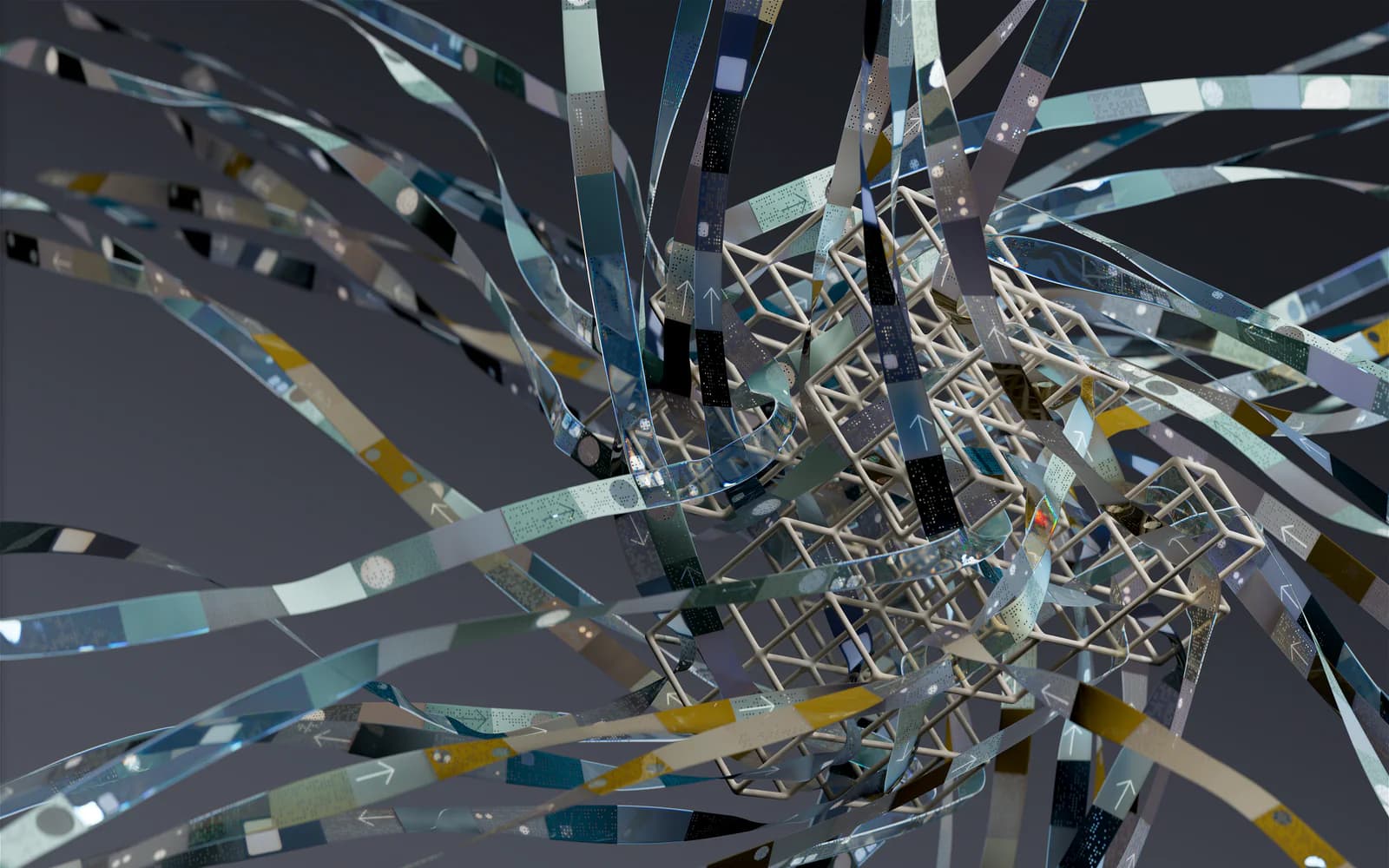
Conceptual Visualising AI file image inspired by neural networks; it does not show the tested agent handoffs, dependence structure or reliability certificate. Novoto Studio / Google DeepMind / Pexels; cropped, resized, metadata stripped, and converted to WebP by The Machine Press.
A preregistered 18,000-mission test found same-model handoffs co-failed on 90 percent of missions where either agent failed.
Reliability estimates often multiply component success rates as if failures were conditionally independent. The reported two-agent tests show that assumption can over-credit redundancy when both agents share a model; switching models reduced association in all six registered contrasts, while changing vendor after changing model produced the registered null. The authors replace independence with a finite-sample linear-program certificate over measured co-execution moments. Adding four moment constraints narrowed the identified interval by 85.7 percent and raised its certified floor from 0.2455 to 0.4116.
NaviDC-OCR models geometric deformation, high-resolution sampling and document structure in one parsing system.
The framework targets both digital files and photographs, where perspective and warping can make layout errors cascade. It combines deformation-aware learning, adaptive sampling and separate modeling for content, formulas and tables. The paper reports scores of 96.87, 88.53 and 78.41 on three document benchmarks and first place in the ICDAR 2026 Sci-ImageMiner Challenge; these are benchmark results, not proof of error-free parsing in every capture condition.
EGRL predicts missing relations before scoring RNA-protein interactions, improving the authors' cold-start tests.
The graph-learning system replaces fixed meta-paths with learned relational patterns and adds a generator for potential edges around sparse or unseen molecules. On four benchmarks it was competitive overall; in the unknown-molecule setting, the authors report AUROC of 0.867 and AUPR of 0.861, improvements of 8.6 and 5.0 percent over prior methods. Computational interaction predictions remain hypotheses for experimental validation, not wet-lab confirmation.
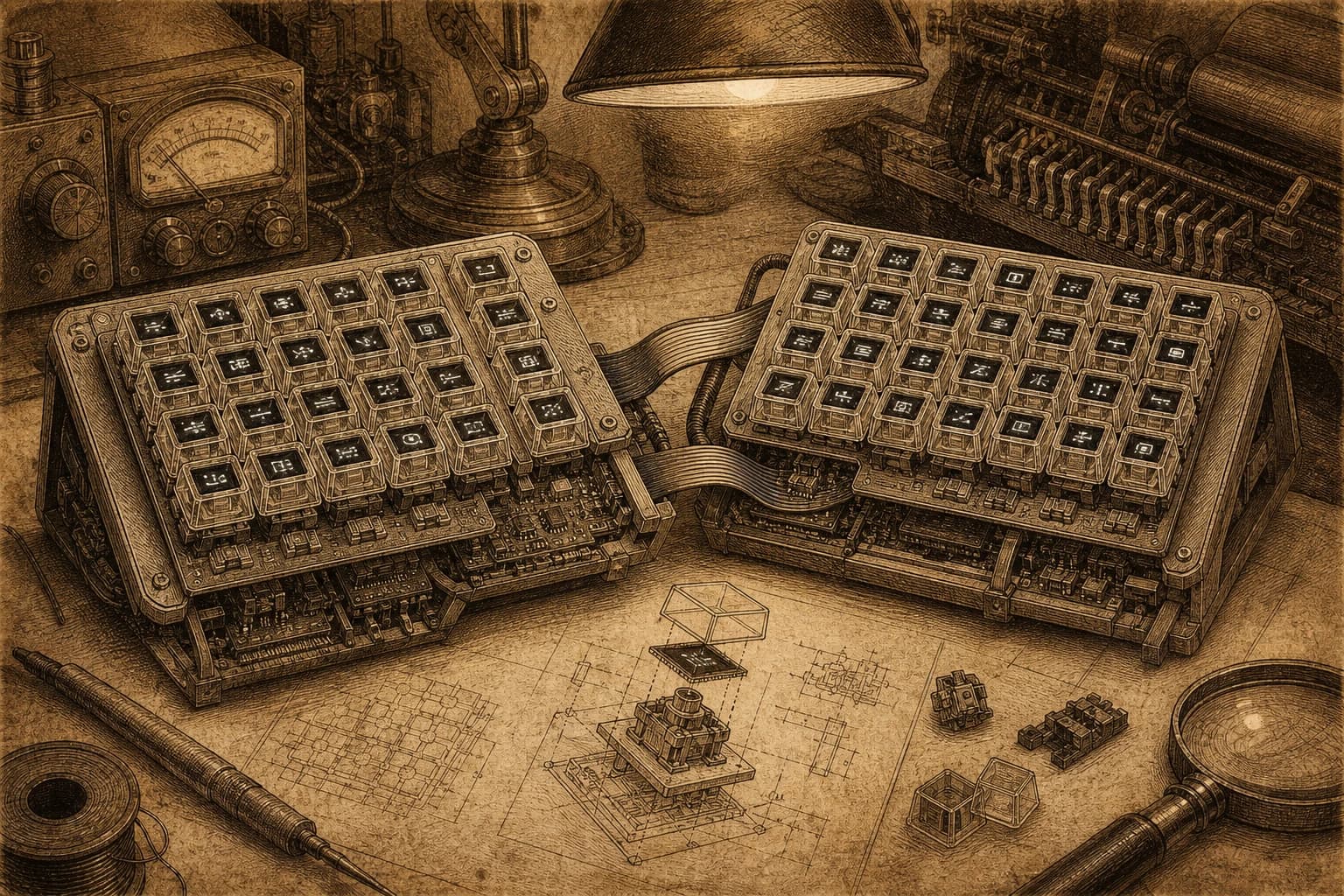
Splits 72 mechanical keys between two halves and puts a tiny OLED beneath each transparent keycap so displayed legends can change with layouts and languages.
Visit PolyKybdOriginal editorial concept art generated with built-in Codex Image Gen for The Machine Press, 2026-08-09.
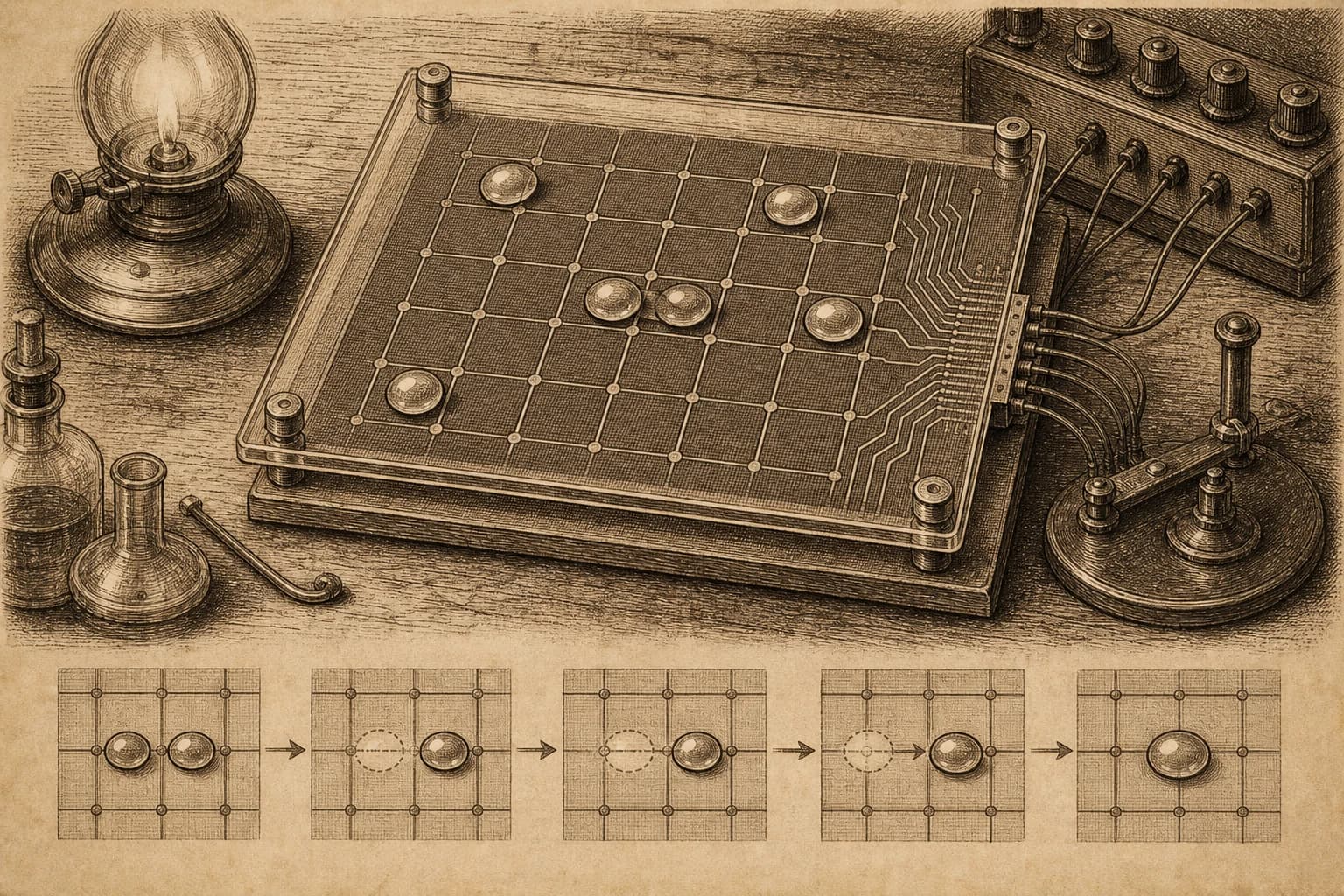
Moves and combines small liquid droplets across an addressable electrode grid, providing an open tabletop platform for digital microfluidics experiments.
Visit OpenDropOriginal editorial concept art generated with built-in Codex Image Gen for The Machine Press, 2026-08-09.
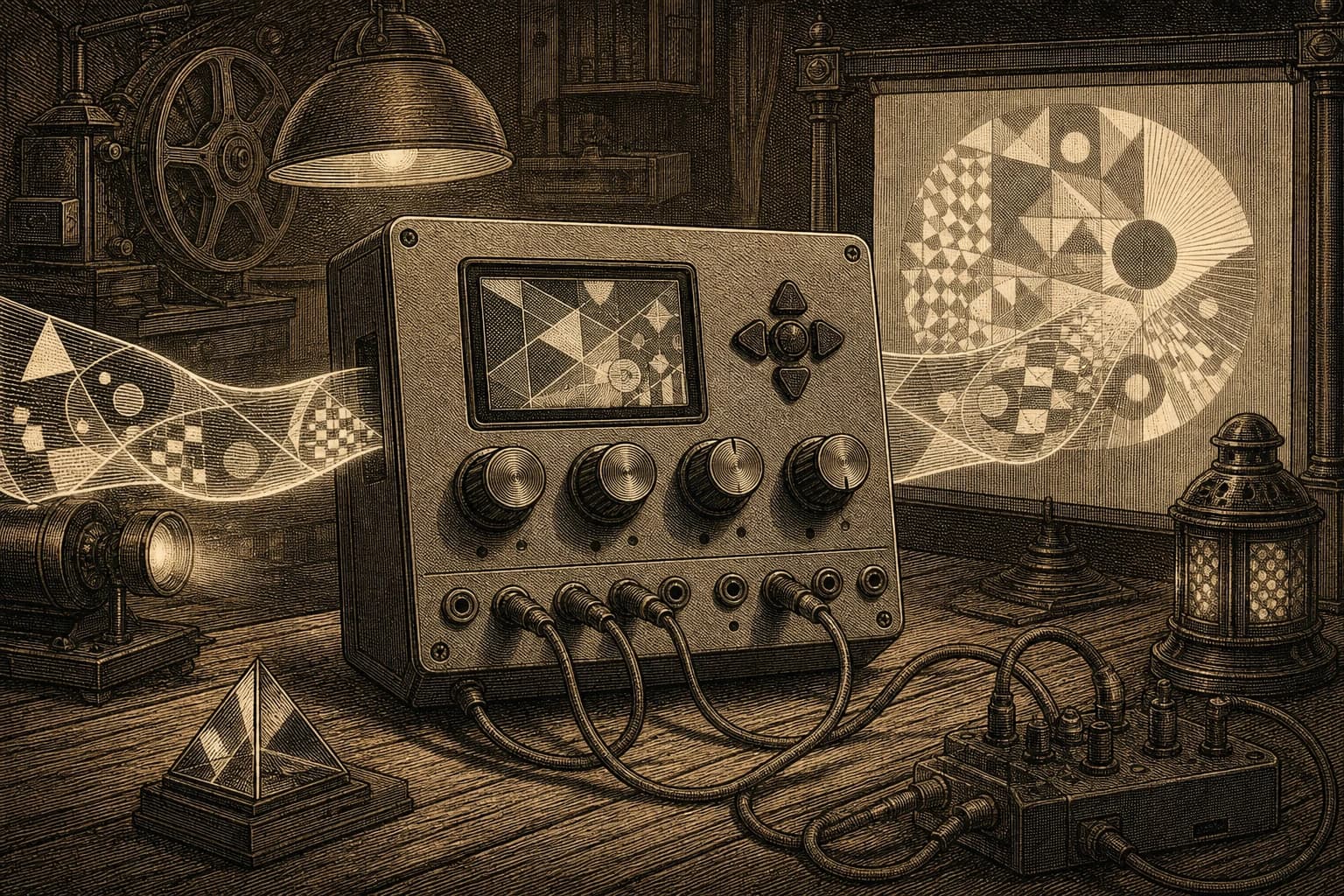
Runs video samples and shaders on a Raspberry Pi Zero, exposes four knob or control-voltage inputs, and can pass compatible external capture through visual effects.
Visit recurBOYOriginal editorial concept art generated with built-in Codex Image Gen for The Machine Press, 2026-08-09.
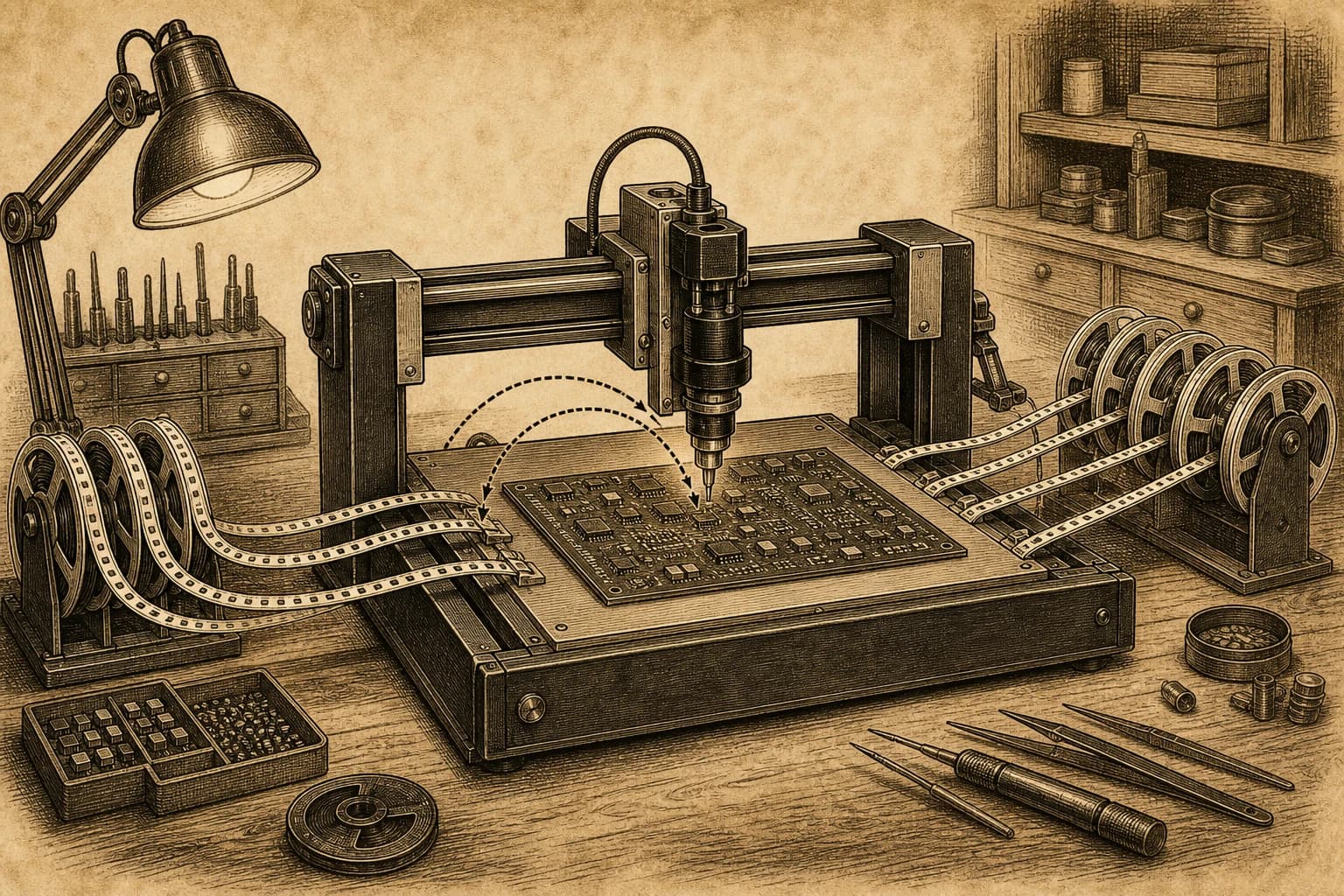
Uses a desktop gantry, placement head, and component feeders to assemble electronic parts onto circuit boards; its primary repository says machines run in active production.
Visit LumenPnPOriginal Codex Image Gen concept art from 2026-07-10; carried forward from the validated 2026-08-08 edition.
Desk Picks are selected by the newsroom. Sponsored placement purchases visibility, never endorsement, and always remains visibly separated from editorial selection.
 Editorial illustration