chips infrastructure
Four Bottlenecks Fell to One Driving Loop
FlashDrive combined reuse, speculative drafting, adaptive denoising and systems work to cut reported VLA latency from 717 milliseconds to 151.
Summary
FlashDrive combined reuse, speculative drafting, adaptive denoising and systems work to cut reported VLA latency from 717 milliseconds to 151.
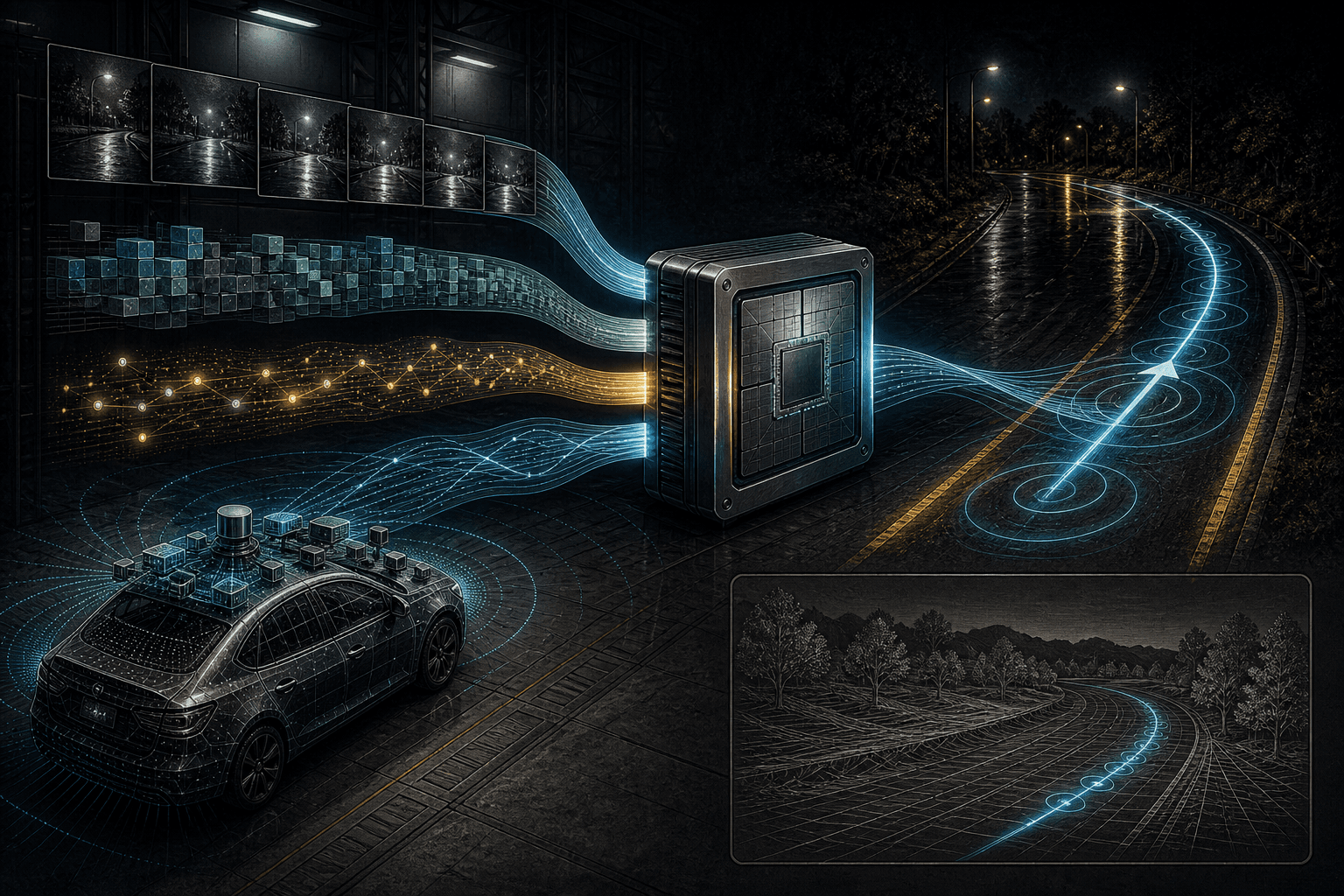
Vision-language-action driving models have to turn video and language into motion quickly enough for control, but the FlashDrive authors argue that no single optimization fixes the whole delay. Their design reuses visual and key-value context across overlapping frames, drafts low-entropy reasoning tokens non-autoregressively, caches the flatter middle of a flow-matching trajectory, and adds CUDA Graph compilation and kernel fusion.
Applied to a quantized 10-billion-parameter driving model on one GPU, the paper reports a 4.7-fold latency reduction, from 717 milliseconds to 151, raising the loop from 1.4 to 6.6 hertz. The reported trajectory error changed by 0.08 meter on one metric, while single-path error and simulated collision and off-road rates improved. Those safety figures come from closed-loop simulation, not a public-road deployment, and the result is specific to the tested model, hardware and optimization stack.
Why it matters
FlashDrive combined reuse, speculative drafting, adaptive denoising and systems work to cut reported VLA latency from 717 milliseconds to 151.
Limits and context
- Those safety figures come from closed-loop simulation, not a public-road deployment, and the result is specific to the tested model, hardware and optimization stack.
Key claims
FlashDrive combined reuse, speculative drafting, adaptive denoising and systems work to cut reported VLA latency from 717 milliseconds to 151.
Qualification: Those safety figures come from closed-loop simulation, not a public-road deployment, and the result is specific to the tested model, hardware and optimization stack.
Evidence: source-2026-08-15-002
Sources
- arXiv preprint 2608.12932arXiv · primary research
Corrections
No corrections have been recorded for this story.