research
A Red Wing Escaped the Early Universe
Ultra-deep JWST spectroscopy of GN-z11 resolved faint Lyman-alpha light, a fast ionized outflow and signatures consistent with very massive young stars.
Summary
Ultra-deep JWST spectroscopy of GN-z11 resolved faint Lyman-alpha light, a fast ionized outflow and signatures consistent with very massive young stars.
The SPURS Cycle 4 program obtained what its authors describe as the deepest rest-ultraviolet spectrum yet for a galaxy beyond redshift 10. In GN-z11, the team reports stellar-wind features and broad helium emission jointly reproduced by low-metallicity population models containing stars above 100 solar masses and younger than roughly three million years. A broad nitrogen component could instead include an active-galactic-nucleus-driven wind, an alternative the paper does not rule out.
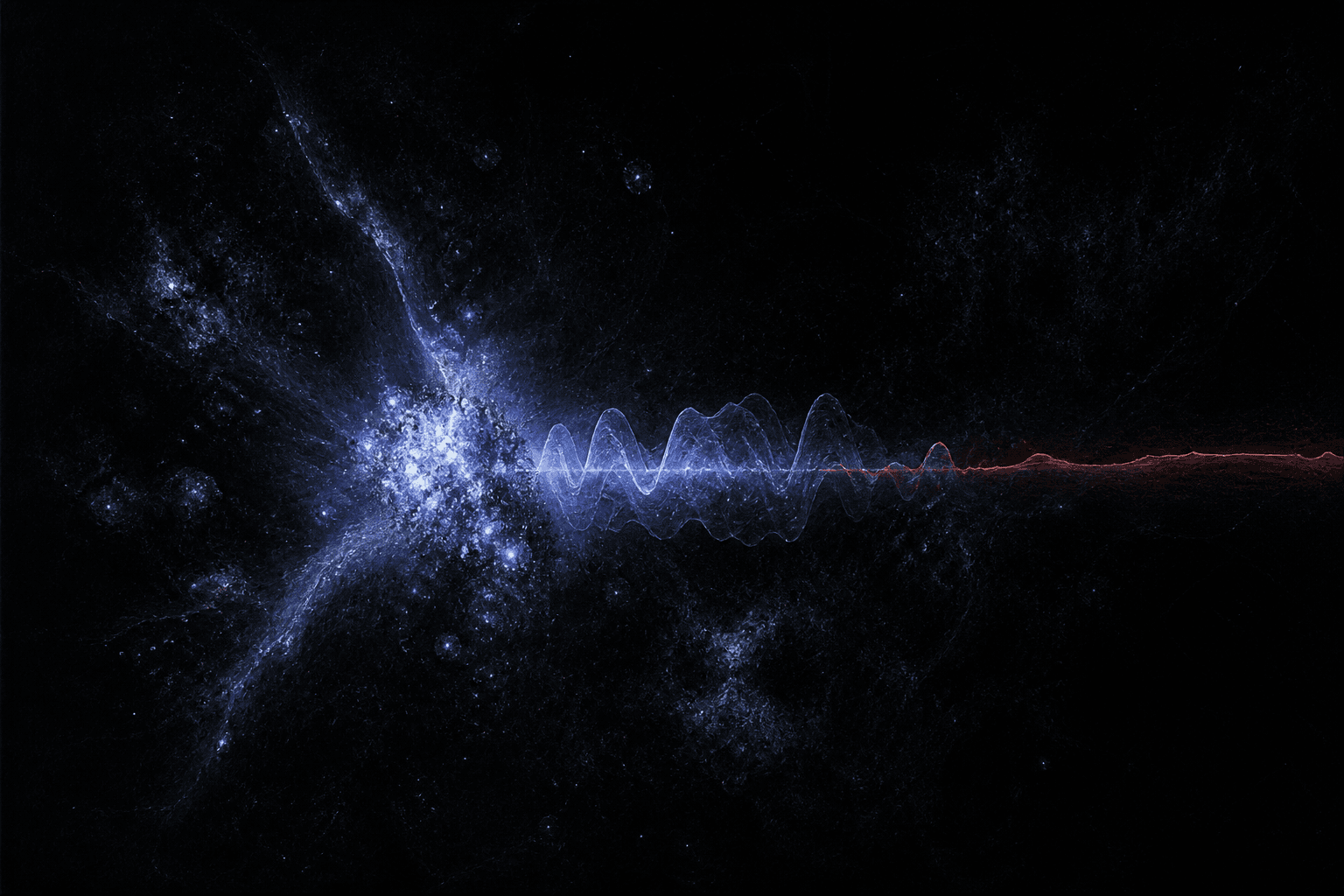
The spectrum also shows a roughly 500-kilometer-per-second ionized outflow and little neutral-gas covering along the measured sightline. Lyman-alpha remains weak, but 44 percent of its flux lies in a broad red wing above 500 kilometers per second, where intergalactic absorption should be reduced. The authors interpret the combined evidence as consistent with an intense, compact burst building dense nuclear gas and surrounding star clusters; the measurements do not directly image individual stars.
Why it matters
Ultra-deep JWST spectroscopy of GN-z11 resolved faint Lyman-alpha light, a fast ionized outflow and signatures consistent with very massive young stars.
Limits and context
- A broad nitrogen component could instead include an active-galactic-nucleus-driven wind, an alternative the paper does not rule out.
- The authors interpret the combined evidence as consistent with an intense, compact burst building dense nuclear gas and surrounding star clusters; the measurements do not directly image individual stars.
Key claims
Ultra-deep JWST spectroscopy of GN-z11 resolved faint Lyman-alpha light, a fast ionized outflow and signatures consistent with very massive young stars.
Qualification: A broad nitrogen component could instead include an active-galactic-nucleus-driven wind, an alternative the paper does not rule out.
Evidence: source-2026-08-15-001
Sources
- arXiv preprint 2608.12699arXiv · primary research
Corrections
No corrections have been recorded for this story.