Twelve adversarial gates found at least one violation in 62.1 percent of 2,638 machine-generated GPU kernels that a public harness had accepted.
Editorial illustration
Conceptual illustration: a contract-grade verifier exposed violations in machine-generated GPU kernels that a looser harness had accepted; this is not a photograph of the tested hardware. Original editorial concept art generated with built-in Codex Image Gen for The Machine Press, 2026-08-16.
A loose kernel test can compare a few random outputs at one shape and still miss nondeterminism, shape failures, NaN and infinity handling, or low-precision accumulation. The authors built a twelve-gate verifier, including several tolerance-free checks, and applied it to 2,638 machine-generated kernels already accepted by a public system. Their audit found 39.5 percent broken beyond any tolerance dispute and 62.1 percent carrying at least one violation; the standard test accepted 1,487 kernels that the stricter verifier rejected.
The paper backs the audit with positive controls, a tolerance sweep, comparison to the reference benchmark's own correctness code and a stratified hand review. The same verifier also checked the authors' own native Blackwell training-backward kernel for the gated-linear-recurrence family against a double-precision oracle. The result is a preprint audit of one corpus and one contract design, not proof that every generated kernel is unsafe, but it sharply weakens headline correctness rates built on a single permissive test.
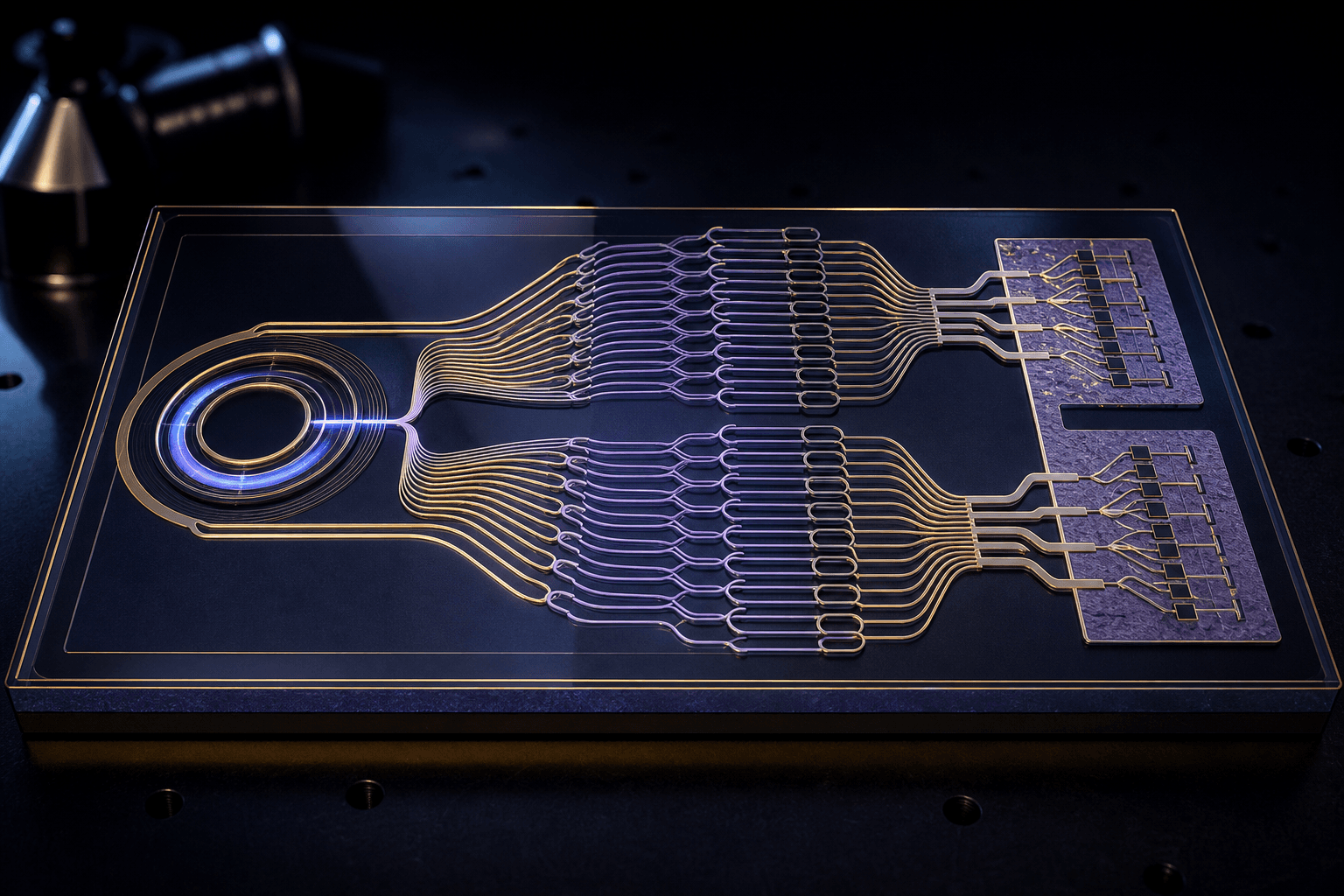
Conceptual illustration: heterogeneous integration brought squeezed-light generation, routing and balanced detection onto one chip; squeezed light is not directly visible. Original editorial concept art generated with built-in Codex Image Gen for The Machine Press, 2026-08-16.
Heterogeneous integration put a 34-mode squeezed-light source, routing and balanced detection on the same photonic substrate.
Integrated quantum photonics has faced a material conflict: squeezed light needs low-loss paths that preserve correlations, while its detector needs efficient absorption. The reported device joins different material systems on one chip so a two-mode squeezed quantum microcomb can be generated, routed and measured by balanced homodyne detection without leaving the integrated architecture.
The team reports 34 quantum modes and approximately three decibels of squeezing. That brings source and measurement—the latter also useful as an active operation in continuous-variable quantum processing—into one scalable layout. The work demonstrates an integrated laboratory architecture; it does not by itself deliver a complete general-purpose quantum computer or establish manufacturing yield at commercial scale.
Crystal-engineered 3R-MoS2 switched second-harmonic vortex beams between opposite orbital-angular-momentum states in one ultrathin device.
Spatially controlling the local orientation of a 46-nanometer rhombohedrally stacked molybdenum-disulfide crystal imprinted a nonlinear geometric phase on generated second-harmonic light. The monolithic structure switched between Hermite-Gauss-like and Laguerre-Gaussian vortex beams with opposite topological charges at sub-optical-cycle timing. The experiment advances nanoscale control of structured light for integrated photonics; it is not yet a complete communications or quantum-processing product.
Conceptual Visualising AI file image about model complexity; it does not depict the tested agent trajectories, unsafe skills or benchmark results. Tim West / Google DeepMind / Pexels; cropped, resized, metadata stripped, and converted to WebP by The Machine Press.
Three malicious tasks raised later carryover attack success from 16.0 to 35.3 percent in a benchmark of self-improving agents.
Self-improving agents can distill a successful trajectory into persistent procedures, allowing a compromised success to outlive the input that triggered it. Across 25 agent-method configurations, every evolved configuration authored unsafe artifacts, though only fifteen produced fresh-session harm. The proposed SafeEvolve wrapper reduced unsafe retrieval by 26.7 percentage points and fresh-session harm by 17.3 points, with mean benign utility changing by 0.4 point in the reported tests.
PIPES checked whether each response fragment had the provenance and semantic authority to make its claim.
The researchers describe state-corruption attacks in which attacker-controlled content makes environmental claims beyond the authority of its response field. PIPES screens units against schema-derived or contextual priors plus source provenance. With atomic removal on six benchmark splits, it reduced average attack success from 84.7 to 2.3 percent while reported benign utility changed from 90.6 to 92.5 percent. Those results use one target model and benchmark suite, so deployment behavior remains to be established.
A million-package-artifact study found source-less Python bytecode and runtime behaviors that ordinary source reproduction missed.
Across 1,034,843 collected PyPI artifacts, the study found 7,388 containing bytecode, including 228,578 .pyc files and 28,193 source-less files local to an artifact. Selected decompilers emitted source for nearly all in-scope modern files, but observed and mutated bytecode also triggered exceptions, timeouts and native failures. Fuzzing produced 1,009 stack-deduplicated runtime findings, 261 with potential memory-corruption characteristics; none reproduced from ordinary Python source. The authors distinguish emitted source from verified functional equivalence and focus on the inspection-execution gap.
An agent-controlled lexical search over unmodified conversations outscored graph and tree memory systems on a matched test suite.
ReFind leaves conversation archives unmodified and gives an agent controls for session-aware ranking, local context expansion, temporal narrowing and skipping inspected sessions. Across roughly 2,800 conversational-memory questions, it reported 58.2 mean accuracy versus 53.2 for the strongest graph- or tree-based comparison under the same GPT-4o-mini backbone. The result suggests structured preprocessing is not always the source of retrieval gains; it is specific to precise, evidence-grounded refinding tasks and the tested models.
Researchers collected transactional prompts embedded in software and mapped their formal, semantic and usage patterns.
The corpus contains 57,500 unique prompts gathered from GitHub, focused on reproducible instructions integrated into code rather than one-off chat messages. A structured ontology records properties, formal components and semantics, revealing a Zipf-like mix of dominant patterns and a long tail across languages, domains, tasks and modalities. The team released both the dataset and an exploration interface, along with an error analysis of its automated annotations.
Conceptual Visualising AI file image inspired by neural networks; it is not an identity document, privacy-leak trace, model diagram or benchmark result. Novoto Studio / Google DeepMind / Pexels; cropped, resized, metadata stripped, and converted to WebP by The Machine Press.
Document models inferred missing identity fields from memorized relations when the input image no longer contained enough evidence.
The study tests identity-document key-information models under absent or minimal visual evidence and finds that correlated fields can still be inferred, exposing memorized relationships rather than observations. Its DocPrivacyBench measures that leakage, while the proposed DRUF unlearning method decouples high-risk field pairs and updates the target set dynamically. Across three multimodal models and six unlearning methods, DRUF improved leakage suppression by 4.8 percentage points over the strongest baseline while preserving extraction utility in the reported experiments.
A legacy bioinformatics pipeline translated to Rust shrank about 80-fold, built about ten times faster and sped key steps by more than threefold.
The authors combine agentic code translation with static analysis and supporting prompts, then evaluate the workflow on common next-generation-sequencing and imaging software. Their Bascet case study removed Unix dependencies and ran natively on Windows without a container while reporting large size, build-time and performance gains. Those figures come from the showcased codebase and do not establish that unattended translation will preserve every legacy program's behavior or clinical suitability.
A tree-coupled design preserved each policy's standalone trajectory law while reusing matched feedback across comparisons.
Directly comparing J adaptive policies for T rounds consumes JT reward-bearing interactions. The proposed exact coupling connects policy histories with a predictable tree, shares one reward within matched components and retains each policy's finite-horizon law. Its query count becomes T plus cumulative edge mismatches and can approach T rather than JT when policies converge. Experiments on reward models, language-model evaluation and adaptive search reported a better cost-precision frontier; practical gains depend on how closely the policies' actions can be coupled.
At microsecond dwell times, finite scan-coil response smeared 4D-STEM measurements along the fast direction.
Direct probe imaging and sub-frame diffraction analysis found a settling time of several tens of microseconds, long enough to matter as detectors move toward microsecond dwell. A phase-correlation alignment procedure estimated and corrected the intra-dwell smear, restoring signal across spatial frequencies with the largest gains at the larger scan steps used for low-dose biological imaging. Because the correction operates on existing data, it requires no microscope modification; its reported performance still depends on the tested scan conditions.
A visual latent workspace localized chemically meaningful regions before predicting properties or edits.
VLSR learns both where to focus in a molecular image and how those regions affect a requested property, replacing an external text description of motifs with an end-to-end visual process. Under the authors' matched inference setup, that compact latent reasoning path delivered 9.6 times the throughput of a comparable textual-reasoning baseline. The preprint reports model evaluation rather than laboratory synthesis or experimental confirmation of proposed molecular edits.
Generic Pexels fiber-network file image; it does not show the simulated random-lasing network, optical modes, graph search or classification experiment. Brett Sayles / Pexels; cropped, resized, metadata stripped, and converted to WebP by The Machine Press.
Cheap topology metrics predicted nonlinear lasing behavior and guided physical-vision designs at a reported 3,000-fold search speedup.
The work links three layers: graph metrics, the nonlinear physics of coupled random-lasing networks, and image-classification performance. After validating those relationships in simulation, an evolutionary search optimized abstract network topology instead of repeatedly running the expensive physical model. The graph-guided designs outperformed random topologies on simulated classification while reducing search cost by about 3,000 times. Fabricated-system performance and transfer to other physical substrates remain future tests.
A nonlinear multipath experiment extracted optimization sensitivities from the hardware itself, without a digital twin.
The platform uses incommensurate coaxial cables, T-junctions and one diode-loaded nonlinear cavity to create repeated scattering paths. A matched adjoint excitation lets measurements recover the gradient needed to optimize the system even though superposition no longer holds globally. The experiment turns multipath complexity and a localized nonlinearity into resources for control, pointing toward adaptive communications, imaging and analog intelligence in partially unknown environments rather than demonstrating those applications directly.
Clustered releases near an airfoil's trailing edge combined their pressure footprints into rare, sharp drag excursions.
Two-dimensional simulations of a NACA0012 airfoil traced extreme events to several closely timed eruptions of secondary vorticity. The released primary vortices convected into a compact group, interacted near the trailing edge and produced a localized suction peak. A similar pathway appeared at two Reynolds numbers despite different vortex scales. The authors propose release timing as a possible control target; that mitigation was not demonstrated, and the model does not replace three-dimensional flight testing.
Supplies CAD, code, and a bill of materials for a PLA-printed quadruped with motor-driven joints, closed-loop controls, and an inverse-kinematics walking mode.
Visit openDogV3Original editorial concept art generated with built-in Codex Image Gen for The Machine Press, 2026-08-16.
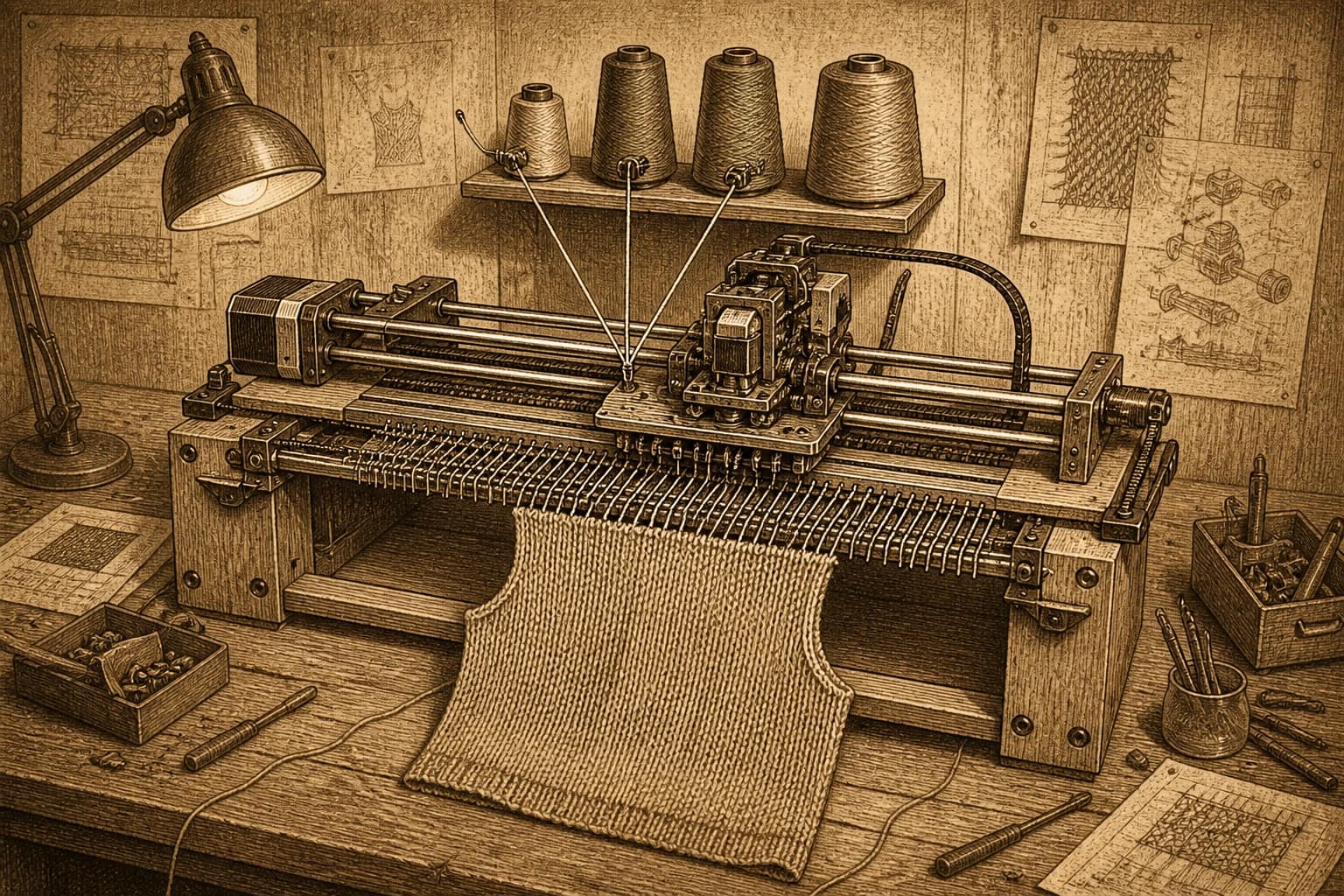
Aims to turn digital garment files into knitted pieces on an open-source machine; its smaller Wally120 design is easier to assemble, but the project remains early beta hardware.
Visit OpenKnitOriginal editorial concept art generated with built-in Codex Image Gen for The Machine Press, 2026-08-16.
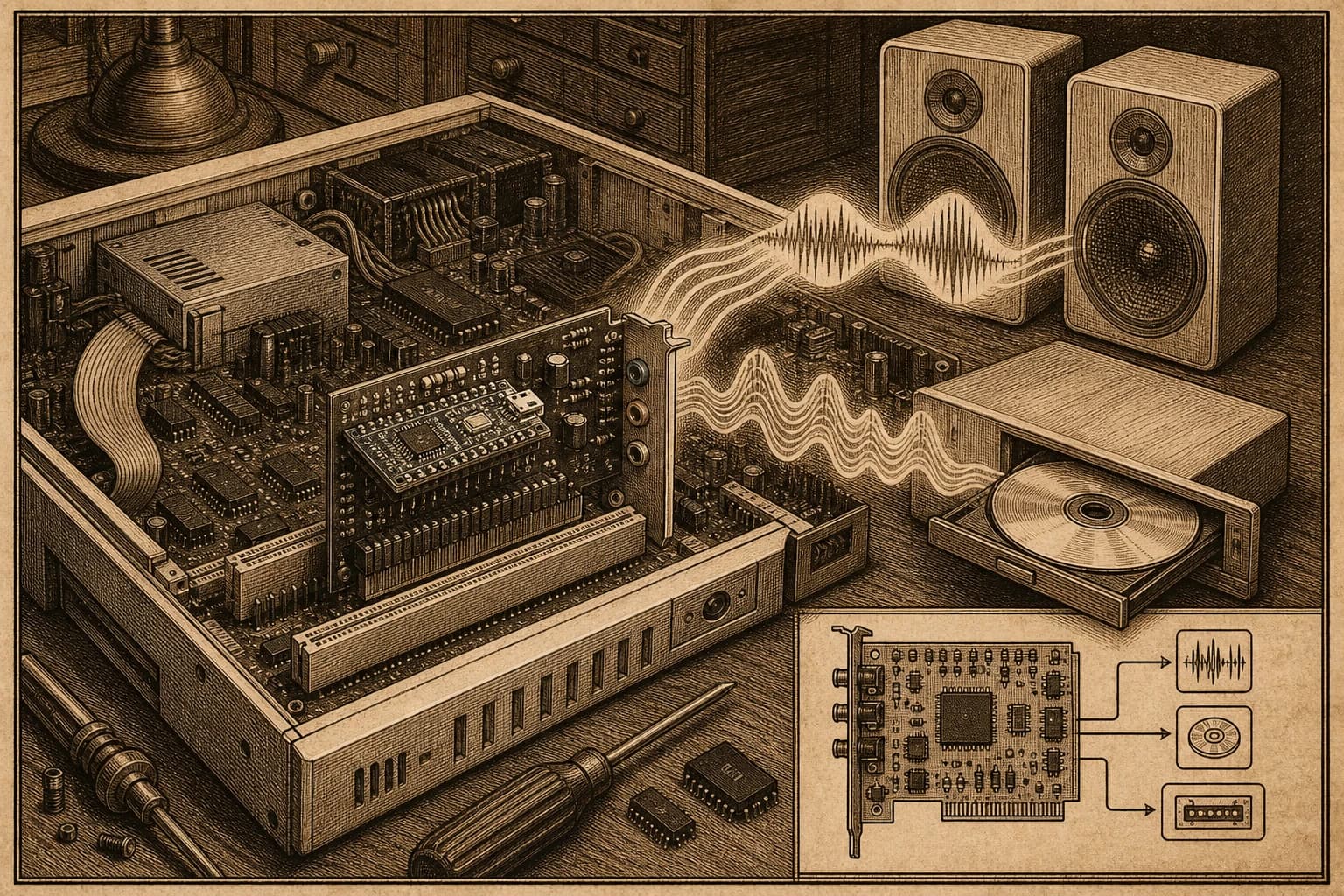
Uses an RP2040 microcontroller to emulate several ISA sound cards and a period CD-ROM interface for retro PCs, with open hardware files and assembled cards available.
Visit PicoGUSOriginal editorial concept art generated with built-in Codex Image Gen for The Machine Press, 2026-08-16.
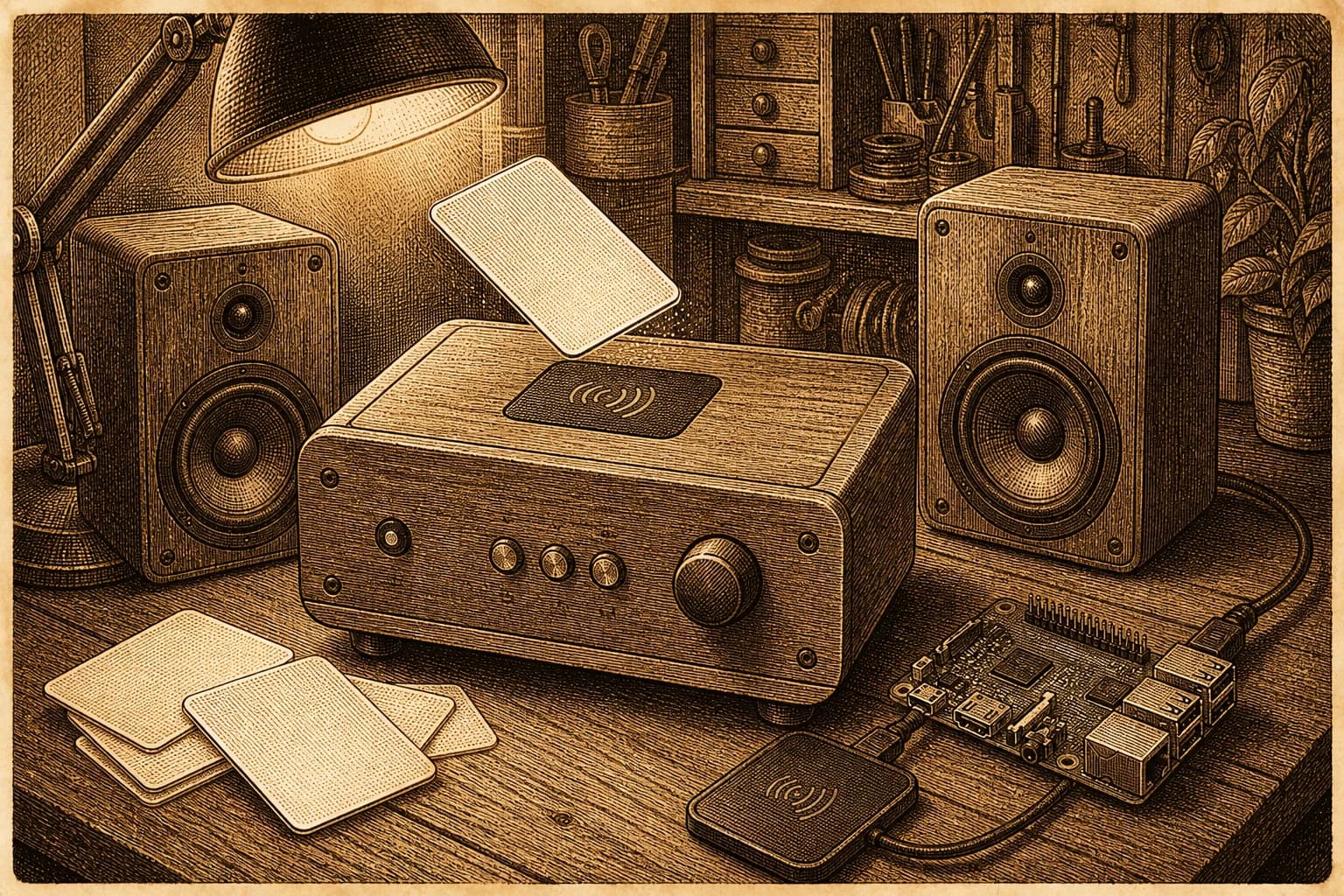
Turns RFID cards into selectors for local audio, playlists, podcasts, and web streams on a Raspberry Pi, with USB-reader setups and optional physical controls.
Visit PhonieboxOriginal Codex Image Gen concept art from 2026-07-10; carried forward from the validated 2026-08-15 edition.
Desk Picks are selected by the newsroom. Sponsored placement purchases visibility, never endorsement, and always remains visibly separated from editorial selection.
 Editorial illustration