research
One Chip Made—and Measured—the Squeezed Light
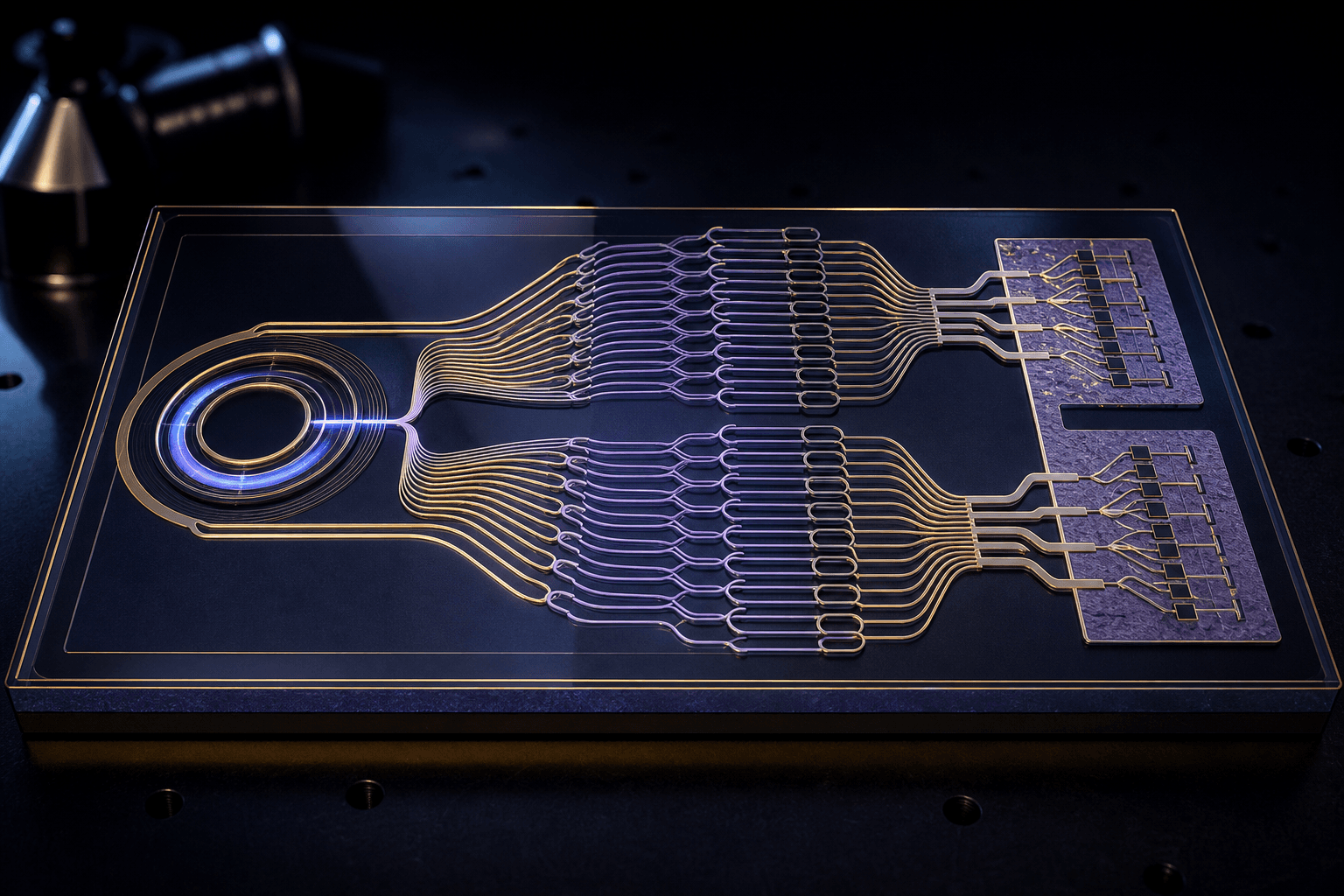
Heterogeneous integration put a 34-mode squeezed-light source, routing and balanced detection on the same photonic substrate.
Summary
Heterogeneous integration put a 34-mode squeezed-light source, routing and balanced detection on the same photonic substrate.
Integrated quantum photonics has faced a material conflict: squeezed light needs low-loss paths that preserve correlations, while its detector needs efficient absorption. The reported device joins different material systems on one chip so a two-mode squeezed quantum microcomb can be generated, routed and measured by balanced homodyne detection without leaving the integrated architecture.
The team reports 34 quantum modes and approximately three decibels of squeezing. That brings source and measurement—the latter also useful as an active operation in continuous-variable quantum processing—into one scalable layout. The work demonstrates an integrated laboratory architecture; it does not by itself deliver a complete general-purpose quantum computer or establish manufacturing yield at commercial scale.
Why it matters
Heterogeneous integration put a 34-mode squeezed-light source, routing and balanced detection on the same photonic substrate.
Limits and context
- The work demonstrates an integrated laboratory architecture; it does not by itself deliver a complete general-purpose quantum computer or establish manufacturing yield at commercial scale.
Key claims
Heterogeneous integration put a 34-mode squeezed-light source, routing and balanced detection on the same photonic substrate.
Qualification: The work demonstrates an integrated laboratory architecture; it does not by itself deliver a complete general-purpose quantum computer or establish manufacturing yield at commercial scale.
Evidence: source-2026-08-16-002
Sources
- arXiv preprint 2608.13218arXiv · primary research
Corrections
No corrections have been recorded for this story.