A reformulated search and AlphaEvolve-assisted optimization lowered the best known upper bound for matrix multiplication to below 2.371177.
Editorial illustration
Conceptual illustration: optimization and an AlphaEvolve-assisted search improved a theoretical matrix-multiplication bound; this is not a software benchmark or claim of practical speedup. Original editorial concept art generated with built-in Codex Image Gen for The Machine Press, 2026-08-18.
The note attacks the optimization problem inside combination-loss analysis, a refinement of the laser method that currently sets the best upper bounds on the matrix-multiplication exponent. The authors first reformulated the optimization so it could be solved in a larger setting, then designed a machine-learning-guided optimizer and refined that search with AlphaEvolve. The combined construction gives an upper bound below 2.371177, improving the previous 2.371339 record.
This is a theoretical bound, not a claim that ordinary matrix multiplication software has suddenly become faster. Its significance lies in narrowing what asymptotic algorithms may ultimately achieve and in showing that a search system can contribute inside a highly structured mathematical optimization pipeline whose result remains explicit enough to check.
Conceptual illustration: a proposed three-terminal fractal interferometer uses engineered dissipation and interference to control modeled heat flow; no fabricated device was reported. Original editorial concept art generated with built-in Codex Image Gen for The Machine Press, 2026-08-18.
A proposed three-terminal fractal interferometer uses engineered dissipation and magnetic flux to amplify heat flow without resonant transmission.
The theoretical device places a floating Büttiker probe at the third terminal of a Sierpinski-gasket Aharonov-Bohm interferometer. That reservoir exchanges energy while carrying no net charge current. In the authors’ nonequilibrium Green’s-function model, magnetic-flux-controlled interference can cancel the base terminal’s differential heat response even as finite heat currents continue through the emitter and collector, causing the calculated thermal gain to diverge.
The mechanism depends on the combination of coherence and deliberately introduced dissipation; the purely coherent comparison showed little or no amplification. The paper proposes a mesoscopic heat-control principle rather than reporting a fabricated device, so the result is a model prediction whose experimental feasibility and stability remain to be established.
A post-hoc monitor adds shape, temporal consistency and image quality, but still raises substantial false alarms under corruption.
TCSR-Monitor wraps a frozen segmentation model and combines confidence with observable shape, temporal and acquisition-quality cues, requiring neither model internals nor deployment ground truth. Leave-one-corruption-out tests on EndoVis 2017 outperformed confidence baselines and a circularity control suggested the monitor was predicting segmentation failure rather than merely spotting degraded images. Yet a global threshold falsely alarmed on up to 40 percent of correctly segmented frames at moderate corruption, and transferred features lost to entropy at both tested SAM2 thresholds. The limitations are central to the result.
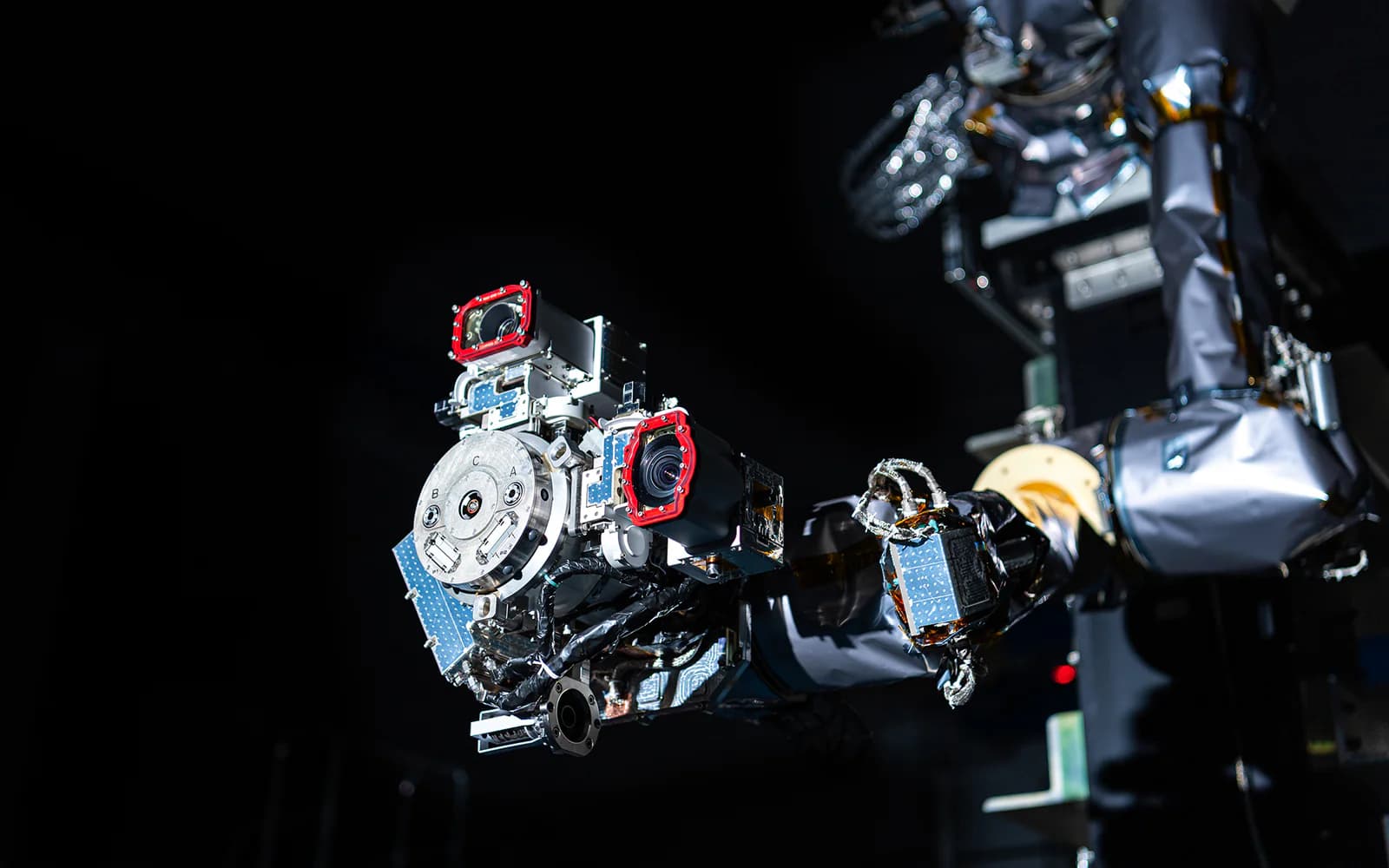
NASA OSAM-1 file image used only as generic robotics context; it does not depict BATON, RoboMemArena, the tested robots or reported results, and use does not imply NASA endorsement. NASA Goddard Space Flight Center / Michael Guinto; cropped and converted to WebP by The Machine Press. Use does not imply NASA endorsement.
BATON explores subtasks separately and repairs the transition state before the next contact-rich skill begins.
BATON freezes the underlying vision-language-action policy and makes each subtask the unit of test-time exploration. Solutions are stored in language memory, turning an approximately multiplicative whole-task search cost into an additive stage-by-stage process. A verifier checks the scene before invoking a contact skill, while handoff and lookahead transitions restore states a successor can inherit. On RoboMemArena, the authors report task-success and cumulative-success gains of 11.6 and 14.9 percentage points over the compared state of the art; these are benchmark results, not evidence of broad real-world reliability.
A latent-to-pixel training recipe matched or beat latent diffusion baselines while cutting reported inference time by 3.18 to 4.75 times.
Direct large-scale pretraining in pixel space converged much more slowly than latent-space training in the authors’ study. Their recipe first acquires generative priors in latent space, then moves to pixels during post-training while tuning initialization, data mix, prediction target, decoder and noise schedule. The resulting models matched or outperformed the tested latent counterparts and delivered reported end-to-end speedups of 3.18 to 4.75 times. Those gains belong to the evaluated architectures and training setup, not every text-to-image system.
A hierarchical VLA searched high-level subtask alternatives at inference time instead of committing after one forward pass.
Tau-zero VLA turns high-level subtask generation into a compute-scalable inference problem. An execution memory proposes the next subtask and, when needed, a world model searches alternatives before a low-level policy acts across multiple robot embodiments. The model was trained with 40,115 hours of heterogeneous real-world data. The authors report that extra test-time computation improved next-subtask prediction and closed-loop long-horizon success in both familiar and shifted settings; the abstract does not establish a universal compute-to-reliability curve.
AutoSR attaches reasoning, probes and independent review to every candidate equation before the research tree chooses a branch.
AutoSR searches persistent research states rather than isolated formulas. Proposer and reviewer agents add motivations, computational evidence and criticism to each branch, while progressive-widening Monte Carlo tree search allocates work among competing investigations. Across nine selected benchmark challenges, the authors report algebraically equivalent recoveries in every case, including three cp3-bench problems not recovered by published comparison systems. The small selected suite supports the workflow concept, not a general claim of autonomous scientific discovery.
Analytical priors cut prediction error for side-branch resonators when only 20 to 70 high-fidelity simulations were available.
The framework either retains the analytical resonator model as a baseline and learns its discrepancy or distills that mapping into a self-contained prior before calibration. Using 86 simulation-labelled geometries and 8,998 analytical-only examples, residual support-vector regression reduced mean absolute error from 1.333 hertz for the analytical model to 0.426 hertz; a fully fine-tuned prior MLP reached 0.371 hertz. These figures describe one rectangular Helmholtz-resonator study, but they quantify how low-cost physics can improve data efficiency.
Illustrative Pexels data-center file image; the facility is unidentified and does not depict the ranking systems, delivery capacity, traffic or evaluation data in the paper. Brett Sayles / Pexels; cropped, resized, metadata stripped, and converted to WebP by The Machine Press.
A counterfactual evaluation task estimates how a candidate ranker would redistribute traffic before it reaches an online A/B test.
Accuracy metrics can improve while a ranking model shifts impressions among click, video-view or other objective buckets in ways that hurt downstream utility. The proposed task models those shares from observational data using candidate confidence and delivery capacity. A random forest cut L1 error by 49 percent for model families seen in training, but failed against the baseline during the hardest first hour for held-out models; a two-hour rollout architecture recovered a 22 percent gain there. The result exposes both the promise and the cold-start limit of offline traffic-allocation forecasts.
Visual grounding built a symbolic state, then constrained decoding and search produced executable household plans under that model.
The agent first explores with a vision-language model to acquire goal-relevant predicates and object bindings, then uses a PDDL transition model to restrict decoding to applicable actions while Monte Carlo tree search evaluates continuations. Open models from 4B to 27B parameters exceeded 90 percent reported success on VirtualHome and ALFWorld. In ALFWorld, constraints or search alone solved under one-third of tasks, while their combination exceeded 95 percent; residual failures moved toward visual state acquisition, and transfer still depends on correct grounding.
PixRestore trains a roughly 50-million-parameter pixel diffusion transformer from scratch and distills it to one-step restoration.
PixRestore avoids a variational autoencoder that may discard restoration-sensitive details and an open-ended synthesis prior that may invent content. It performs flow matching on patchified pixels, predicts which layer features are reliable under each degradation and uses those features as conditioning. After adversarial fine-tuning to one step, the authors report the best overall fidelity, perceptual quality and robustness among their compared unified-restoration models. Those claims depend on the released benchmark suite and should not be read as proof against restoration artifacts in general.
A white-box inversion method injects identity gradients through a flow-matching trajectory to reconstruct representative target-class faces.
SFMI first trains an unconditional flow-matching prior over faces, then backpropagates through the target recognition model to guide intermediate samples toward a selected identity class. Under an identity-disjoint CelebA evaluation against ArcFace, the paper reports 0.9248 attack accuracy, FID 22.61 and LPIPS 0.3874, with competitive results across additional targets. The images are representative reconstructions rather than recovered source photographs, but the experiment illustrates the privacy exposure created by white-box access to recognition models.
A cross-band search found no coherent X-ray and optical periodicity, then converted the null result into an amplitude-dependent population limit.
The study searched 1,194 Swift-BAT active galactic nuclei and a second stage of 175 4XMM-DR14 objects, requiring individually significant X-ray and optical periods to agree within five percent. No co-periodic candidate survived. For 100- to 900-day periods, the completeness-corrected 95 percent upper limit falls below about three percent only when hard-X-ray fractional modulation is at least 0.3; sensitivity becomes weak at lower amplitudes. The null therefore constrains loud shared clocks, not the existence of all supermassive black-hole binaries.
Illustrative Pexels CSS code-screen file image; it does not show TDD-Agent, generated tests, a studied repository or benchmark results. Pixabay / Pexels; cropped, resized, metadata stripped, and converted to WebP by The Machine Press.
TDD-Agent generates executable tests first, then refines both tests and implementation with execution feedback.
Instead of treating generated tests as fixed post-hoc judges, TDD-Agent uses them to clarify expected behavior before implementation and revises both tracks iteratively. A test-first prompt improved over reasoning baselines on LiveCodeBench, and the full framework outperformed retrieval- and agent-based comparisons on RepoEval. The authors also report higher pass rates, coverage and mutation scores as refinement continued. Generated tests can still encode incomplete assumptions, so the benchmark gains do not remove the need for independent specification and review.
A per-frame keypoint template estimates monocular vehicle speed without fixed camera calibration or roadway reference marks.
The method detects 36 vehicle keypoints, updates a homography each frame and compares keypoint-only tracking with warped optical flow. Across more than 400 roadside and overhead clips spanning 30 to 100 miles per hour, warped flow produced mean absolute errors of 15.0 and 9.7 percent on two datasets; trimming edge-of-frame outliers improved those to 11.7 and 7.6 percent. The remaining errors are material for enforcement, so the result supports low-cost estimation research rather than automatic evidentiary reliability.
A lattice construction solves the temporal gauge field analytically and derives polynomial resource scaling for real-time SU(3) simulation.
The proposal represents independent gauge fields in a local basis, uses local quantum Fourier transforms for conjugate momentum and avoids maintaining Gauss’s-law constraints during Trotterized evolution by working in axial gauge. The paper bounds qubit requirements for states below a chosen energy and derives per-step gate scaling of order nA to the fourth times volume to the four-thirds, plus volume to the five-thirds for up to six fermion flavors. This is an algorithmic resource analysis, not a demonstration on hardware capable of useful quantum chromodynamics.
Four independently verified builder projects from the active August 16–22 cycle, plus one disclosed house-example sponsored slot and one placement CTA. Weekly images are carried over from the validated Sunday handoff.
Four editorial selections
$7 for seven days
Paid work is clearly labeled
Placement is never endorsement
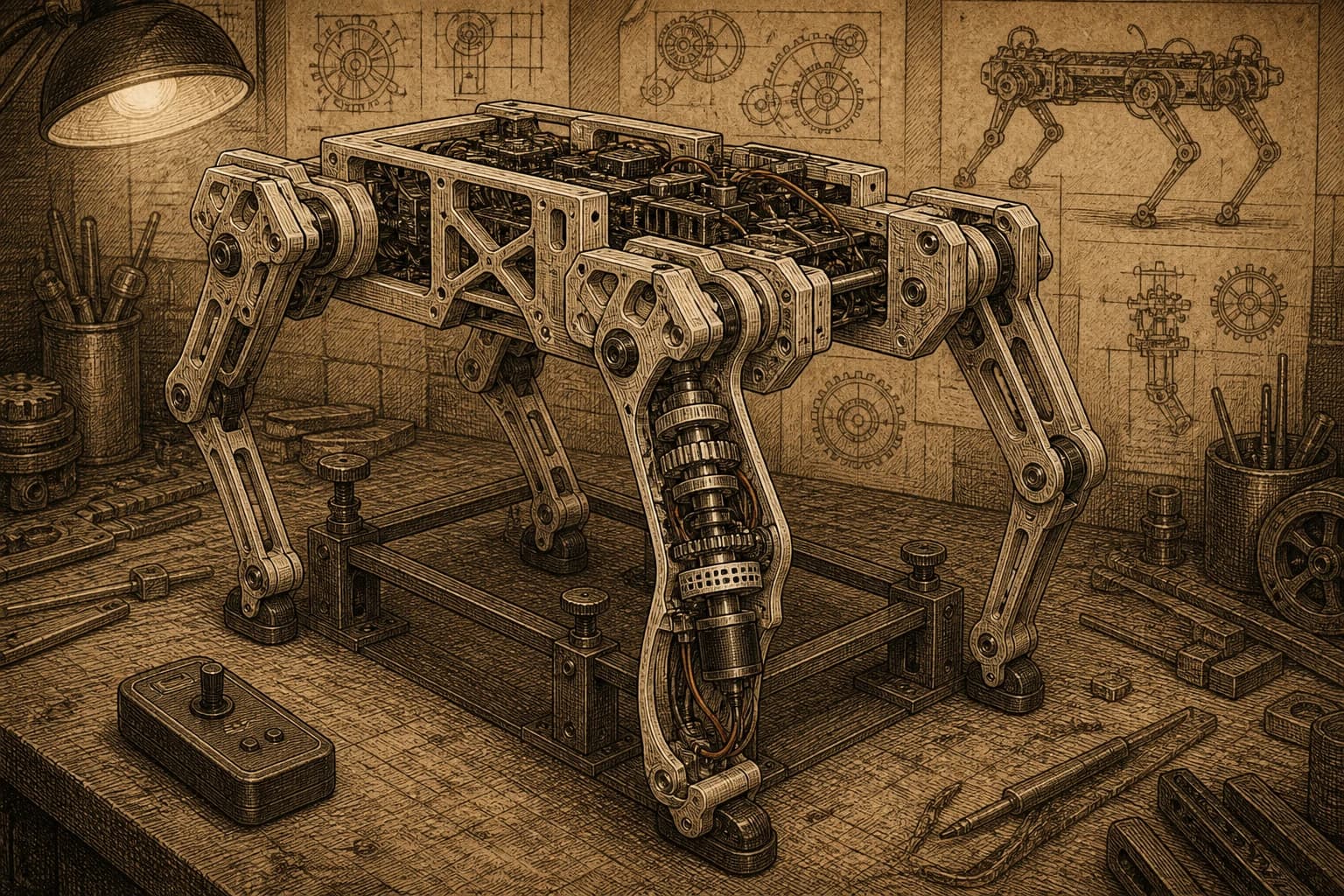
Original editorial concept art generated with built-in Codex Image Gen for The Machine Press, 2026-08-16.
Supplies CAD, code, and a bill of materials for a PLA-printed quadruped with motor-driven joints, closed-loop controls, and an inverse-kinematics walking mode.
Visit openDogV3Original editorial concept art generated with built-in Codex Image Gen for The Machine Press, 2026-08-16.
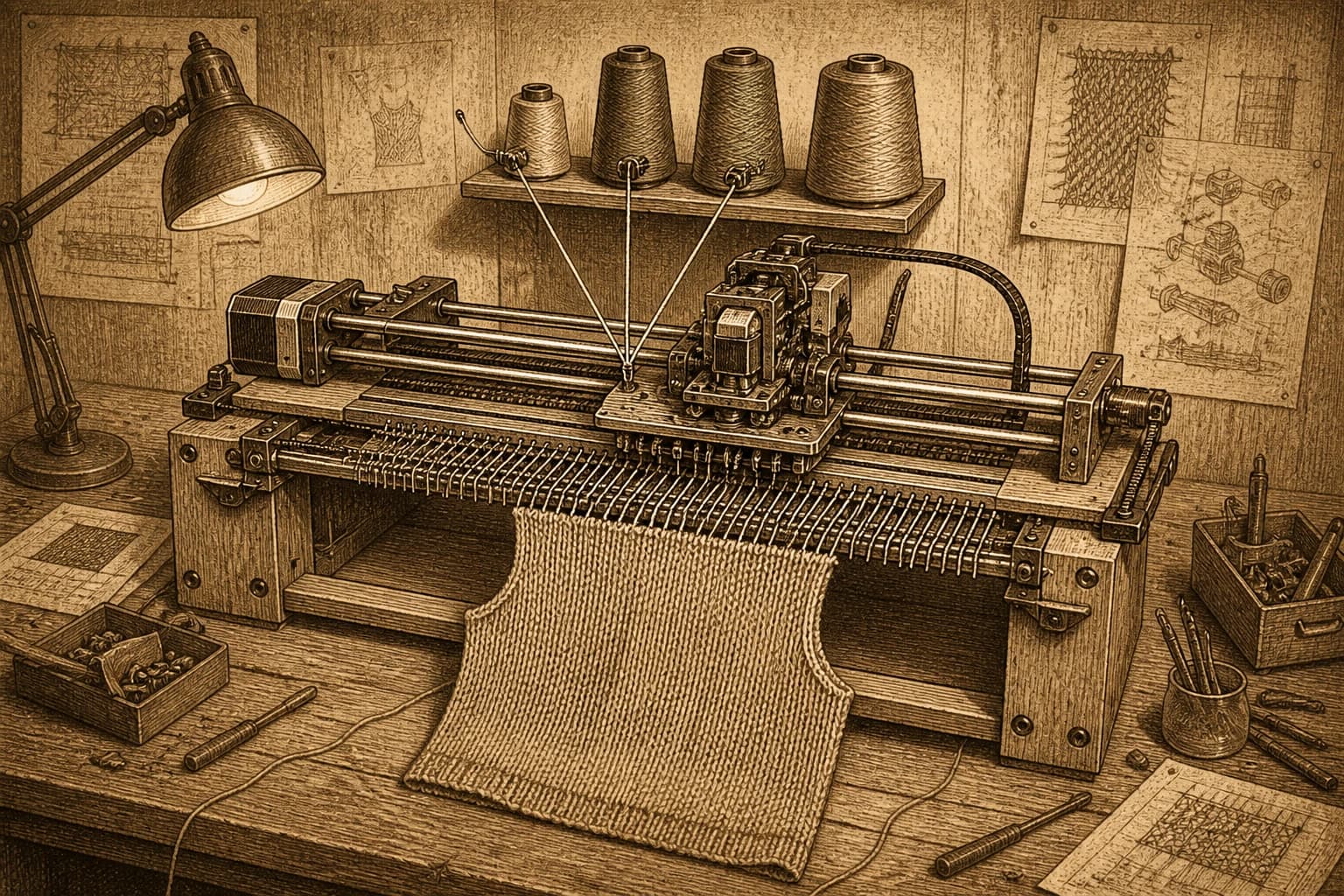
Aims to turn digital garment files into knitted pieces on an open-source machine; its smaller Wally120 design is easier to assemble, but the project remains early beta hardware.
Visit OpenKnitOriginal editorial concept art generated with built-in Codex Image Gen for The Machine Press, 2026-08-16.
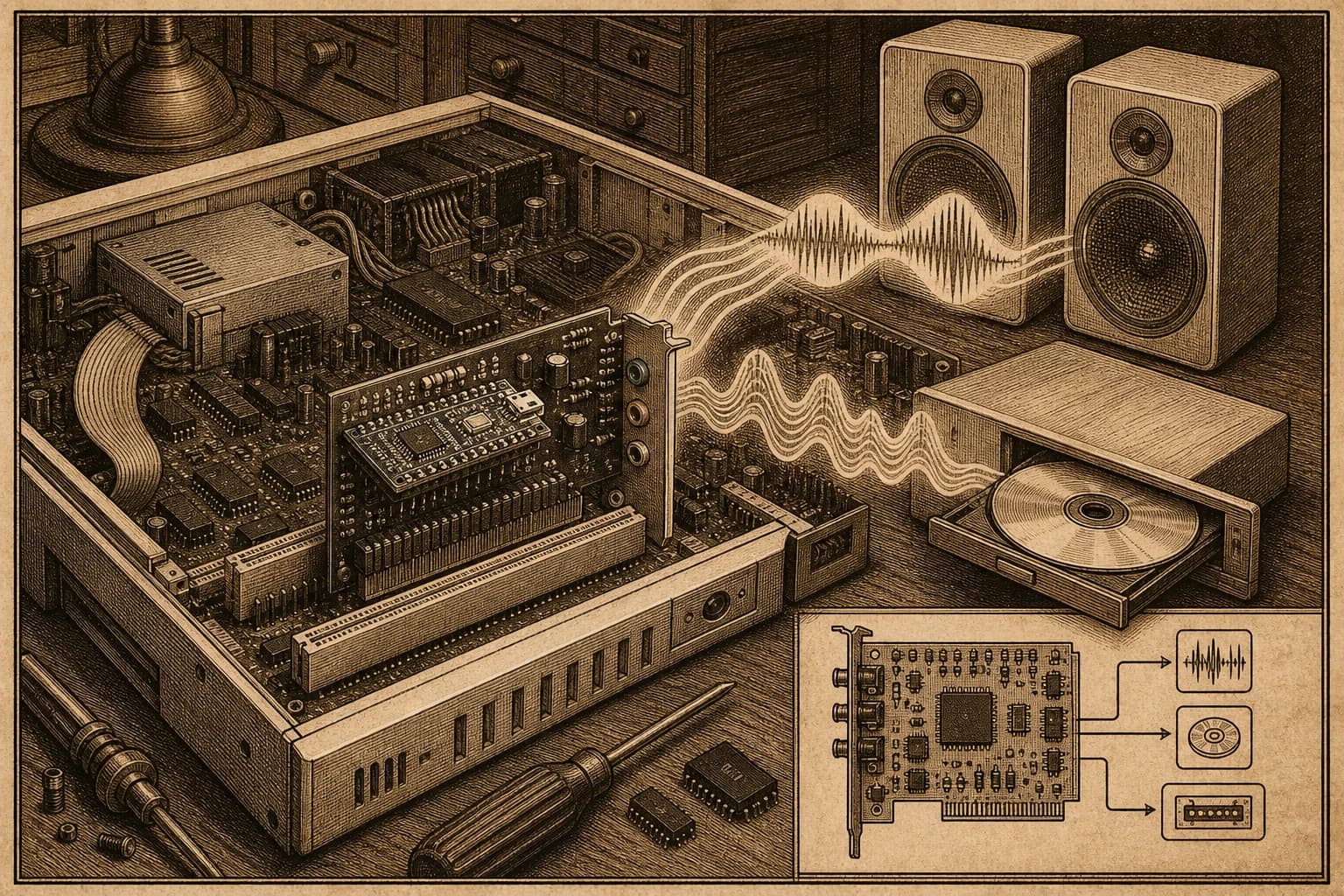
Uses an RP2040 microcontroller to emulate several ISA sound cards and a period CD-ROM interface for retro PCs, with open hardware files and assembled cards available.
Visit PicoGUSOriginal editorial concept art generated with built-in Codex Image Gen for The Machine Press, 2026-08-16.
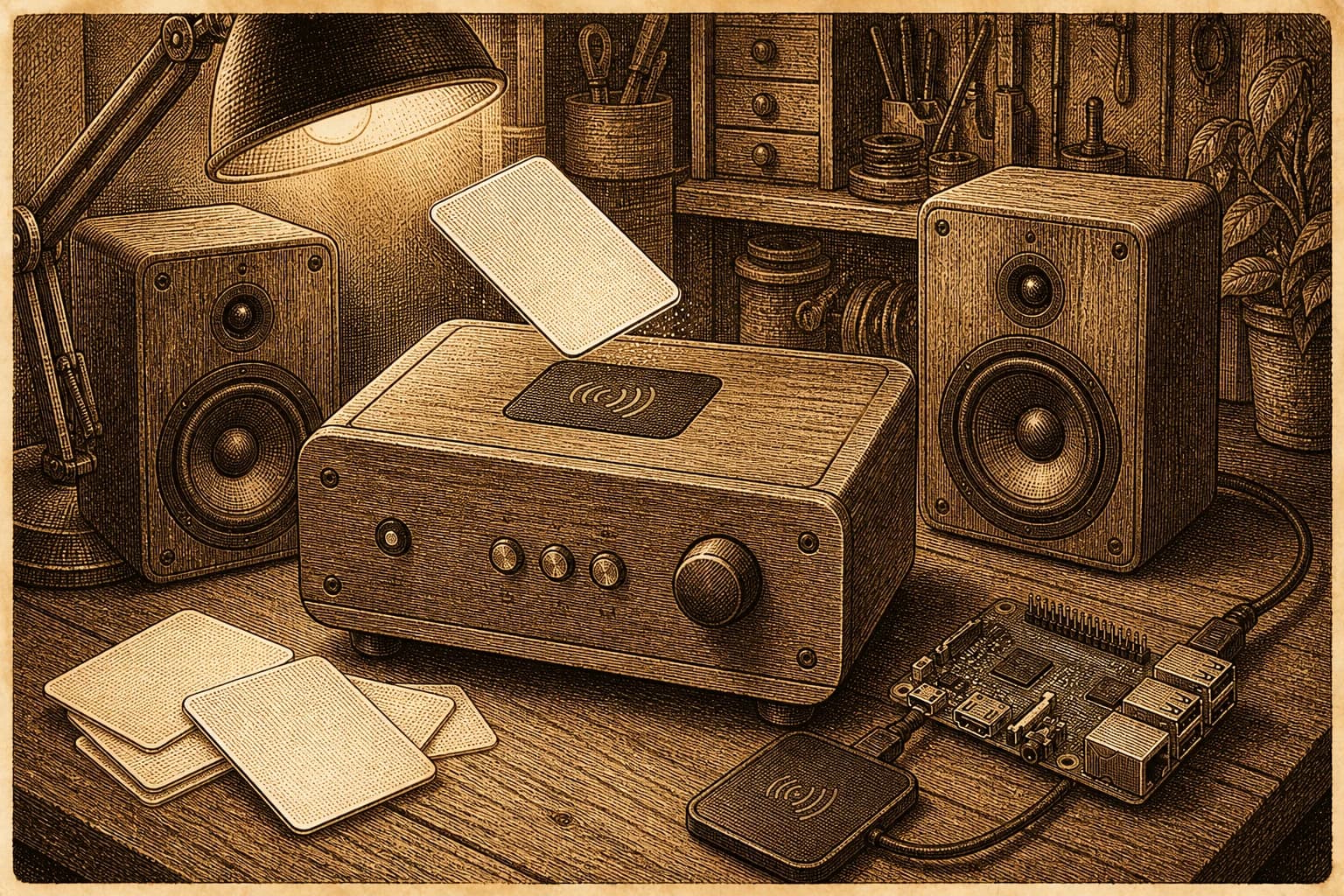
Turns RFID cards into selectors for local audio, playlists, podcasts, and web streams on a Raspberry Pi, with USB-reader setups and optional physical controls.
Visit PhonieboxOriginal Codex Image Gen concept art from 2026-07-10; carried forward from the validated 2026-08-15 edition.
Desk Picks are selected by the newsroom. Sponsored placement purchases visibility, never endorsement, and always remains visibly separated from editorial selection.
 Editorial illustration