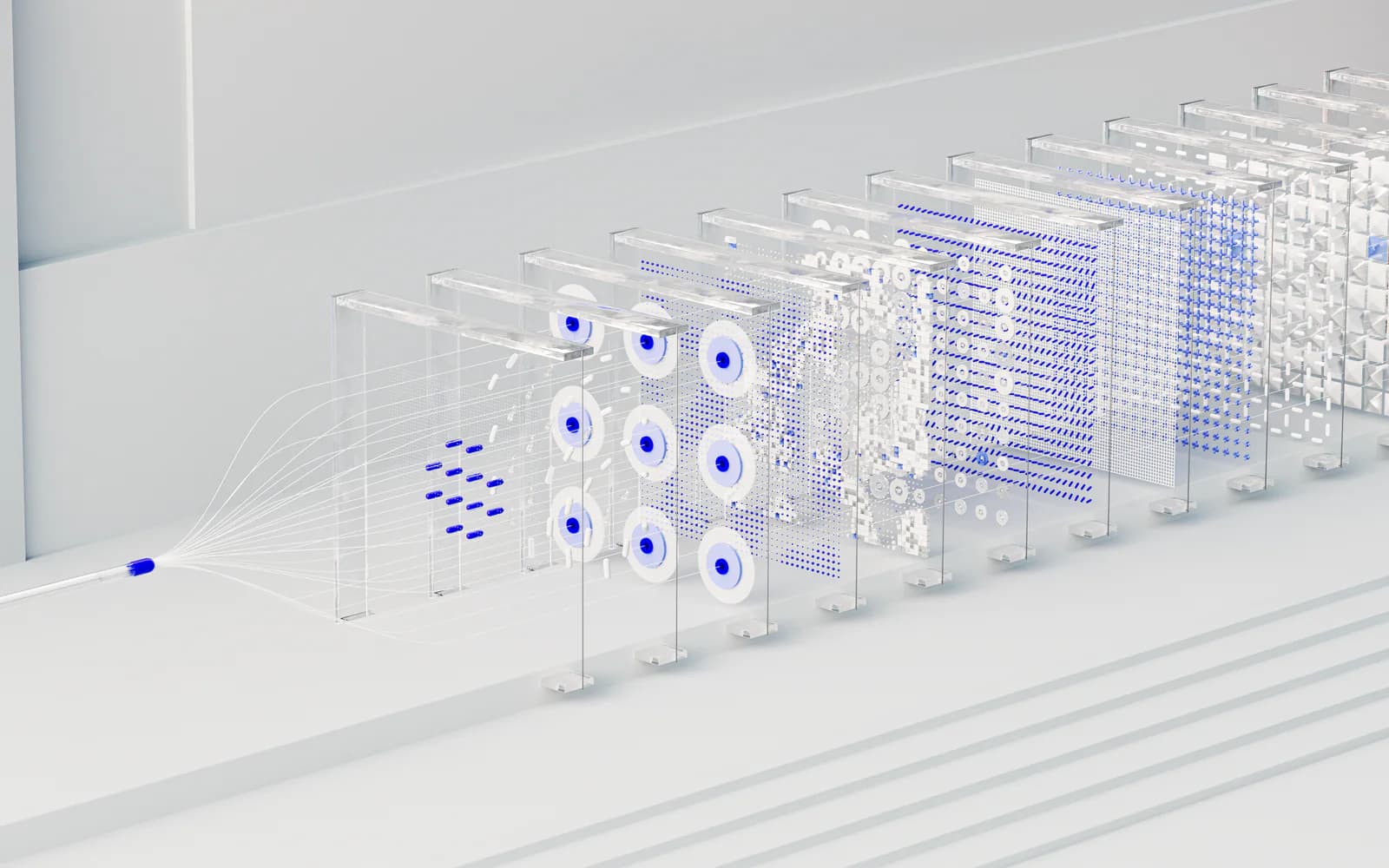
A paired oversight experiment found that wider action windows increased catches and false rejections together; one or two actions carried the clearest signal.
Editorial illustration
Conceptual illustration: a paired benchmark varied how many planned actions an AI monitor reviewed; this does not depict its prompts, interfaces or results. Original editorial concept art generated with built-in Codex Image Gen for The Machine Press, 2026-08-26.
The twin-prefix framework holds a plan fixed while comparing a clean prefix with a version that differs by one environment-accepted error. Six language-model judges reviewed those pairs at five nested lengths. Longer windows caught more bad plans, but false rejection rose in lockstep, so preregistered informedness peaked at one or two actions in both tested domains. Replaying observations that the longer prompt had withheld recovered much of the lost discrimination. The result does not say that short review is universally safest; it says a safety case must name its verification unit and measure clean-plan rejection alongside catch rate.
Conceptual illustration: NeuronGuard trains measured refusal behavior to persist under deliberate neuron ablation; this is not a model diagram or universal safety claim. Original editorial concept art generated with built-in Codex Image Gen for The Machine Press, 2026-08-26.
NeuronGuard trains refusal behavior to survive deliberate neuron ablation, targeting jailbreaks and post-deployment pruning through one shared weakness.
NeuronGuard periodically identifies safety-critical neurons with per-layer classifiers, then trains the model to preserve refusal behavior while some of those neurons are deliberately ablated. KL regularization keeps output distributions consistent, while randomized gradient projection manages conflicts with task learning. Across three models, six attack strategies and multimodal tests, the authors report near-zero attack success while maintaining task accuracy, including under white-box adaptive attacks, and give an upper-bound argument for reduced attack success. Those are controlled experimental results on the tested settings, not proof that redistributed signals make every model or deployment universally safe.
A shared harness compares three test-time recursion operators under identical prompts, budgets and grading.
Across 49,327 graded items and 151,876 model calls, branching improved accuracy in all 14 model-benchmark settings by an average 5.98 percentage points and ranked best in 12. Growing one trace averaged 2.18 points and pruning/recomposition 0.94; paired scoring also showed how pipeline failures could reverse comparative conclusions.
Conceptual Visualising AI file image used illustratively; it is not CPP, a conformal set, a pruning mask or an experimental result. Tim West / Google DeepMind / Pexels; cropped, resized, metadata stripped, and converted to WebP by The Machine Press.
Calibration-Preserving Pruning treats compression as an efficiency problem after split conformal prediction fixes the reliability contract.
At 50 percent sparsity on DBpedia-14, CPP-SparseGPT reduced mean prediction-set size from 10.1 to 8.6 while accuracy moved from 0.347 to 0.366. It produced smaller sets in 13 of 15 dataset-sparsity cells, but matched controls showed generic supervised gradients explain much of the gain; the claims remain limited to reliability-sensitive classification.
SPIDER4TianoCore reports downstream patch status with reviewable evidence instead of claiming that a match proves safe propagation.
On 20 prepared target-CVE pairs from eight public EDK II repositories, the analyzers found 10 high-confidence pre-patch matches, four high-confidence post-patch matches and abstained on six. None of the confident classifications disagreed with recorded manual labels, but the authors frame this as preliminary evidence generation for prepared targets, not general downstream accuracy.
EXAM² combines speech, sound, music, mixed audio and images in one multilingual benchmark.
The benchmark contains 5,667 multiple-choice questions, 22,614 image instances and 135,684 translations across six languages. Tested audio and multimodal models showed substantial multilingual and cross-modal gaps; a lightweight fusion model fine-tuned on the training split improved up to 12.4 percent in multilingual tests and 21.7 percent in multimodal evaluation over its stated baseline.
TrustShift models an MCP server that behaves honestly through a conditioning window before switching to a malicious payload.
Across four production-style domains and frontier proprietary and open-weight models, the staged attacks reached a reported 69.5 percent mean success rate. A transport-boundary defense learned behavioral baselines during clean windows and reduced that figure to 42.7 percent, leaving meaningful residual risk and showing why static deployment checks cannot see a later server-controlled defection.
A two-study simulation traces how embeddings, structural screens and selection policy determine what psychometricians ever review.
Across 32,000 selected Big Five items, broad semantic agreement concealed large local changes in evidence and survival. Every evaluable form filled all content cells, yet inclusive primary forms from different embedding configurations shared a median of only six of 40 items, making the computational evaluator part of measurement design rather than neutral plumbing.
Generic programming file image; it does not show Shopify, a listed app, marketplace data or the study's survival model. Dhirendra Singh Dhami / Pexels; cropped, resized, metadata stripped, and converted to WebP by The Machine Press.
A seven-year Shopify marketplace panel finds that governance and entry conditions mattered more than simply arriving first.
The study combines a 24,826-app snapshot with weekly tracking of 7,708 apps across 366 weeks. Later entrants grew faster in 88 percent of 50 analyzed categories, while public data from an app's first six months predicted two-year exit with cross-validated AUC above 0.8. The measurements describe Shopify's marketplace and detection method, not every software platform.
A resilience suite separates rebound, stability and graceful extensibility from end-of-task success.
Across 400 household tasks and 10 embodied-agent systems, the process metrics exposed recovery-cost differences of 25.2 among episodes that all ended successfully, along with instability and task-family degradation. Metric-guided changes reduced recovery cost and improved stability and extensibility completion, while also revealing tradeoffs among those properties.
Pipeline-native transformers co-design dependency graphs with a stage-major runtime for bandwidth-bound decoding.
One tested architecture halved critical-path weight bandwidth from 9.00 to 4.50 MB per token while staying within 0.24 perplexity of the best candidate. On a 30.9-billion-parameter mixture-of-experts model, the cflow runtime reported 5.94 tokens per second on 32 Ice Lake vCPUs; the authors also report one design claim refuted and another inconclusive.
CloudEmu combines documentation-driven code synthesis with symbolic constraints and oracle tests against live services.
The system generates API-level emulators for AWS and GCP services, then uses real-cloud behavior to test, repair and align them. The authors report higher coverage and accuracy than LocalStack in their evaluation, but the comparison is confined to the selected services and harness rather than every behavior in either cloud platform.
PuzzleKV compresses completed per-head pages independently instead of sharing one projection across a broad cache region.
At roughly 60 percent of original KV storage, PuzzleKV retained more than 96 percent of Full KV performance across both evaluated models and all reported settings. Combined with quantization, it retained more than 93 percent using 18.7 percent of storage, with attention computed directly over dense and factorized pages.
Conceptual Visualising AI file image; it is not an ExTS search tree, evaluated workflow, score trace or benchmark result. Novoto Studio / Google DeepMind / Pexels; cropped, resized, metadata stripped, and converted to WebP by The Machine Press.
ExTS treats expansion as a value-of-information decision when evaluations and model calls are scarce.
The policy combines sharper reward separation, a virtual child that estimates the value of branching and quality-conditioned expansion. Across prompt optimization, code generation, molecular structure elucidation and workflow optimization, one fixed configuration produced a reported average relative gain of 5.5 percent over task-specific tree-search baselines.
FlowNeg uses a hierarchical generative flow network to sample informative knowledge-graph counterexamples across modes.
Across a five-seed grid of five architectures and five benchmarks, FlowNeg had higher mean reciprocal rank than two comparison methods in 24 of 25 cells. A separate 15-seed control on FB15k-237 with RotatE reported 0.359 versus 0.346 MRR, with fixed diagnostic and compute budgets.
A source-level case study finds replayable sessions, model quirks as data, progressive context and extension seams across opposing designs.
The authors trace convergence through parallel discovery, diffusion and direct reuse rather than claiming independent invention. All three examined coding-agent harnesses showed the five recurring elements, while none supplied an externally verifiable, tamper-evident record that an outside party could check without trusting the runtime.
A self-contained touchscreen computer boots into MicroPython and combines programmable graphics, MIDI connections, and an open-source synthesizer in focused, buildable hardware.
Visit Tulip Creative ComputerOriginal editorial concept art generated with built-in Codex Image Gen for The Machine Press, 2026-08-23.
Shrinks an intaglio press into 3D-printed tabletop hardware, with free fabrication plans for makers and finished presses for artists without a printer.
Visit Open Press ProjectOriginal editorial concept art generated with built-in Codex Image Gen for The Machine Press, 2026-08-23.
BuilderRichard Bowman and OpenFlexure contributors
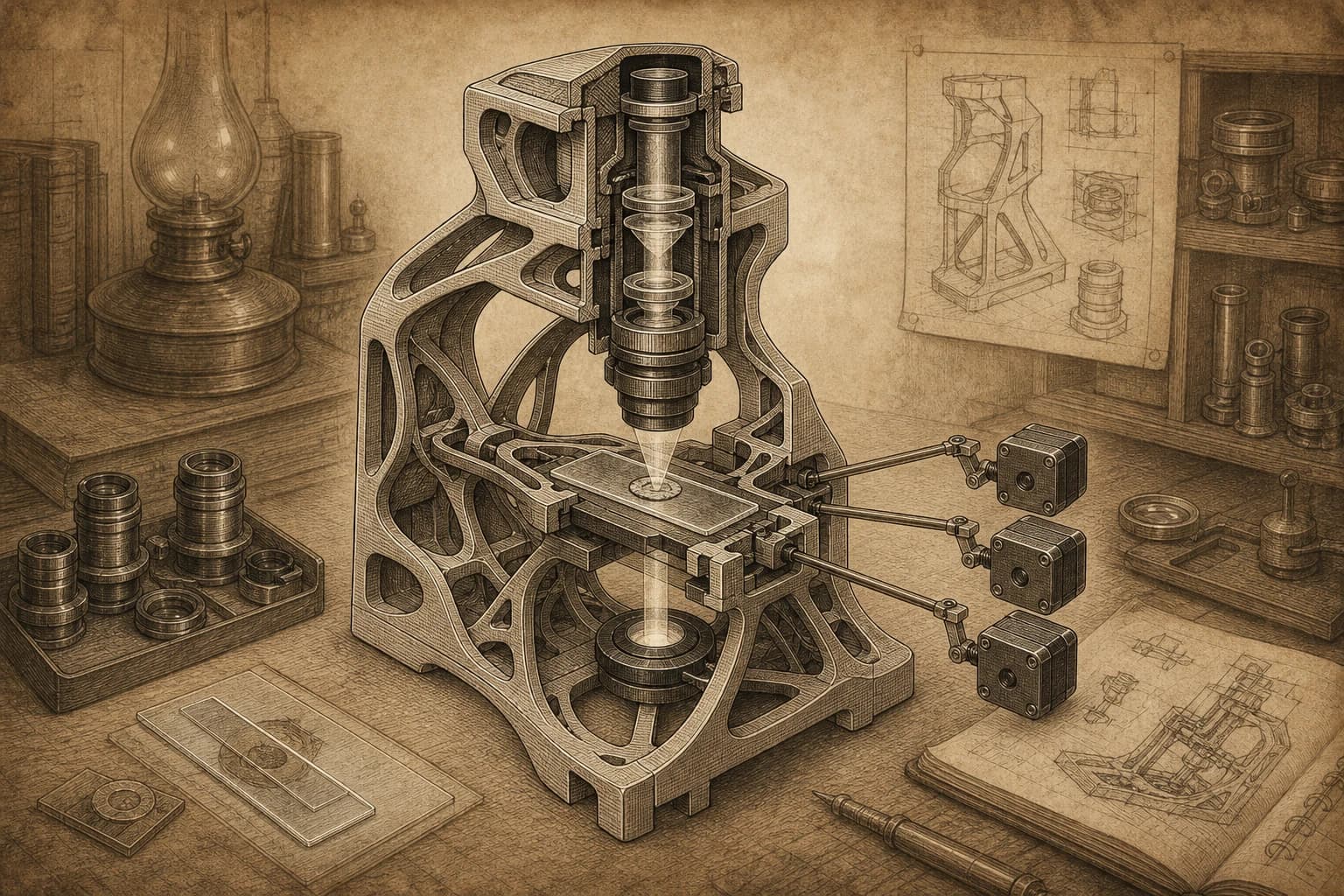
Prints most of a precise microscope body as one flexure mechanism, pairing interchangeable optics with optional motorized sample positioning and open control software.
Visit OpenFlexure MicroscopeOriginal editorial concept art generated with built-in Codex Image Gen for The Machine Press, 2026-08-23.
BuilderLibre Space Foundation and SatNOGS contributors
Links volunteer-built radio ground stations to shared scheduling and observation services, turning backyard antennas into a public satellite-observation network.
Visit SatNOGSOriginal Codex Image Gen concept art from 2026-07-10; carried forward from the validated 2026-08-25 edition.
Desk Picks are selected by the newsroom. Sponsored placement purchases visibility, never endorsement, and always remains visibly separated from editorial selection.
 Editorial illustration