Evolution-strategy post-training improved first-answer accuracy while preserving broader reasoning coverage than GRPO in the reported comparisons.
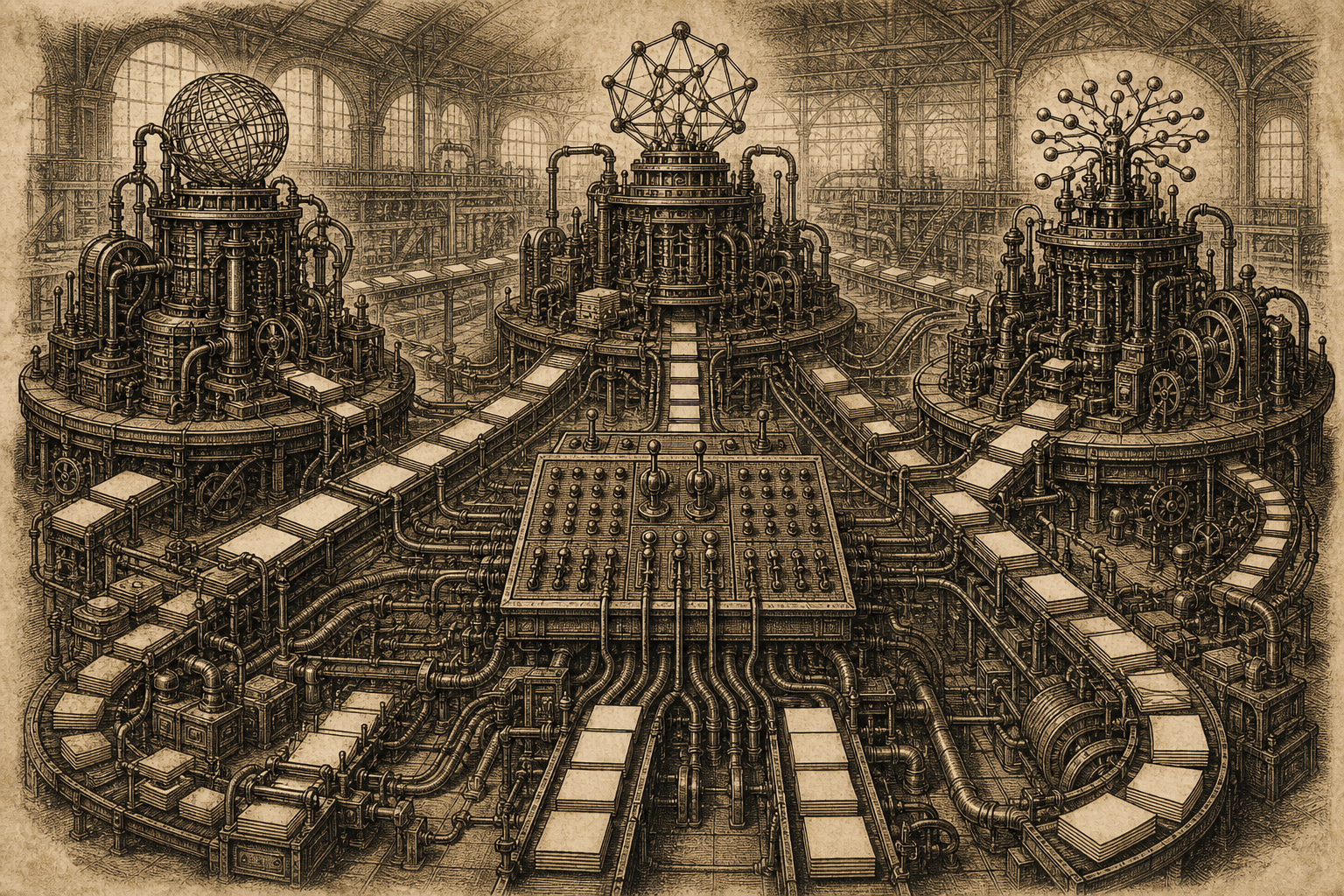
Editorial illustration
Conceptual illustration: the study contrasts broader sampled reasoning coverage with optimization collapse; this is not a paper figure, model trace or benchmark result. Original editorial concept art generated with built-in Codex Image Gen for The Machine Press, 2026-08-29.
The study separates success on the most likely answer from coverage across multiple attempts. Its authors report that evolution strategies increased Pass@1 while retaining higher Pass@K than GRPO, whose sampled reasoning diversity narrowed during training. A sequential GRPO-then-ES schedule combined the two tendencies. The paper also found that task gains came from a sparse subset of larger parameter updates despite broad movement across the model. These are author-reported experiments and theory on selected models and tasks, not evidence that evolution strategies dominate every reasoning workload.
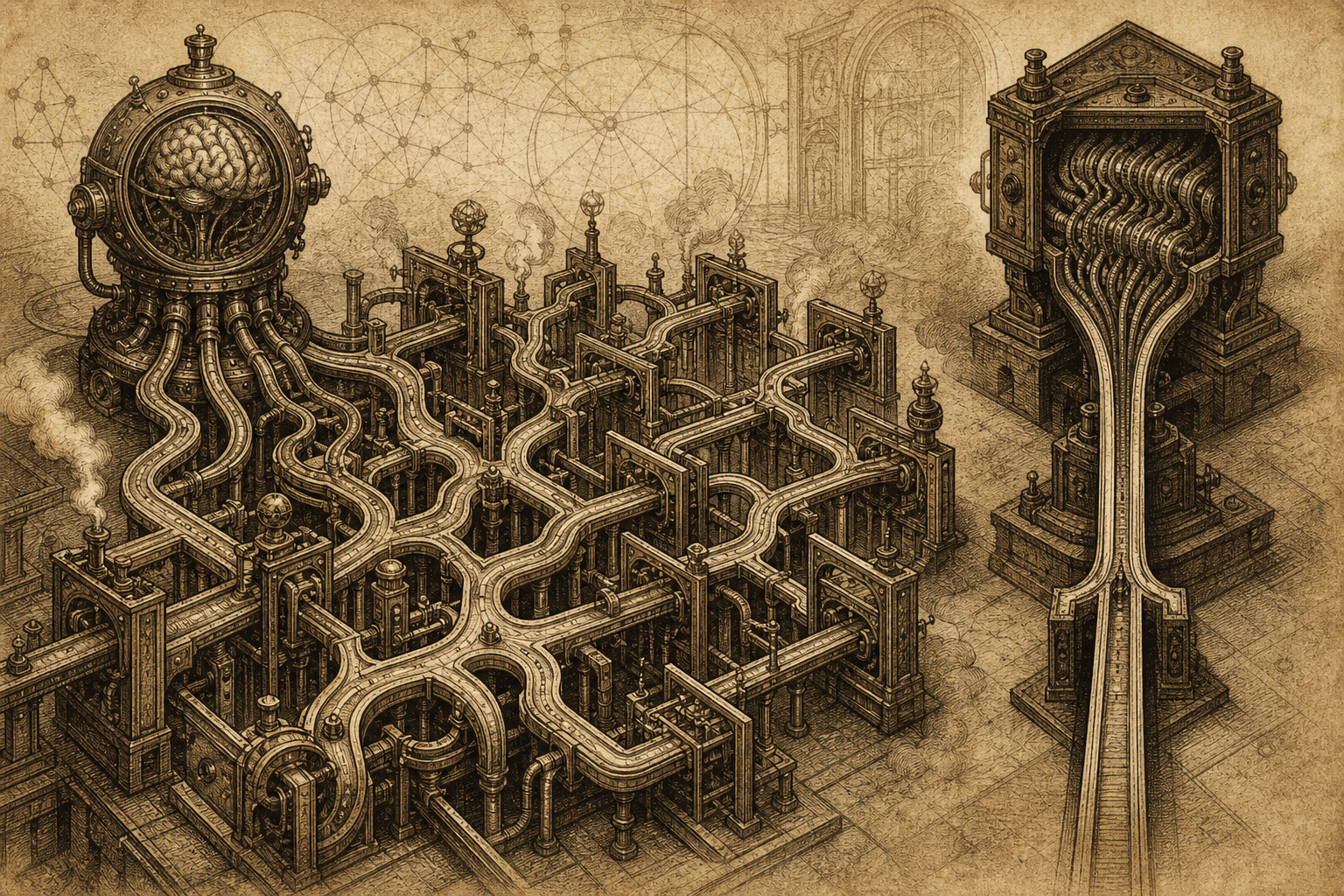
Conceptual illustration: reasoning-model post-training couples multiple compute stages and communication paths; this is not a real training cluster or framework diagram. Original editorial concept art generated with built-in Codex Image Gen for The Machine Press, 2026-08-29.
A compute-centered survey maps how reinforcement-learning post-training turns multiple models, memory paths and asynchronous stages into one distributed workload.
The paper systematizes PPO, GRPO and related post-training pipelines through the work-depth model of parallel computing. Its taxonomy spans familiar data, tensor, pipeline, sequence, context and expert parallelism alongside disaggregated placement, stage fusion, hybrid layouts and asynchronous execution. The central argument is architectural: reasoning-model training couples generation, reward, inference and optimization so tightly that algorithm choices cannot be separated from placement and communication costs. This is a synthesis and set of design guidelines, not a measured claim that one framework or topology is universally fastest.
A theoretical analysis shows repeated paraphrasing can move machine-written responses toward an empirical human-writing distribution.
Under stated mixing and stability assumptions, the paper derives a convergence rate and describes how the needed human samples and paraphrasing rounds scale with the target error. The result characterizes a strategic evasion process in a controlled multi-sample setting; it does not prove that all AI text is presently undetectable.
Generic code-screen file image used illustratively; it is not a block drafter, target rollout, attention path or measured result. Markus Spiske / Pexels; cropped, resized, metadata stripped, and converted to WebP by The Machine Press.
A new information floor separates unavoidable rejection in parallel token drafting from errors caused by the draft model itself.
Across four domains and five targets, the authors report that the final position in an all-parallel block faced a substantial unavoidable rejection floor. Revealing one earlier token removed 86 to 100 percent of that floor, while current drafters still sat well above the theoretical limit. The decomposition turns accepted length into two distinct engineering targets: short-range conditioning and proposal quality.
QuantumBoostNet switches between classical and quantum heads while learning cardiac ultrasound views.
The hybrid architecture uses a classical backbone and a parametrized ten-qubit circuit, with a loss-driven mixing parameter controlling the transition between its two heads. The authors report better view-identification performance than tested classical and hybrid baselines and greater robustness to noise. The work relies on simulated qubits and benchmark evaluation; it is not clinical validation or evidence of improved patient outcomes.
MM-Spectrum gives a sparse mixture-of-experts router explicit modality identity before combining heterogeneous molecular measurements.
The model adds modality-aware routing, shared experts, interaction experts and unequal expert capacities to balance complementary spectra. Its authors report consistent gains across full-modality, bimodal and missing-modality molecular-structure tasks, supported by ablations and interpretability analysis. Those benchmark results do not establish a molecule in a laboratory.
LEON replaces a generic latent transition predictor with context-modulated operator propagation and an additive forcing path.
The architecture draws on controlled Koopman dynamics to distinguish persistent evolution from additive change inside latent world-action models. Across two policy integrations, the authors report stronger closed-loop performance and robustness even when LEON fully replaced the baseline transition component. The evidence comes from controlled systems and robotics benchmarks, not deployment in an uncontrolled physical environment.
Circuit Condensation prunes low-attribution edges and retrains through what remains, accepting cuts only when behavior and general capability survive.
Across four behaviors and eight models, condensed circuits were smaller than the strongest frozen-discovery baseline in 30 of 32 settings, by 8.1 times on average and as much as 316 times. Exhaustive subset tests found some circuits irreducible and others still carrying removable edges. The result offers more inspectable mechanisms, but only for the studied behaviors and models.
Conceptual Visualising AI file image used illustratively; it is not a HALO sensor embedding, activity trace, architecture or result. Tim West / Google DeepMind / Pexels; cropped, resized, metadata stripped, and converted to WebP by The Machine Press.
HALO conditions inertial channels on natural-language descriptions and aligns the resulting representation with activity labels.
Trained on ten datasets and tested on seven held-out sets, the 35-million-parameter model led five baselines on all eight aggregate metrics and improved a broad zero-shot measure by 13.7 percentage points. Yet HALO and every comparator collapsed on two further datasets with severe distribution shift, an important limit on the open-set claim.
TraceBench generates controlled physical time series so root-cause attribution can be tested against known parameter changes.
Four evaluated agents benefited substantially from domain context and explored data mainly through numerical console output rather than visualizations. They also performed worse when asked to write a reusable sample-to-label Python program than when submitting predictions directly. The released simulations, trajectories and leaderboard make these behavioral differences auditable.
A diffusion policy generates short action chunks, then executes them in a receding horizon for dense crowd navigation.
PDPO combines offline demonstrations with online PPO and treats denoising as an internal decision process. The authors report better success than tested baselines and find that action chunks matter especially when benchmark boundaries count as collisions. That boundary change closes an artifact that otherwise let agents escape the valid domain instead of navigating through it.
Rotating high-gain transmitters and probabilistic inference reconstruct paths for receivers too small and power-limited for satellite navigation.
The reported system tracked 38-milligram receivers over a scalable landscape using sparse signal-strength measurements, reaching about 15-meter accuracy below 180 microwatts and about 10 meters below 600 microwatts. A bee-return-flight demonstration grounds the method, though accuracy and range remain dependent on the tested landscape and radio setup.
A reinforcement-learning controller generates state-dependent preferences among competing objectives instead of fixing their weights in advance.
The framework pairs a multi-objective inner controller with an outer preference generator trained on a higher-level goal. In constructed exploration environments, the learned preferences switched priorities by context, made graded trade-offs and persisted over time while outperforming fixed and handcrafted strategies. The paper defines a computational mechanism inspired by emotion; it does not demonstrate feelings or subjective experience.
Generic data-center file image used illustratively; it is not FiUni infrastructure, a Fisher subspace, training data or measured compute. Brett Sayles / Pexels; cropped, resized, metadata stripped, and converted to WebP by The Machine Press.
FiUni detects latent task changes batch by batch, then reuses, expands or creates low-rank adaptation subspaces.
The method compares principal subspaces from a Kronecker-factored Fisher approximation and freezes historical structure to balance knowledge sharing against isolation. The authors report competitive results against task-aware continual-learning methods with fewer trainable parameters, despite receiving no explicit task boundary at training time. The evidence is benchmark-based and does not remove all forgetting risk.
A soft fingertip electrode samples muscle signals near the lips only when the wearer chooses to speak silently.
The interface combines liquid-metal connections, flexible transparent electrodes and elastomer encapsulation. A neural classifier averaged 97.2 percent across three subjects on a 30-word vocabulary, and the authors demonstrated real-time drone control. The small participant count and restricted vocabulary make this an early interface result, not a general speech-recognition claim.
The usual beta coefficient controls both preference-noise scale and optimization dynamics, making policy movement non-monotonic at a fixed learning rate.
The analysis shows a small-beta dead zone, an intermediate peak in policy deviation and a decline at larger values; similar-looking loss curves can hide several-fold differences in distance from the reference model. A centered-softplus reformulation separates the two roles while retaining the same optimum for positive beta.
A self-contained touchscreen computer boots into MicroPython and combines programmable graphics, MIDI connections, and an open-source synthesizer in focused, buildable hardware.
Visit Tulip Creative ComputerOriginal editorial concept art generated with built-in Codex Image Gen for The Machine Press, 2026-08-23.
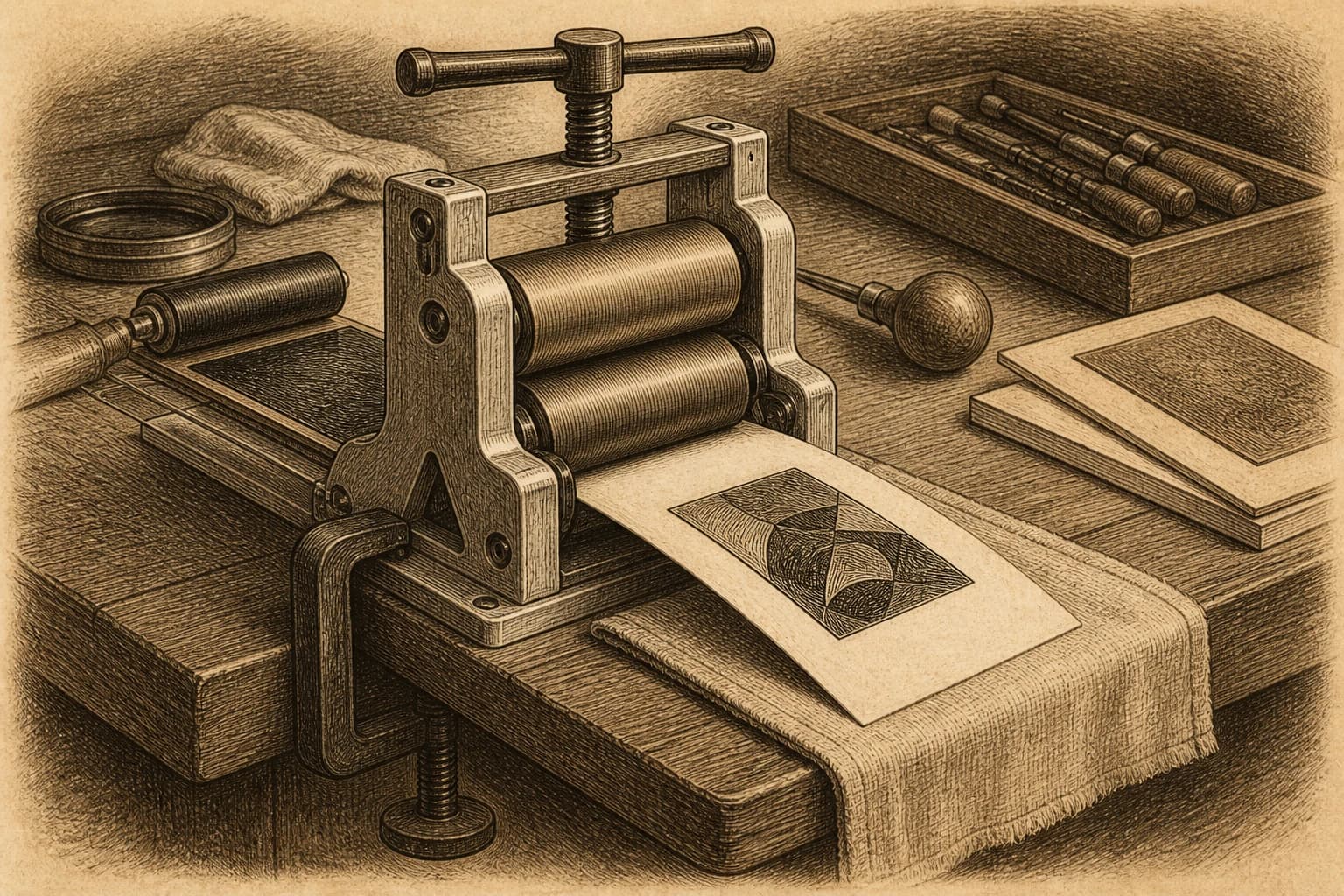
Shrinks an intaglio press into 3D-printed tabletop hardware, with free fabrication plans for makers and finished presses for artists without a printer.
Visit Open Press ProjectOriginal editorial concept art generated with built-in Codex Image Gen for The Machine Press, 2026-08-23.
BuilderRichard Bowman and OpenFlexure contributors
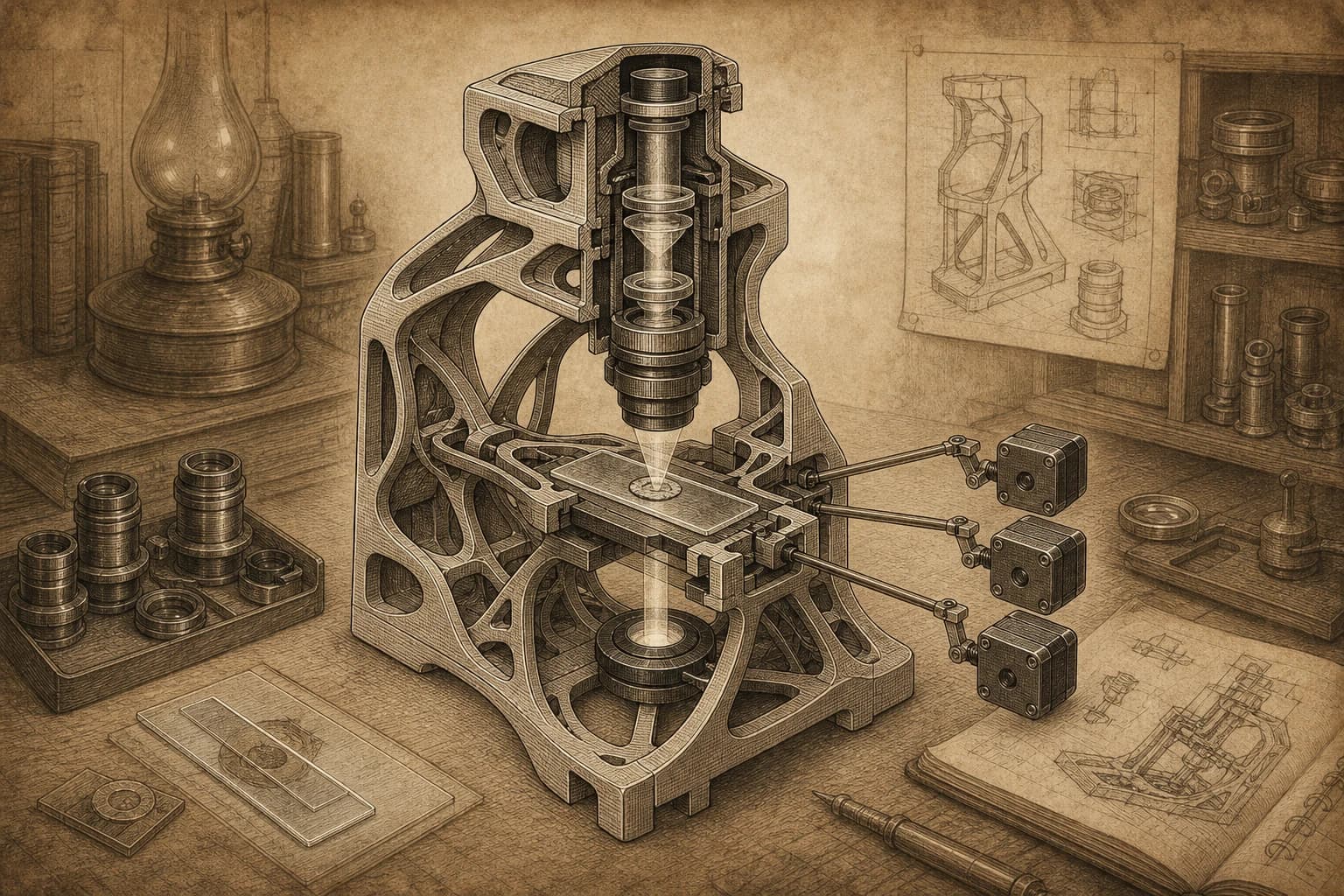
Prints most of a precise microscope body as one flexure mechanism, pairing interchangeable optics with optional motorized sample positioning and open control software.
Visit OpenFlexure MicroscopeOriginal editorial concept art generated with built-in Codex Image Gen for The Machine Press, 2026-08-23.
BuilderLibre Space Foundation and SatNOGS contributors
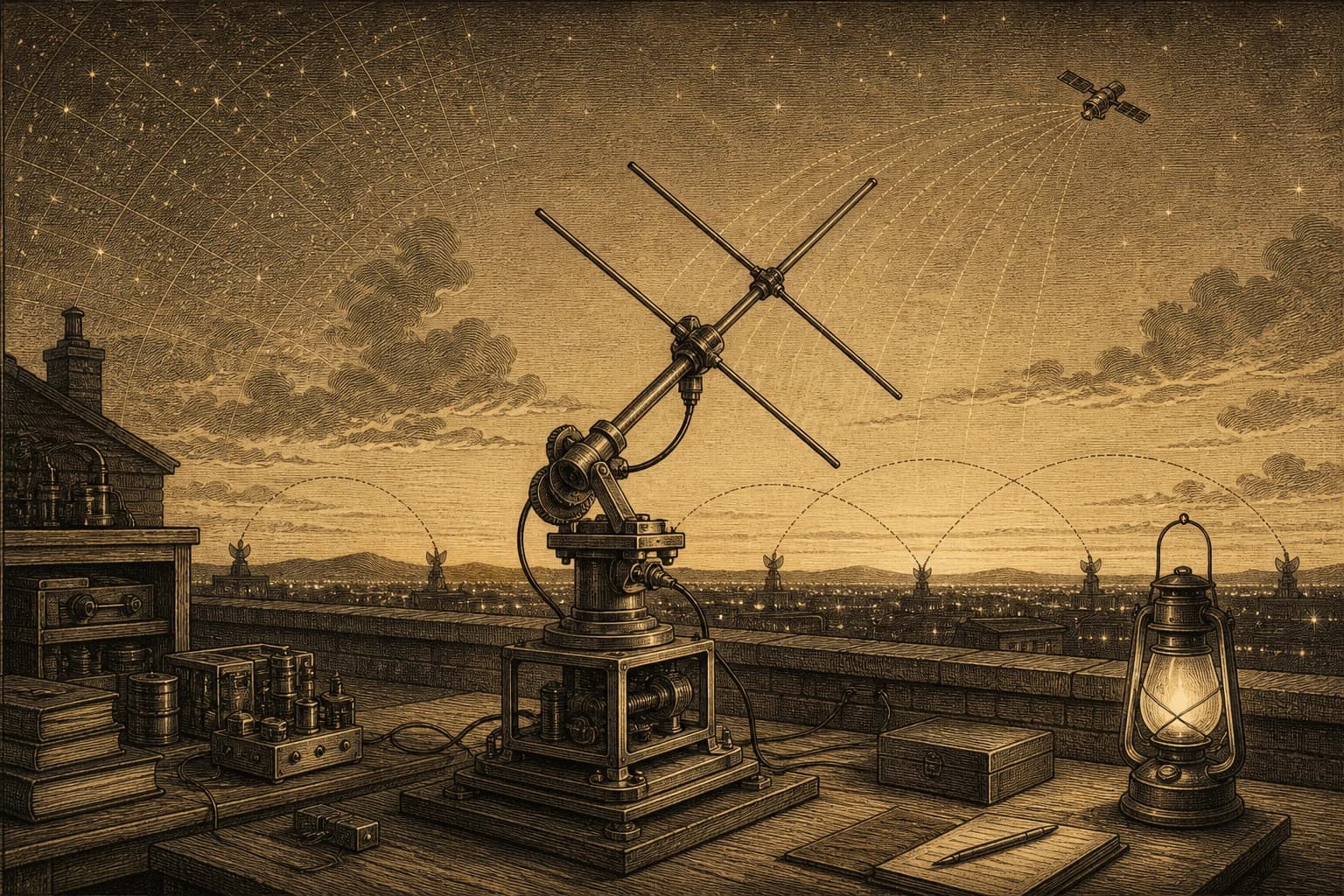
Links volunteer-built radio ground stations to shared scheduling and observation services, turning backyard antennas into a public satellite-observation network.
Visit SatNOGSOriginal Codex Image Gen concept art from 2026-07-10; carried forward from the validated 2026-08-28 edition.
Desk Picks are selected by the newsroom. Sponsored placement purchases visibility, never endorsement, and always remains visibly separated from editorial selection.
 Editorial illustration