infrastructure
Reasoning Training Became a Systems Problem
A compute-centered survey maps how reinforcement-learning post-training turns multiple models, memory paths and asynchronous stages into one distributed workload.
Summary
A compute-centered survey maps how reinforcement-learning post-training turns multiple models, memory paths and asynchronous stages into one distributed workload.
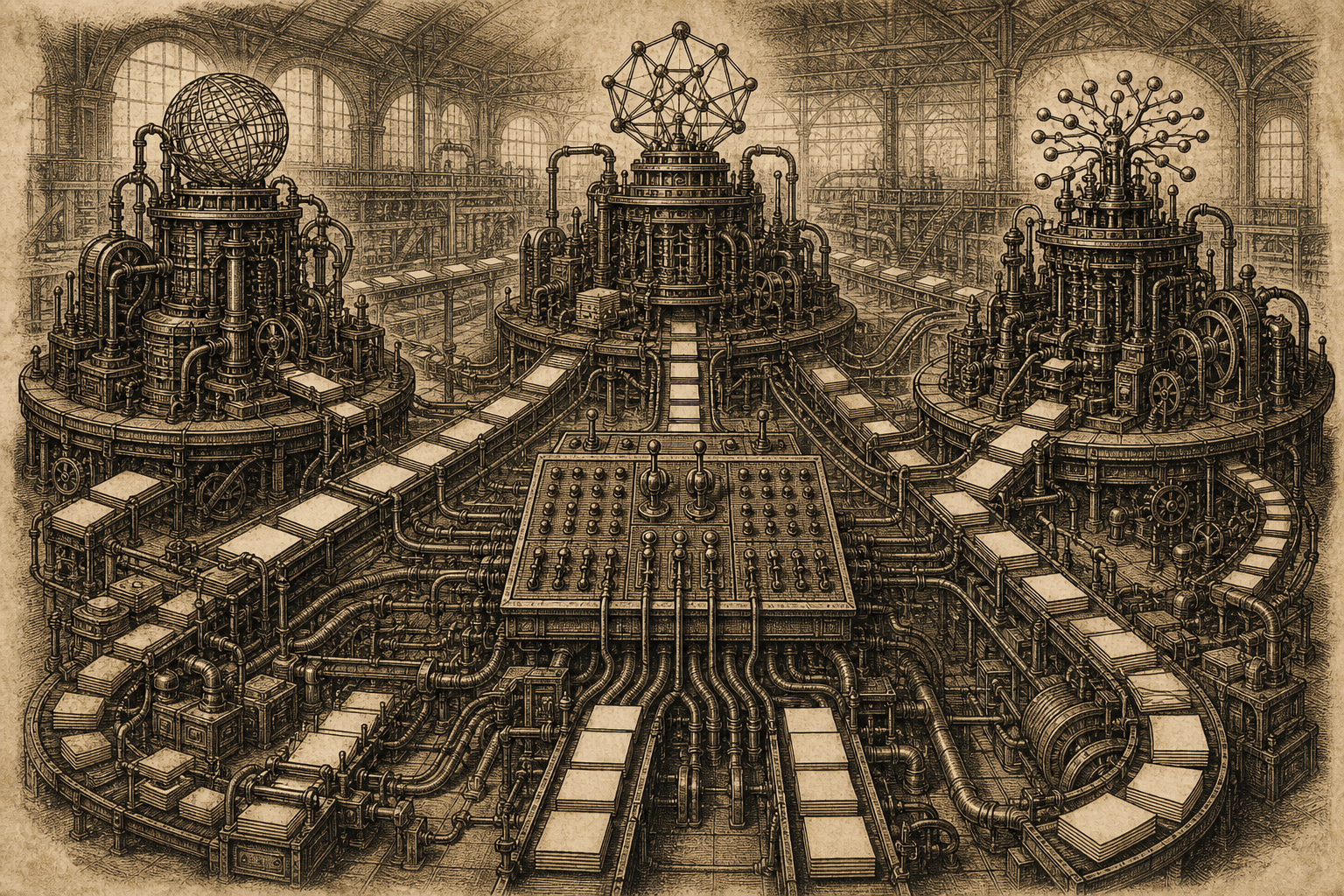
The paper systematizes PPO, GRPO and related post-training pipelines through the work-depth model of parallel computing. Its taxonomy spans familiar data, tensor, pipeline, sequence, context and expert parallelism alongside disaggregated placement, stage fusion, hybrid layouts and asynchronous execution. The central argument is architectural: reasoning-model training couples generation, reward, inference and optimization so tightly that algorithm choices cannot be separated from placement and communication costs. This is a synthesis and set of design guidelines, not a measured claim that one framework or topology is universally fastest.
Why it matters
A compute-centered survey maps how reinforcement-learning post-training turns multiple models, memory paths and asynchronous stages into one distributed workload.
Limits and context
- The central argument is architectural: reasoning-model training couples generation, reward, inference and optimization so tightly that algorithm choices cannot be separated from placement and communication costs.
- This is a synthesis and set of design guidelines, not a measured claim that one framework or topology is universally fastest.
Key claims
A compute-centered survey maps how reinforcement-learning post-training turns multiple models, memory paths and asynchronous stages into one distributed workload.
Qualification: The central argument is architectural: reasoning-model training couples generation, reward, inference and optimization so tightly that algorithm choices cannot be separated from placement and communication costs.
Evidence: source-2026-08-29-002
Sources
- arXiv preprint 2608.27046arXiv · primary research
Corrections
No corrections have been recorded for this story.