Facet-0 predicts wrist-force consequences alongside actions and reports 82% mean success across five sub-millimeter assembly tasks.
Editorial illustration
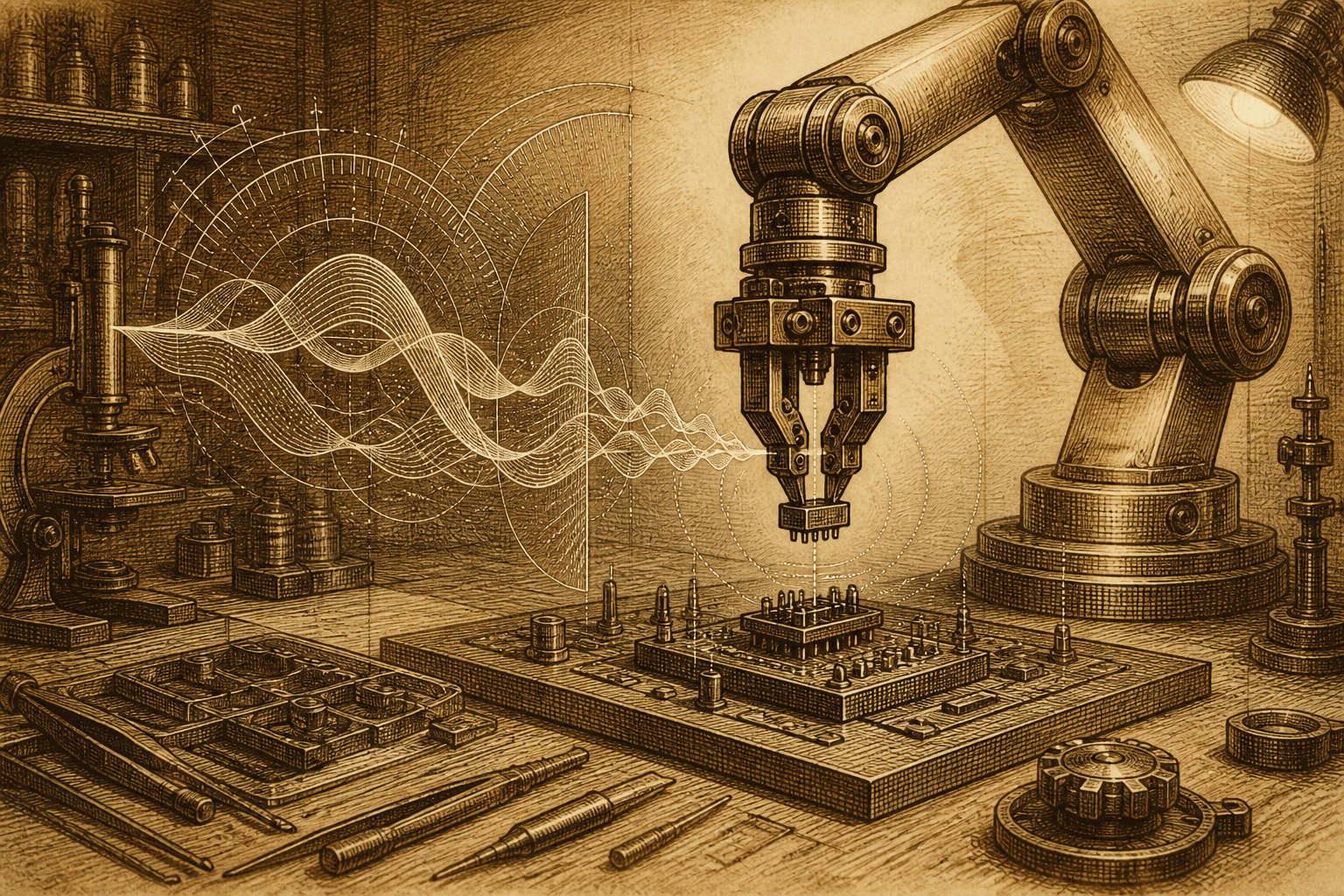
Concept illustration of a manipulation policy proposing an action together with the wrist-force profile it expects that action to produce. Original editorial illustration generated with built-in Codex Image Gen for The Machine Press, 2026-09-02.
A 1,000-hour force-synchronized corpus aligns visual-language context, kinematics and wrench history before the policy proposes an action together with its expected force profile. A distributional critic then distinguishes similar-looking progress with different contact outcomes, while a bounded adapter tunes the frozen representation to a specific part. The authors report 82% mean success across five computer-assembly tasks, versus 15% for their strongest baseline, with 0.5-millimeter placement accuracy and 50-millisecond command latency; those are results on the evaluated system, not a general guarantee for factory robotics.
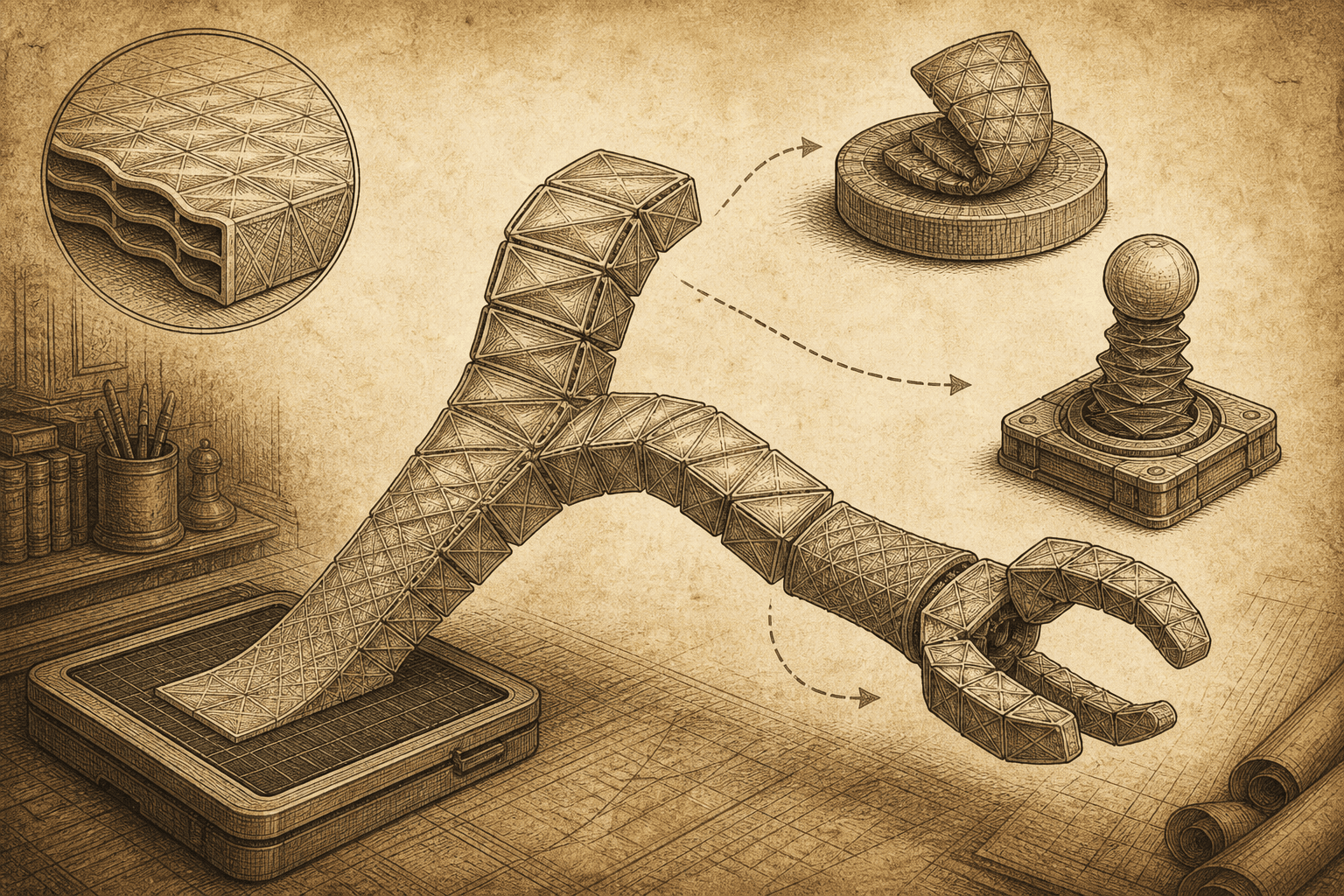
Concept illustration of patterned stiffness turning one soft printed module into composable folding motions. Original editorial illustration generated with built-in Codex Image Gen for The Machine Press, 2026-09-02.
MONORIGAMI programs stiffness into one soft printed part, then composes those folding modules into multi-axis devices.
The actuator varies material thickness across origami-like facets and creases so a compliant print bends in intended directions while resisting unwanted deformation. It needs one material, one print and no added reinforcement; linked modules mechanically program more complex trajectories. The authors demonstrate the same motion primitive in a four-axis wearable haptic device, a three-axis force-feedback joystick and an underwater gripper, establishing a fabrication approach rather than a production-ready product.
A learned trajectory policy uses sliding and rolling contact to launch heavy, large or deformable objects beyond pick-and-place reach.
The policy plans joint-jerk trajectories without an analytical contact model, then uses system identification and uncertainty training for transfer. In simulation it reported 99% success, and zero-shot tests on a UR5e threw items up to 790 grams toward targets as far as 3.5 meters with 97% real-world success. Sensitivity remained high to dynamic friction, an important limit of the sliding release.
NASA OSAM-1 file image used as a robotics-hardware motif. It does not show either humanoid, the reported behavior system, task demonstrations or results; use does not imply NASA endorsement. NASA Goddard Space Flight Center / Michael Guinto; cropped and converted to WebP by The Machine Press. Use does not imply NASA endorsement.
A robot-local behavior system keeps operator tools synchronized for live authoring, monitoring and repair.
Object-centered affordance templates sit inside a behavior tree, while editable perception and scene actions feed a whole-body controller that can walk and move concurrently. The researchers demonstrate six task variants on two humanoids, including a 34-second push-door traversal and sorting six colored balls in 45 seconds under human disturbance. The comparison is to demonstrations in the cited paper, not evidence of unsupervised deployment.
SG-AMP turns uncertain plant geometry into a scene graph that proposes where hidden pepper attachments may be.
The system combines depth completion, panoptic mapping and active view planning, then represents peppers, stems and peduncles with different motion costs. Instead of revisiting only uncertain visible regions, it hypothesizes occluded attachments and directs the sensor closer to them. Reported pepper-data results include 55.27% semantic mean intersection over union, 38.67% panoptic quality and 40.62-millimeter depth error.
An imitation policy matched its expert at nominal pace, then lost far more insertions as the task accelerated.
In a parcel stowing task, both the scripted expert and an ACT learner achieved 100% success at nominal speed. At the fastest demonstrated pace, expert success fell to 84% while the learner reached 53%; 35 of the learner's 47 failures were insertion misalignments. The controlled comparison shows that nominal task success does not establish temporal robustness.
A front-facing RGB-D camera supplies relative pose when GPS or external positioning becomes unreliable.
A lightweight detector finds the leader drone, depth supplies range, and a pinhole camera model turns the observation into a relative position for formation control. The ROS implementation was tested in physics-based simulation with sensor noise, communication dropouts and simulated positioning failures. The reported stable formations are simulation evidence and not a field-safety certification.
SCARAB agents localize, dock and assemble aquatic formations without GPS or inter-agent communication.
The proposed unmanned surface vehicles use onboard sensing of peers and docking targets, then follow distributed controls toward a requested configuration. Physics-engine simulations add currents and wind while the agents join formations without radio-frequency links. The work describes a military bridging concept with possible disaster-relief use; it does not report a completed field crossing.
Conceptual Visualising AI file artwork used for structured planning. It does not depict the RB-POMDP, FastSLAM state, search-and-rescue environment or reported measurements. Novoto Studio / Google DeepMind / Pexels; cropped, resized, metadata stripped, and converted to WebP by The Machine Press.
The planner keeps a hybrid continuous-discrete belief and analytically propagates tractable state components instead of sampling every uncertainty. Integrated with FastSLAM 2.0 in a search-and-rescue task, it achieved higher cumulative rewards with fewer particles and planning simulations than purely sampling-based methods at equal compute budgets. The advantage applies where sufficient statistics remain tractable.
EmbodiedSkills tests prerequisites before execution and verifies outcomes afterward through one stable interface.
The shared interface connects high-level selection, bounded vision-language-action execution, post-action verification and recovery while recording structured trajectories. Task-adapted low-level policies averaged 86.20% success across 50 RoboTwin 2.0 tasks and 97.40% across LIBERO, but only 12.5% on four memory-dependent tasks. The gap separates executor performance from the harder closed-loop agent problem.
DNC-IMM uses surrounding gaps and relative velocities to calibrate an interpretable intention model.
A neural network adjusts both the transition matrix and measurement likelihoods of an interacting multiple-model estimator rather than replacing its probabilistic decision. On the highD dataset, the calibrated posterior recognized lane changes before crossing and was strongest at two- to three-second horizons. The evidence is retrospective dataset evaluation, not a road deployment claim.
HitMem decays old scene knowledge and narrows relocation searches with semantic, spatial and temporal context.
A lightweight topological graph records support relationships while continuous perception lowers the activity of stale memories. When an object has moved, a two-stage retriever combines another agent's trajectory constraints with class affinities to identify likely regions. On the authors' Dyna-THOR benchmark, the method improved relocation accuracy and reduced exploration cost; the paper also evaluates dynamic simulated environments rather than every real home.
VerNav batches action checks and calls an autoregressive generator only when uncertainty rises.
The verifier-first path replaces a full generated rationale at every navigation step with compact action verification, while an entropy trigger requests state evidence for uncertain decisions. On Room-to-Room, the verifier-only path remained competitive with representative language-model navigators and reduced average decision-stage model latency per step by more than tenfold. Results are benchmark-specific.
Generic programming file image used for a robot-policy inference story. It does not show the evaluated VLA models, attention weights, manipulation tasks or results. Nemuel Sereti / Pexels; cropped, resized, metadata stripped, and converted to WebP by The Machine Press.
A training-free rule ends an action chunk when observation grounding disperses into a sustained entropy plateau.
Long open-loop chunks can drift as the world changes, while short chunks repeatedly pay inference cost. The method watches cross-attention weights already computed inside the action expert and truncates execution when their entropy remains high. Evaluations across two VLA families, simulation suites and three real manipulation tasks improved average success over fixed and adaptive baselines with negligible added overhead.
Peg-in-Bench makes insertion evaluation reconfigurable with printable geometries, tolerances and machine-readable scenarios.
Modular pegs and bases can vary layouts, orientations and task structures while holding other physical conditions controlled. A scenario tool emits standardized configurations and descriptions, and the authors released the STL files and repository. The contribution is an evaluation apparatus, not a new insertion policy.
A frontier-connectivity extension stabilizes decentralized exploration plans when communication becomes intermittent.
The method extends exploration graphs while preserving area partitions as links fail and spatial layouts change. Applied to two existing partitioning methods in simulation, it improved exploration efficiency at low communication rates over prior graph-extension approaches. The result concerns simulated unknown environments, not certified emergency operations.
Independent builders turning improbable ideas into real things.
Four editorial selections
$7 for seven days
Paid work is clearly labeled
Placement is never endorsement
Original editorial concept art generated with built-in Codex Image Gen for The Machine Press, 2026-08-30; carried into the September 2 issue from the active weekly handoff.
Reworks a laptop into public, swappable modules: processor, port boards, keyboard, trackpad, and user-serviceable battery packs can evolve without sealing the whole machine.
Visit MNT Reform NextOriginal editorial concept art generated with built-in Codex Image Gen for The Machine Press, 2026-08-30; carried into the September 2 issue from the active weekly handoff.
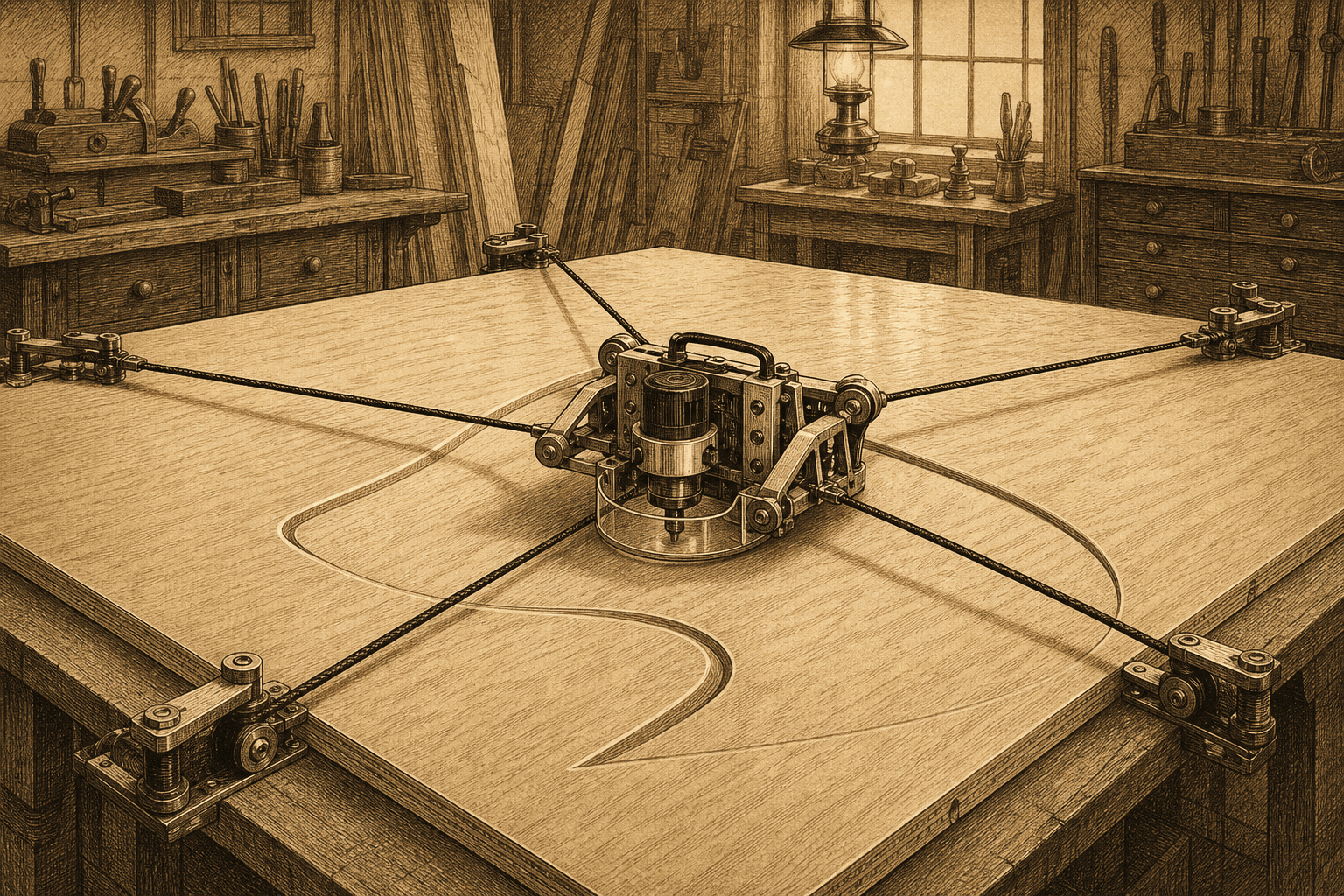
Pulls a compact router sled across full sheets with four measured belts, trading a bulky gantry for corner anchors and community-developed control software.
Visit Maslow 4Original editorial concept art generated with built-in Codex Image Gen for The Machine Press, 2026-08-30; carried into the September 2 issue from the active weekly handoff.
BuilderRory Aronson, Rick Carlino, Tim Evers, and FarmBot contributors
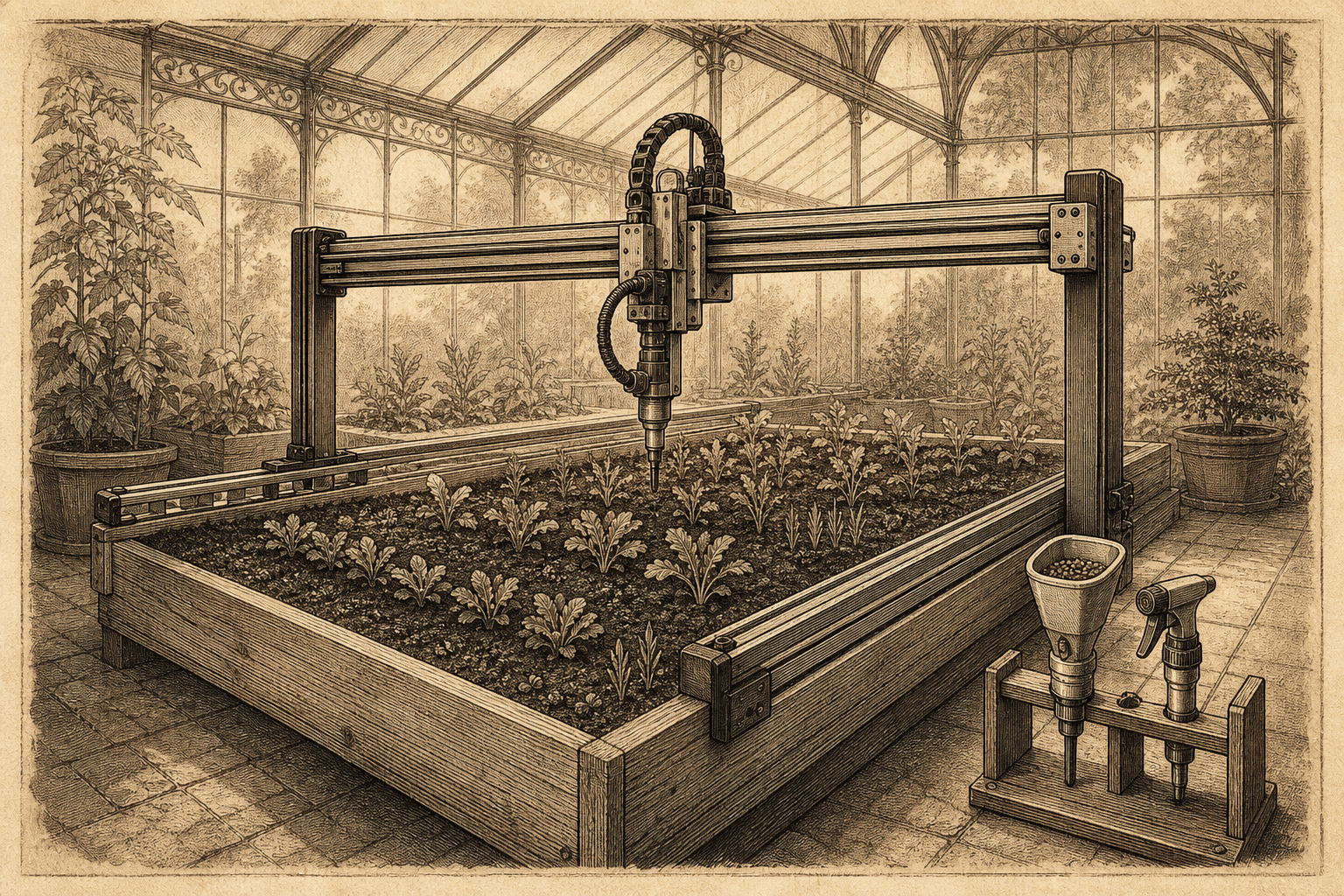
Moves an interchangeable tool head across a raised bed to place seeds, water plants, and measure soil, backed by published hardware, software, data, and documentation.
Visit FarmBot GenesisOriginal editorial concept art generated with built-in Codex Image Gen for The Machine Press, 2026-08-30; carried into the September 2 issue from the active weekly handoff.
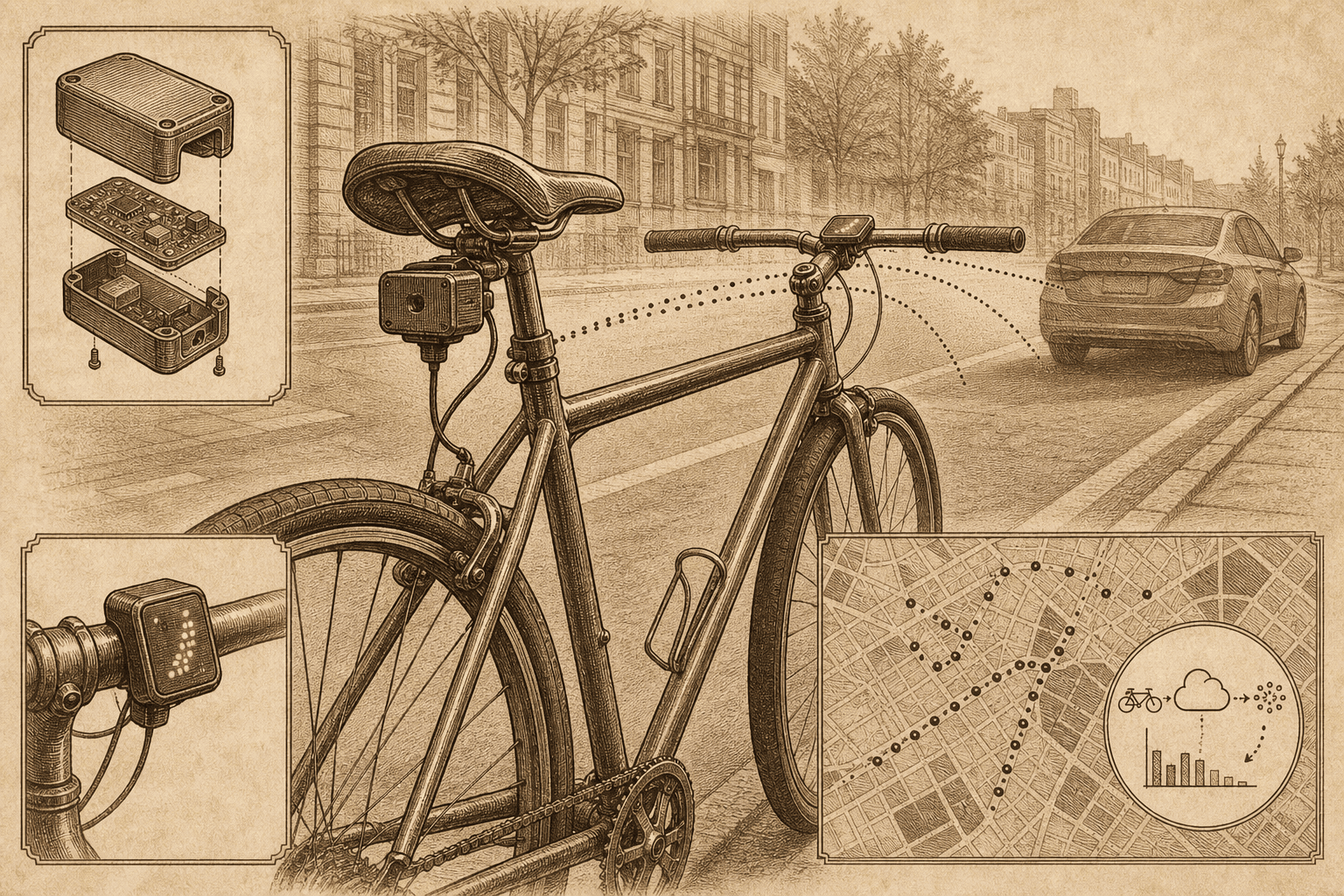
Combines a DIY bicycle distance sensor, GPS, and a shared portal so volunteer riders can map close passes and study where street design needs attention.
Visit OpenBikeSensorOriginal Codex Image Gen concept art from 2026-07-10; carried forward from the validated September 1 edition.
Desk Picks are selected by the newsroom. Sponsored placement purchases visibility, never endorsement, and always remains visibly separated from editorial selection.
 Editorial illustration