robotics
The Robot Learned What Contact Would Feel Like
Facet-0 predicts wrist-force consequences alongside actions and reports 82% mean success across five sub-millimeter assembly tasks.
Summary
Facet-0 predicts wrist-force consequences alongside actions and reports 82% mean success across five sub-millimeter assembly tasks.
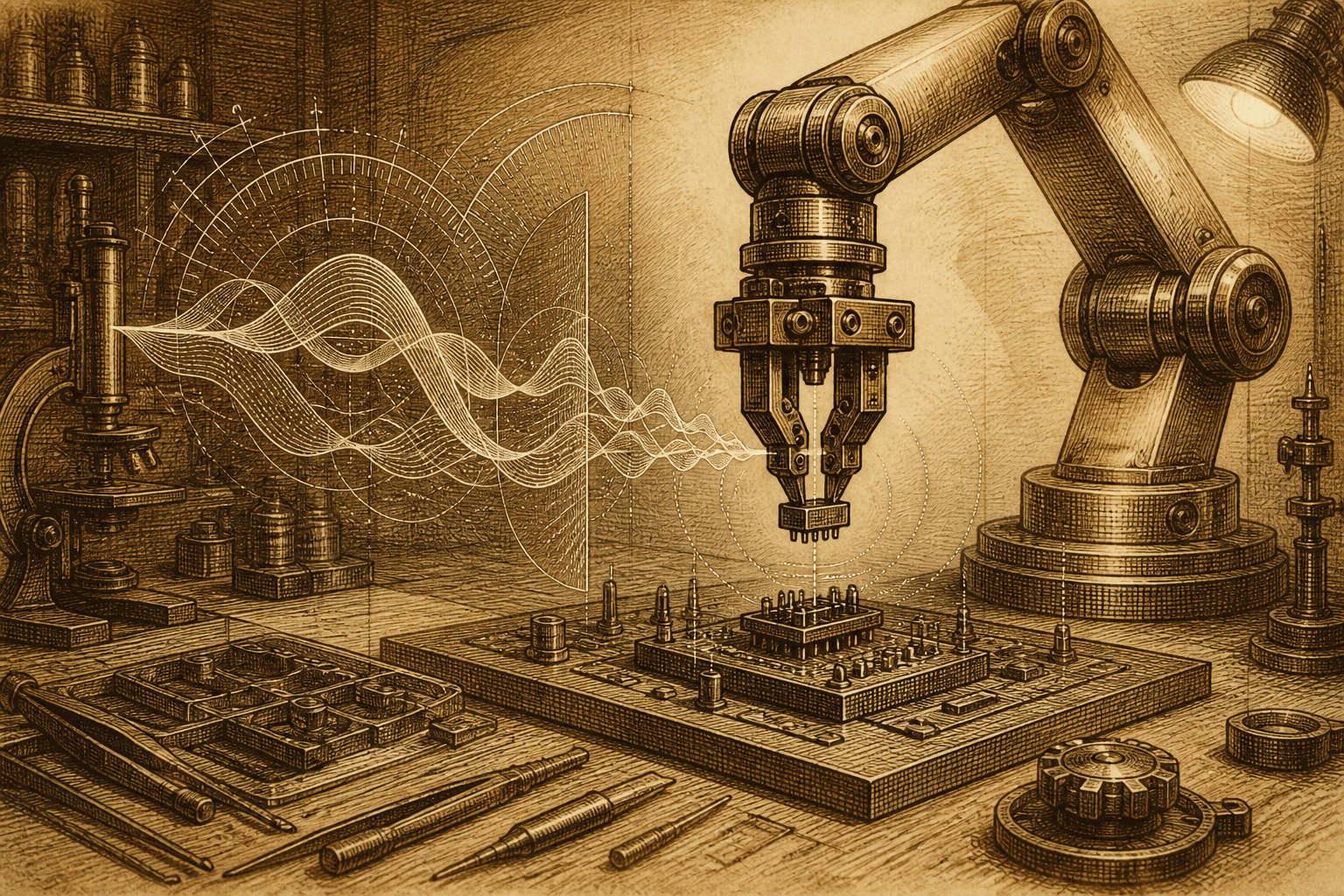
A 1,000-hour force-synchronized corpus aligns visual-language context, kinematics and wrench history before the policy proposes an action together with its expected force profile. A distributional critic then distinguishes similar-looking progress with different contact outcomes, while a bounded adapter tunes the frozen representation to a specific part. The authors report 82% mean success across five computer-assembly tasks, versus 15% for their strongest baseline, with 0.5-millimeter placement accuracy and 50-millisecond command latency; those are results on the evaluated system, not a general guarantee for factory robotics.
Why it matters
Facet-0 predicts wrist-force consequences alongside actions and reports 82% mean success across five sub-millimeter assembly tasks.
Limits and context
- The authors report 82% mean success across five computer-assembly tasks, versus 15% for their strongest baseline, with 0.5-millimeter placement accuracy and 50-millisecond command latency; those are results on the evaluated system, not a general guarantee for factory robotics.
Key claims
Facet-0 predicts wrist-force consequences alongside actions and reports 82% mean success across five sub-millimeter assembly tasks.
Qualification: The authors report 82% mean success across five computer-assembly tasks, versus 15% for their strongest baseline, with 0.5-millimeter placement accuracy and 50-millisecond command latency; those are results on the evaluated system, not a general guarantee for factory robotics.
Evidence: source-2026-09-02-001
Sources
- arXiv preprint 2609.01596arXiv · primary research
Corrections
No corrections have been recorded for this story.