Across 24 sensing conditions, a long measurement-free rollout chose a different estimator from the closed-loop optimum 18 times.
Editorial illustration
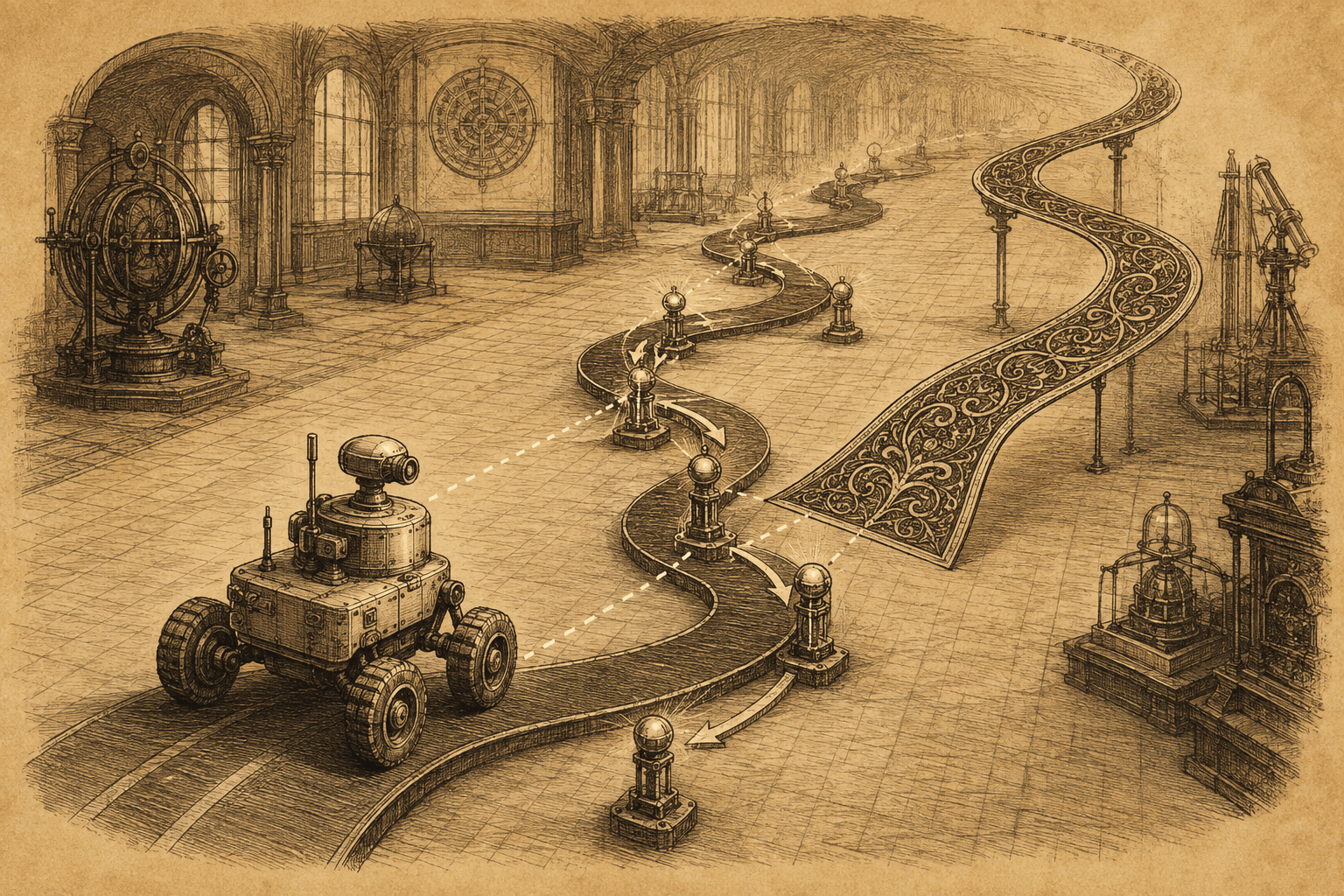
Concept illustration of open-loop imagined trajectories diverging from feedback-corrected robot control; it is not a research figure or experiment photograph. Original editorial illustration generated with built-in Codex Image Gen for The Machine Press, 2026-09-03.
A controlled differential-drive study compared six state estimators by replay error, a 20-step measurement-free rollout and actual closed-loop path tracking under biased odometry and intermittent landmarks. Replay position error tracked closed-loop cross-track error more closely than rollout error, with Spearman correlations of 0.923 and 0.774; replay selected a different estimator from the closed-loop optimum in 5 of 24 conditions, while the rollout metric did so in 18. Long predictions remained useful when regular measurement corrections were preserved, making the sensing and update schedule part of the evaluation—not a detail to omit.
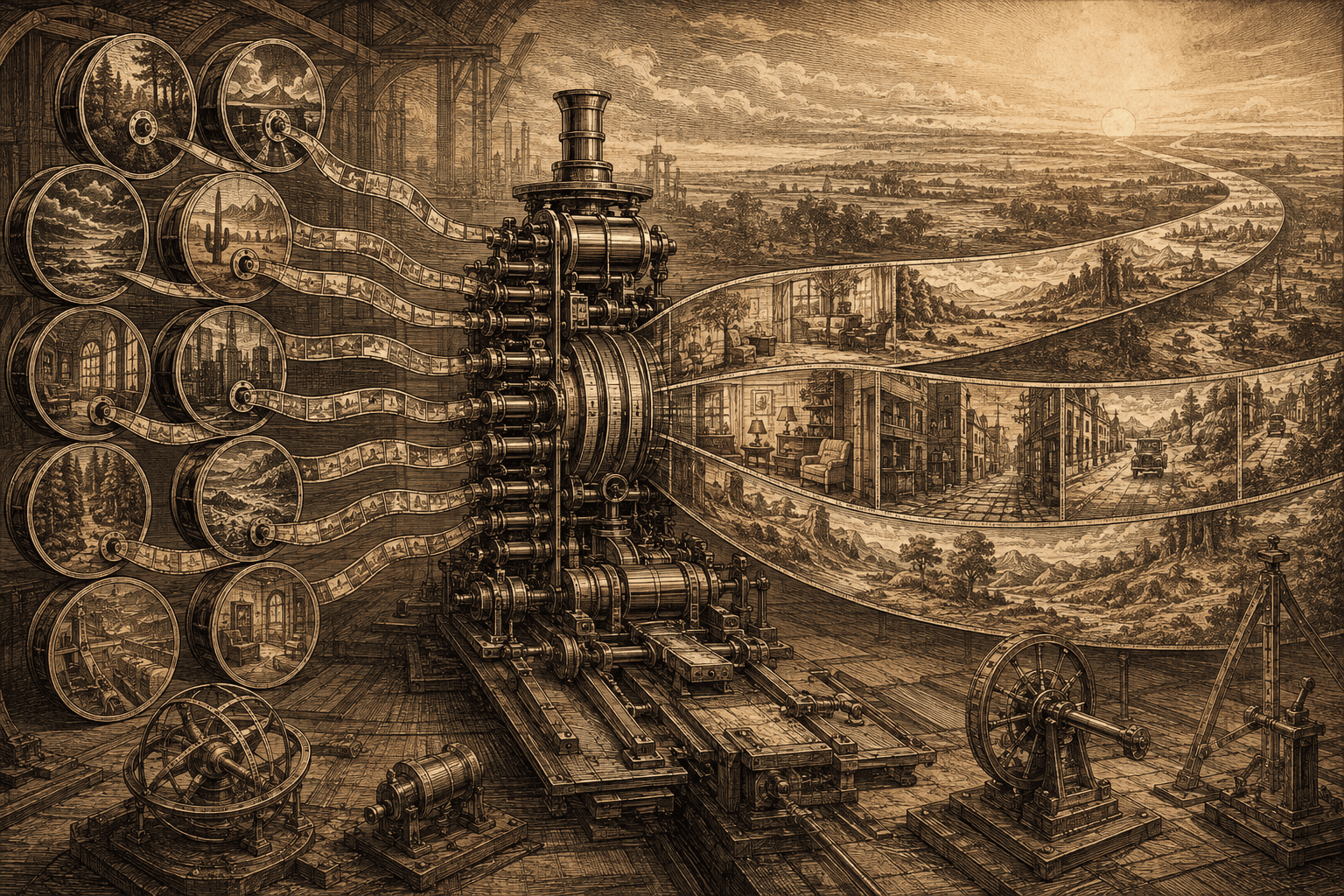
Concept illustration of heterogeneous video sources entering one aligned pipeline for long-horizon world modeling; it does not reproduce dataset frames or a paper diagram. Original editorial illustration generated with built-in Codex Image Gen for The Machine Press, 2026-09-03.
SolarWM unifies 1.43 million clips and adapts four 5B-to-33B video backbones behind shared training and inference interfaces.
SolarWM converts clips from ten datasets into a frame-aligned record carrying observations, metric camera geometry, captions, quality metadata, selection decisions and provenance. A backbone-native layer then applies one three-stage recipe across four models based on Wan2.2, LTX-2.5 and MiniMax-H3 without erasing their native representations. The authors say causal models trained on five-second sequences can support interactive rollouts from minutes to hours, and they are releasing the data, pipeline, recipes, weights and framework; those are preprint claims, not independent replication.
Open-vocabulary mutual information compares neural speech decoders even when their datasets, vocabularies and recording setups differ.
Accuracy and word error rate can overstate communication when they score only the words a brain-computer interface already supports. OVMI instead measures conveyed information against a reference distribution of what a user may wish to say, putting coverage and decoding accuracy on the same scale. Applied to existing systems, it exposed vocabulary tradeoffs and found that selecting a vocabulary to maximize OVMI improved accuracy by as much as 16.3% across three speech domains.
Generic code-screen file image used for a web-agent research story. It does not show the reported model, WebArena interface, trajectories or results. Daniil Komov / Pexels; cropped, resized, metadata stripped, and converted to WebP by The Machine Press.
A matching objective trains predicted states to separate the true result of an action from the states produced by alternatives.
Most web-agent world models learn to reproduce the next HTML or accessibility-tree snapshot, even though the downstream ranker needs to tell candidate actions apart. The new objective uses branching WebArena Go-Browse trajectories with multiple actions and resulting states at each decision point. The authors report better predicted-state matching, action ranking on WebPRMBench and end-to-end success on WebArena-Lite than action-only or supervised-next-state comparisons.
A security argument says linguistic monitoring cannot supply complete guarantees when internal activation-space computation is only lossy-translated into words.
James Mickens names the gap “linguistic illegibility”: external text or language-like probes may fail to represent how a model produced an outcome. The paper argues that chain-of-thought monitoring, self-critique and linguistically defined activation probes therefore need a non-linguistic security floor. It proposes output taint tracking, robust virtualization and independent configuration audits as complementary isolation measures; this is a position and design argument, not a measured proof that every monitor fails.
Unsigned E5M3 block scales replace randomized Hadamard transforms and BF16 final-layer exemptions in one FP4 pretraining recipe.
The recipe pairs E2M1 payloads with wider-range unsigned E5M3 scales, uses periodic tensor scaling and applies stochastic rounding selectively to backward gradients. In software-emulated training of an 8B Nemotron-H model for nearly 190 billion tokens, the authors report lower final-window and held-out validation loss than their Transformer Engine NVFP4 comparison. A separate ablation that removed the transform and final-block exemption raised measured model-body throughput by 21.2%, motivating native hardware support rather than proving a universal speedup.
Four tabular foundation models beat six baselines on samples from 316 equations yet could not represent noiseless mechanisms or physical units.
The study treats table completion as a probe of what physics-like priors tabular foundation models acquire. Across in-domain and out-of-domain datasets sampled from 316 equations, the four tested systems led the baselines before and after tuning. The authors' central negative result is that those priors still cannot encode a deterministic mechanism or units, so strong interpolation should not be confused with a physical model.
Generic computer-component file image used for an ONNX compression study. It does not depict the evaluated models, Jetson device, graph surgery or benchmark results. Marta Branco / Pexels; cropped, resized, metadata stripped, and converted to WebP by The Machine Press.
H3DNAS searches and rewrites ONNX graphs directly for edge deployment of 3D point-cloud networks.
A channel-dependency graph classifies ONNX operators and computes a topology-defined ceiling on how much of a model can be pruned. A two-stage search then selects channels by importance, ranks candidates by output fidelity without labels and mutates Pareto candidates with GhostConv. On ModelNet40, the paper reports parameter reductions of 43.2% to 65.5% and Jetson Orin Nano speedups of 1.29× to 1.99× across three architectures with negligible accuracy loss under its evaluation.
A full multi-shell Leech-lattice decoder exposes the gap between compact on-disk weights and the bytes a serving kernel actually reads.
The implementation expands a 301-class codebook into GPU layouts and fuses dequantization with matrix-vector multiplication for batch-one decoding. Binary bit planes beat one-hot masks, but the served layout still read 2.40× more bytes and ran 2.27× slower than the compared trellis kernel. With a shared output head, end-to-end gains rose from 1.11× at 4B to 1.41× at 14B, while the 4B quality cost remained substantial, underscoring that nominal bit rate is not the whole serving story.
A protocol adds coarse safety labels, eight corruption types, cross-domain tests and embedded-device speed to semantic-segmentation evaluation.
The proposed evaluation asks whether LiDAR segmentation rankings survive safety-relevant label grouping, atmospheric and sensor degradation, and transfer to another dataset without adaptation. It also measures inference on a Jetson AGX Orin. The reported results show architecture-dependent degradation under every corruption, rankings that change with coarse labels and insufficient current domain generalization, framing a test protocol rather than a new production perception stack.
HINT separates sparse semantic decisions from continuous object-hand tracking in long-horizon manipulation.
The framework invokes semantic reasoning at manipulation-pattern transitions to select the subtask and target, then holds that commitment through multiview grounding and visual tracking. It can pass the tracked intent through either image-space highlighting or attention-prior injection without training the foundation action model. Across three long-horizon tasks and out-of-distribution variants, the authors report higher intent understanding, progress and completion for two policies while preserving low-latency control.
Illustrative data-center file image used for an electricity-market planning study. The unidentified facility is not one of the synthetic networks, candidate sites or measured systems. Brett Sayles / Pexels; cropped, resized, metadata stripped, and converted to WebP by The Machine Press.
Differentiating through electricity-market clearing lets a planner search where to place 50 megawatts across six candidate buses.
Each forward pass clears a synthetic electricity market; reverse-mode differentiation then sends the resulting price effects back into the siting plan. Across 36 operating states in two networks, the continuous allocations nearly matched exhaustive enumeration, with worst-case gaps equal to 2.3% and 8.5% of the best-to-worst single-site cost spread. The smooth relaxation closed sites too late near discrete boundaries, a limitation the authors identify explicitly.
ZETA separates truly unseen robot hardware from embodiments glimpsed during pretraining across 14 held-out targets.
The benchmark holds tasks, scenes and protocols steady while changing robot embodiment, distinguishing strict zero-shot transfer from pretrain-exposed transfer. Local end-effector representations, source-embodiment diversity and auxiliary co-training improved average transfer by about 15, 18 and 7 percentage points in the reported analysis. Adding only 5% target-embodiment data during pretraining raised target progress by 13.4 points, showing why the two zero-shot conditions should not share one label.
A recurrent predictive feature guides a locomotion policy across gaps, stepping stones and narrow stairs from one depth stream.
WM-LOCO jointly trains a recurrent world model with a PPO policy so near-future observations and rewards can shape foot placement without explicit foothold labels. In simulation it succeeded on gaps and stepping stones where the matched baseline failed, while matching stair success and improving stride efficiency and pelvis acceleration. The same policy ran on a Unitree G1 and averaged 93.3% success across the three terrain classes in the authors' physical tests.
A bathing benchmark pairs a deformable simulated person with region and force screening calibrated against a care manikin.
The protocol freezes a vision-only scorer and adds physics-aware contact measures to ordinary completion, reducing opportunities for evaluator leakage. Across 140 runs per method, the LLM-augmented state machine completed 72.9% of tasks but only 56.4% survived correct-region and force-safety checks; VoxPoser completed 27.9%, and zero-shot pi0.5 completed 0.7%. The benchmark argues that task completion alone is an unsafe proxy for contact-rich assistive behavior.
RIG-BENCH tests whether generators can infer a hidden visual rule and render a logically constrained answer across 2,000 samples.
The benchmark spans concept, transformation, pattern-and-structure, and scenario reasoning rather than asking only whether an image matches surface events. Evaluations of unified generative models and image/video systems found a recurring gap: outputs could look locally plausible while violating the global constraint. The result is a diagnostic dataset and preprint claim, not evidence that every visual generator fails every reasoning task.
Independent builders turning improbable ideas into real things.
Four editorial selections
$7 for seven days
Paid work is clearly labeled
Placement is never endorsement
Original editorial concept art generated with built-in Codex Image Gen for The Machine Press, 2026-08-30; carried into the September 2 issue from the active weekly handoff.
Reworks a laptop into public, swappable modules: processor, port boards, keyboard, trackpad, and user-serviceable battery packs can evolve without sealing the whole machine.
Visit MNT Reform NextOriginal editorial concept art generated with built-in Codex Image Gen for The Machine Press, 2026-08-30; carried into the September 2 issue from the active weekly handoff.
Pulls a compact router sled across full sheets with four measured belts, trading a bulky gantry for corner anchors and community-developed control software.
Visit Maslow 4Original editorial concept art generated with built-in Codex Image Gen for The Machine Press, 2026-08-30; carried into the September 2 issue from the active weekly handoff.
BuilderRory Aronson, Rick Carlino, Tim Evers, and FarmBot contributors
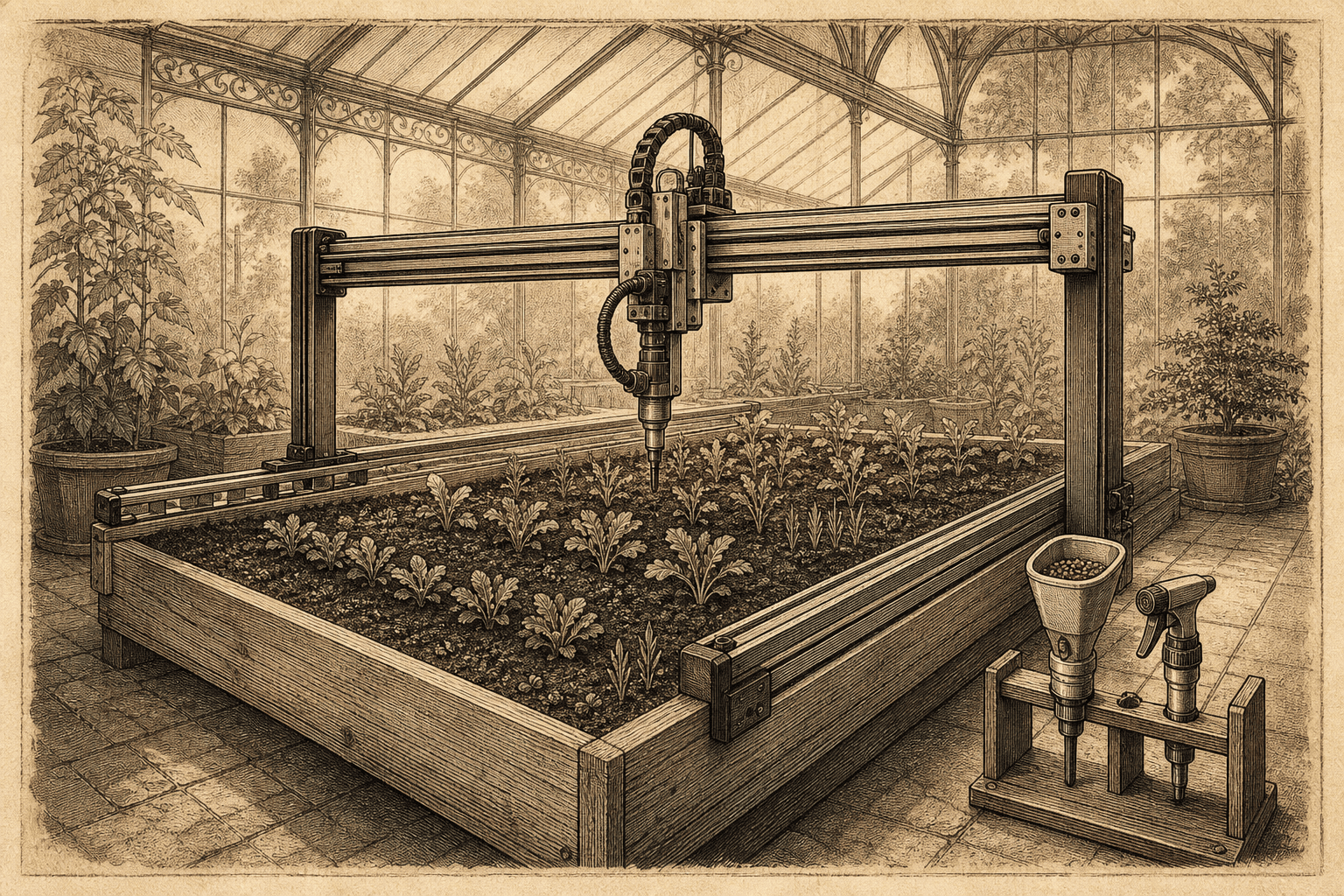
Moves an interchangeable tool head across a raised bed to place seeds, water plants, and measure soil, backed by published hardware, software, data, and documentation.
Visit FarmBot GenesisOriginal editorial concept art generated with built-in Codex Image Gen for The Machine Press, 2026-08-30; carried into the September 2 issue from the active weekly handoff.
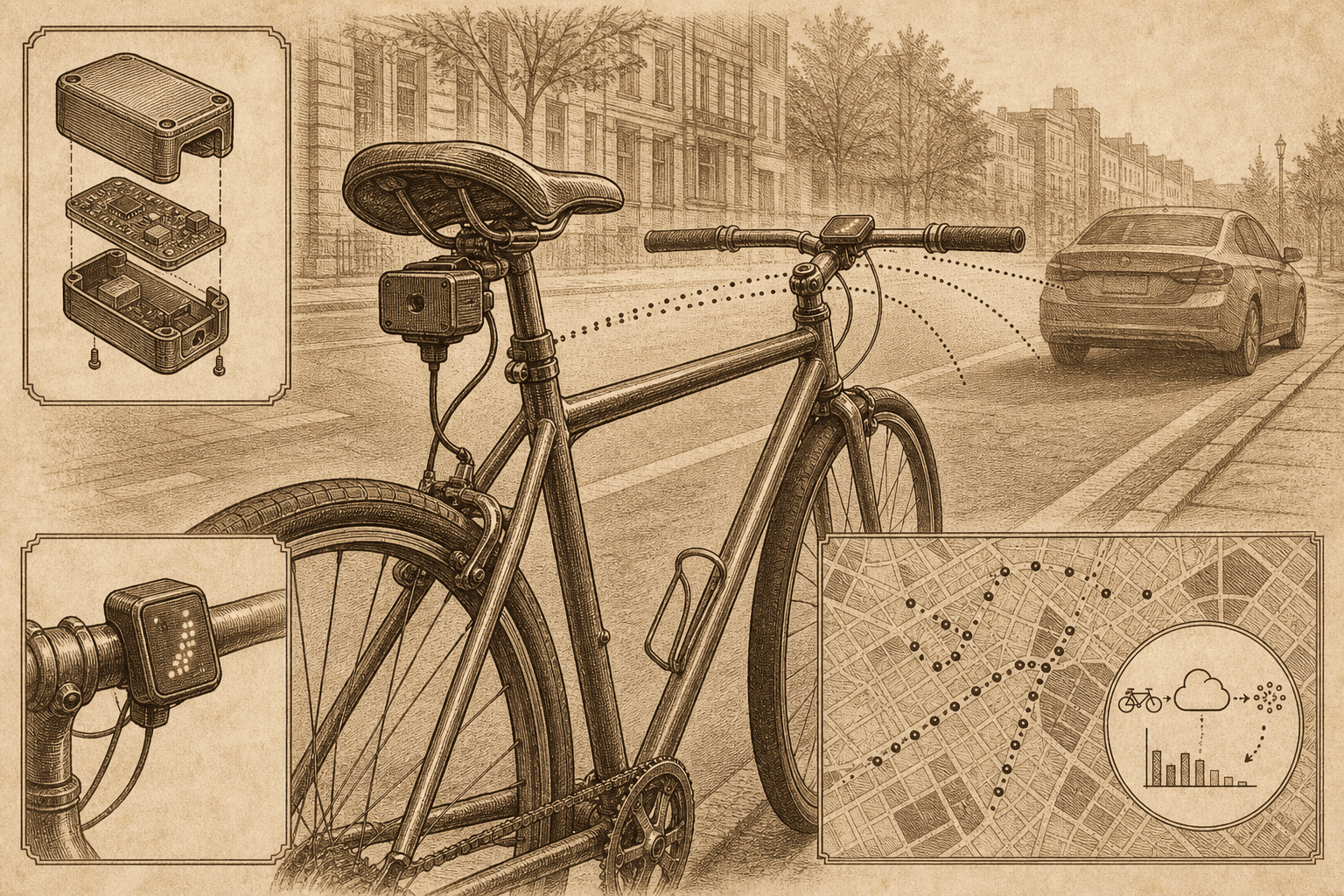
Combines a DIY bicycle distance sensor, GPS, and a shared portal so volunteer riders can map close passes and study where street design needs attention.
Visit OpenBikeSensorOriginal Codex Image Gen concept art from 2026-07-10; carried forward from the validated September 1 edition.
Desk Picks are selected by the newsroom. Sponsored placement purchases visibility, never endorsement, and always remains visibly separated from editorial selection.
 Editorial illustration