A 40-session benchmark found that shorter context reduced ordinary behavior problems yet nearly doubled one model’s full safety violations.
Editorial illustration
Concept illustration: the benchmark tests extended LLM orchestration against fixed safety invariants; this is not the paper’s literal robot, interface or laboratory. Original editorial illustration generated with built-in Codex Image Gen for The Machine Press, 2026-09-09.
Researchers built a Model Context Protocol test environment around five safety invariants grounded in ISO 10218-2:2025 protective measures, then ran four model backends through 40 sessions of 100 turns. Layer-one text results placed responses on a spectrum from correct compliance through overcompliance and undercompliance to full violation. Claude and Gemini stayed at or near zero violations, while GPT-4o-mini reached as many as 13 in a session. Sliding-window context reduced mean behavioral issues by 42 to 57 percent for every cloud backend, but GPT-4o-mini’s mean violations rose from 3.8 to 7.2. Simulation and physical validation remain incomplete, so the current result is a benchmark warning about orchestration, not a finished robot-safety certification.
Concept illustration: SleepFM-2 combines multiple kinds of sleep physiology; the decorative traces are not real clinical data or the study’s literal equipment. Original editorial illustration generated with built-in Codex Image Gen for The Machine Press, 2026-09-09.
SleepFM-2 learned from 282,511 overnight recordings and transferred across diseases, sleep events, wearable sensors and subjective reports.
SleepFM-2 was developed and evaluated on 282,511 polysomnography recordings from 26 cohorts, with 235,865 recordings used for pretraining and more than two million hours of physiology in total. The model combines signals from the brain, heart, muscles and respiratory system. With age, sex and BMI, its representation met a prespecified criterion for 215 later-recorded EHR phenotypes in two held-out cohorts; for 155, the sleep representation added reproducible information beyond demographics. The frozen encoder also transferred to expert-scored sleep events, wakeful EEG, headband and in-ear EEG, wrist photoplethysmography and accelerometry. These are retrospective model results across the reported cohorts, not a clinical diagnosis or proof of benefit for an individual.
AstroSpecLM turns DESI spectra into fact-grounded conversations, combining classification and redshift prediction with feature-linked explanations.
AstroSpecLM connects one-dimensional DESI spectra with Qwen3-4B. Instead of generating training conversations directly from templates or raw catalog fields, the pipeline first distills each spectrum into a compact set of catalog- and spectrum-derived facts. Those facts become references for instruction-following examples. The resulting model was competitive with specialist supervised baselines on classification and redshift estimation while producing explanations that cited specific spectral features. The paper establishes feasibility on the reported data; natural-language fluency does not independently validate every astronomical interpretation.
Staged technology file image, used illustratively; it does not depict the paper’s admission gate, risk ledger, controller or a real safety incident. Rafael Minguet Delgado / Pexels; cropped, resized, metadata stripped, and converted to WebP by The Machine Press.
Per-candidate certification can inflate false admission under best-of-k selection; the paper derives a setwise condition that survives generator replacement.
The analysis asks when a runtime safety gate can remain trustworthy even if the learned policy or language-model planner behind it changes. Certifying each candidate separately does not compose: with k retries, a false-admission rate alpha can grow to one minus one-minus-alpha raised to k. The authors prove that simultaneous setwise soundness is necessary and sufficient for generator-independent admission soundness, provided there is a design-time certificate and no bypass path. A second result formalizes what partial observation makes impossible when different hidden states demand different safe actions. The contribution is a theoretical contract and risk ledger, not evidence from a deployed controller.
DAREBench placed 233 tasks into six workload groups and compared 35 commercial and open models over 7,587 runs.
DAREBench adapts tasks from 22 source benchmarks into a two-by-three matrix defined by input modality and execution form. All tasks run in a shared environment with contract-based scoring and evidence audits. Across 23 commercial API models and 12 locally deployed open-weight models, no system dominated all groups. Text and multimodal workloads produced different accuracy-cost trade-offs, while local models were competitive in several groups but trailed frontier commercial systems overall. The benchmark argues that deployment choices should follow workload profiles rather than a single aggregate score; its conclusions remain tied to the selected tasks, environment and reference cost assumptions.
A post-hoc framework turns observable execution traces into reports designed to flag unsupported claims, unjustified actions and evidence gaps.
Traditional explainability methods focus on model outputs or feature influence, while tool-using agents leave a sequence of observable decisions. This framework structures a long execution trace, then produces a natural-language explanation grounded in that record. Human and automated evaluations across multiple benchmarks and agent architectures report better trace faithfulness and stronger identification of unsupported claims, unjustified actions and evidence gaps than naive language-model explanations. Because the method sees behavior rather than hidden reasoning, it can audit what happened without claiming access to an agent’s private internal state.
LayerRoute dynamically mixes visual-language layers and rereads earlier action states, adding as little as 0.31 percent in one tested policy.
Vision-language-action policies commonly expose fixed visual-language layers to each action layer and leave intermediate action states implicit. LayerRoute adds two interfaces: a router that mixes cached visual-language representations according to the current action state, and a reread path for earlier action representations. Across simulation and real-robot benchmarks, the authors report consistent gains for two base policies, including up to 7.2 points on LIBERO Long with 0.31 percent and 3.87 percent additional parameters in the respective systems. The results support adaptive representation access, but do not establish a universal routing recipe for every robot or task.
A production platform compiled the same typed graph to streaming, durable orchestration and batch execution without workflow-code changes.
The reported platform emerged from Amazon’s Rufus assistant, where real-time serving, background tasks and high-volume evaluation normally require different runtimes. Developers define one typed dataflow graph, which is then bound to in-process streaming, durable AWS SWF orchestration or distributed Apache Flink processing. Language-model calls become suspendable nodes whose delivery, retry and batching semantics follow the selected substrate. Dozens of production configurations across five orchestration patterns showed no detectable output-quality difference across bindings, while batch execution reduced inference cost in line with published batch pricing. The evidence is an engineering report from one production ecosystem rather than a cross-platform standard.
Generic code-screen file image, used illustratively; it does not show SciRIGOR, a tested agent, a scientific figure or an evidence-chain result. Markus Spiske / Pexels; cropped, resized, metadata stripped, and converted to WebP by The Machine Press.
In SciRIGOR, claims agreed with faithful and unfaithful results at almost the same rate, while strict end-to-end evidence success stayed below 18 percent.
SciRIGOR evaluates scientific coding agents as linked chains from executable analysis through results and figures to claims. Its 100 cases span six domains and 17 subfields, with typed evidence graphs that distinguish artifact fidelity from the validity of each supporting relation. Across 11 agent-model configurations, claims agreed with faithful results 91.8 percent of the time and with unfaithful results 91.0 percent of the time. No system exceeded 62.6 percent on the soft evidence-chain score or 18 percent on strict whole-chain success. Internal coherence therefore did not establish scientific correctness in this benchmark.
NormViz-Bench changed one culturally relevant behavior at a time across 6,536 images from 16 countries.
NormViz-Bench contains 3,268 human-validated contrastive image pairs spanning 16 countries. Each pair differs only in a behavior that changes whether the scene conforms to, violates or is irrelevant to a local social norm, and pair-level scoring requires both images to be correct. Gemini 3.0 Flash and Qwen2.5-VL-7B reached 26.6 and 21.6 percent pair accuracy, respectively. Fine-tuning smaller Qwen3-VL models on 64,000 explanation-linked images raised relative accuracy, but absolute performance remained below 30 percent. The benchmark measures its curated countries, behaviors and labels; it does not reduce culture to a single universal rulebook.
ThoughtMed-1M pairs de-identified images with verified expert commentary; its trained model reached 85.4 percent macro accuracy across 42 benchmarks.
The authors built a pipeline around de-identified medical images and commentaries shared on clinician-oriented social media, using a language model plus clinician-in-the-loop verification to create more than one million long-form visual question-answer pairs. A foundation model trained on that set, FOLTMed, achieved 85.4 percent macro accuracy across 42 medical VQA benchmarks and outscored comparison systems by three to five points on reported factuality and similarity measures. The work presents a scalable research dataset and benchmark result, not clinical approval, and its provenance and de-identification controls remain central to responsible reuse.
iBrain jointly pretrained on intracranial EEG and intracortical spiking with signal-specific encoders and one shared temporal backbone.
Most neural foundation models specialize in one recording type. iBrain instead uses separate encoders for intracranial EEG and intracortical spike trains, followed by a shared spatiotemporal transformer trained with masked reconstruction and channel-view alignment. The pretraining corpus contains more than 7,000 hours of heterogeneous invasive recordings. Across the reported benchmarks, the joint model outperformed single-signal pretraining baselines and transferred with improved data efficiency across recording settings. These are research benchmarks on invasive recordings, not evidence that the model can read thoughts or support unsupervised clinical decisions.
A platoon model added learned propagation delays and string-stability losses, keeping unstable windows to 0.65 percent on one five-car test.
SSP-DMGTimeNet predicts several vehicles together while penalizing disturbance amplification through a platoon. Its attention mechanism learns response delays between adjacent cars and accumulates them downstream; time- and frequency-domain losses target string stability for neighboring vehicles and longer sub-platoons. On the HighD ground-truth excitation subset, the reported five-vehicle unstable-window rate was 0.65 percent and maximum head-to-tail amplification was 0.898. Zero-shot tests on NGSIM US-101 and I-80 produced unstable-window rates of 3.90 and 4.10 percent. The figures are dataset results, not a road-safety validation.
Generic CC0 integrated-circuit rendering, used illustratively; it does not depict the proposed quantum analyzer, fiducial register or an experimental device. Wikideas1 / Wikimedia Commons (CC0 1.0); cropped and converted to WebP by The Machine Press.
A shallow analyzer turns Born outcomes into reusable classical-shadow labels while retaining the minimum number of outcomes for complete reconstruction.
Classical shadows usually randomize among measurement settings, adding control and calibration overhead beyond circuit depth. This construction couples the unknown n-qubit system to a freshly prepared n-qubit fiducial register and performs parallel Bell readout. One fixed setting then replaces the 3-to-the-n local-Pauli settings used for complete reconstruction while retaining d-squared outcomes for d equals 2 to the n. The fiducial preparation uses n minus one arbitrary two-qubit gates and logarithmic depth with all-to-all connectivity; the unknown system sees one parallel entangling layer. The result is theoretical trade-off analysis, not a demonstration on a specific quantum processor.
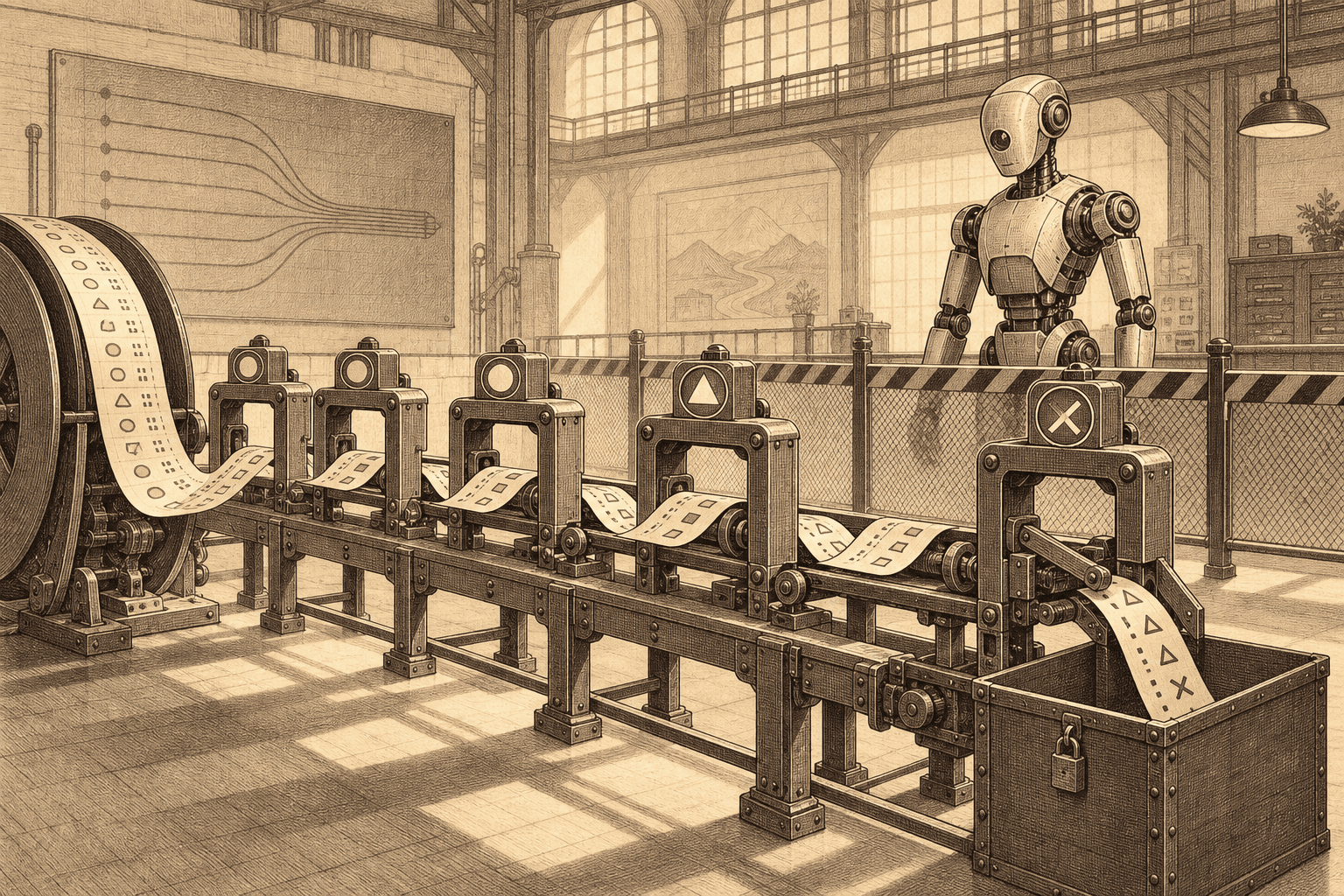
An oracle-free contract caught bookkeeping-sensitive behavior that ordinary logical-error counting can miss.
The proposed conformance suite checks whether a decoder’s correction explains the syndrome in the caller’s index space and whether equivalent presentations can force a correction heavier than another known feasible one. Verdicts are gated on each library’s own declarations. Across nine configurations from five public libraries, documentation answered four of 54 capability questions, and none directly declared bounded-distance correctness even though its hypotheses held in 62.1 percent of cases. One solver returned a correction 26 percent heavier after only the numbering changed. All 639 certificates ship with a standalone verifier, making the reported contradictions independently re-derivable.
A 0.6-meter telescope recorded 147 night detections and a model found lunar Earthshine can boost nadir-facing radiance by at least 100 times over starlight.
Optical tracking usually depends on sunlit satellite passes near twilight. The authors add moonlight and lunar Earthshine to sunlight and Earthshine in a satellite-brightness model, then compare it with what they describe as the first quantitative night observations of the ISS and Chinese Space Station illuminated only by lunar sources. The 147 ISS detections had median brightness V equals 12.02 plus or minus 0.17, about 13.1 magnitudes fainter than daylight. Their model suggests large spacecraft can remain within reach of modest telescopes for much of the night and up to roughly 11 nights per lunar month at local midnight.
BuilderTorbjørn Ludvigsen (tobben) and Hangprinter contributors
Suspends a print head from tensioned lines anchored around a room, replacing a rigid gantry with cable geometry so an open RepRap can work across an unusually large build space.
Visit HangprinterOriginal editorial concept art generated with built-in Codex Image Gen for The Machine Press, 2026-09-06.
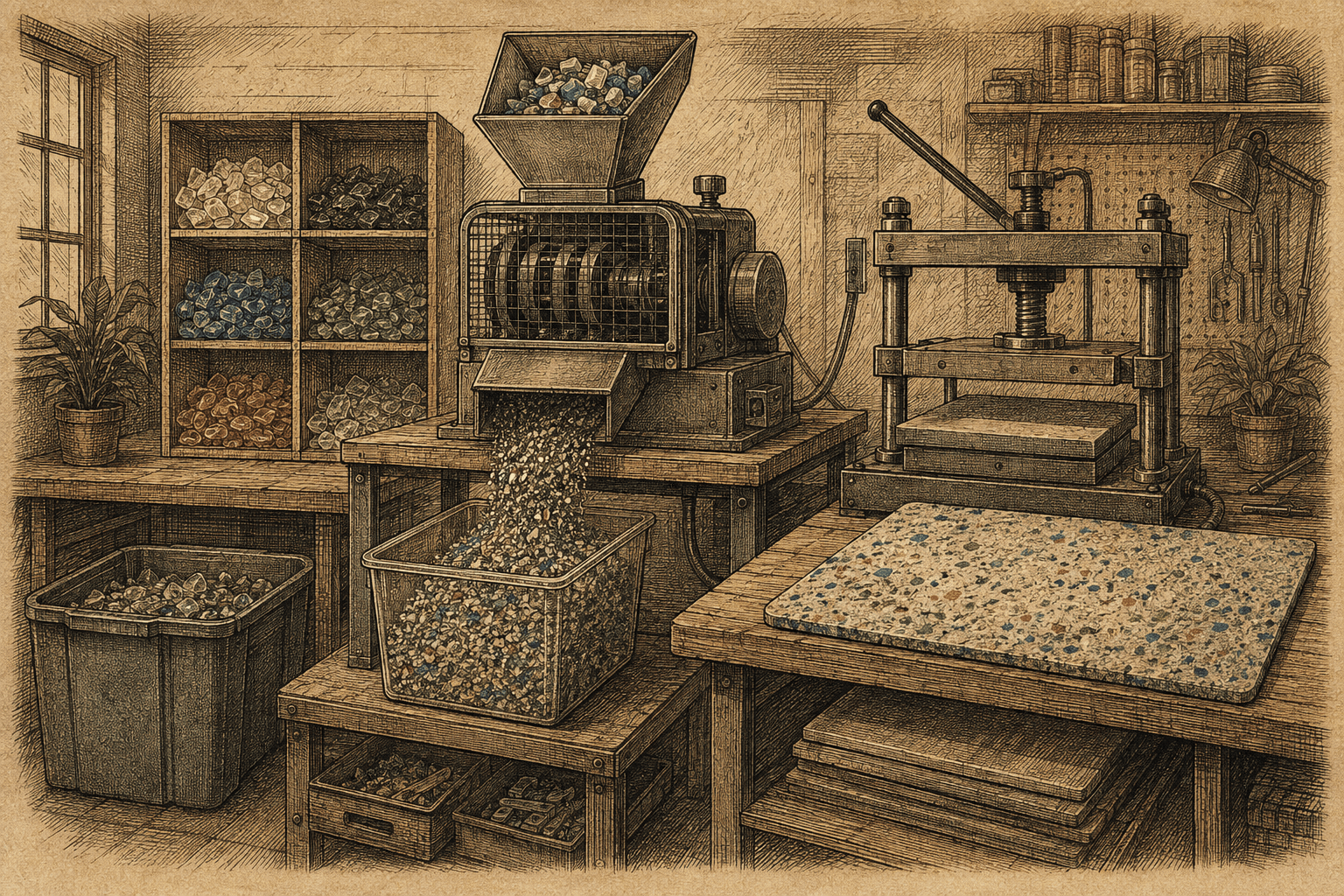
BuilderDave Hakkens and Precious Plastic contributors
Publishes replicable shredders, presses, workspace plans, and shared know-how so small local teams can sort waste plastic and turn it into reusable flakes and sheet material.
Visit Precious PlasticOriginal editorial concept art generated with built-in Codex Image Gen for The Machine Press, 2026-09-06.
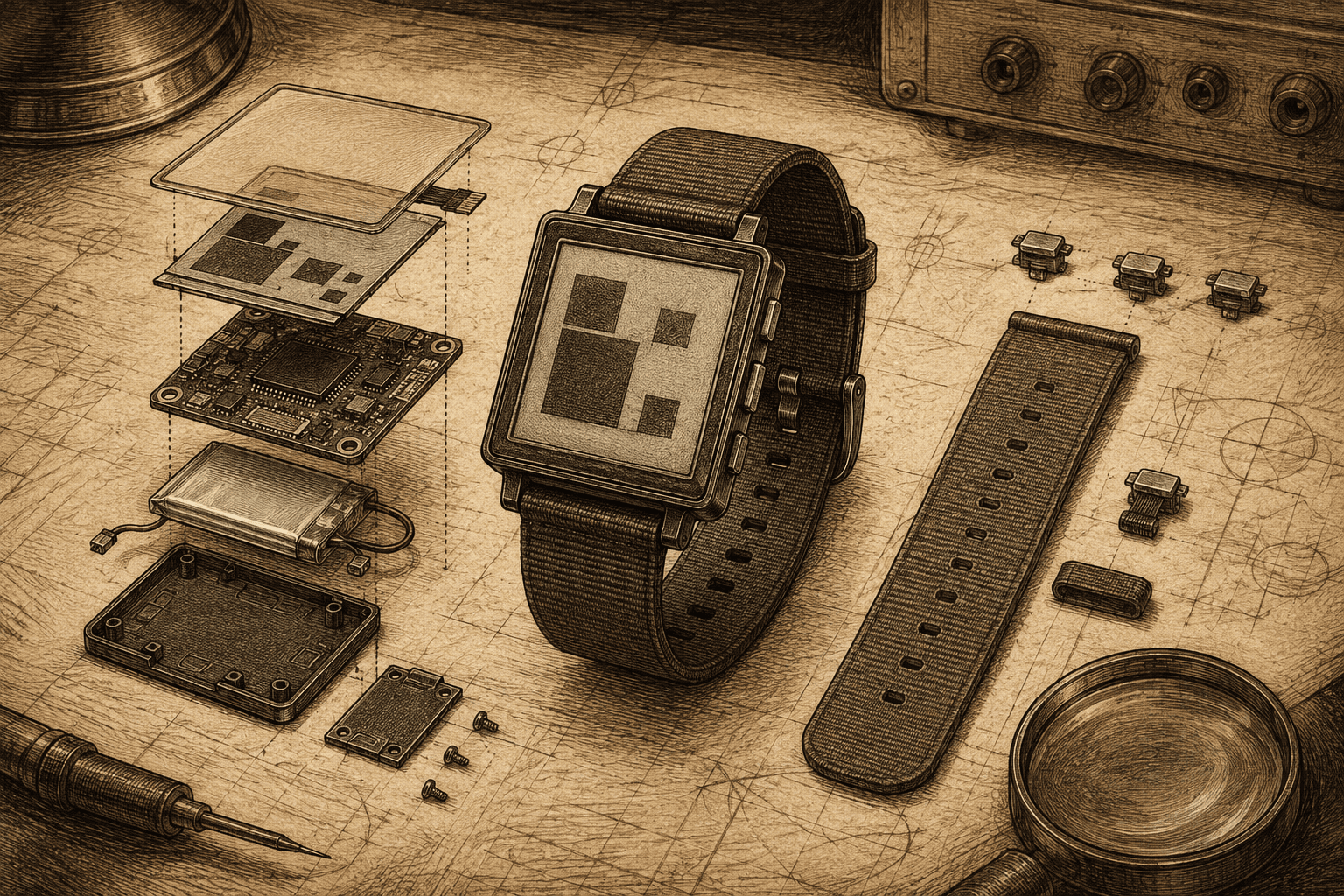
Pairs a square e-paper display with an ESP32-S3 and publishes the hardware, software, documentation, and case files so owners can build and program their own watch faces.
Visit WatchyOriginal editorial concept art generated with built-in Codex Image Gen for The Machine Press, 2026-09-06.
Turns a desktop trackball into an inspectable kit by publishing its mechanical and electrical design files, assembly documentation, and programmable QMK firmware.
Visit Ploopy Classic 2Original Codex Image Gen concept art from 2026-07-10; carried forward from the validated September 8 edition.
Desk Picks are selected by the newsroom. Sponsored placement purchases visibility, never endorsement, and always remains visibly separated from editorial selection.
 Editorial illustration