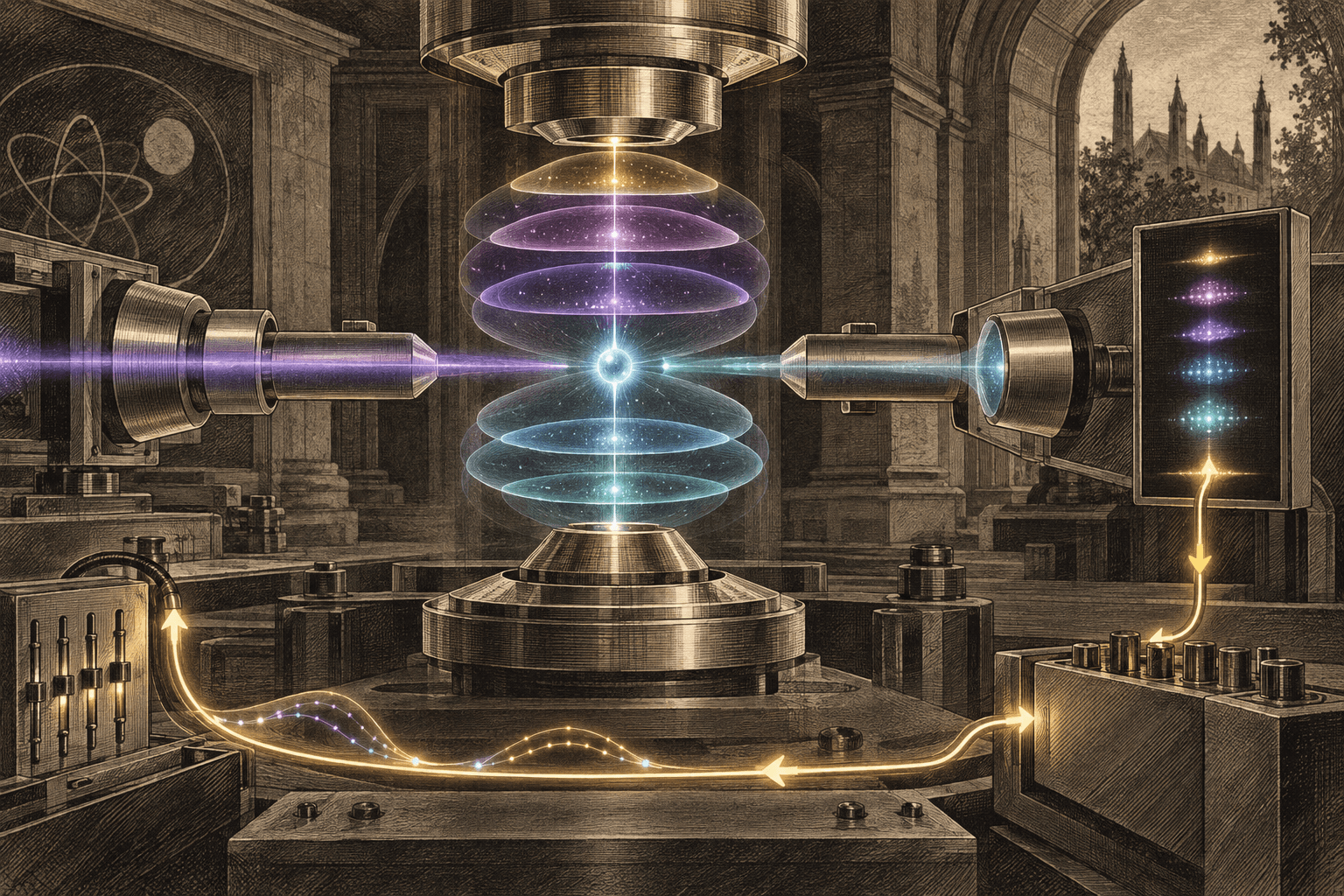
A trapped calcium qudit carried a quantum neural network through hybrid training and reached 95.7% classification accuracy on the reported image test.
Editorial illustration
Concept illustration: one trapped-ion qudit supplies multiple internal levels to a hybrid backpropagation loop; this is not a photograph or paper figure. Original editorial illustration generated with built-in Codex Image Gen for The Machine Press, 2026-09-14.
Quantum neural networks are usually framed around two-level qubits, which restrict the accessible state space of each physical carrier. This experiment instead encoded a neural network in the multiple levels of one trapped calcium-40 ion and trained it with a hybrid quantum-classical implementation of backpropagation. The authors report 95.7% classification accuracy on their test image set. The result demonstrates a working qudit training loop on physical hardware, but it is a compact classification experiment rather than evidence that qudit processors already outperform mature classical systems or scale without new control and error challenges.
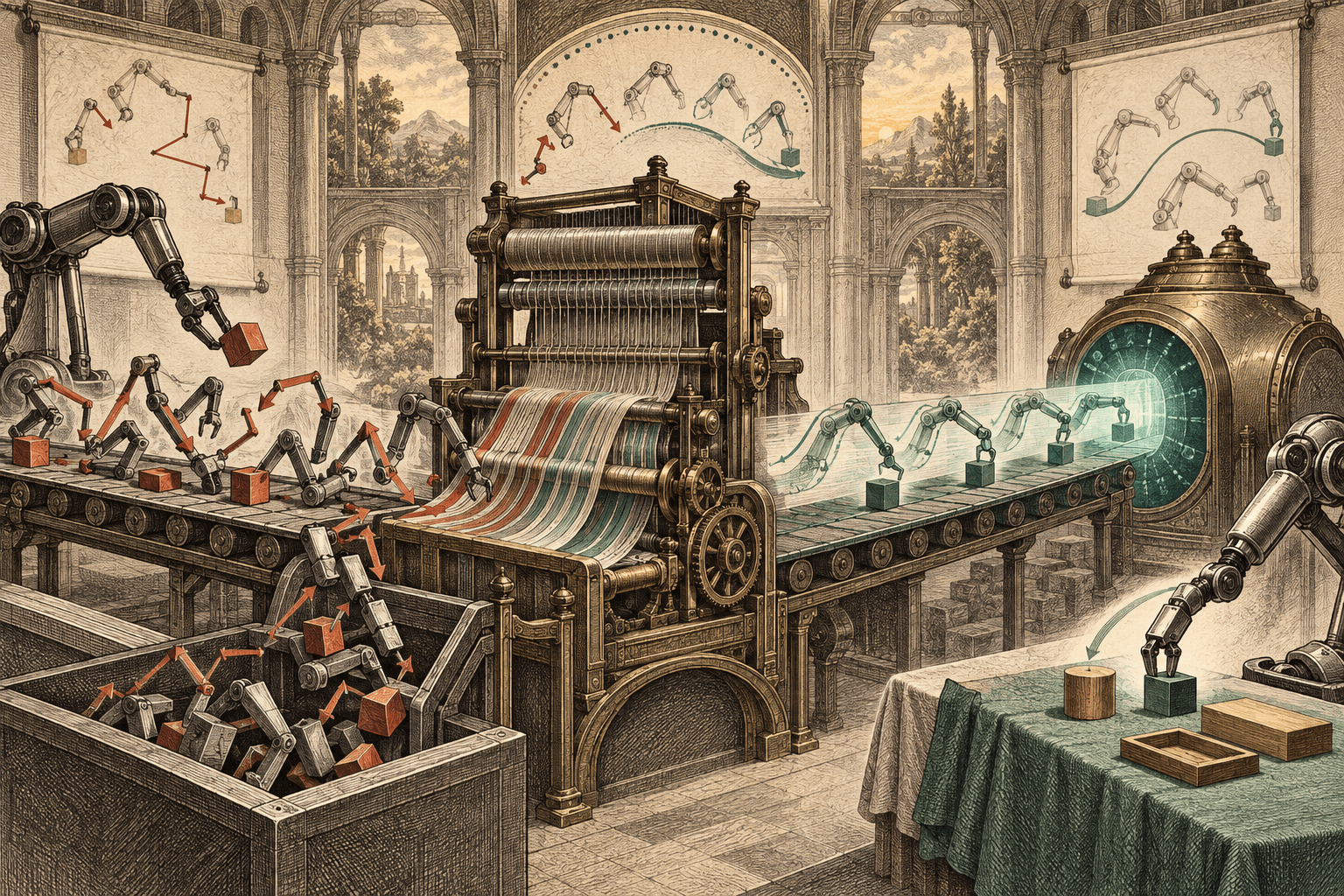
Concept illustration: planner trajectories are reshaped toward a pretrained robot model’s familiar behavior distribution; it is not a benchmark plot or documentary scene. Original editorial illustration generated with built-in Codex Image Gen for The Machine Press, 2026-09-14.
Raw planner demonstrations produced 8.3% success after fine-tuning; matching the pretrained model’s motion distribution raised the result to 56.7%.
Task-and-motion planners can produce successful robot demonstrations at scale, yet DATAFARM’s authors found that feeding raw planner trajectories into a pretrained vision-language-action model transferred surprisingly little. They attribute the gap to behavior: the planner moves through joint configurations, motion styles and timing patterns unlike the data the model saw during pretraining. DATAFARM reshapes the generated demonstrations toward that prior distribution. Across three tabletop tasks and one cloth-folding task, the aligned data produced 56.7% average success, compared with 8.3% for raw planner data and 61.7% for human teleoperation. On an out-of-distribution deformable-object task, the fine-tuned model retained 85% success versus 90% before fine-tuning. These are the authors’ reported tasks and models, not a guarantee that distribution alignment replaces human robot data broadly.
A joint DESI, Planck and nucleosynthesis pipeline explicitly marginalized the prediction nuisance parameters that earlier combinations often fixed.
Big Bang nucleosynthesis connects primordial light-element abundances to the baryon density used alongside baryon-acoustic-oscillation and cosmic-microwave-background data. This analysis combines DESI DR2 BAO, Planck and BBN while explicitly marginalizing BBN nuisance parameters. Its fiducial ΛCDM fits place the dimensionless Hubble parameter near 0.68, with the exact value and uncertainty changing by dataset and model; extensions for the effective number of relativistic species remain consistent with the standard neighborhood. The authors emphasize that investigator choices affect joint results and provide a pipeline that propagates BBN prediction uncertainty. It is a methods result, not a resolution of the Hubble tension.
Generic code-screen file image, used illustratively; it does not depict the forecasting gate, evaluated models, questions or reported scores. Markus Spiske / Pexels; cropped, resized, metadata stripped, and converted to WebP by The Machine Press.
Across 2,357 resolved questions, domain-level competence weights improved the main external baseline’s Brier score from 0.0771 to 0.0732.
A language model is not always the best signal in a forecast, especially when a market, crowd or statistical prior already exists. This study estimates each source’s marginal value by domain, shrinks uncertain weights toward a global value and recalibrates the pooled result. Across 2,357 resolved binary questions and five language models, the gate improved the main external baseline’s Brier score from 0.0771 to 0.0732 and beat global combinations under the reported leakage controls. On ForecastBench’s official market subset it found no significant gain and mostly deferred to the market. Verbal confidence across four Qwen models did not reliably identify when the model added value.
DU-NO used 3.64 million parameters, improved rollout error 14.9% over U-FNO and preserved high-frequency wave structure.
Phase-resolving coastal models are accurate but too expensive for many ensembles and real-time forecasts. DU-NO places lightweight convolutional U-Net branches only on the fine encoder and decoder levels where high-wavenumber content exists, leaving coarser levels spectral. The resulting 3.64-million-parameter neural operator used 10.8 times fewer parameters than U-FNO while improving autoregressive rollout error by 14.9% on the authors’ FUNWAVE-TVD benchmark. A parameter-matched baseline still trailed by 28.6%, and tests extended to Navier–Stokes and shallow-water rollouts. Operational warning performance remains to be established.
Direct promotion reached the top ten every time, but avoided collateral rank damage in only about 23% of edits.
Editing a knowledge-graph embedding to promote one desired answer can displace other correct answers even when ordinary locality tests look clean. The authors audit three scopes: facts sharing the edited parameter, alternative correct answers to the target query and correct answers across the same relation. On FB15k-237 with DistMult and ComplEx, direct promotion always moved the target into the top ten but caused no measured damage in only 23.0–23.2% of edits. Strict preservation avoided damage but succeeded in only 1.3–1.4%. Support regularization delivered the highest joint success, while rank-truncated preservation sharply reduced the number of displaced answers.
In a synthetic draft–verify–revise test, balanced accuracy ranged from 0.156 to near-perfect as models and reasoning settings changed.
Draft–verify–revise pipelines pass language from one model role to another, creating an opening for context-dependent words such as ‘previous’ to change referents. A study built ten base examples in three controlled conditions and tested six models across 21 reasoning configurations. Balanced accuracy ranged from 0.156 to near-perfect. GPT-5.2 rose from 0.156 without reasoning to 0.942 at its highest tested effort, while Gemini 3 Pro stayed above 0.94 across settings and achieved its low-effort result at roughly 5% of the reported per-trial cost of GPT-5.2 at xhigh. The narrow synthetic design supports an engineering warning, not a universal model ranking.
GT Bench spans 100,000 examples and four graph encodings; a selector-and-planner lifted Phi-4 from 33.0% to 41.5% on the hard split.
Graph Theory Bench tests 24 classical graph problems in 44 task-structure settings and more than 100,000 examples represented as natural language, structured language, adjacency lists or adjacency matrices. Across eight language models, accuracy changed with graph density, size, topology and encoding; no single representation stayed best. The accompanying Graph Theory Agent chooses a representation, plans and decomposes around a frozen executor. On the reported benchmark it raised Phi-4 from 53.5% to 69.1% on the easy split and from 33.0% to 41.5% on the hard split, then transferred without retraining to two other graph benchmarks.
NASA OSAM-1 robotics file image, used illustratively; it does not depict Pelican-Sim, its training trajectories, benchmarks or results. Use does not imply NASA endorsement. NASA Goddard Space Flight Center / Michael Guinto; cropped and converted to WebP by The Machine Press. Use does not imply NASA endorsement.
Pelican-Sim trained on about one million trajectories and distilled 35 rollout steps to four for a reported 5.67-fold speedup.
Pelican-Sim 1.0 predicts future observations from images and robot actions across heterogeneous bodies. Its shared 28-dimensional action space is paired with rendered action videos that connect robot descriptions and camera views to pixels. Sparse mixture-of-experts layers absorb differing dynamics, while causal adaptation and distillation reduce autoregressive rollout generation from 35 steps to four. The authors report a 5.67× speedup and stronger controllability and video-quality metrics on AgiBotWorld Beta, RoboMIND and RoboTwin after training on roughly one million real and simulated trajectories. Those are simulator benchmarks, not evidence of general physical-world reliability.
A pre-flight framework intersected probabilistic arrival bounds with operator-defined three-dimensional weather hazards.
Advanced-air-mobility flight plans must account for uncertainty in where an aircraft will be when a moving weather hazard arrives. This proposed framework fits a kinematic path with NURBS curves, propagates state covariance with a Kalman filter and transforms velocity uncertainty into arrival-time bounds. Gridded weather becomes intensity-stratified polyhedral volumes expanded by aircraft-specific safety buffers. Mesh intersections then test the spatial uncertainty tube and temporal overlap. The paper presents a planning framework rather than an operational validation or certification result, so its value lies in making uncertainty and operator thresholds explicit before flight.
Chain-SLAM propagated reliable local matches through an adjacency graph to align and reuse LiDAR maps across sessions.
Robots revisiting a site can accumulate maps whose local trajectories look sound while global alignment drifts across days or platforms. Chain-SLAM initializes session alignment from GNSS proximity, detects loop closures online and propagates their geometric constraints through an adjacency graph. Loaded maps and new trajectories are then optimized inside one factor graph, preserving both inter-session and intra-session consistency without requiring dynamic-object removal. The authors report improved trajectory accuracy and robust large-scale integration and release the source code. Performance remains tied to the tested datasets, place-recognition assumptions and available loop closures.
DIA learned values for partially denoised actions instead of assigning one environment-level reward to an entire action chunk.
Diffusion robot policies generate an action through multiple denoising steps, but common reinforcement-learning methods assign the same final credit to every intermediate choice. Denoising Intermediate Advantage learns a value function over partially denoised actions and combines that inner-step signal with the ordinary PPO advantage from the environment. Across Robomimic, FurnitureBench, Franka Kitchen and D3IL, the authors report higher final performance than the tested diffusion-policy fine-tuning methods, earlier arrival at successful states and greater movement away from the behavior-cloned starting distribution. The abstract does not supply one aggregate gain or physical-robot guarantee.
Boiling-fluid actuator modules formed inflate-and-fire rings that sustained oscillation under load without a centralized electronic controller.
Pneumatic neurons combine a low-boiling-point fluid, heater and mechanical switch into one self-exciting soft actuator. Connected in excitatory-inhibitory rings, the modules inflate, fire and inhibit neighbors to generate sequential oscillations whose frequency emerges from material dynamics and environmental conditions. Those rhythms can directly drive soft-robot locomotion. The authors report sustained oscillation under mechanical load and thermal variation and derive a dimensionless bifurcation map for the network’s behavior. The system still uses heaters and switches; the claim is controller-free coordination at the material level, not energy-free autonomy or biological intelligence.
Rendered wafer-scale integrated-circuit file illustration, used generically; it does not depict a tested quantum processor, QUOPS circuit or reported hardware result. Wikideas1 / Wikimedia Commons (CC0 1.0); cropped and converted to WebP by The Machine Press.
QUOPS combined the largest successful relevant circuit with execution speed and found a five-order-of-magnitude gap to selected utility workloads.
Quantum processors are hard to compare when hardware technologies, logical architectures and favored benchmarks differ. The Quantum Universal Operation Performance System measures the size of the largest computationally relevant circuit a machine executes successfully and the speed of that execution. The team applied QUOPS directly to physical processors from Quantinuum, Google and IBM, then translated resource estimates for recognized challenge problems into the same units. Under those mappings, capability must grow by five orders of magnitude. The study also tested a simple fault-tolerant processor with up to eight encoded logical qubits on Quantinuum Helios-1. QUOPS is a proposed comparative benchmark, not a declaration of present utility.
Below log₂ n depth an extensive subsystem stayed unentangled; at logarithmic depth every subsystem approached maximum entanglement within a constant factor.
A theoretical analysis of random hypercube linear-optical networks starts with all modes squeezed and tracks how subsystem entanglement develops with circuit depth. Below log₂ n, the authors prove that an extensive subsystem has no entanglement. At depth proportional to log n, ensemble-averaged entanglement in every subsystem comes within a constant factor of its maximum. The transition parallels recent arguments for logarithmic-depth average-case sampling hardness in Gaussian boson sampling. This is a mathematical result about a random network ensemble, not an experimental demonstration or a general statement about every optical circuit.
NOEMA detected [CII] at 5.1 sigma in a redshift-7.108 galaxy with the strongest known high-redshift 2175-angstrom ultraviolet bump.
The 2175-angstrom ultraviolet bump is associated with small carbonaceous grains, so seeing it in the early universe challenges slow dust-formation pictures. NOEMA observations of GNWY-7379420231 detected the [CII] 158-micrometer line at 5.1 sigma and a redshift of 7.1078, agreeing with the galaxy’s optical [OIII] measurement. The [CII]-inferred star-formation rate was consistent with other short-timescale tracers. Dust continuum was not detected, placing reported upper limits on obscured star formation and dust mass. The measurements link gas and the unusual UV feature but do not by themselves identify the exact grain source.
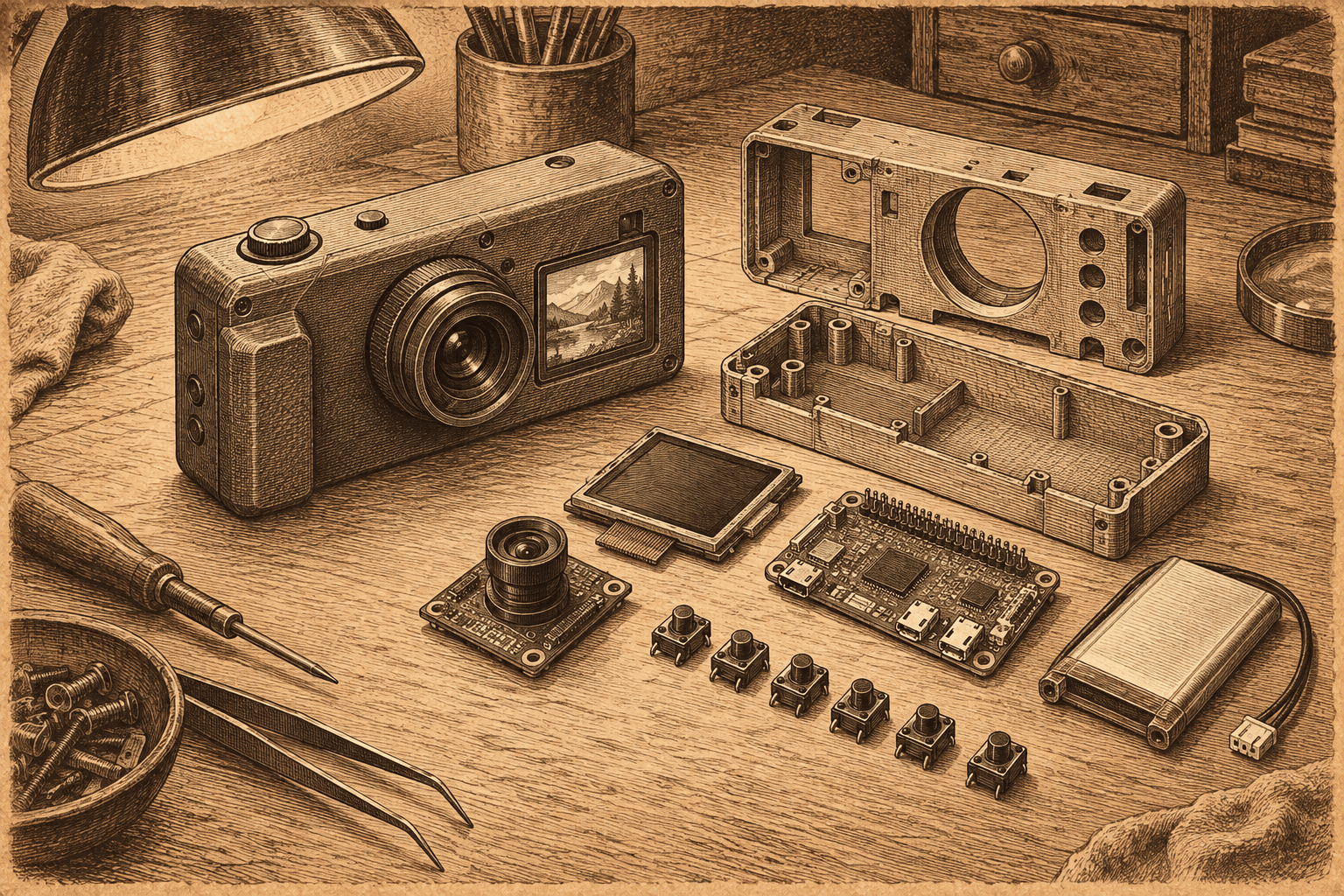
Builds a tactile digital camera around a Raspberry Pi Zero 2 W, an autofocus sensor, a small viewfinder, and mechanical-switch controls while publishing the software and printable hardware files.
Visit SATURNIXOriginal editorial concept art generated with built-in Codex Image Gen for The Machine Press, 2026-09-13.
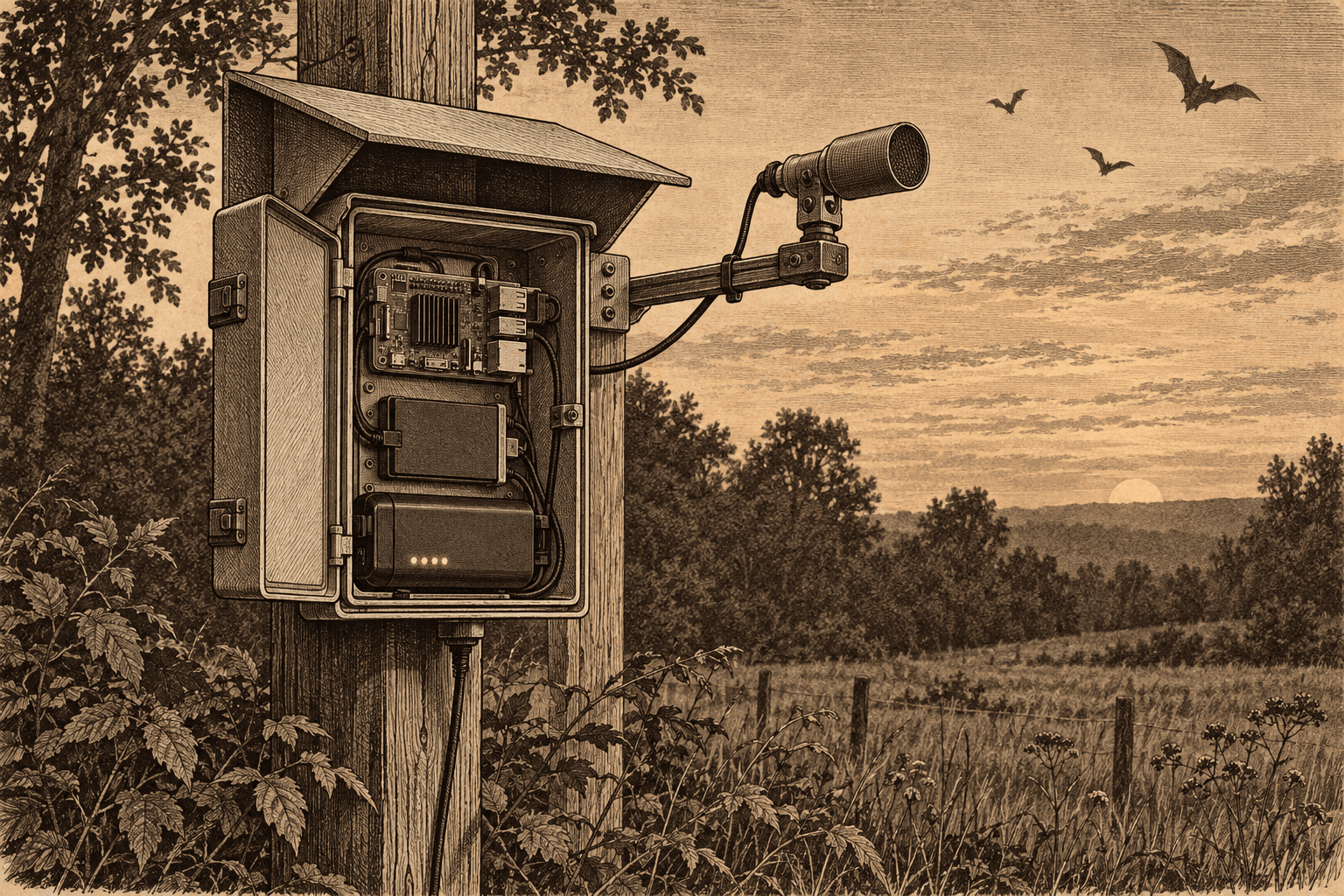
Combines a Raspberry Pi-class computer, an ultrasonic microphone, local storage, and a web interface into a modular recorder for active or unattended bat monitoring.
Visit WURB-2026Original editorial concept art generated with built-in Codex Image Gen for The Machine Press, 2026-09-13.
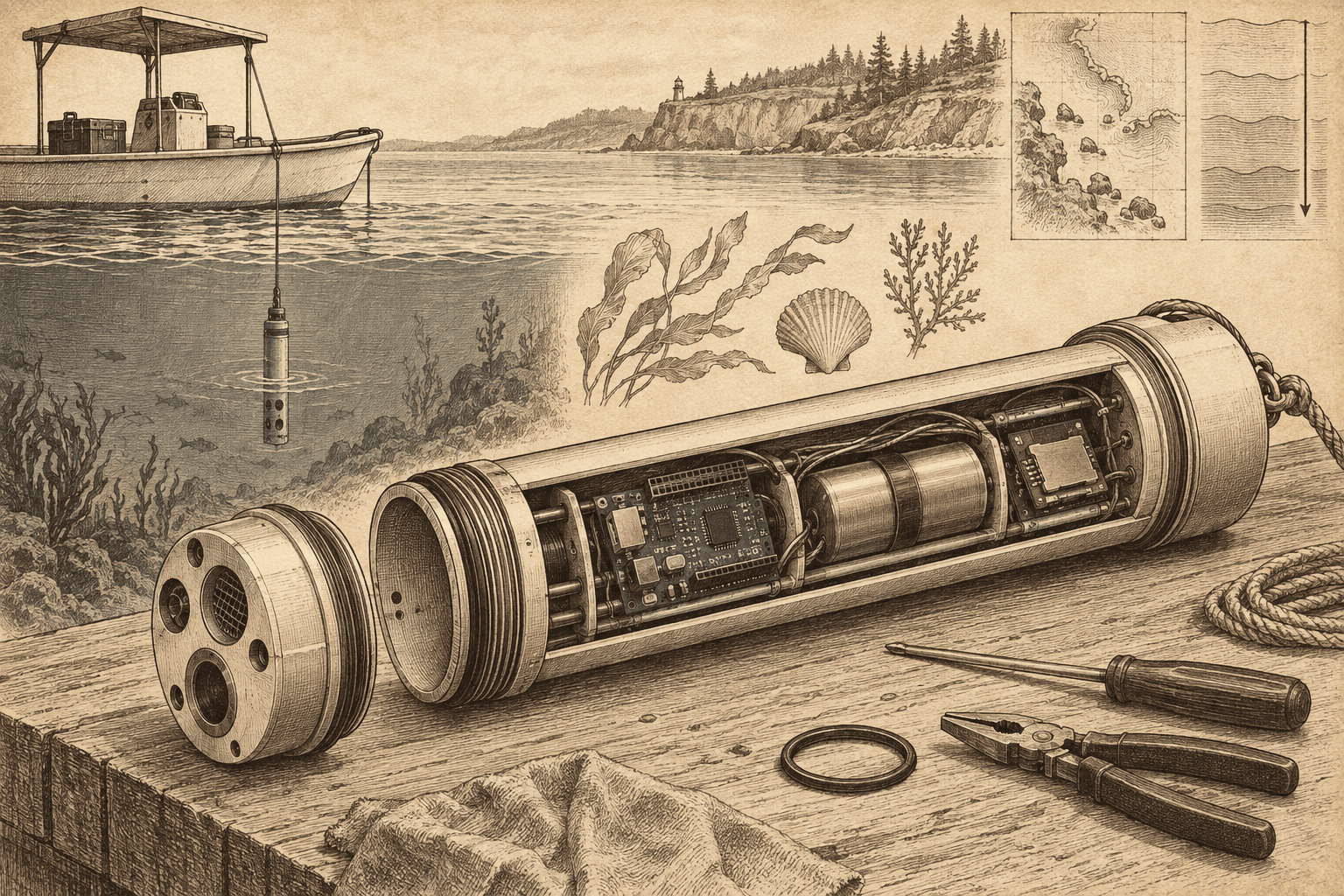
BuilderOceanography for Everyone core team and contributors
Packages conductivity, temperature, and depth sensors with an Arduino-compatible controller, battery, and SD storage inside a user-built housing for nearshore research and education.
Visit OpenCTDOriginal editorial concept art generated with built-in Codex Image Gen for The Machine Press, 2026-09-13.
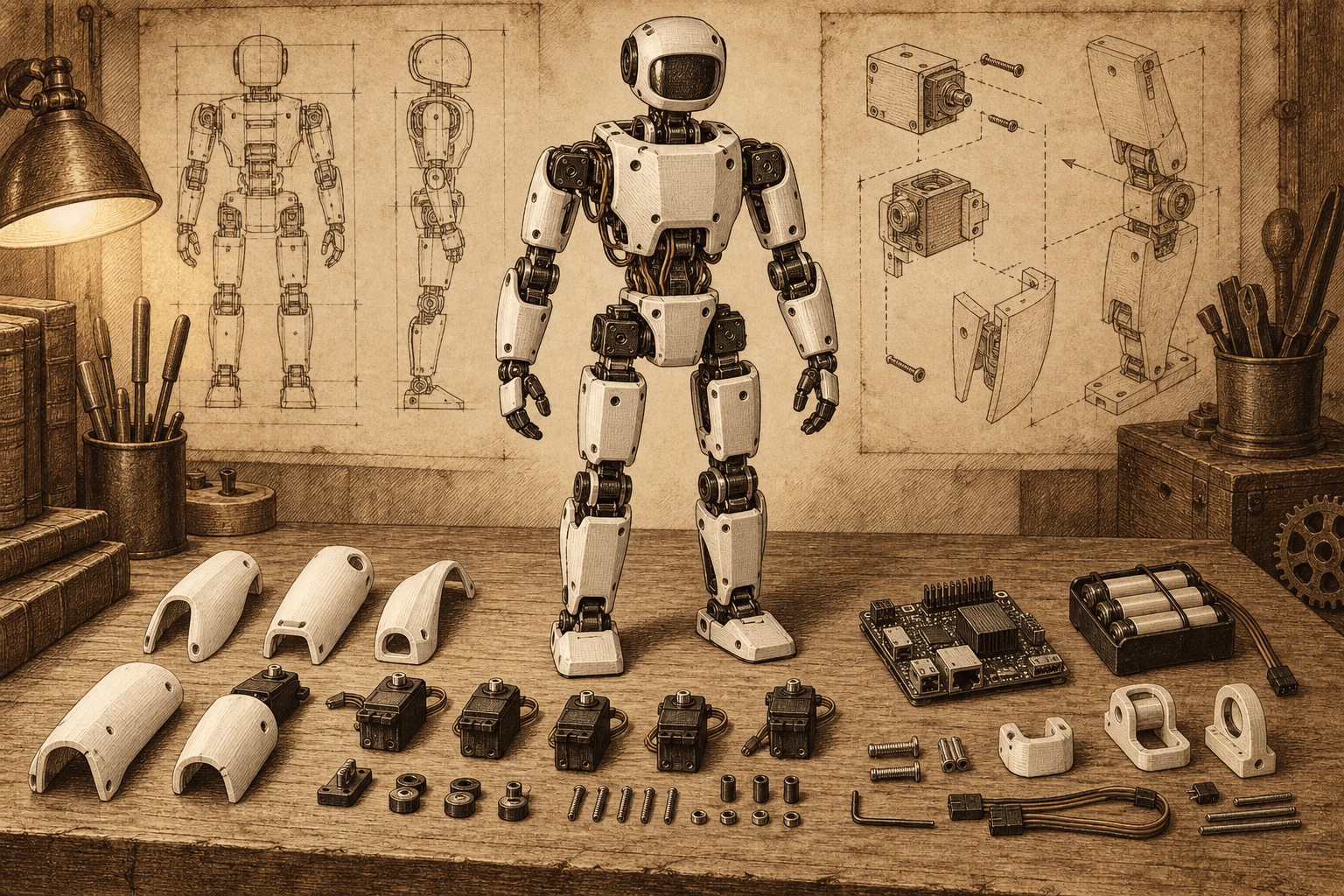
Turns printable body parts, nineteen servomotors, a Raspberry Pi Zero 2 W, batteries, and shared control software into a compact humanoid platform for hands-on robotics work.
Visit MicrobanOriginal Codex Image Gen concept art from 2026-07-10; carried forward from the validated 2026-09-13 edition.
Desk Picks are selected by the newsroom. Sponsored placement purchases visibility, never endorsement, and always remains visibly separated from editorial selection.
 Editorial illustration