robotics
The Plans Worked. The Robot Learned Almost Nothing
Raw planner demonstrations produced 8.3% success after fine-tuning; matching the pretrained model’s motion distribution raised the result to 56.7%.
Summary
Raw planner demonstrations produced 8.3% success after fine-tuning; matching the pretrained model’s motion distribution raised the result to 56.7%.
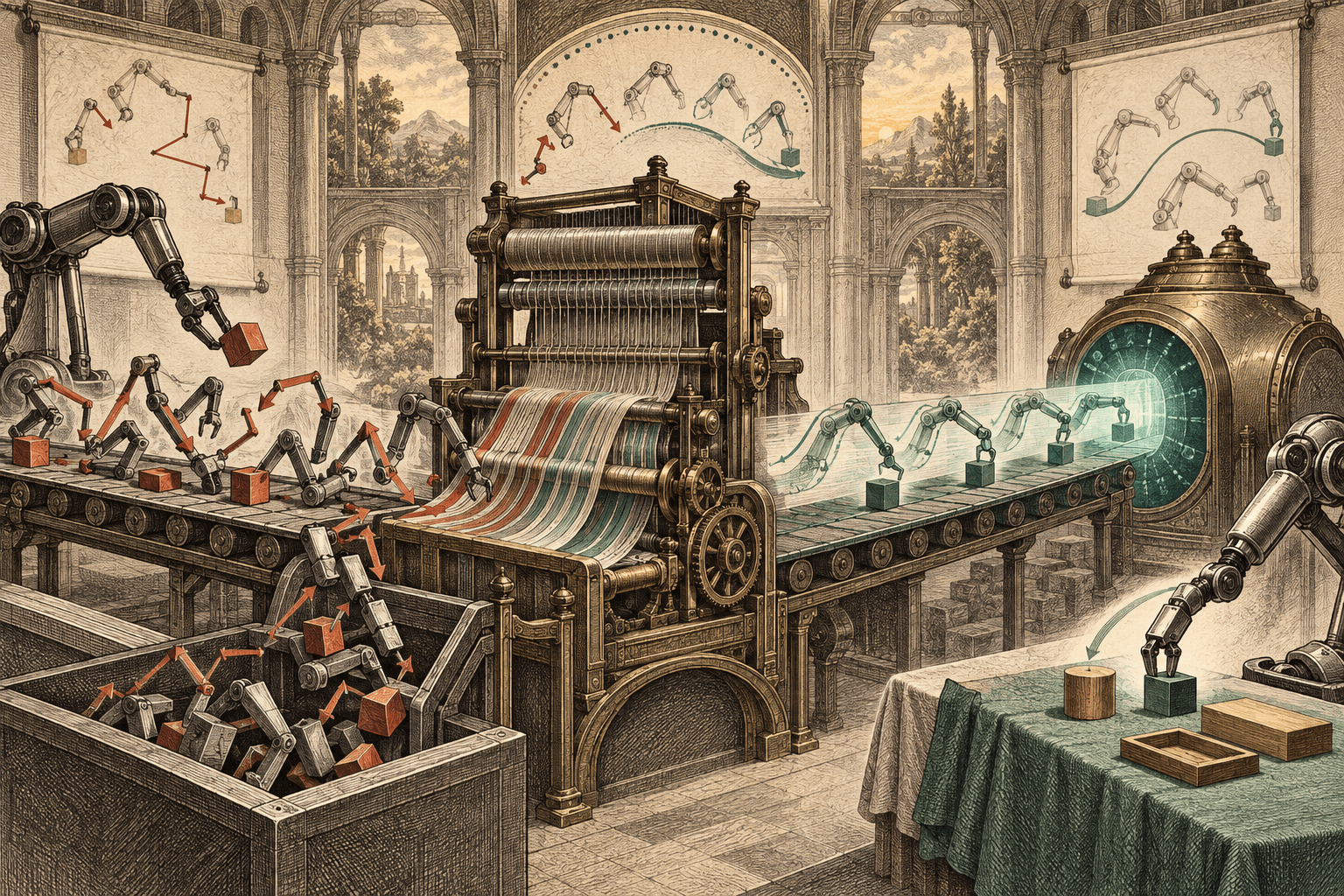
Task-and-motion planners can produce successful robot demonstrations at scale, yet DATAFARM’s authors found that feeding raw planner trajectories into a pretrained vision-language-action model transferred surprisingly little. They attribute the gap to behavior: the planner moves through joint configurations, motion styles and timing patterns unlike the data the model saw during pretraining. DATAFARM reshapes the generated demonstrations toward that prior distribution. Across three tabletop tasks and one cloth-folding task, the aligned data produced 56.7% average success, compared with 8.3% for raw planner data and 61.7% for human teleoperation. On an out-of-distribution deformable-object task, the fine-tuned model retained 85% success versus 90% before fine-tuning. These are the authors’ reported tasks and models, not a guarantee that distribution alignment replaces human robot data broadly.
Why it matters
Raw planner demonstrations produced 8.3% success after fine-tuning; matching the pretrained model’s motion distribution raised the result to 56.7%.
Limits and context
- These are the authors’ reported tasks and models, not a guarantee that distribution alignment replaces human robot data broadly.
Key claims
Raw planner demonstrations produced 8.3% success after fine-tuning; matching the pretrained model’s motion distribution raised the result to 56.7%.
Qualification: These are the authors’ reported tasks and models, not a guarantee that distribution alignment replaces human robot data broadly.
Evidence: source-2026-09-14-002
Sources
- arXiv preprint 2609.12316arXiv · primary research
Corrections
No corrections have been recorded for this story.